What is IT OT convergence security?
IT OT convergence security is the practice of unifying threat detection, monitoring, and response across IT and OT environments instead of running them separately. It gives security teams full visibility into both digital systems and physical operations, so an attack that starts in IT and moves into OT gets caught as one incident, not two disconnected alerts.
Introduction
For years, IT and OT lived in separate worlds. IT protected data, applications, and corporate networks. OT kept the machines running, the power flowing, the production lines moving. Security budgets followed that same split. Most companies poured money into IT protection and treated OT like someone else’s problem.
That gap is exactly what attackers are walking through right now.
The Hidden Cost of Weak OT Security Monitoring
The numbers make the case better than any pitch deck could:
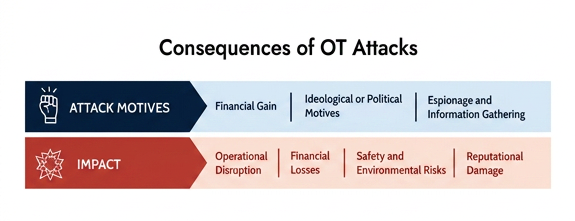
- Jaguar Land Rover lost close to $1.9 billion after an intruder got into their cloud infrastructure and pivoted straight into OT systems, halting production across multiple plants for over a month.
- United Natural Foods took a $350 to $400 million sales hit when malware compromised their supply chain OT assets and spoiled millions of tons of food.
- In Poland, attackers came within reach of taking command and control of 35 electricity distribution centers spanning wind, solar, and combined heat and power generation, before the intrusion got caught and shut down.
Here’s what connects these three. None of them lacked investment. All three had mature IT security programs. What they didn’t have was integration between IT and OT security, so the attackers moved from one environment to the other without anyone noticing until the damage was done.
IBM’s 2025 report puts the average breach cost at $4.4 million. Threat actors typically sit inside a compromised network for around 200 days before anyone catches them, and once they’re found, root cause analysis takes another 60-plus days. Run IT and OT security as separate silos, and that cost and timeline don’t just add up. They multiply.
Why Operational Technology Security Is More Vulnerable Than IT
Gateway devices, PLCs, and RTUs share one stubborn problem: they can’t run EDR, EPP, or antivirus the way IT endpoints can. The logs they send back are usually generic, missing the detail needed to catch anything in progress. A lot of these devices are decades old. A 25-year-old building management controller just can’t host modern endpoint protection, no matter how badly a security team wants it to.
This isn’t theoretical. It’s how breaches actually happen. One of the more memorable ones started with a smart aquarium thermometer at a Las Vegas casino, which gave attackers a foothold into the broader IT network. The entry point rarely matters as much as what happens next. That’s where visibility across the IT and OT convergence boundary becomes the difference between a contained incident and a six-month recovery.
What Is IT OT Convergence Security and Why Does It Matter?
Visibility only counts if it’s complete. That means pulling together:
- Packet data
- Log data
- Endpoint telemetry
- NetFlow data
- OT protocol data
Then layering threat intelligence and business context on top of all of it. Partial visibility, the kind you get from metadata alone, tells you something happened. It won’t tell you what actually occurred inside that traffic, and that gap is the difference between reacting to an alert and understanding the full attack chain.
Think of it like the difference between a motion sensor and a camera. A motion sensor tells you something moved. Some tools go a step further and flag known malicious payloads, but they still miss zero days because they’re only matching against known signatures. Continuous, full packet capture, recording everything on the wire whether it looks suspicious or not, is what gives teams the historical depth to reconstruct an incident later and catch attacks that don’t match anything in the signature library yet.
This is where session reconstruction earns its keep. Full packet capture lets a team rebuild an entire attack chain:
- The phishing email that kicked things off
- The malicious link a user clicked
- The command and control activity that followed
- The lateral movement into an OT jump server
- The commands eventually sent to a PLC
That’s not a guess pieced together from scattered logs. That’s a documented, chronological trail you can actually use as evidence.
Common IT OT Convergence Challenges
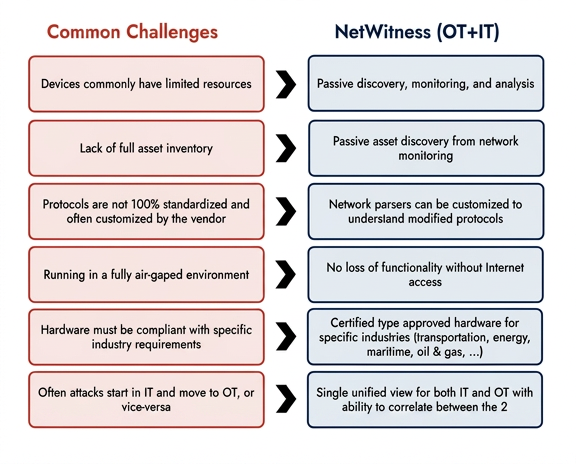
OT environments come with constraints IT teams rarely deal with:
- No active scanning. These are live production environments, and interrupting them isn’t something anyone wants to explain later.
- Legacy devices. Asset discovery has to happen passively, through network traffic analysis, since you can’t probe these devices the way you’d probe a modern endpoint.
- Different protocols entirely. Modbus, DNP3, Profinet, NMEA. Monitoring them properly means parsers built specifically to understand OT communication, not tools that treat it as generic noise.
- Harsh physical conditions. High heat, constant vibration, and often fully or partially air-gapped networks.
That last point matters more than people expect. Ruggedized, certified hardware built for maritime, transportation, and energy environments isn’t a nice-to-have here, it’s the only realistic way to get reliable monitoring in these conditions. And it needs to keep working without a live internet connection, drawing on a maintained threat repository instead of depending on constant cloud access.
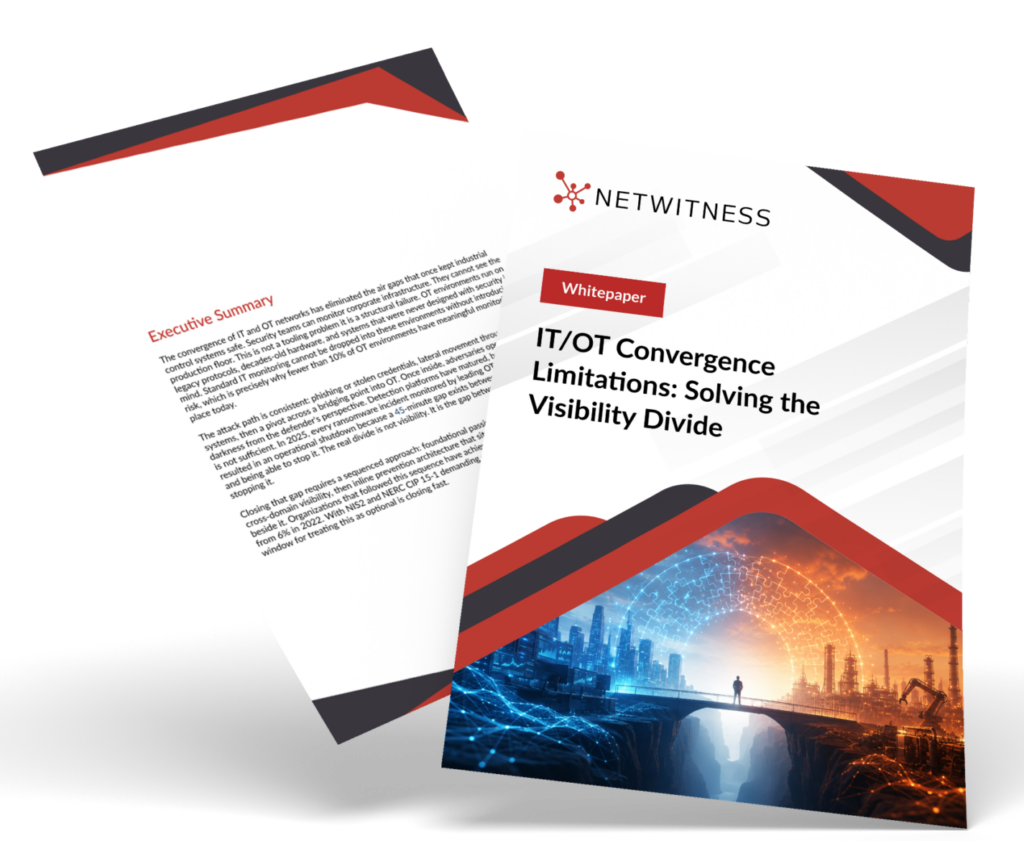
IT/OT convergence is creating new security blind spots. Learn how to close the visibility gap.
How Unified Security Operations Improve IT and OT Security
Bringing IT and OT together under one security operations center does a few things at once:
- Correlates behavior across both environments. A login to a jump server outside business hours followed by a connection to an OT historian gets flagged as one meaningful sequence, not two unrelated blips.
- Applies behavioral baselines specific to OT. Industrial processes behave predictably, so deviations from that pattern are usually the earliest sign something is wrong.
- Cuts down alert noise. Fewer, higher-fidelity alerts tied to real business risk instead of a flood that burns out analysts.
None of this requires ripping out what’s already in place. A good platform pulls data from cloud, on-prem, and OT environments alike, understands well over a hundred OT-level protocols out of the box, and supports custom parser creation for proprietary systems. The result is one platform correlating threat detection and response across IT and OT, instead of two teams working off two different pictures of the same network.
How NetWitness Strengthens IT OT Convergence Security
What sets NetWitness and NetWitness OT apart comes down to one idea: visibility, analysis, and action have to work as one continuous flow, not three disconnected steps.
Visibility starts wide. Data comes in from cloud, virtual, and on-premises environments, covering packets, logs, endpoints, NetFlow, OT, threat intel, and business context. Every bit of it gets intelligently tagged and indexed the moment it’s acquired, so nothing sits around waiting to be made useful later. Metadata is created at time of acquisition, not bolted on afterward.
Analysis and insight is where that raw visibility turns into something a team can actually act on. Real-time detection sits at the center, feeding into user behavior analytics and archiving, all built on rules, parsers, and logic tuned for both IT and OT traffic. This is the stage that identifies early threat indicators and analyzes their impact before they become a full-blown incident.
Action closes the loop. Incident management, investigation, compliance reporting, orchestration and automation, session reconstruction, threat hunting. All of it draws on reports and feeds generated upstream, giving teams the ability to remediate automatically or systematically depending on what the situation calls for.
The whole pipeline is powered by NetWitness Live, Incident Response, and Engineering, plus input from the broader NetWitness community. That’s what makes investigations faster. Nobody’s stitching together data from five different tools after the fact. It’s already connected, already contextualized, and ready the moment something needs a closer look.
Conclusion
Unified security operations don’t happen in a single deployment. It’s a maturity curve. Visibility improves first, then workflows, then automated response. Jumping straight to full orchestration before the underlying visibility and processes are solid is usually how these initiatives stall out.
The organizations that get this right treat it as ongoing work:
- Aligning governance between IT and OT teams
- Giving operators and analysts one unified view instead of two disconnected ones
- Tuning the environment continuously as new use cases and threats show up
Every organization named earlier in this piece had strong IT security. They got hit anyway, because the gap between IT and OT was exactly where the attacker operated, uncontested. Industrial cybersecurity today isn’t about choosing between IT security and OT security. It’s about making sure neither one is blind to what’s happening in the other.
Want a deeper walkthrough of how this works in practice, including a live demo of session reconstruction and OT threat detection? Watch the full webinar here.
Frequently Asked Questions
1. What are the best practices for bridging IT OT cybersecurity gaps?
Organizations should align IT OT convergence security with a unified security strategy that provides visibility across both environments. Best practices include continuous OT security monitoring, network segmentation, asset discovery, centralized logging, and threat detection and response. Integrating IT and OT security into a single Security Operations Center improves incident response, reduces blind spots, and strengthens overall industrial cybersecurity.
2. Which companies offer solutions to bridge the IT and OT gap?
Several cybersecurity vendors provide solutions for IT OT convergence, including NetWitness, Nozomi Networks, Dragos, and Microsoft. These platforms help organizations improve IT and OT security through asset visibility, OT security monitoring, threat detection and response, and unified security operations.
3. What technologies support unified IT/OT security operations?
Unified Security Operations rely on technologies such as SIEM, Network Detection and Response (NDR), Endpoint Detection and Response (EDR), Security Orchestration, Automation and Response (SOAR), OT security monitoring, threat intelligence, and industrial protocol analysis. Together, these capabilities strengthen IT OT Security by providing centralized visibility, faster threat detection and response, and coordinated protection across IT and Operational Technology Security environments.
4. What should organizations consider when implementing a unified IT/OT security strategy?
A successful IT OT convergence strategy should prioritize complete asset visibility, compatibility with legacy OT systems, real-time OT security monitoring, regulatory compliance, and seamless integration with existing Security Operations Center workflows. Organizations should also choose scalable solutions that support industrial cybersecurity while enabling efficient threat detection and response across both IT and OT security environments.
5. How does NetWitness support unified IT/OT security?
NetWitness supports IT OT convergence security by delivering unified visibility across IT and Operational Technology Security environments. Its platform combines network, endpoint, log, and cloud telemetry with advanced threat detection and response to identify attacks across converged infrastructures. By integrating IT and OT security into a single Security Operations Center, NetWitness enables faster investigations, improved OT security monitoring, and more effective unified security operations.
Find the right OT cybersecurity solution for your manufacturing environment.
- Assess critical security capabilities
- Compare OT security platforms
- Reduce operational risk
- Improve security visibility