How does unified visibility help close IoT security gaps?
Unified visibility helps close IoT security gaps by giving security teams one continuously updated view of every connected device. Instead of treating IoT security as a device-by-device problem, unified visibility connects network traffic, logs, endpoint data, cloud telemetry, vulnerability context, asset ownership, and threat intelligence so teams can detect risky behavior faster, prioritize exposed devices, enforce segmentation, and respond with confidence.
Most organizations already have some form of IoT security in place. They may have firewalls, NAC, SIEM, vulnerability scanners, endpoint tools, segmentation projects, cloud controls, and asset spreadsheets.
The problem is that connected devices rarely fit neatly into one security tool.
A camera may sit on the network but never show up in endpoint management. A badge reader may be owned by facilities but visible only through firewall logs. A building management controller may be managed by a vendor. A printer may be known to IT but not monitored for lateral movement. An industrial sensor may be critical to operations but invisible to the SOC.
IoT security gaps come from fragmented visibility. The SOC sees partial telemetry. IT sees managed assets. OT teams see operational systems. Facilities see physical devices. Cloud teams see IoT hubs and APIs. No one has a full picture.
That is why modern IoT security solutions need to start with unified visibility. Without it, every other control becomes harder to trust.
Why IoT Security Gaps Are Getting Harder to Ignore
IoT environments are expanding faster than traditional security programs can document them. Connected devices now include cameras, printers, sensors, kiosks, smart TVs, badge readers, HVAC controllers, medical devices, industrial gateways, routers, building systems, and operational technology assets.
Palo Alto Networks’ 2025 device-security research analyzed more than 27 million connected devices across 1,803 enterprise networks. It found that the average enterprise network had about 35,000 devices across 80 device types, and 32.5% of devices operated outside IT control. That is a major warning sign for any organization relying only on traditional endpoint or CMDB-based coverage.
This is why unified visibility cybersecurity is no longer a “nice to have.” It is becoming the operating layer for IoT risk management, OT security, incident response, and compliance.
What Creates IoT Security Gaps?
IoT security is difficult because many devices were not designed to behave like normal IT assets. They may not support agents. They may run old firmware. They may use proprietary protocols. They may require high uptime. Some cannot be scanned aggressively without creating operational risk.
The most common gaps are predictable.
1. Unknown and Unmanaged Devices
Unknown IoT devices often appear through business purchases, facilities projects, vendor installations, lab environments, smart office upgrades, manufacturing expansions, or temporary deployments that become permanent. They may never be entered into the CMDB, never assigned an owner, and never reviewed by security.
Security teams cannot secure devices they do not know exist. A strong IoT security platform should discover these devices passively, classify them accurately, and connect them to the business context.
2. Weak Credentials and Exposed Management Interfaces
Many IoT devices still depend on local admin accounts, shared credentials, weak passwords, outdated authentication, exposed web interfaces, Telnet, FTP, SNMP, or vendor remote-access portals.
This becomes a major risk when devices are reachable from user networks, third-party networks, or the internet.
NIST SP 800-213 frames IoT cybersecurity around identifying the security capabilities an organization expects from the device, the manufacturer, and supporting parties. In plain terms, organizations should define what “secure enough” means before devices are acquired and deployed, not after they become operational dependencies.
Unified visibility helps here because it turns weak identity into a known condition. Teams can identify devices with exposed management ports, default-access patterns, missing certificate-based authentication, unsupported protocols, and risky remote-access behavior.
3. Firmware and Patching Blind Spots
Patching IoT is rarely as straightforward as patching laptops.
Some devices have unclear firmware versions. Some require vendor maintenance windows. Some are no longer supported. Some are fragile. Some are tied to physical operations, clinical workflows, building systems, or production lines.
That is why IoT vulnerability management cannot rely only on CVSS scores. It needs exposure and an exploitability context.
For IoT, the priority should be:
A vulnerable device that is reachable and business-critical should move ahead of a theoretical CVE on an isolated device with compensating controls.
That is IoT risk management in practice.
4. Flat Networks and Uncontrolled Lateral Movement
Many IoT environments grow through convenience. A new device is plugged into the nearest network. A vendor asks for access. A camera system expands. A building controller needs cloud connectivity. A printer subnet becomes reachable from too many places.
Over time, the network becomes flatter than anyone intended.
Attackers need only one weak device to become a foothold, pivot point, scanner, proxy, or bridge into more sensitive systems.
Unified visibility helps by mapping actual communication flows. Instead of guessing what segmentation rules should look like, security teams can see normal behavior: which devices communicate, which ports and protocols they use, what applications they connect to, and where unnecessary access exists.
This is where IoT network security becomes enforceable. Segmentation should be based on observed behavior, business role, and risk.
5. Missing Behavioral Baselines
IoT devices are usually predictable. That is a defensive advantage.
A badge reader should not suddenly scan SMB. A camera should not start communicating with an unknown offshore IP. A printer should not behave like a reconnaissance node. A smart display should not initiate unusual outbound sessions. A production sensor should not begin talking to systems outside its expected path.
But these signals are visible only when network behavior is monitored and baselined.
This is where IoT threat detection depends heavily on network telemetry. Since many IoT devices cannot run EDR agents, the network becomes the evidence source. Packet data, metadata, DNS, DHCP, firewall logs, NetFlow, authentication logs, and cloud IoT activity all matter.
What Unified Visibility Should Mean for IoT Security
Unified visibility is not just a dashboard. A dashboard may show assets, but it does not close security gaps by itself.
A useful definition is:
Unified IoT visibility is a continuously updated, context-rich view of every connected device, its identity, behavior, vulnerabilities, ownership, location, business function, risk level, and control status across IT, IoT, OT, cloud, and physical environments.
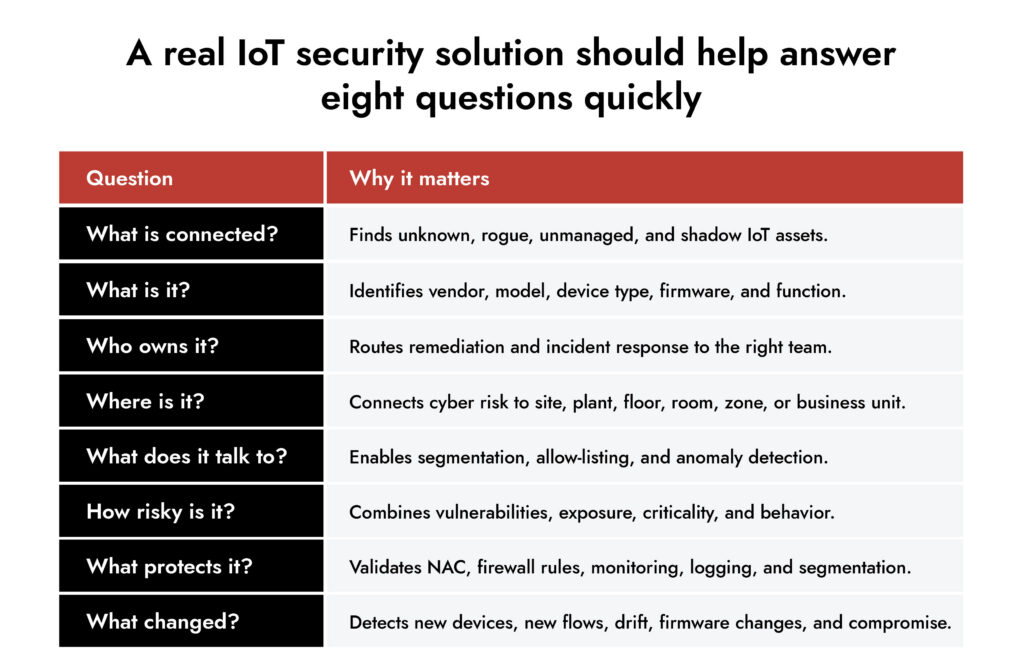
How Unified Visibility Closes Iot Security Gaps
Device Discovery in the SOC Workflow
IoT security cannot depend on annual inventory exercises. Devices appear, disappear, move, and change behavior constantly.
Unified visibility gives the SOC a live asset view. That view should combine passive network discovery, DHCP, DNS, IPAM, firewall logs, NAC, switch data, wireless-controller data, cloud telemetry, vulnerability data, CMDB context, and procurement or ownership records.
The value is not just knowing that a device exists. The value is knowing whether the device belongs there.
For example:
“Unknown device at 10.12.44.81” is not enough.
A useful view that looks more like the following is actionable:
“Axis camera, lobby entrance, facilities-owned, firmware behind, communicates with approved NVR, new outbound connection to unknown external IP observed at 02:14.”
Precise IoT Threat Detection
IoT environments generate noise when tools do not understand the device context. A generic anomaly engine may flag too much. A traditional SIEM may not have enough network context. An endpoint tool may not see the device at all.
Unified visibility improves IoT threat detection by connecting behavior to device identity.
Detection usually requires correlation across device behavior, logs, network sessions, identity, threat intelligence, and business context.
Improved Segmentation Without Breaking Operations
Segmentation is one of the most important IoT security controls, but it is also one of the easiest to get wrong.
Overly broad access leaves the organization exposed. Overly aggressive blocking can break cameras, printers, building systems, medical workflows, or industrial operations.
Unified visibility reduces that risk by showing real communication paths before policy changes are made.
Security teams can build segmentation rules based on actual dependencies:
- Camera to NVR
- Sensor to gateway
- Badge reader to access-control server
- Printer to print server
- PLC to HMI
- HMI to historian
- Building a controller to approve vendor service
- IoT gateway to approved cloud endpoint
This is especially important for industrial iot security, where availability and safety matter as much as confidentiality.
Vulnerability Management
Most vulnerability programs are overloaded. IoT makes the problem worse because many devices are difficult to patch, hard to scan, or owned by teams outside IT.
Unified visibility helps security teams move from “list of CVEs” to “ranked IoT risk.”
The better question is not:
“How many vulnerabilities do we have?”
The better question is:
“Which vulnerable IoT devices are exposed, exploitable, business-critical, poorly segmented, and currently behaving abnormally?”
That question creates a much better remediation queue.
Evidence Collection
When an IoT device is suspected of compromise, the first questions are usually basic:
What is this device?
Is it supposed to be here?
What did it talk to?
When did behavior change?
Was data transferred?
Did it scan internally?
Did it connect to known malicious infrastructure?
What other devices behaved similarly?
Can it be isolated safely?
Without unified visibility, every one of those questions becomes manual work.
IoT investigations often need both network evidence and log context. A firewall log may show a connection. Packet metadata may show protocol behavior. DHCP may identify the device. DNS may reveal destination patterns. SIEM correlation may connect the device to a broader campaign.
The faster that evidence comes together, the faster the SOC can decide whether to isolate, monitor, patch, segment, or escalate.
What to Look for in a Unified Security Platform
- Cut through tool sprawl with a practical evaluation framework.
- Compare platforms based on visibility, detection accuracy, and automation.
- Validate real-world performance across hybrid and cloud environments.
- Make confident, risk-aligned security decisions.

What Good IoT Security Solutions Should Include
Not every tool that claims IoT visibility is enough. The best iot cyber security solutions should support the full lifecycle: discovery, classification, monitoring, detection, risk ranking, enforcement, investigation, and reporting.
Here is what to look for.
1. Passive discovery and classification
IoT devices should be discovered without relying only on agents or aggressive scans. Passive network monitoring is especially important for fragile, industrial, medical, and operational systems.
The platform should classify device type, vendor, model, operating system, firmware where possible, MAC address, protocol behavior, location, and network zone.
2. Network behavior baselining
A useful IoT security platform should learn normal communication patterns by device type and business function. That includes internal traffic, cloud endpoints, management access, DNS behavior, protocol use, and peer relationships.
3. Risk-based prioritization
Strong IoT security services should not simply produce long vulnerability lists. They should prioritize devices based on exploitability, exposure, business criticality, segmentation status, and behavior.
4. Integration with SIEM, NDR, EDR, SOAR, NAC, and firewall controls
IoT security cannot remain a standalone dashboard. The data has to flow into detection and response workflows.
5. Segmentation support
A good IoT security solution should help teams create and validate segmentation policies. It should show normal flows, unnecessary access, risky paths, and devices that violate policy.
6. Forensic depth
For serious IoT incidents, alerts are not enough. Analysts need to reconstruct sessions, review metadata, investigate protocol behavior, and understand what changed.
This is where full packet visibility and enriched metadata become important. They give analysts evidence rather than just notifications.
7. Compliance and reporting
IoT security also needs to produce evidence. Teams should be able to prove which devices exist, which are monitored, which are segmented, which are vulnerable, which have owners, and which exceptions are approved.
This matters for regulated industries, industrial environments, healthcare, retail, energy, utilities, and any organization with cyber-physical systems.
A practical framework for closing IoT security gaps
Step 1: Build a minimum viable IoT inventory
Step 2: Baseline normal behavior
Step 3: Prioritize exposed and exploitable risk
Step 4: Segment based on observed communication
Step 5: Feed IoT telemetry into the SOC
Where NetWitness Fits in IoT Security
NetWitness is strongest where IoT security needs deep network visibility and cross-domain investigation.
For IoT-heavy environments, NetWitness can help security teams:
- Monitor IoT network traffic with rich metadata and packet-level evidence
- Detect abnormal device behavior using network analytics and threat intelligence
- Reconstruct sessions during investigations
- Correlate IoT activity with logs, endpoints, cloud, users, and threat intelligence
- Support industrial and OT visibility through the NetWitness OT solution powered by DeepInspect
- Feed IoT evidence into broader SOC workflows
- Reduce the time analysts spend manually stitching together evidence
That makes NetWitness a practical fit for organizations that need more than a standalone iot security service. It is especially relevant when IoT assets sit inside a larger attack surface that includes IT networks, cloud systems, OT environments, users, endpoints, and third-party access.
Frequently Asked Questions
1. What are the main types of IoT security threats?
The main IoT security threats include
- default or weak credentials,
- exposed management interfaces,
- unpatched firmware,
- insecure protocols,
- botnet recruitment,
- lateral movement,
- rogue devices,
- data exfiltration,
- vendor remote-access abuse,
- cloud misconfigurations,
- physical-process disruption in industrial IoT environments.
The most serious risks usually come from a combination of poor visibility, weak access control, and unmanaged device behavior.
2. How to implement zero trust principles for IoT devices?
Start by identifying every IoT device and assigning it an owner, role, location, and approved communication pattern. Then enforce least-privilege access, segment devices by function, restrict internet egress, use certificate-based authentication where possible, monitor behavior continuously, and verify every exception. For IoT, zero trust works only when device identity and network behavior are visible.
3. What are the best IoT security solutions for small businesses?
Small businesses should look for IoT security solutions that provide
- device discovery,
- network visibility,
- basic segmentation guidance,
- vulnerability awareness,
- alerting, and
- simple reporting.
A managed IoT security service may be more practical if the business does not have a dedicated SOC. The best option is usually one that integrates with existing firewall, network, and log-management tools instead of adding another isolated dashboard.
4. How to choose an IoT security service provider?
Choose an IoT security services provider based on
- visibility depth,
- device classification accuracy,
- network behavior monitoring,
- vulnerability prioritization,
- integration with SIEM/NDR/SOAR tools,
- Incident response support,
- reporting,
- Experience in your industry.
For industrial, healthcare, energy, utilities, or manufacturing environments, the provider should understand uptime, safety, OT protocols, and change-control requirements.
5. How does unified visibility help close IoT security gaps?
Unified visibility closes IoT security gaps by connecting device identity, network behavior, ownership, vulnerability context, business criticality, and control status in one place. This helps teams find unknown devices, detect abnormal behavior, prioritize high-risk assets, enforce segmentation, investigate incidents, and prove that controls are working.
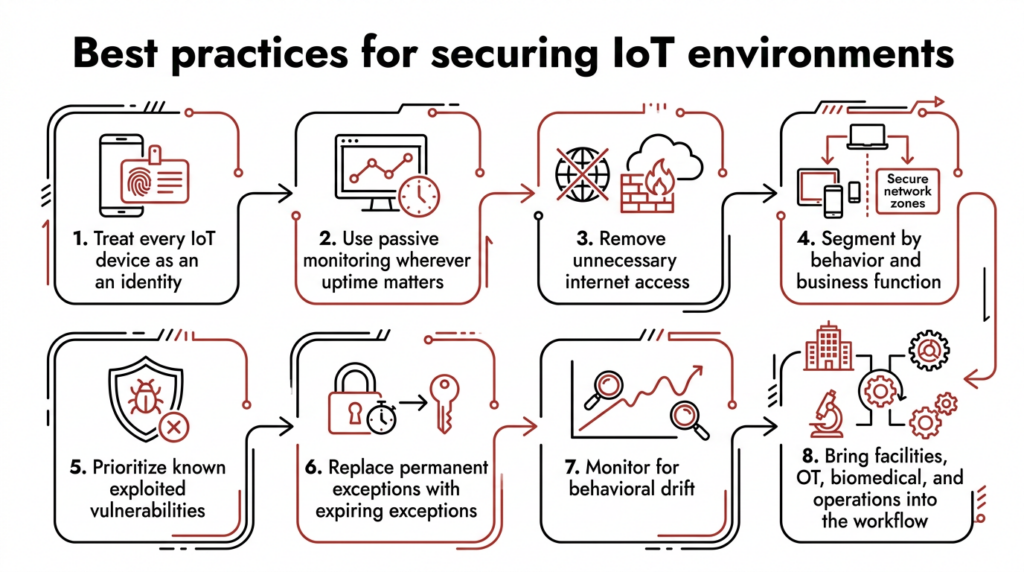
6. What are best practices for securing IoT environments?
Best practices include maintaining a live asset inventory, using passive discovery, assigning ownership, removing default credentials, limiting internet access, segmenting by function, monitoring network behavior, prioritizing known exploited vulnerabilities, validating vendor access, replacing unsupported devices, and feeding IoT telemetry into SOC workflows.
FIN13: Inside a Fintech Cyber Attack
FIN13 is one of today’s most disruptive threat groups targeting fintech organizations with precision and persistence. This whitepaper breaks down their full attack chain—from reconnaissance and credential theft to lateral movement, data exfiltration, and evasion techniques. Gain insights into their TTPs, discover detection opportunities across the kill chain, and learn how NetWitness empowers faster response and mitigation.