What are the top identity threat detection and response tools available?
Top ITDR tools fall into a few categories. Identity-native tools focus on Active Directory, Entra ID, Okta, privilege abuse, service accounts, and identity posture. Broader security platforms such as XDR, SIEM, NDR, UEBA, and SOAR, correlate identity activity with endpoint, network, cloud, and log telemetry.
Vendors commonly considered in the ITDR market include
- Microsoft,
- CyberArk,
- CrowdStrike,
- Silverfort,
- Semperis,
- Netwrix,
- Huntress.
NetWitness should be in the evaluation when the requirement extends beyond identity control into SOC visibility, network traffic analysis, behavioral analytics, packet evidence, threat hunting, and coordinated response.
Microsoft reported that it analyzes 38 million identity risk detections on an average day and processes 100 trillion security signals daily.
For years, the focus stayed narrow: protect the login. Enforce MFA. Manage privileged access. Deprovision users quickly. Review permissions. Harden Active Directory. These controls, however, are no longer enough on their own.
Today’s identity-driven attacks don’t announce themselves with noisy exploits or obvious malware. Attackers use valid credentials, stolen sessions, OAuth tokens, privileged accounts, service accounts, or cloud identities, which makes it difficult to detect.
The question your SOC is really asking is different: Was it actually the right user, using the right account, from the right place, doing the right things?
To know if it is actually the right user using the right account from the right place and doing the right things, it takes network visibility, behavioral analytics, endpoint context, log correlation, packet evidence, and response workflows that help analysts understand what happened after access was granted. That’s the role we built NetWitness Platform to fill.
NetWitness does not replace IAM, PAM, IGA, MFA, or your identity provider. Those systems own access control, identity lifecycle, privilege governance, and policy enforcement. What we do is strengthen identity threat detection and response by giving your SOC a richer investigation layer around identity activity. We answer what the account touched, how it moved, which systems it talked to, whether the behavior looked normal, and what evidence supports containment.
Why Identity Threat Detection Needs More Than Login Monitoring
Identity tools are essential, but they typically answer only the first question: did an identity authenticate?
A user can log in successfully and still be compromised. A suspicious identity event becomes far more meaningful when analysts can connect it to the source device, destination systems, network sessions, protocols used, authentication patterns, peer-group behavior, endpoint activity, asset criticality, threat intelligence, and the actual packet or session evidence tying it all together.
Without that context, identity security monitoring generates a lot of uncertainty. A risky login alert might be real, or it might be a traveling employee. A new admin action might be malicious, or it might be a planned change. A service account touching a new system could be expected behavior or an early sign of compromise.
We built NetWitness to reduce that uncertainty by correlating identity activity with network traffic analysis, behavioral analytics, endpoint telemetry, logs, metadata, and threat intelligence.
The NetWitness View: Identity is Not Just an Access Event
Our view is straightforward: identity threat detection and response should not stop at authentication.
A login event tells you that access happened. It doesn’t prove intent. It doesn’t show the full path.

“Identity threat detection should not stop at the login event. A successful authentication only tells the SOC that access was granted. The real question is whether the identity’s behavior after access matches its normal role, peer group, systems, and network activity. That’s where network and behavioral visibility become critical.”
— Ibrahim Badawi, Sales Engineer, NetWitness
We help SOC teams answer the questions that come next:
- What did this user or entity do after logging in? Did the account access systems it normally never touches?
- Did it use unusual protocols?
- Did it move laterally?
- Did it connect to sensitive assets?
- Did it generate abnormal DNS, SMB, RDP, LDAP, Kerberos, SSH, WinRM, VPN, proxy, or cloud API activity?
- Did its behavior deviate from its own baseline or peer group?
- Can we reconstruct the session and validate what happened?
How NetWitness Strengthens Identity Threat Detection and Response
1. Network Visibility Shows What Happens After Authentication
When an attacker uses a valid account, the login itself is often not the strongest signal. The stronger signal shows up in the network behavior that follows.
A compromised user account might authenticate through VPN and then start touching servers the real user has never accessed. A privileged account might begin unusual LDAP queries or remote sessions. A service account might suddenly communicate from a new host or initiate interactive behavior. A cloud identity might trigger abnormal API access or unexpected data movement.
NetWitness NDR lets analysts observe post-login activity across network traffic, metadata, NetFlow, and full-packet visibility where deployed. Attackers don’t need exotic malware when SMB, RDP, SSH, WinRM, Kerberos, LDAP, DNS, HTTPS, SaaS APIs, or cloud management APIs give them everything they need.
With NetWitness, analysts can dig into identity-linked network behavior such as
- First-time connections between a user and a sensitive system
- Rare use of administrative protocols
- Abnormal east-west movement
- Unusual VPN-to-internal traffic patterns
- Service account communication outside its normal scope
- Data staging
- Suspicious DNS or proxy activity after a potential compromise
That’s the difference between identity monitoring and identity-aware network traffic analysis.
2. Behavioral Analytics Detects the Wrong Person Using the Right Account
Identity attacks often look completely legitimate on the surface. The attacker has the password. They have the token. They may have bypassed MFA through session theft or social engineering. They might be on an approved device or using a known remote access path.
So, the signal is an anomalous behavior. NetWitness Platform identifies unusual user and entity behavior by learning normal activity patterns and surfacing deviations. Compromised accounts, insider misuse, and service account abuse typically create behavioral changes before they generate obvious technical indicators, which is exactly why behavioral analytics is so valuable here.
We can help identify patterns like a user accessing systems outside their normal role, a privileged account behaving differently from peer administrators, a dormant account suddenly going active, a service account acting like a human user, unusual access times or source locations, abnormal data access or transfer behavior, and suspicious activity sequences across login, network, and endpoint telemetry.
3. SIEM Correlation Connects Identity Signals to the Wider Attack Chain
Identity alerts are rarely useful in isolation. A suspicious login becomes more important if it’s followed by endpoint activity, unusual network sessions, privileged access, threat intelligence matches, or data movement.
NetWitness SIEM unifies logs across on-premises, cloud, hybrid, SaaS, identity, endpoint, network, and application sources. That broader correlation helps analysts understand whether an identity alert is a standalone anomaly or part of a larger attack path.
If your identity detection platform creates another silo, your SOC still has to rebuild the story manually. NetWitness brings identity activity into the same investigation plane as logs, packets, endpoint telemetry, metadata, NetFlow, threat intelligence, and response workflows. The SOC sees the identity event in context rather than as a disconnected alert.
4. Packet and Session Evidence Improves Investigation Confidence
Alerts tell analysts where to look, and evidence tells them what happened.
One of NetWitness’s strongest capabilities is investigation depth. With packet capture, metadata enrichment, and session reconstruction, analysts can validate suspicious activity instead of relying on summary events that may or may not tell the full story.
Consider a compromised VPN account. The VPN log shows a session. The identity provider shows a successful authentication. But the SOC still needs to know what happened inside the environment. Did the identity scan internal systems? Did it open RDP sessions? Did it access file shares? Did it touch a domain controller? Did it move data? Did it communicate with suspicious infrastructure?
5. SOAR Workflows Turn Identity Detection into Response
Identity threat detection and response isn’t complete until the SOC can act.
NetWitness SOAR helps teams orchestrate response actions across connected tools and processes. For identity incidents, that means workflows like
- Disabling or suspending an account through IAM integration
- Forcing a password reset
- Triggering credential rotation
- Revoking sessions or OAuth grants
- Isolating an endpoint through EDR
- Blocking infrastructure through firewall or proxy tools
- Rotating service account secrets
- Preserving investigation evidence
- Opening ITSM tickets
- Escalating to incident response with a reconstructed timeline.
The identity provider, PAM system, IGA platform, EDR, firewall, or cloud control plane still owns the enforcement action. NetWitness helps the SOC detect, enrich, investigate, prioritize, and coordinate the response.
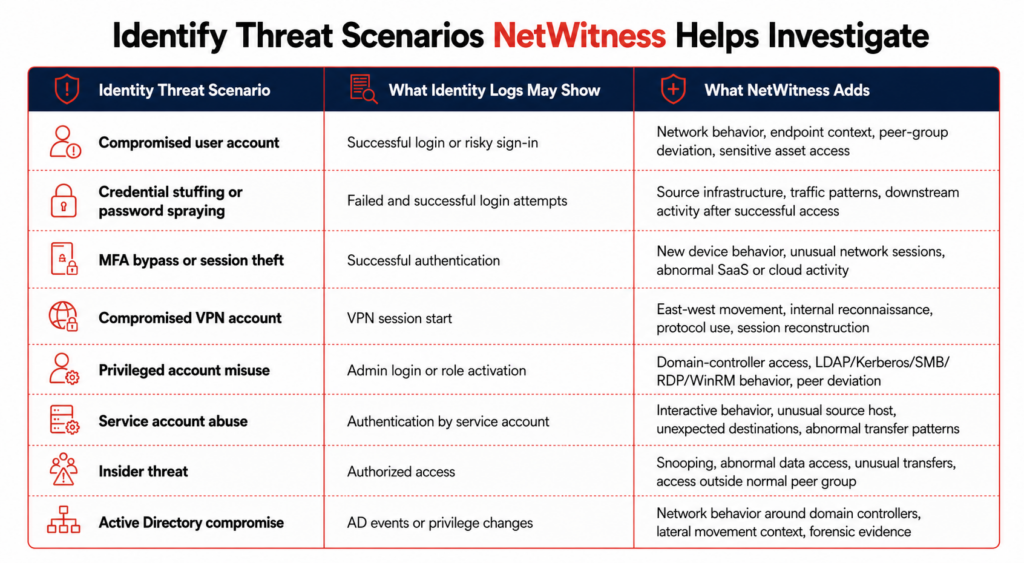
Where NetWitness Fits in an Enterprise Identity Threat Detection and Response Architecture
A mature Identity Threat Detection and Response strategy usually stacks several control layers. IAM and SSO manage authentication. MFA and passkeys strengthen access. PAM controls privileged access. IGA governs the lifecycle and certification. Cloud entitlement tools reduce excessive permissions. Secrets management protects keys and credentials. Identity posture tools identify misconfigurations and risky privileges.
NetWitness fits beside these controls as the SOC visibility and investigation layer.
We’re strongest in environments where security teams need to correlate identity activity with network traffic, endpoint telemetry, log data, cloud and SaaS activity, full-packet and metadata evidence, behavioral analytics, threat intelligence, and SOAR-driven response workflows.
That’s why we’re especially valuable in
- Hybrid enterprises,
- Regulated industries,
- Active Directory-heavy environments,
- Cloud-connected SOCs,
- Organizations where attackers use valid credentials instead of malware.
Frequently Asked Questions
1. How do enterprise identity threat detection platforms compare?
Platforms should be compared by
- coverage
- telemetry depth
- detection logic
- response options
- SOC usability
NetWitness is strengthens the SOC side of identity threat detection and response. We correlate identity activity with logs, packets, metadata, endpoint telemetry, NetFlow, behavioral analytics, threat intelligence, and SOAR workflows. That makes us a strong fit for enterprises that need identity detection connected to the wider attack chain.
2. What are the best practices for implementing ITDR systems?
Start with the identity estate. Inventory human users, privileged users, contractors, service accounts, machine identities, cloud roles, OAuth apps, API keys, certificates, SaaS admins, and dormant accounts.
Then prioritize high-risk controls:
- Enforce phishing-resistant MFA for privileged and sensitive access,
- Monitor privilege changes aggressively,
- Treat tokens and sessions as credentials,
- Harden Active Directory and hybrid identity,
- Secure service accounts and non-human identities,
- Ingest identity, endpoint, network, cloud, and saas logs into the SOC,
- Use behavioral analytics to detect abnormal users and entities, and
- Build response workflows for account disablement, session revocation, endpoint isolation, and secret rotation.
Identity alerts shouldn’t live in isolation; they should enrich SOC investigations with user risk, device risk, asset context, network behavior, endpoint activity, and response options.
3. How do you build an effective identity incident response plan?
An effective identity IR plan defines what the SOC does when a user account, privileged account, service account, token, or identity infrastructure component is suspected of compromise.
It should cover
- Triage criteria for risky sign-ins, privilege changes, token abuse, and abnormal behavior
- Evidence collection from identity logs, endpoint data, network traffic, saas logs, and cloud activity
- Containment actions like disabling accounts, revoking sessions, forcing password resets, rotating secrets, and isolating endpoints
- Validation steps to confirm whether the identity was actually misused; communication workflows between SOC, IAM, IT, cloud, legal, and incident response teams
- Recovery steps for restoring access safely, and post-incident review of permissions, policies, detections, and monitoring gaps
NetWitness supports this process by helping analysts reconstruct activity, correlate related telemetry, preserve evidence, and trigger response workflows through integrations.
4. How does ITDR improve overall cybersecurity posture?
ITDR helps organizations detect and contain account abuse before it becomes a broader breach. It helps SOCs
- Identify compromised credentials,
- Privileged misuse,
- Service account abuse,
- Insider threats,
- Abnormal access,
- Token misuse,
- Lateral movement, and
- Suspicious post-login activity.
Combined with network visibility and behavioral analytics, ITDR gives security teams the context to separate normal access from risky behavior.
NetWitness improves that posture by connecting identity activity to the broader security environment. Instead of investigating a login alert in isolation, analysts can see the related network sessions, endpoint behavior, asset context, peer-group deviation, packet evidence, and response options. That’s how identity threat detection becomes an actual investigation and response capability — not just monitoring.
5. Why Choose NetWitness for Identity Threat Detection and Response?
Choose NetWitness when your identity security challenge isn’t just access control, it’s investigation.
We’re at our strongest when your SOC needs to detect identity abuse that doesn’t rely on malware, investigate post-login behavior, connect identity events with network traffic analysis, use behavioral analytics to surface abnormal users and entities, reconstruct suspicious sessions, hunt across logs, packets, endpoint, NetFlow, cloud, and SaaS telemetry, prioritize identity alerts with context, coordinate response through SOAR workflows, and improve SOC visibility across hybrid environments.
Most enterprises have strong identity prevention controls, but limited visibility into what identities do after access is granted. NetWitness closes that gap, with network visibility, user behavior analytics, advanced threat detection, forensic evidence, and response orchestration working together.
Evaluate unified security platforms with confidence using a practical guide to essential capabilities.