What should organizations look for in a buying guide for unified cybersecurity platforms in large enterprises?
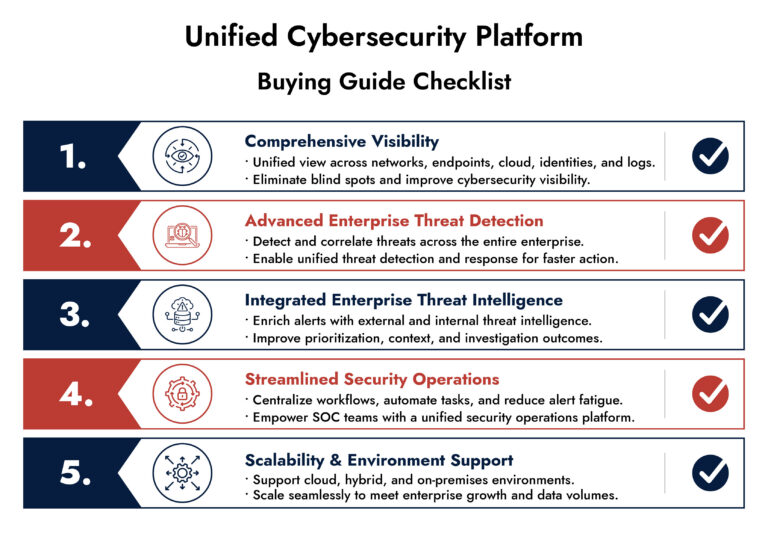
A buying guide for unified cybersecurity platforms should focus on key factors such as comprehensive visibility, advanced enterprise threat detection, integrated enterprise threat intelligence, scalability, automation, and support for cloud and hybrid environments. The right enterprise cybersecurity platform should enable unified threat detection and response, reduce tool complexity, and provide a centralized security operations platform that improves SOC efficiency and overall cybersecurity visibility across the enterprise.
Introduction
Security teams are surrounded by more technology than ever before. Yet many large enterprises still struggle to investigate incidents quickly, understand their exposure, and coordinate effective responses.
The problem is not necessarily a lack of security tools. In many cases, it is the opposite.
Research shows that the average organization manages 83 security solutions from 29 different vendors. More than half of security leaders identify security complexity as one of their biggest operational challenges. As security environments expand, teams often find themselves navigating multiple dashboards, disconnected workflows, and fragmented data sources just to understand a single incident.
This reality is driving a major shift in how enterprises approach cybersecurity. Rather than adding another standalone solution to address the latest threat, organizations are looking for ways to consolidate visibility, analytics, threat detection, and response into a single operational framework.
That is where a unified cybersecurity platform enters the conversation.
But choosing the right platform is not as simple as comparing feature lists. For large enterprises, the decision affects visibility, security operations, analyst productivity, compliance, and long-term security strategy.
The most successful organizations evaluate platforms based on architecture, operational outcomes, and future scalability rather than marketing claims.
What Is a Unified Cybersecurity Platform?
A unified cybersecurity platform is an integrated security architecture that brings together data collection, analytics, enterprise threat detection, investigation, threat intelligence, and response capabilities within a shared operational environment.
At first glance, many products appear to meet this definition. Most vendors offer some form of centralized dashboard or integrated management console.
However, there is an important distinction between a truly unified security platform and a collection of connected products.
Some solutions simply aggregate information from multiple tools through integrations. While this creates a single interface, the underlying data often remains fragmented across separate databases, workflows, and analytics engines.
A mature enterprise cybersecurity platform goes further. It enables security teams to correlate activity across endpoints, networks, cloud environments, identities, applications, and logs from a common data foundation.
The difference may not be obvious during a product demonstration. It becomes obvious during an active investigation.
When analysts are trying to determine how an attacker gained access, what systems were affected, and whether the threat has been contained, fragmented tools create delays. A unified cybersecurity platform provides the context needed to answer those questions faster.
Why Enterprise Security Teams Are Reconsidering Their Security Stack
Most enterprises did not intentionally create security sprawl.
Security environments typically evolve over many years. A new endpoint security product is deployed to address one challenge. A cloud security solution is added later. Threat intelligence, identity security, network monitoring, and security analytics platforms follow.
Over time, organizations build an extensive security stack that appears comprehensive on paper but becomes increasingly difficult to manage in practice.
This creates several operational challenges:
- Multiple sources of alerts
- Duplicate investigations
- Inconsistent threat prioritization
- Visibility gaps between environments
- Increased analyst workload
- Longer incident response cycles
The impact extends beyond operational efficiency.
Security complexity can slow enterprise threat detection, delay investigations, and make it more difficult for security teams to understand risk across the organization.
This helps explain why platform consolidation is becoming a strategic priority. Research shows that 87% of IT leaders are actively evaluating a move toward a unified platform approach as they look for ways to simplify operations and improve security outcomes.
The objective is not simply reducing the number of tools. The objective is creating a security operations model where information, analytics, and response actions work together rather than operating in silos.
Key Features and Capabilities of a Mature Unified Platform
1. Unified Threat Detection and Response
Modern attacks rarely affect a single system.
An attacker may compromise an endpoint, establish persistence, move laterally through the network, access cloud resources, and abuse privileged credentials as part of the same campaign.
When security data remains isolated across multiple products, analysts must manually connect those events.
A platform built for unified threat detection and response helps security teams correlate activity across different environments automatically.
Key capabilities should include:
- Cross-domain threat correlation
- Behavioral analytics
- Risk-based prioritization
- Automated investigation support
- Integrated response workflows
The goal is not generating more alerts. The goal is helping analysts identify meaningful threats faster while reducing investigation complexity.
2. Enterprise-Wide Visibility
Visibility remains one of the most important requirements for modern security operations.
A cybersecurity visibility platform should provide insight into activity across:
- Networks
- Endpoints
- Cloud environments
- Identities
- Applications
- Logs and security events
Without broad visibility, security teams often struggle to reconstruct attack timelines or understand the full impact of an incident.
When evaluating a cybersecurity platform for enterprises, leaders should ask a simple question:
Can analysts investigate threats without switching between multiple tools?
The answer often reveals how unified the platform truly is.
3. Enterprise Threat Intelligence
Threat intelligence becomes significantly more valuable when it is integrated directly into security workflows.
Many organizations subscribe to multiple intelligence feeds but still rely on manual processes to determine relevance.
A mature enterprise cybersecurity platform should operationalize enterprise threat intelligence by enriching alerts, investigations, and threat hunting activities automatically.
This helps analysts:
- Identify known adversaries faster
- Prioritize high-risk incidents
- Improve investigation efficiency
- Reduce false positives
Threat intelligence should provide context at the moment decisions are made.
4. Automation and Analyst Efficiency
Security teams face constant pressure to improve performance without dramatically increasing headcount.
Automation has become a critical component of modern security operations.
The best security operations platform solutions automate repetitive activities such as:
- Alert enrichment
- Data collection
- Initial investigation workflows
- Evidence gathering
- Response orchestration
Automation should not replace analysts. It should allow analysts to spend more time investigating threats and less time performing manual tasks.
5. Scalability and Future Readiness
Large enterprises generate vast amounts of security telemetry every day.
A platform that performs well in a controlled demonstration environment may struggle when faced with real-world enterprise scale.
Organizations should evaluate:
- Data ingestion capabilities
- Search and query performance
- Multi-cloud support
- Hybrid environment visibility
- Long-term scalability
The platform selected today should be able to support future growth without requiring major architectural changes.
The Business Case for a Unified Security Platform
Platform adoption is often discussed in technical terms, but the strongest arguments are operational. Organizations that embrace platform-based security operations consistently report better outcomes than those relying on fragmented security environments.
Platform adopters detect incidents 72 days faster and contain incidents 84 days faster than organizations operating fragmented security stacks.
For security leaders, those improvements translate into:
- Reduced business risk
- Faster investigations
- Improved analyst productivity
- Lower operational overhead
- More effective threat response
The value of a unified security platform is not simply consolidation. It is the ability to make security operations more effective at scale.
Implementation: Five Steps from Fragmented to Unified
Step 1: Audit Your Existing Security Stack
Before evaluating vendors, organizations should document:
- Existing security tools
- Visibility gaps
- Overlapping capabilities
- Integration dependencies
- Operational challenges
This creates a baseline for measuring future improvements.
Step 2: Define Architectural Requirements
Successful platform projects begin with clear requirements.
Consider:
- Data sources
- Compliance obligations
- Visibility requirements
- Detection capabilities
- Cloud strategy
- Scalability needs
Requirements should drive platform selection rather than vendor marketing.
Step 3: Evaluate Architecture, Not Features
Feature parity is becoming increasingly common across vendors.
Architecture often determines long-term success.
Security leaders should understand:
- How data is collected
- How telemetry is correlated
- Which capabilities are native
- Which functions rely on integrations
These answers reveal how unified the platform actually is.
Step 4: Plan a Phased Rollout
Large enterprises rarely replace their entire security stack at once.
A phased implementation approach allows organizations to validate workflows, minimize disruption, and build operational confidence before expanding deployment.
Step 5: Define Success Metrics
Organizations should establish measurable outcomes before implementation.
Examples include:
- Mean time to detect
- Mean time to investigate
- Mean time to respond
- Alert reduction rates
- Analyst efficiency improvements
These metrics help quantify the value of platform adoption.
How NetWitness Delivers a Unified Security Platform
Many security platforms focus on consolidating alerts. NetWitness focuses on unifying visibility, investigation, and response while integrating with the broader security ecosystem already in place. This allows organizations to enhance security operations without requiring a wholesale replacement of existing tools and processes.
The NetWitness platform brings together network, endpoint, cloud, identity, and log telemetry within a common operational environment, helping analysts see relationships that might otherwise remain hidden across disconnected tools.
As a unified cybersecurity platform, NetWitness helps organizations:
- Improve enterprise threat detection through deep visibility across attack surfaces
- Correlate data from networks, endpoints, cloud environments, and identities
- Integrate enterprise threat intelligence into investigations and threat hunting activities
- Support unified threat detection and response workflows
- Streamline security operations through a single investigative experience
- Integrate with existing security technologies and workflows, helping organizations preserve operational knowledge and maximize the value of existing security investments
For enterprises managing complex hybrid environments, NetWitness functions as both a cybersecurity visibility platform and a security operations platform, helping teams move from detection to investigation and response with greater speed and context.
The Future of Unified Cybersecurity Platforms
The conversation around platform adoption is changing.
Organizations are no longer asking whether consolidation matters. They are asking how much operational value they can gain from it.
As security environments become more distributed and attacks become more sophisticated, visibility, intelligence, and response speed will become increasingly important differentiators.
The enterprises that succeed will be those that can connect security data, analytics, and response actions within a unified operating model.
Conclusion
Choosing a unified cybersecurity platform is not simply a technology decision. It is a decision about how security operations will function over the next decade.
The right enterprise cybersecurity platform helps organizations improve visibility, strengthen enterprise threat detection, operationalize enterprise threat intelligence, and support unified threat detection and response at scale.
Rather than focusing solely on features, large enterprises should evaluate platforms based on architecture, operational outcomes, scalability, and investigative efficiency.
The platforms that deliver the greatest value are not the ones with the most dashboards. They are the ones that help security teams understand threats faster and respond with confidence.
Frequently Asked Questions
1. Why do large enterprises need a unified cybersecurity platform?
A unified cybersecurity platform helps large enterprises consolidate security tools, improve visibility across the environment, and accelerate threat detection and response. It reduces operational complexity while enabling security teams to manage risks more efficiently from a single platform.
2. What features should enterprises look for in a unified cybersecurity platform?
Key features include centralized visibility, enterprise threat detection, threat intelligence integration, automated response capabilities, cloud and hybrid environment support, advanced analytics, and scalable security operations workflows.
3. How do unified cybersecurity platforms support SOC teams?
A unified security platform helps SOC teams by correlating data from multiple sources, reducing alert fatigue, improving investigation efficiency, and enabling faster response to threats through automation and centralized workflows.
4. What should large enterprises consider when buying a unified cybersecurity platform?
A unified cybersecurity platform should provide comprehensive visibility, advanced threat detection, seamless integration with existing security tools, automation capabilities, threat intelligence support, and the scalability needed to secure complex enterprise environments.
5. Can unified cybersecurity platforms support cloud and hybrid environments?
Yes. Modern enterprise cybersecurity platforms are designed to provide consistent visibility, monitoring, and threat detection across on-premises, cloud, and hybrid environments, helping organizations secure their entire digital ecosystem from a single platform.
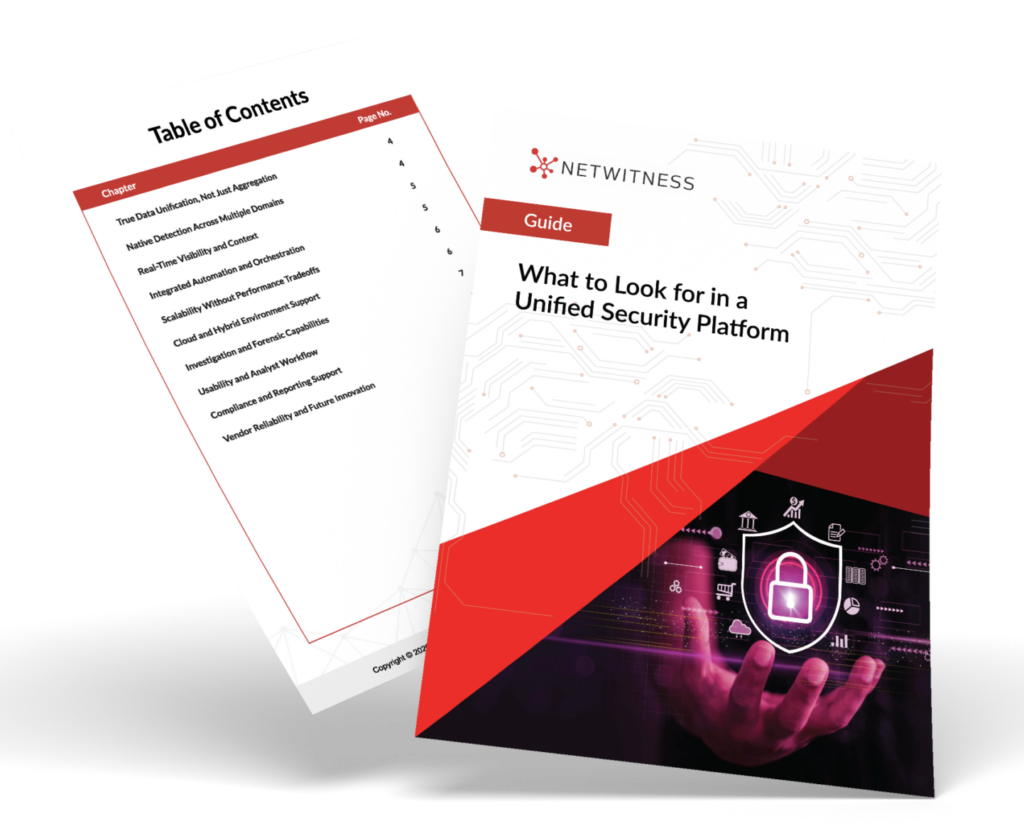
What to Look for in a Unified Security Platform
- Cut through tool sprawl with a practical evaluation framework.
- Compare platforms based on visibility, detection accuracy, and automation.
- Validate real-world performance across hybrid and cloud environments.
- Make confident, risk-aligned security decisions.