What is digital supply chain security against ransomware?
Digital supply chain security against ransomware means protecting every vendor, software dependency, and third-party connection that touches your network, not just your own systems. It combines vendor risk assessments, zero trust security, continuous threat detection, and incident response planning to stop ransomware that enters through a compromised supplier rather than a direct attack.
A hospital doesn’t get hit because someone clicked a bad link in its own inbox. It gets hit because the software vendor managing its patient records had a weak password on an admin account three states away. That’s the reality of ransomware in 2026. Attackers don’t need to breach your walls anymore. They just need to find the weakest supplier in your network and walk in through the side door you didn’t know existed.
Third-party involvement in breaches doubled from 15% to 30% in a single year, the largest single-year shift ever recorded by the Verizon Data Breach Investigations Report. That’s not a trend line inching upward. That’s an entire threat model changing shape while most security teams were still watching their own front door.
Why the Supply Chain Became Ransomware’s Favorite Target
Every vendor, software library, cloud service, and API integration your business relies on is a potential entry point. Attackers figured this out a while ago, and they’ve gotten efficient about exploiting it. Compromise one software provider, and you might get access to hundreds or thousands of downstream customers in a single move.
The MOVEit Transfer breach is the textbook case. One vulnerability in one file transfer product gave the Cl0p ransomware group a path into organizations across finance, healthcare, and government, all at once. It wasn’t hundreds of separate attacks. It was one exploit, replicated at scale, because so many organizations trusted the same piece of software.
Ransomware remains a global crisis impacting all industries, with healthcare, manufacturing, education, and critical infrastructure sectors affected the most, and supply chain attacks are a major reason why. When one vendor’s weakness becomes everyone’s problem, the math changes for attackers. Why breach one target when a single supplier compromise can open a thousand doors?
What Makes Supply Chain Ransomware Different
Traditional ransomware defense assumes you know where your perimeter is. Supply chain attacks blow that assumption apart. The malicious code doesn’t come from an external attacker probing your firewall. It comes bundled inside a software update you trusted, or through credentials belonging to a vendor who had no idea they’d been compromised.
In a typical supply chain attack, an adversary might start with a code compromise in a software library, then move laterally using valid accounts or stolen tokens, and eventually deploy ransomware to disrupt operations. Each stage looks legitimate on its own. That’s what makes these attacks so hard to catch with defenses built around known bad actors and obvious anomalies.
Unauthorized access through compromised credentials accounts for a large share of these incidents, which means credential hygiene across your entire vendor ecosystem matters just as much as it does inside your own organization. You can have flawless internal password policies and still get taken down because a contractor’s login was sitting in a leaked credential dump.
Open source software adds another layer of exposure. Package repositories like npm have become a favorite hunting ground. Widely used packages with billions of weekly downloads have been compromised after maintainers fell for phishing attacks, turning trusted logging libraries into delivery mechanisms for malicious code. If your development team pulls dependencies from public repositories without scrutiny, you’ve inherited risk you never signed up for.
Building Real Visibility Into Vendor Risk
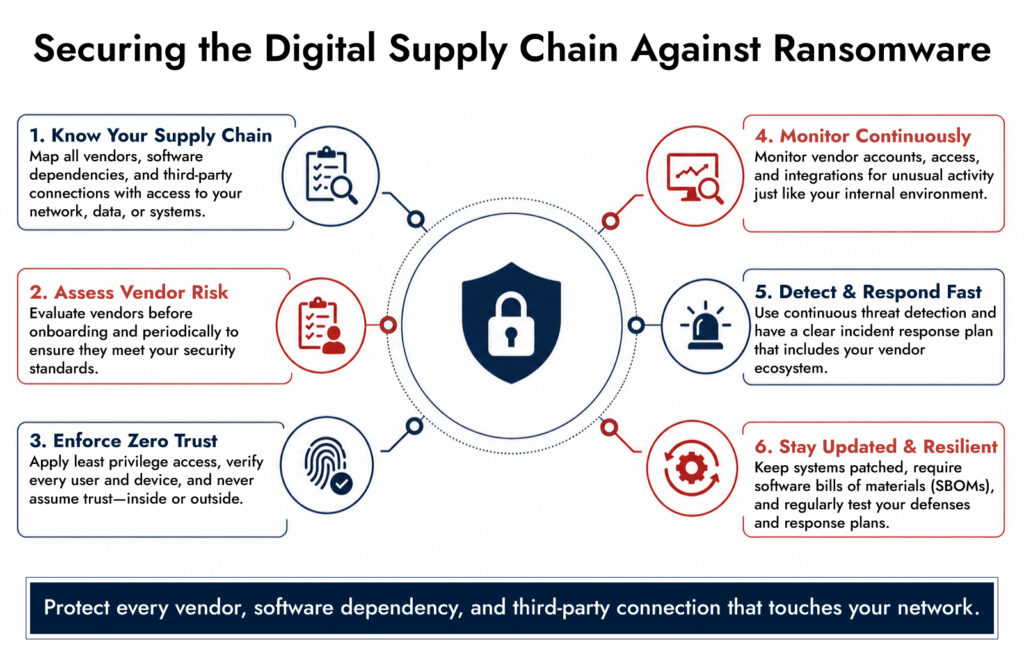
You can’t protect what you can’t see, and most organizations have far less visibility into their digital supply chain security than they think. Start with an honest inventory. Every vendor with system access, every software dependency, every API integration, every managed service provider. If a spreadsheet feels inadequate for this task, that’s because it probably is.
A few things worth doing right now:
- Map every third party with access to your network, data, or systems, and rank them by the level of access they hold, not just by contract size
- Require software bills of materials from critical vendors so you know exactly what components are running inside the tools you depend on
- Set minimum security standards for vendors before onboarding, and revisit those standards periodically instead of treating them as a one-time checkbox
- Monitor for unusual behavior from vendor accounts the same way you’d monitor your own employees, because a compromised vendor credential looks identical to a legitimate one until it doesn’t
Software bills of materials in particular are moving from nice-to-have to expected practice. Regulatory guidance is pushing SBOM requirements from voluntary toward a procurement standard, and organizations that get ahead of this now will have an easier time when it becomes non-negotiable.
Why Zero Trust Matters More in a Connected Ecosystem
Zero trust security isn’t a buzzword here. It’s the practical answer to a question every security team eventually has to face: how do you defend a network where you can’t fully trust any single connection, including ones from your own vendors?
The old model assumed that anything inside your network perimeter was safe by default. That assumption doesn’t survive contact with a supply chain where a “trusted” vendor connection might be the exact thing carrying the ransomware payload. Zero trust flips this. Every access request gets verified, every time, regardless of where it originates.
For vendor relationships specifically, this means segmenting network access so a compromised supplier account can’t move freely across your environment. It means enforcing least-privilege access, so a vendor tool that needs to touch one system doesn’t have a standing pathway to everything else. Network segmentation between IT and OT environments, and even between different vendor integrations, limits how far an attacker can travel once they’re inside.
Why Digital Supply Chain Security Needs Detection
No amount of vendor vetting eliminates risk entirely. Supply chain attacks are built to look legitimate, which means prevention alone will always leave gaps. Threat detection has to pick up where prevention stops working, catching the behavioral signals that something in your environment, even something coming from a trusted source, isn’t acting right.
This is where a lot of organizations fall short. They have endpoint protection and firewall logs, but no unified way to correlate activity across the network and spot the subtle signs of a digital supply chain security compromise unfolding in real time. Full packet capture and network detection give security teams the raw visibility to catch lateral movement and unusual data flows before encryption starts, not after the ransom note appears.
Organizations rank ransomware as their top cybersecurity concern, ahead of phishing and supply chain disruption specifically, and that concern is well placed. Attackers move fast once they’re inside. The window between initial compromise and full encryption keeps shrinking, which means detection speed isn’t a nice-to-have metric buried in a quarterly report. It’s the difference between an incident you contain and one that takes down operations for weeks.
Incident Response Built for Multi-Party Breaches
When ransomware does hit through a supply chain vector, response gets complicated fast. You’re not just containing an incident inside your own walls. You might be coordinating with a vendor’s security team, figuring out which systems talked to the compromised third party, and trying to determine your exposure while the vendor is still working through their own breach.
A response plan built only around internal incidents won’t hold up here. Effective incident response for supply chain ransomware needs clear protocols for vendor notification, defined steps for isolating affected integrations without shutting down your entire operation, and pre-established communication channels with critical suppliers before a crisis, not during one. Running tabletop exercises that specifically simulate a third-party compromise, rather than only internal breach scenarios, exposes gaps you won’t find any other way.
How NetWitness Strengthens Supply Chain Ransomware Protection
Most ransomware protection solutions are built to catch known threats at the perimeter. Supply chain ransomware doesn’t respect that model, since it often arrives through a connection you already trust. That’s the gap NetWitness is built to close.
NetWitness gives security teams full packet capture across both IT and OT environments, so unusual behavior from a vendor account or third-party integration gets flagged based on what it’s actually doing, not just where it came from. Combined with unified detection across network traffic, endpoints, and logs, this cuts down the time between initial compromise and full visibility into an incident, which is exactly the window supply chain attacks depend on.
For enterprise ransomware protection, this matters most in the moments before encryption starts. Lateral movement from a compromised vendor connection tends to leave a trail. Full network visibility gives teams the ability to catch that trail early, rather than discovering the breach after operations have already stopped.
Cybersecurity Risk Management as an Ongoing Practice
None of this works as a one-time project. Cybersecurity risk management for the digital supply chain security has to be continuous, because your vendor list changes, your dependencies change, and the threat landscape shifts constantly. A vendor that was low risk last year might have grown its access footprint without anyone reassessing the risk that comes with it.
Regular risk assessments, updated vendor questionnaires, and ongoing monitoring of third-party security postures should sit on the same priority level as patching your own systems. Enterprise ransomware protection built for 2026 has to extend past the traditional network boundary, because that boundary barely exists in any meaningful sense anymore.
This is exactly the kind of visibility gap NetWitness was built to close. Its network detection and response platform gives security teams full packet capture across IT and OT environments, so lateral movement from a compromised vendor connection gets flagged before it turns into an enterprise-wide encryption event. Combined with unified threat detection across endpoints, network traffic, and log data, it gives teams the kind of ransomware protection solutions that account for how attacks actually unfold today, through the connections you trust, not just the ones you’re watching closely.
The digital supply chain security isn’t going to get simpler or smaller. Every new vendor, every new integration, every new open source dependency adds another thread to a web that’s already hard to fully see. Treating that web as part of your attack surface, not an afterthought to it, is what separates organizations that catch these attacks early from the ones that end up as the next MOVEit headline.
Frequently Asked Questions
1. What are the biggest ransomware risks in the digital supply chain?
The biggest risks come from vendors and software providers with weak security practices that give attackers a path into your network without ever touching your own defenses. Compromised credentials, unpatched software from third-party vendors, and malicious code hidden in open source dependencies are the most common entry points for supply chain ransomware. A single compromised supplier can expose every organization downstream, which is why supply chain ransomware often causes damage far beyond the original target.
2. How can organizations reduce ransomware risk across the supply chain?
Reducing ransomware risk starts with full visibility into every vendor, software dependency, and third-party connection with access to your systems. From there, cybersecurity risk management should include vendor security assessments before onboarding, software bills of materials for critical tools, and ongoing monitoring rather than a one-time review. Zero trust security also plays a major role here, since it limits how far a compromised vendor account can move once inside your network. Together, these steps form the backbone of effective ransomware prevention.
3. How does network visibility help protect the digital supply chain?
Network visibility lets security teams see lateral movement and unusual data flows the moment they happen, rather than after ransomware has already encrypted critical systems. Since supply chain attacks often look legitimate on the surface, coming through trusted vendor connections or software updates, threat detection built on full network visibility is often the only way to catch the compromise before it spreads. This is a core reason network security tools with deep packet inspection matter as much as perimeter defenses.
4. How can organizations prepare for a supply chain ransomware attack?
Preparation means building an incident response plan that accounts for multi-party breaches, not just internal incidents. That includes clear protocols for vendor notification, predefined steps for isolating a compromised third-party connection without halting your entire operation, and established communication channels with critical suppliers before a crisis occurs. Running tabletop exercises that simulate a third-party compromise specifically, rather than only internal breach scenarios, is one of the most effective ways to find gaps in enterprise ransomware protection before attackers do.
5. What industries are most vulnerable to supply chain ransomware?
Healthcare, manufacturing, education, financial services, and critical infrastructure sectors face the highest exposure to supply chain ransomware. These industries tend to rely heavily on third-party software providers and managed service providers for core operations, which widens their attack surface considerably. Government and transportation are also frequent targets, given how much sensitive data and critical service delivery runs through shared vendor systems in these sectors.
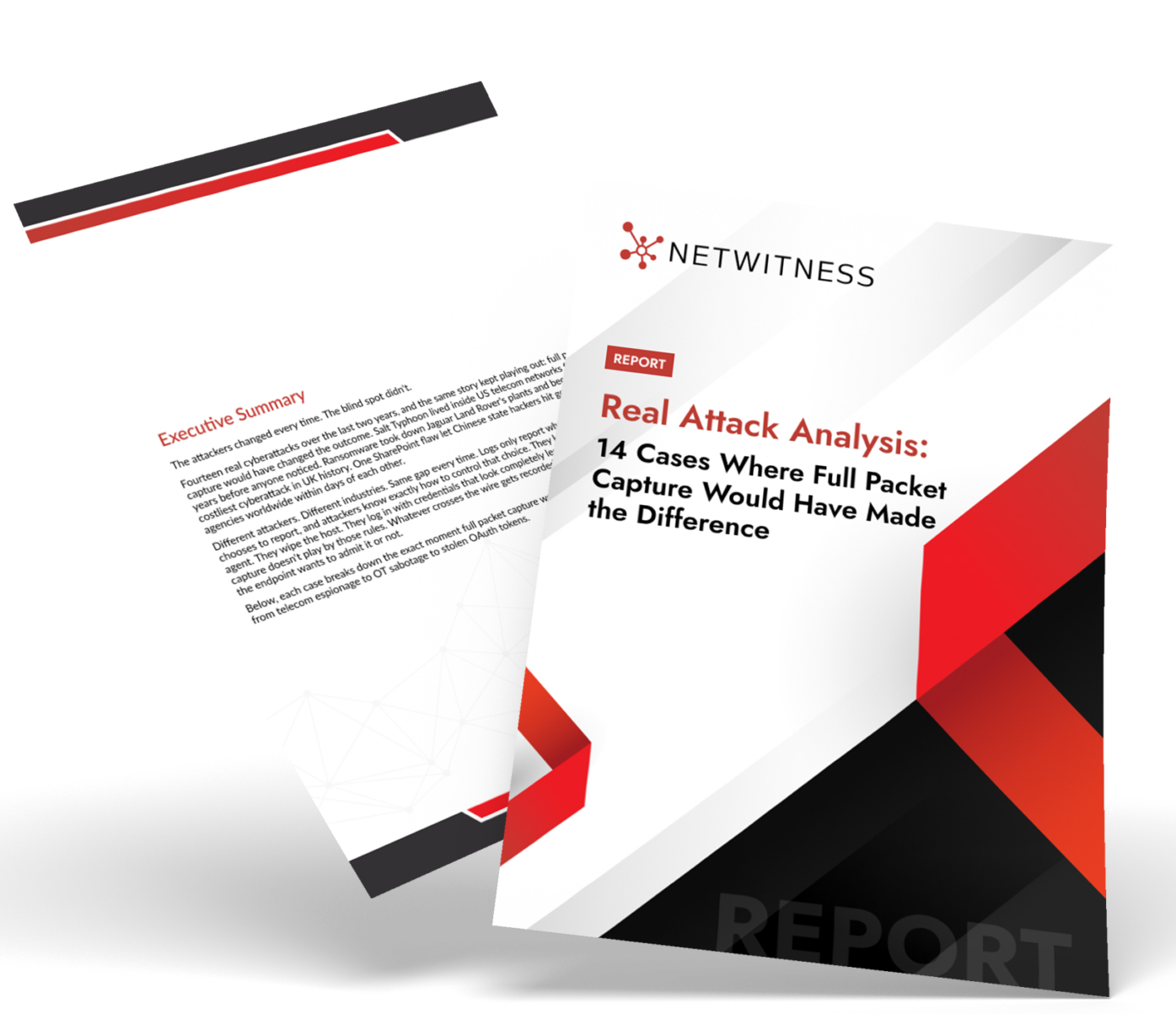
14 Real Attacks. One Critical Lesson: Visibility Matters.
- See What Really Happened
- Reconstruct Attack Activity
- Uncover Hidden Threats
- Investigate with Packet-Level Evidence