Best cybersecurity solutions for protecting financial institutions
The strongest solutions help financial institutions detect, investigate, and prove attacker activity across the environment. That includes identity, endpoint, network, cloud, logs, fraud systems, third-party access, and OT-relevant systems. A practical stack usually includes SIEM, NDR, endpoint telemetry, identity security, cloud logging, fraud monitoring, and cyber threat intelligence. Incident response workflows should connect that evidence quickly. NetWitness is a strong fit for teams that need connected investigation rather than another isolated alert stream.
Cybersecurity for financial services depends on how quickly teams can connect identity, endpoint, cloud, network, log, and transaction evidence during an investigation. Mature financial institutions do not need more isolated alerts. They need enough shared context to prove how an attacker entered, where they moved, what they touched, and whether containment is real.
We at NetWitness know that the hardest part of a financial cybercrime investigation is the evidence gap that appears five minutes later.
A scenario like this is common in financial environments. A suspicious authentication lands in the SIEM. Endpoint telemetry shows PowerShell on a high-value workstation. NDR data suggests unusual east-west traffic. A fraud team reports abnormal wire activity. Cloud logs show access to a storage bucket from an unfamiliar session. An identity log shows a privileged account used from a location that looks almost legitimate.
Nobody owns the full timeline yet. Financial security teams are dealing with disconnected evidence, monitoring gaps, and limited network context. The cost of not knowing enough, fast enough, can quickly become operational.
In financial services, cyber risk becomes operational risk quickly. Payment operations, trading systems, ATM fleets, branch networks, customer portals, call centers, data centers, cloud services, and third-party ecosystems all depend on trust. When that trust is abused, the investigation cannot wait for manual exports and console-hopping.
Financial Cybercrime Snapshot
Financial services are not just another enterprise sector. In the U.S., CISA lists Financial Services among the 16 critical infrastructure sectors whose disruption can affect national economic security and public safety. A compromise inside a bank, payment processor, insurer, exchange, or fintech provider can create business, customer, regulatory, and even systemic risk.
The FBI IC3 2025 Internet Crime Report recorded more than 1 million complaints and $20.877 billion in reported losses. Investment fraud, business email compromise, and tech support scams were among the largest loss categories.
Verizon’s 2025 DBIR gives the financial sector a sharper operational lens. For Financial and Insurance organizations, Verizon reported 3,336 incidents and 927 breaches with confirmed data disclosure. System Intrusion, Social Engineering, and Basic Web Application Attacks represented 74% of breaches, and financial motive appeared in 90% of breaches. Credentials were compromised in 22% of breaches.
Financial Cybercrime Investigation Lifecycle: Where NetWitness Helps
The lifecycle below is the operating model that financial institutions should pressure-test. It is not an academic process map. It reflects how investigations need to move when attackers cross identity, endpoint, cloud, network, third-party, and OT-relevant systems.
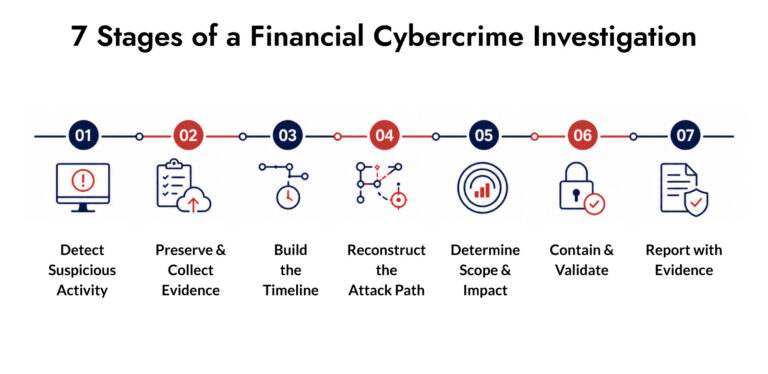
Stage 1: Detect Suspicious Activity Without Treating the Alert as the Case
A financial cybercrime investigation often begins with a signal that is true but incomplete.
A privileged account authenticates from a plausible location. A fraud platform sees an abnormal wire instruction. An endpoint shows PowerShell launched by a user who rarely uses it. A cloud alert fires after a new API key is created. DNS telemetry shows requests to unfamiliar infrastructure. A vendor VPN account accesses a jump server outside its normal pattern.
The mistake is treating the alert as the incident. The alert is only the doorway.
For SOC analysts, detection needs context immediately. Identity data may show the account. Endpoint telemetry may show process activity. Network metadata may show connections before and after the alert. Logs may show application access. Cyber threat intelligence may tie an IP, domain, hash, or behavior pattern to a known financial crime group.
How NetWitness helps at this stage
NetWitness helps teams connect early signals before the investigation fragments.
A suspicious authentication event can be enriched with evidence from across the environment. That may include VPN logs, endpoint telemetry, network sessions, Active Directory activity, DNS requests, cloud control plane events, and privileged account behavior.
NetWitness supports detection across logs, network traffic, endpoint telemetry, cloud environments, and threat intelligence sources, with behavioral analytics and correlation across multiple data sources. The practical benefit is faster triage with evidence.
Stage 2: Preserve and Collect Evidence Before It Disappears
Digital forensics fails when the evidence is already gone.
This is where many financial institutions discover that collection and investigation are not the same thing. Evidence decay is brutal during incident response for financial services.
Packet data ages out. Sessions close. Tokens expire. Endpoints are reimaged. Vendors rotate credentials. Cloud resources change. Infrastructure teams apply necessary blocks and resets. Those actions can also alter the evidence trail.
For financial cybercrime investigation, the evidence need to prove what happened usually includes:
- Authentication and privileged account activity
- VPN and remote access records
- Endpoint process trees and command execution
- DNS, RDP, SMB, PowerShell, and Active Directory activity
- Packet data and network metadata
- Cloud control plane events
- SaaS audit logs
- Payment application and database access logs
- Vendor access and jump server activity
- OT-relevant network and log evidence tied to data centers, facilities systems, ATM infrastructure, and building automation
How NetWitness helps at this stage
NetWitness helps support digital forensics by giving investigators access to connected evidence across log, network, endpoint, identity, cloud, and OT-relevant sources.
Packet-level and session-level context matter here. NetWitness network forensic capabilities include packet capture, metadata enrichment, protocol parsing, and session reconstruction. Behavioral analytics, threat intelligence, and cross-domain correlation add context for evidence-backed investigation
This is the stage that determines whether the rest of the lifecycle is evidence-led or assumption-led.
Stage 3: Build the Timeline Across Fraud, SOC, Cloud, Identity, Network, and OT-Relevant Teams
The timeline is where disconnected tools become visible.
A fraud analyst may know when the suspicious payment instruction was submitted. The SOC may know when the identity alert fired. The endpoint team may know when PowerShell executed. The cloud team may know when the API key was created. The network team may know when data left the environment. The OT or facilities team may know when a jump server accessed a building automation segment.
They are one timeline.
The problem is that financial institutions often ask analysts to assemble that timeline manually under pressure. They move between SIEM, endpoint, NDR, identity, and cloud tools. They also have to pull evidence from VPN systems, fraud platforms, ticketing systems, and application logs.
When fraud, SOC, cloud, IT, and OT-relevant teams do not share the same timeline, leadership gets a narrative before investigators have proof.
How NetWitness helps at this stage
NetWitness helps build investigation workflows that connect logs, network metadata, endpoint activity, identity context, cloud events, and OT-relevant evidence into a shared timeline.
With NetWitness, analysts can preserve the thread across evidence types. They can move from an identity alert to endpoint activity and then to the related network session. From there, they can investigate cloud events, affected assets, and the associated business process.
The timeline becomes an investigative workspace, not a slide built after the fact.
Stage 4: Reconstruct the Attack Path from Credential to Transaction
Financial cybercrime often starts with access and ends with money, data, disruption, or extortion. The path between those points is what investigators need to reconstruct.
The attack path may cross IT, OT, cloud, endpoint, identity, network, logs, and transaction systems. That is why network detection and response (NDR) cannot sit apart from SIEM, endpoint telemetry, identity analytics, cloud logging, and cyber threat intelligence.
How NetWitness helps at this stage
NetWitness helps analysts follow activity across domains rather than restarting the investigation in each tool.
A threat hunter looking for lateral movement needs evidence from several sources. That includes network metadata, DNS, SMB, RDP, PowerShell, Active Directory, VPN, endpoint telemetry, and identity logs. Packet- or session-level context can provide additional evidence. NetWitness supports these pivots by connecting network monitoring, endpoint telemetry, log evidence, behavioral analytics, and threat intelligence inside the investigative workflow.
That matters when payment fraud leaves a network trail.
A payment application log may show that a database query ran. NetWitness can help connect that event to the host and endpoint process behind the session. Analysts can then examine DNS lookups, internal session behavior, related authentication, and other network metadata. With packet evidence or session reconstruction, analysts have a stronger basis for determining whether activity was part of normal business or part of an intrusion.
Stage 5: Determine Scope and Impact Without Guesswork
If the SOC scopes too narrowly, attackers remain in the environment. If the SOC scopes too broadly, response actions can disrupt payment operations, trading systems, customer service, call centers, ATM availability, branch operations, or cloud services.
Scope is not just a list of hosts.
It is affected users, accounts, privileges, tokens, applications, transactions, data, vendors, business processes, and operational dependencies.
Third-party access makes scoping harder. Banks rely on providers and contractors across payments, cloud, ATMs, trading technology, data centers, and facilities. Their access may run through VPNs, SaaS portals, privileged sessions, or jump servers. Some also support operational technology in data centers, branches, and building management system.
How NetWitness helps at this stage
NetWitness helps incident responders investigate scope by connecting remote access logs, network sessions, endpoint telemetry, identity activity, cloud events, and OT-relevant evidence.
For a vendor VPN investigation, NetWitness can help correlate authentication records, VPN sessions, jump server access, and RDP or SMB activity. Analysts can also examine DNS and outbound network metadata, endpoint processes, cloud or SaaS administrative events, and relevant application logs. Zone-boundary traffic can add context where OT-relevant environments are involved.
That connection helps incident response for financial services avoid two bad outcomes: declaring containment before the evidence supports it, or disrupting too much of the environment because the team cannot narrow the blast radius.
For CISOs, scope is also a communication problem. The business needs to know what was affected, what was not affected, what remains uncertain, and what evidence supports those conclusions.
NetWitness helps support that conversation with connected evidence rather than screenshots from disconnected tools.
Stage 6: Contain and Validate Containment
Containment is not a checklist of completed actions.
Financial institutions need containment decisions that do not create unnecessary business disruption and do not leave access behind.
That is difficult when attackers use valid credentials, cloud tokens, remote access pathways, endpoint persistence, scheduled tasks, new accounts, abused OAuth grants, unmanaged devices, or third-party infrastructure.
Validation requires post-action evidence.
After containment, responders need to verify that the activity has actually stopped. Are suspicious authentications continuing? Have related network sessions reappeared? Were new credentials created? Teams also need to check for persistent endpoint activity, renewed outbound traffic, continued cloud access, and the same indicators elsewhere.
How NetWitness helps at this stage
NetWitness helps teams validate containment by correlating evidence after response actions are taken.
After credentials are reset, analysts can look for continued authentication, unusual VPN sessions, new identity activity, and related cloud events. Host isolation can be validated against endpoint telemetry, network metadata, and logs to see whether suspicious behavior stopped or moved elsewhere. Network blocks should also be checked for alternate destinations, DNS changes, beaconing, or command-and-control activity
For OT-relevant financial environments, this validation also needs operational context. Large financial institutions also operate physical infrastructure across data centers, campuses, branches, and ATM estates. That can include building automation, power and cooling systems, physical security, and other facilities networks. Some environments also contain PLCs, HMIs, controllers, historians, and industrial protocols.
NetWitness helps security teams connect OT-relevant evidence to the enterprise investigation rather than leaving IT and OT teams with separate timelines. A suspicious identity event, a jump server session, abnormal east-west traffic, zone boundary traffic, and unusual industrial protocol activity can be investigated as part of the same case.
Stage 7: Report With Evidence and Improve Controls
The final stage is not “write the report.” It is prove the story.
Executives, regulators, legal teams, auditors, fraud leaders, and operational stakeholders need a defensible explanation:
- Entry point
- Timeline
- Attack path
- Affected accounts
- Affected systems
- Data and transaction impact
- Third-party involvement
- OT-relevant or operational exposure
- Response actions
- Containment validation
- Residual risk
- Control gaps
- Next actions
How NetWitness helps at this stage
NetWitness supports faster threat detection, investigation, and response by helping teams move from alert to timeline to scope to response with evidence they can explain.
NetWitness provides capabilities across NDR, SIEM, EDR, SOAR, UEBA, and OT Security. The platform supports threat detection, investigation, and response across IT and OT environments, including network, log, endpoint, and OT data.
For reporting, that connected evidence helps reduce the gap between technical detail and executive communication. Analysts can show how the investigation progressed, which evidence supported each decision, and what control improvements should follow.
Conclusion
Cybersecurity for financial services does not improve by piling more disconnected tools into an already fragmented stack.
It improves when teams can see across the environment, investigate without losing context, and act before uncertainty becomes operational exposure. Financial cybercrime is fast, identity-driven, and distributed across the environment. Cloud, endpoint, network, third-party, fraud, log, and OT-relevant evidence all play a role. Isolated alerts cannot carry the investigation.
The investigation lifecycle gives financial security teams a clearer operating model. Detect suspicious activity. Preserve the evidence. Build the timeline and reconstruct the attack path. Then determine scope, validate containment, report with evidence, and improve controls.
For cybersecurity financial services leaders, the future is connected evidence, shared investigation context, and faster response across complex environments.
Frequently Asked Questions
1. Which cybersecurity software is recommended for financial services firms?
Financial services firms should prioritize software that helps analysts reconstruct attacker behavior across domains. For cybersecurity for financial services, NetWitness supports teams by helping them investigate across network, endpoint, identity, cloud, logs, and OT-relevant evidence.
2. What are the best incident response services for financial sector data breaches ?
The best incident response services for financial sector data breaches combine
- Speed
- forensic discipline
- regulatory awareness
- experience with fraud-linked intrusions
Technology matters too: incident response for financial services is stronger when responders can access connected evidence instead of waiting for exports from separate tools.
3. What technologies support financial cybercrime investigations?
Financial cybercrime investigations depend on SIEM, NDR, endpoint detection and response, identity analytics, cloud audit logging, packet capture, network metadata, log management, behavioral analytics, case management, cyber threat intelligence, and digital forensics tools. These technologies should support a shared investigation timeline rather than forcing analysts to rebuild the incident manually from separate consoles.
4. What are the warning signs of financial cybercrime?
Common warning signs include
- suspicious authentication
- unusual privileged account use
- vendor VPN sessions outside approved patterns
- abnormal wire or ACH activity
- unexpected PowerShell
- unusual DNS requests, RDP or SMB traffic between uncommon hosts
- cloud access from unfamiliar sessions
- endpoint process activity before sensitive transactions
5. How does digital forensics support financial cybercrime investigations?
Digital forensics helps prove what happened. It preserves and analyzes endpoint artifacts, logs, packet data, authentication records, cloud events, file access, process execution, network sessions, and related evidence. In a financial cybercrime investigation, forensics can show whether an account was compromised, whether data was accessed or moved, which systems were touched, and whether containment actions removed attacker access. Good forensics depends on evidence being available before the incident begins.
6. What metrics should financial organizations track to evaluate cybersecurity performance?
Track metrics that show investigation quality, not just alert volume. Useful measures include:
- mean time to detect
- mean time to investigate
- mean time to contain
- percent of incidents with complete timelines
- percent of high-risk assets covered by network monitoring, packet or session evidence availability
- log source health
- endpoint telemetry coverage
- identity-to-network correlation rate
- third-party access review findings
- containment validation success
- percent of incidents reported with defensible evidence
These metrics tell leaders whether financial threat detection and response are actually improving.
Evaluate your NDR capabilities against 10 real-world attack scenarios that modern security teams should detect.