What makes network threat analysis more effective?
Threat analysis in networks involves more than just detecting any suspicious activity on the network. There is a need for the context of who was communicating, what was done, the state of things prior to the incident, after the incident, and if there is any evidence of a breach or not. NetWitness provides a platform which combines all of that into one place.
Network Threat Analysis Has a Context Problem
Most enterprise security teams do not suffer from a shortage of telemetry. They suffer from a shortage of usable context.
An analyst may see unusual outbound traffic. Another tool may show an authentication event. Endpoint telemetry may reveal a suspicious process. Individually, each signal raises questions. The difficult work begins when someone has to determine whether they belong to the same attack.
That is where network threat analysis often breaks down.
Modern attackers do not operate inside neat technology boundaries. Initial access may happen through exploited vulnerability. Credentials may be abused later. Lateral movement can blend into ordinary east-west traffic, while command-and-control communications may hide inside encrypted sessions or legitimate protocols.
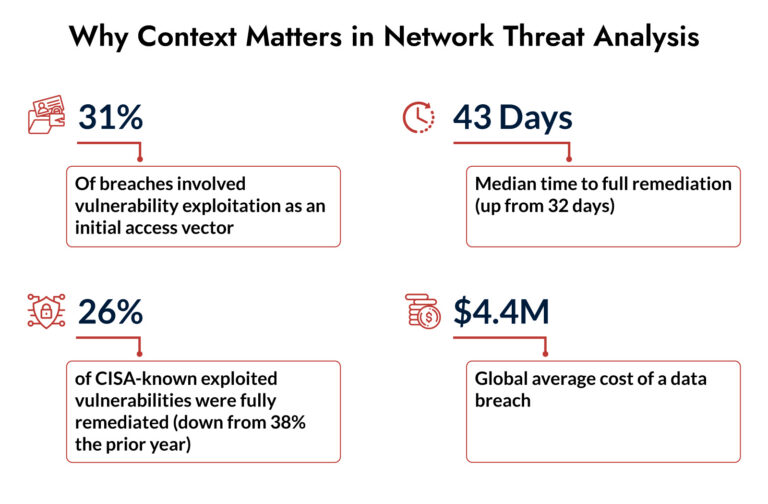
This information is evidence that businesses need more than prevention as their strategy. According to reports, 31 percent of breaches are linked to vulnerability exploitation, which was the leading initial access method in their dataset. Only 26% of CISA-known exploited vulnerabilities were fully remediated, down from 38% the prior year, and the median time to full remediation rose from 32 to 43 days.
These figures illustrate a real security issue, as defenders always have some weaknesses, and attackers might have enough time to work in them.
For CISOs, the answer is evident: network threat detection helps to find something suspicious, but network threat analysis will reveal if there is an attack behind it.
What Context Actually Means During a Threat Investigation
Context is often discussed as though it was another feature added to an alert. In a real SOC investigation, it is much more practical than that.
An analyst investigating suspicious network activity may need to connect:
- Network metadata to identify communicating entities, protocols, timing, and relationships
- Full-packet evidence to examine what actually occurred during a communication
- Related sessions to determine whether the activity was isolated or part of a larger sequence
- Behavioral patterns to identify activity that deviates from expected behavior
- Threat intelligence to add known indicators and external knowledge
- Endpoint and log evidence to establish what happened beyond the network
The value comes from the ability to move between those layers without losing the investigation. That is the architectural principle behind the NetWitness approach to network threat analysis.
NetWitness NDR leverages full packet capture, enriches metadata, performs behavioral analysis, applies threat intelligence, does network forensics, conducts session reassembly, and uses investigation workflows. It has been built for enterprises with complex IT architecture where visibility is needed for on-premise, virtualized, cloud, and hybrid networks.
This matters because an alert is rarely the answer. It is usually the starting point.
The NetWitness Technique: Capture, Contextualize, Investigate
The strength of the NetWitness approach is not simply that it captures network traffic. Plenty of security technologies can observe traffic.
The real difference lies in what happens after the data enters the investigation workflow.
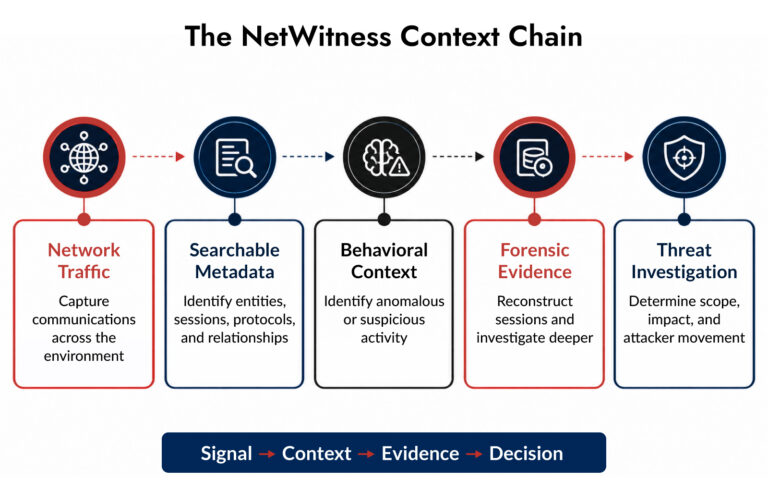
NetWitness captures and analyzes network communications, enriches them with searchable metadata, applies behavioral analytics and threat intelligence, and supports deeper investigation through session reconstruction and network forensics.
That creates a more useful chain for network security analysis:
- Capture the activity – Network communications provide evidence of how systems interact. Depending on the deployment and requirements, NetWitness can provide full-packet capture and metadata visibility.
- Turn traffic into searchable context – Raw packets alone are not an efficient investigation interface. Metadata enrichment gives analysts a way to search, filter, pivot, and identify relationships across network activity.
- Detect suspicious behavior – Behavioral analytics and threat intelligence help identify known, unknown, and anomalous activity that deserves investigation.
- Investigate the underlying evidence – When metadata and detections raise serious questions, analysts can move deeper into session reconstruction, protocol analysis, and network forensics.
That sequence matters because network threat analysis should narrow uncertainty at every stage.
Why Full-Packet Capture Still Changes the Investigation
There is a reason experienced investigators care about evidence depth.
Metadata can tell an analyst that two systems communicated. It can show when the communication occurred, which protocol was involved, and other characteristics of the session.
But some investigations eventually reach a harder question: What actually happened inside that communication?
That is where full-packet capture becomes important.
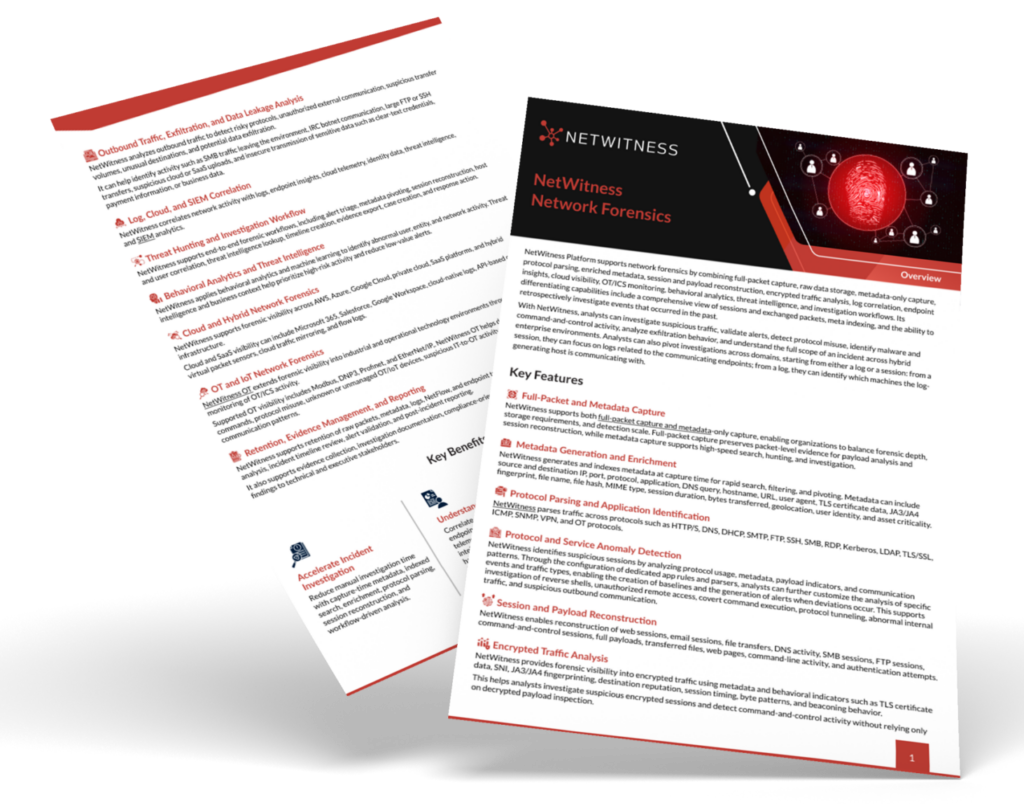
NetWitness supports forensic-grade network visibility through full-packet capture, detailed metadata, protocol analysis, and session reconstruction. These capabilities help investigators examine communications in context and determine the scope of suspicious activity.
This does not mean every enterprise should capture and retain everything indefinitely. Storage requirements, network throughput, regulatory obligations, and critical infrastructure priorities all influence architecture.
The more useful question is whether the organization can access deeper evidence when an investigation requires it.
For critical network segments, the difference can be significant.
Metadata tells an analyst where to investigate. Forensic evidence helps establish what happened.
That distinction becomes especially important during incident scoping, retrospective threat hunting, and investigations involving lateral movement or suspicious data transfer.
How Context-Driven Network Threat Analysis Works in Practice
Consider a common scenario.
An analyst identifies unusual outbound communication from a server that normally connects to a limited group of approved destinations.
The alert alone does not establish compromise.
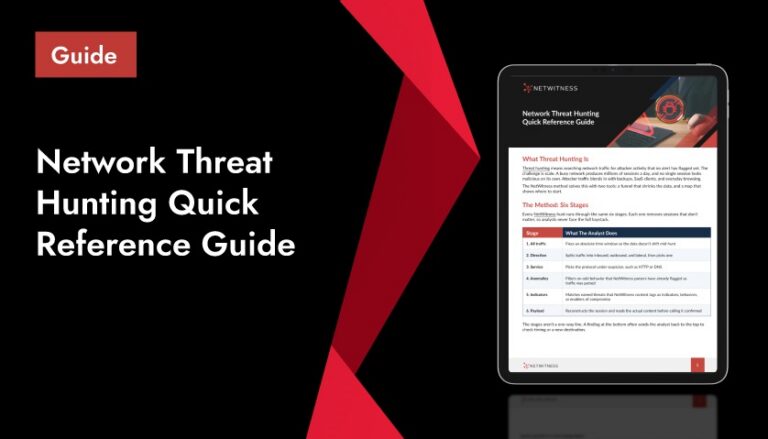
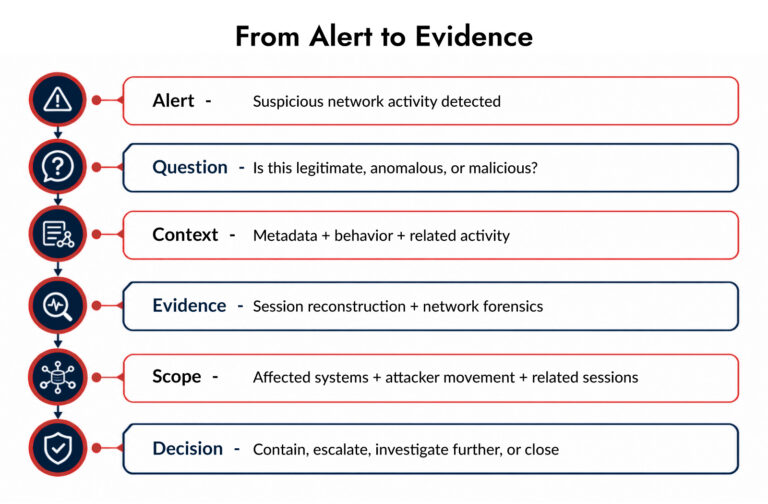
A context-driven network threat analysis workflow would look more like this:
- Identify the suspicious communication – Examine the destination, protocol, timing, and affected asset.
- Pivot into related activity – Determine whether other systems communicated with the same destination.
- Check behavioral context – Investigate whether the volume, frequency, timing, or communication pattern differs from normal activity.
- Examine related sessions – Identify activity that occurred before and after the suspicious connection.
- Move deeper into the evidence – Use session reconstruction and network forensics when the investigation requires more than metadata.
- Trace potential attacker movement – Investigate east-west traffic and connected assets to determine whether the activity spread internally.
- Determine the incident scope Establish which systems, accounts, communications, and time periods may be involved.
This is a more realistic model of threat investigation than the familiar alert-review-close cycle.
The analyst is not simply validating a detection. They are building and testing a hypothesis.
What Enterprises Should Evaluate in a Network Threat Analysis Platform
At the BOFU stage, security buyers should move beyond feature checklists.
The important question is whether the architecture can support the SOC when a detection turns into a complex investigation.
| Evaluation Area | Basic Monitoring Approach | Context-Driven Approach with NetWitness |
| Network visibility | Limited traffic observations | Full-packet capture and metadata analysis |
| Detection | Alert-focused monitoring | Behavioral analytics and threat intelligence |
| Investigation | Manual correlation | Metadata pivots, session reconstruction, and investigation workflows |
| Evidence depth | Flow or alert information | Packet-level forensic evidence where required |
| Threat hunting | Search for known indicators | Searchable historical data and behavioral context |
| Internal movement | Limited east-west visibility | Visibility into internal network activity |
| Hybrid environments | Potential coverage gaps | Support for on-premises, cloud, virtual, and hybrid environments |
| Investigation workflow | Multiple disconnected tools | Connected network forensic and investigation capabilities |
NetWitness has been recognized as a Visionary in the 2026 Gartner Magic Quadrant for Network Detection and Response. Gartner describes NDR platforms as technologies that continuously monitor traffic for anomalies, suspicious patterns, and threat indicators while complementing other threat detection solutions.
That recognition should not replace technical evaluation. Gartner itself evaluates vendors through its methodology, while every enterprise still needs to assess whether a platform fits its architecture, operating model, and security priorities.
For buyers evaluating network threat analysis capabilities, the better questions are:
- Can analysts move from a detection to the underlying evidence?
- Does the platform support both metadata-driven investigation and deeper forensic analysis?
- Can security teams investigate east-west traffic effectively?
- Does the architecture support hybrid and cloud environments?
- Can analysts reconstruct sessions when metadata alone is insufficient?
- How much manual correlation is required during an incident?
- Can threat hunters investigate historical activity without losing context?
Those questions reveal far more about operational value than a generic capabilities matrix.
The Real Value of Context is Investigation Confidence
Security teams will always have alerts. Better detection technology may reduce noise, but it will not eliminate uncertainty.
The real test comes after the alert fires.
- Can the analyst explain what happened?
- Can they determine whether the activity represents a false positive, an isolated anomaly, or part of a larger intrusion?
- Can they trace related communications?
- Can they establish scope with evidence rather than assumptions?
That is where context-driven network threat analysis becomes strategically valuable.
NetWitness brings together full-packet capture, metadata enrichment, behavioral analytics, advanced network forensics, automated investigation, and visibility across hybrid environments to help enterprise defenders investigate threats with greater depth. For a mature SOC, that architectural difference matters.
Network threat detection identifies activity worth investigating. Network threat analysis provides the context needed to understand it.
And when an enterprise is dealing with sophisticated attackers, lateral movement, encrypted traffic, or activity that does not fit a known signature, the ability to move from a signal to defensible evidence can make the difference between closing an alert and actually understanding an attack.
Frequently Asked Questions
1. What are the top network threat analysis services for real-time monitoring?
The strongest services combine continuous network monitoring with behavioral detection, threat intelligence, metadata analysis, and investigation capabilities. Enterprises should also consider whether managed detection and response services are needed to supplement internal SOC resources.
2. What are the best tools for network threat analysis in enterprise environments?
Enterprise-grade platforms should provide broad network visibility, behavioral analytics, threat intelligence, historical search capabilities, network forensics, and efficient investigation workflows. Buyers should evaluate how well the platform supports real analyst investigations rather than comparing features in isolation.
3. How do you compare network threat analysis platforms for cloud infrastructure?
Evaluate cloud and hybrid visibility, deployment architecture, east-west traffic monitoring, encrypted traffic analysis, metadata quality, forensic capabilities, scalability, and integration with endpoint and log telemetry.
4. What are the benefits of a context-driven approach to network threat analysis?
A context-driven approach helps analysts connect suspicious traffic with related sessions, behavior, assets, and evidence. This can improve threat validation, incident scoping, forensic investigation, and threat hunting.
5. How can security teams implement a context-driven approach?
Start with the investigations that currently require the most manual correlation. Identify the telemetry involved, define visibility and retention requirements, and evaluate whether the NDR architecture allows analysts to move from detection to evidence efficiently. Testing the platform against realistic attack scenarios is essential before production deployment.
See Every Packet. Understand Every Threat.
- Capture Network Traffic
- Reconstruct Attacker Sessions
- Uncover Hidden Threats
- Accelerate Investigations