Why are AI-Accelerated Breaches Harder to Contain?
AI can shorten the time between individual stages of an intrusion, leaving security teams with less time to investigate and contain suspicious activity. The combination of fragmented environments, legitimate credentials, trusted tools, and rapidly changing attack paths makes AI cybersecurity increasingly dependent on visibility, investigation speed, and coordinated response.
Artificial intelligence is transforming cybersecurity. Unfortunately, it is transforming AI cyberattacks too.
For years, defenders have used automation to improve AI powered threat detection, accelerate investigations, and reduce response times. Today, attackers are leveraging many of the same capabilities. Generative AI, agentic workflows, and automated decision-making systems are increasingly being used to accelerate traditional attack techniques, allowing threat actors to operate at a speed and scale that many security programs were never designed to handle. Recent incident response reporting shows that attackers are moving significantly faster than in previous years, with AI increasingly used across reconnaissance, phishing, scripting, and operational activities. [paloaltonetworks.com]
The result is not necessarily new attack methods. Rather, it is a new operational reality: familiar attacks executed at machine speed.
The Age of Attack-Cycle Compression
Historically, cyberattacks followed a predictable sequence. Reconnaissance took days or weeks. Initial access required carefully crafted phishing campaigns. Privilege escalation and lateral movement required manual effort and technical expertise. Defenders often had time to detect suspicious activity before a compromise reached critical systems.
That timeline is shrinking.
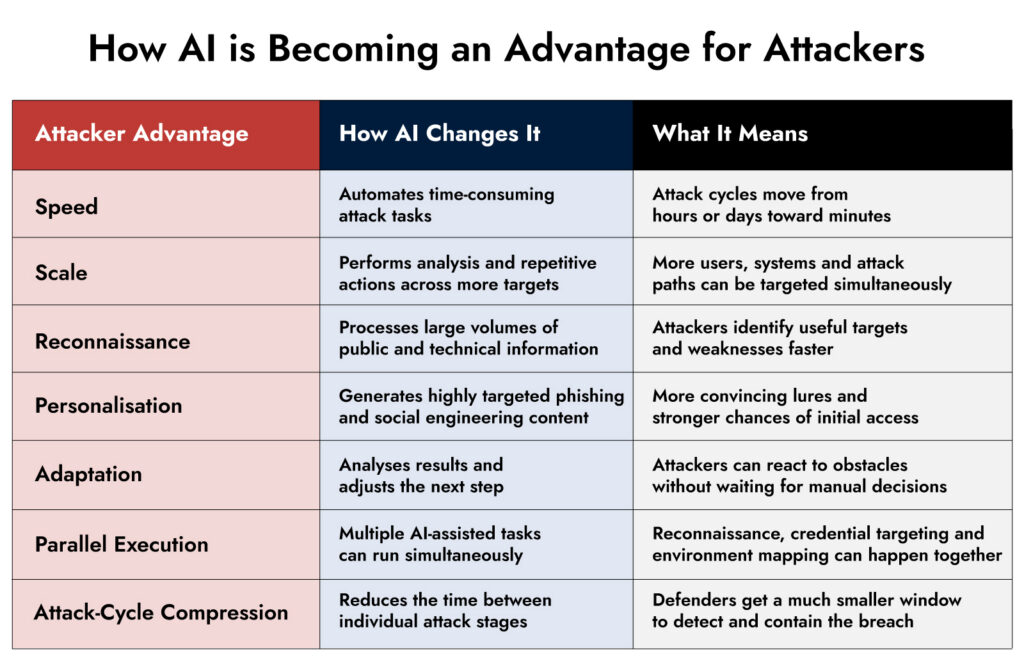
Modern AI tools can process vast amounts of information, generate convincing social engineering content, identify exposed technologies, analyze vulnerabilities, and automate portions of attack execution. Security researchers increasingly describe this phenomenon as “attack-cycle compression” where the time between initial access and business impact continues to decrease. Recent frontline incident response reporting found some attacks reaching data exfiltration in as little as 72 minutes after initial access. [live.paloa…tworks.com], [paloaltonetworks.com]
The challenge for defenders is simple: human response processes do not naturally operate at machine speed.
The Most Dangerous AI Cybersecurity Threat is Not the One You Think
Much of the public discussion surrounding AI cybersecurity focuses on deepfakes, autonomous malware, or hypothetical future threats. Those risks are real, but many incident responders are seeing something more practical.
AI is making ordinary attacks more efficient.
A phishing email no longer needs to contain obvious grammatical mistakes. Social engineering messages can be personalized at scale. Attackers can rapidly analyze public information, develop targeted lures, and create convincing content tailored to specific industries and roles. AI enables attackers to perform more reconnaissance, test more attack paths, and adapt more quickly when defenses slow them down. [cybertechi…igence.com], [redhelix.com]
The danger is not necessarily smarter attacks.
The danger is faster attackers.
Attackers are Increasingly Logging in Instead of Breaking In
One of the most significant trends emerging from recent investigations is the growing importance of identity. Modern attackers increasingly target credentials, authentication systems, tokens, and trusted identities rather than relying solely on malware or software exploits. Large-scale incident response studies have found identity-related weaknesses playing a material role in the vast majority of investigated breaches. [paloaltonetworks.com]
AI amplifies this problem.
Credential theft campaigns can be optimized more effectively. Social engineering becomes more convincing. Adversaries can automate the analysis of compromised environments to identify privileged users and potential escalation paths.
The result is that many organizations are facing AI security threats or Ai cyberattacks that bypass traditional security assumptions.
The question is no longer “Can someone break in?”
The question is “How quickly can AI threat detection identify when someone successfully logs in? “
Complexity is Becoming the Attacker’s Advantage
Businesses are more connected than ever before.
Cloud platforms, SaaS applications, APIs, contractors, business partners, managed service providers, and AI-powered business tools all contribute to larger and more complex attack surfaces. Every connection creates potential opportunities for attackers. Recent incident response reporting shows that most major intrusions now span multiple attack surfaces simultaneously, often involving combinations of endpoint, cloud, SaaS, identity, and browser-based activity. This complexity creates a significant challenge during investigations.
Security teams may have visibility into individual technologies while lacking visibility across the entire attack chain, making AI cyber threat detection increasingly important for connecting activity across multiple environments.. Attackers exploit these gaps, using legitimate tools, trusted relationships, and normal business processes to blend into everyday activity.
AI simply increases their ability to move through those environments more efficiently. AI driven threat detection can help security teams identify suspicious activity across these environments and connect signals that may otherwise appear unrelated.
Why Traditional Response Models are Under Pressure
Many incident response plans were developed around a world where organizations had hours, days, or even weeks to react.
Today’s environment is different.
By the time an alert is reviewed, an adversary may have already established persistence, accessed cloud resources, harvested credentials, or begun staging sensitive data. The traditional sequence of detect, investigate, discuss, approve, and respond may not move quickly enough when attackers are operating with machine-assisted speed.
This is forcing organizations to rethink incident readiness altogether.
The focus is shifting from response after discovery to preparation before compromise.
Organizations are increasingly emphasizing:
- Faster decision-making authority
- Automated containment capabilities
- Identity-centric monitoring
- Cross-domain visibility
- Crisis-management readiness
- Continuous validation of response plans
The goal is not simply to respond faster.
The goal is to reduce the window of opportunity available to attackers.
The Future of Incident Response in AI cybersecurity
The lesson from Ai cybersecurity threats is not that defenders are losing.
It is that the nature of the game has changed.
Attackers are using AI to increase speed, scale, and operational efficiency. They are exploiting identity, trusted relationships, cloud services, and business complexity. In many cases, successful breaches are less about technical brilliance and more about operational agility.
Defenders must respond accordingly.
Organizations that continue relying on manual processes, disconnected visibility, and untested response plans may struggle to keep pace. Those that invest in readiness, validation, investigation capability, and rapid decision-making will be better positioned to withstand the next generation of cyber incidents.
Because in the era of AI cyberattacks,, the question is no longer whether machines will be involved in the next breach.
The question is whether your organization can respond as quickly as the attackers can act.
Frequently Asked Questions
1. What are AI-accelerated cyberattacks?
AI-accelerated cyberattacks are attacks where artificial intelligence is used to speed up or scale activities such as reconnaissance, phishing, credential theft, vulnerability analysis, and attack execution. These AI cyberattacks may rely on familiar techniques, but AI allows attackers to carry them out faster and with greater scale.
2. How is AI changing cyberattacks?
AI is helping attackers automate repetitive tasks, analyze large amounts of information, personalize social engineering, and identify potential attack paths more quickly. This creates new AI cybersecurity threats by reducing the time defenders may have to detect and respond to an intrusion.
3. What are AI-powered cybersecurity threats?
AI-powered cybersecurity threats are security risks in which AI is used to improve the speed, scale, or effectiveness of an attack. These can include AI-assisted phishing, automated reconnaissance, credential attacks, and vulnerability discovery. As a result, organizations need AI powered threat detection to identify suspicious activity across their environments.
4. What types of attacks can be accelerated by AI?
AI can accelerate several established attack techniques, including phishing, social engineering, reconnaissance, credential theft, vulnerability analysis, malware development, and lateral movement. AI threat detection can help security teams identify unusual patterns associated with these activities and investigate them before they progress further.
5. How can network visibility help detect AI-accelerated attacks?
Network visibility gives security teams insight into communications between users, devices, applications, and external infrastructure. This context can help reveal suspicious connections, command-and-control activity, lateral movement, and data transfers that may otherwise go unnoticed. Combined with AI cyber threat detection, network visibility can help connect individual signals and provide a clearer view of an attack in progress.
6. How should enterprises prepare for AI-driven cyber threats?
Enterprises should combine broad visibility with faster threat detection, identity monitoring, threat intelligence, tested incident response plans, and appropriate automation. AI driven threat detection can help security teams analyze large volumes of security data and prioritize suspicious activity, while strong investigation and response processes help turn those findings into action.
Navigate Agentic AI Risks with Confidence
- Identify AI Security Exposure
- Strengthen Access and Governance Controls
- Improve Threat Monitoring and Containment
- Build a Prioritized Risk Mitigation Roadmap