How can government agencies detect insider threats before they cause damage?
Government agencies can detect insider threats in government by combining behavioral analytics, continuous monitoring, identity-based access controls, and network visibility. Correlating endpoints, user, and network activity helps security teams identify suspicious behavior early, reduce insider risk, and strengthen Zero Trust security without disrupting critical government operations.
Why Insider Threats in Government Require a Different Security Strategy
The governments of the world have scattered lots of money in protecting the perimeter of security, endpoint protection, and network attacks from happening. These measures still count, but they are not always helpful in spotting misuse done by trusted users.
Access to sensitive systems is not only required by employees but also by external contractors, privileged administrators, and business associates. Misuse of credentials on their part can go unnoticed since the traditional data protection tools only register login processes as safe and legitimate.
Just because of situations like that, insider threats in government have become a priority in strategic planning instead of being perceived as just a HR or compliance issue.
Several facts confirmed by different research works prove it:
- Compromised credentials come 4th in the list of causes of data breaches in the world.
- Talking about security incidents, humans play a key role, including privilege misuse and the root cause of data breaches.
- CISA recommends using behavioral monitoring and the Zero Trust approach to prevent insider risks in the government sector.
The question is not whether insider threats do exist. The agenda is to find them before they become a national security problem.
A Smarter Way to Detect Insider Threats in Government
An effective insider threat program will be based on behavior, not intent.
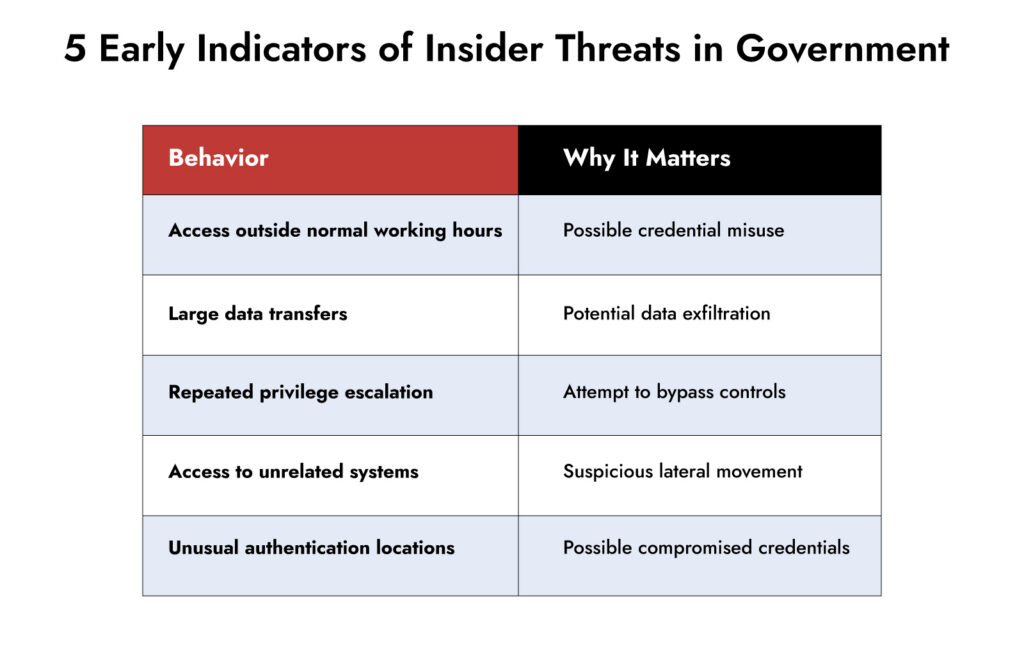
It will take into account people who download sensitive information in the middle of the night, access computer systems that have nothing to do with their job or move unusually large volumes of data around.
There are many methods used by current insider threat programs, some of which include:
- Endpoint activity
- Network traffic
- Authentication logs
- User behavior analytics
- Cloud access events
- Identity information
- Threat intelligence
As opposed to investigating single alerts, analysts get correlated pieces of information that form a whole story.
For instance: A person with legitimate credentials accesses the database using an authorized device. A few minutes later, the same user starts accessing data that does not fall under their specific project scope and then transfers encrypted data into the cloud.
Alone, each piece seems normal but altogether it reveals increased risk associated with insiders.
The behavioral method greatly enhances threat detection and decreases unnecessary investigations.
Building a Framework to Reduce Insider Threats in Government
Technology alone cannot solve insider risk.
An effective programme to reduce insider threats in government combines governance, security operations, and organizational policies into a unified framework.
Some critical elements include:
- Access governance – Users need access to permissions appropriate to their roles. Entitlement review decreases privileges that may be used by adversaries who have compromised credentials.
- Insider threat continuous monitoring – Point in time audits will not catch all the developing threats. Continuous monitoring for insider threats provides visibility to behavioral changes within users, endpoints, applications and networks.
- Behavior analytics – Just because something unusual does not mean that it is harmful. Machine learning and behavior analytics allow the establishment of baseline activities of users to help differentiate between normal operation and suspicious activities.
- Response integration – Deterring an attack without responding to it is not effective. Integration of insider alerts in the incident response process ensures evidence collection while preserving the chain of custody.
- Cross-functional governance – The legal, compliance, HR and cybersecurity departments should align investigation practices in advance to avoid different actions in high-pressure situations.
Simplify audit readiness with complete security evidence and visibility. Discover where compliance gaps exist.
Why Zero Trust Helps Prevent Insider Threats in Government
A modern strategy for addressing insider threats in government aligns naturally with Zero Trust networking principles.
Zero Trust assumes that no user, device, or application should receive implicit trust simply because it operates inside the network.
Instead, every access request undergoes continuous verification.
Combined with behavioral monitoring, Zero Trust network help agencies:
- Continuously validate user identity
- Reduce unnecessary lateral movement
- Limit privileged access
- Detect compromised credentials faster
- Improve overall government cybersecurity
For example, if an administrator authenticates successfully but immediately attempts to access classified databases outside their normal responsibilities, Zero Trust controls can trigger additional verification or temporarily restrict access while investigations begin.
This proactive model reduces exposure without interrupting legitimate government operations.
How NetWitness Detects Insider Threats in Government
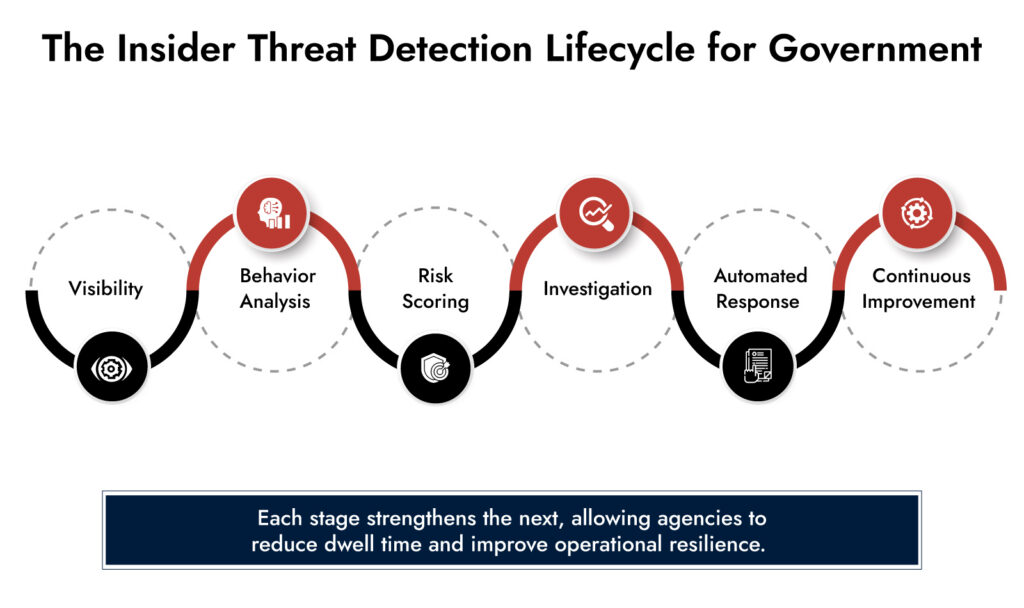
Detecting insider threats in government requires visibility across users, endpoints, networks, and cloud environments.
NetWitness helps government agencies achieve this through integrated security analytics rather than isolated monitoring tools.
Its capabilities help organizations strengthen insider risk management by providing:
- Deep network visibility across hybrid environments
- Endpoint telemetry for behavioral investigations
- User and entity behavior analytics (UEBA)
- Correlated detection across multiple security layers
- High-fidelity investigations with forensic evidence
- Automated prioritization of suspicious activity
Instead of creating isolated alerts, NetWitness associates events from identities, devices, applications, and network traffic.
If an employee logs into their account normally but then proceeds to download confidential documents, access unknown infrastructure, and send encrypted documents over the network, then this entire attack timeline can be analyzed from a single platform.
This unified visibility strengthens security monitoring for government, accelerates investigations, and reduces the time between detection and response.
Due to the nature of the government environment being based on legacy systems, cloud-based infrastructure, and classified networks, such visibility becomes critical for detecting insider attacks.
Conclusion: Future-Proofing Government Cybersecurity
Insider threats in government rarely begin with obvious malicious actions. More often, they develop through subtle behavioral changes that become apparent only when activity is correlated across users, identities, endpoints, and networks.
Reducing insider threats in government requires more than individual security controls. Agencies need continuous monitoring, behavioral analytics, effective governance, and Zero Trust principles working together to identify warning signs before sensitive information is compromised.
While insider risk can never be eliminated entirely, its impact can be significantly reduced through better visibility, faster investigations, and consistent security governance.
As government agencies modernize their infrastructure and threat actors become more sophisticated, organizations that invest in proactive insider threat detection will be better positioned to protect critical services, sensitive information, and public trust.
Frequently Asked Questions
1. What are insider threats in government?
Insider threats in government involve authorized users, including employees, contractors, or third-party partners, who intentionally or unintentionally misuse their access to compromise government systems, sensitive information, or critical operations.
2. What are the best software solutions for detecting insider threat in government?
The best software solutions have insider threat detection, behavioral analysis, endpoint visibility, network monitoring, identity monitoring, and automation built-in. Solutions that aggregate information from different environments provide more protection than single-use products.
3. What is an insider threat governance framework?
An insider threat governance framework outlines the procedures, policies, technology, and methods used for identifying, assessing, monitoring, and responding to insider threats in a regulated manner.
4. Which companies offer solutions for insider threats in government?
There are various cybersecurity solution vendors who provide their offerings in the form of security analytics, UEBA, SIEM, and network detection solutions. The government should consider the solution in terms of its visibility, investigation capability, scalability, and regulations.
5. What are the key components of an effective insider threat policy?
The following elements are essential to create an effective insider threat policy; least privilege, continuous monitoring for insider threats, behavioral analysis, incident response, employee education, governance oversight, and periodic review of the policy based on organizational risk.
6. How NetWitness help in detecting insider threats in government?
NetWitness helps agencies detect insider threats in government by correlating networks, endpoints, identity, and behavioral data into a unified view. This enables earlier threat detection, faster investigations, improved security monitoring for government, and stronger advanced threat detection across complex environments.
Cut through the AI hype and discover how machine learning strengthens modern threat detection.