How does NetWitness support advanced threat detection?
With NetWitness, we support advanced threat detection by combining NDR, full packet capture, metadata enrichment, user behavior analytics, endpoint visibility, logs, threat intelligence, and investigation workflows. This helps analysts detect known and unknown threats, validate alerts, reconstruct sessions, and investigate activity across users, hosts, and network traffic.
Advanced threats rarely appear as one obvious alert.
A compromised account can look like a normal login. Lateral movement can look like routine internal traffic. Data staging can look like ordinary file access. Command-and-control traffic may hide inside encrypted sessions, low-volume beaconing, or traffic patterns that do not trigger a basic rule.
That is why advanced threat detection needs two things at the same time: evidence and context.
With NetWitness, we bring those two layers together through full packet visibility and user behavior analytics. Packet visibility helps analysts understand what actually happened on the network. User and entity analytics helps determine whether the behavior is normal, suspicious, or risky for a specific user, peer group, device, or entity. This blog is based on the supplied research brief around NetWitness NDR, UEBA, packet visibility, and SOC investigation workflows.
For SOC teams, this is the difference between reviewing isolated alerts and running evidence-based investigations.
The Visibility Gap in Modern Threat Detection
Most SOC teams do not have a shortage of alerts. They have a shortage of connected, high-quality context.
A log can show that a connection occurred.
An endpoint alert can show that a process behaved suspiciously.
An identity alert can show that a user logged in from an unusual location.
But each signal alone has limits.
An analyst still needs to know:
- Was the network session actually malicious?
- What data moved across the network?
- Was the activity part of lateral movement?
- Was the user behavior normal for that account?
- Was this a one-time anomaly or part of a broader cyber threat?
- Can the SOC reconstruct what happened before and after the alert?
This is where network traffic visibility becomes critical. NetWitness NDR provides real-time visibility into network traffic with full packet capture, helping teams detect emerging, targeted, and unknown threats, monitor attacker movement, and reconstruct network sessions.
For a BOFU buyer, this matters because a threat detection platform should not only generate alerts. It should help analysts validate the alert, investigate the session, understand the scope, and support response with evidence.
Full Packet Visibility: The Network Truth Layer
Full packet visibility gives analysts access to the network evidence behind an event.
That matters because advanced attackers often leave traces in traffic before they trigger a traditional control. These traces may include unusual east-west connections, suspicious DNS behavior, abnormal encrypted traffic patterns, unexpected protocol use, beaconing, large outbound transfers, or communication with unfamiliar infrastructure.
NetWitness NDR performs real-time packet capture and metadata enrichment across network infrastructure. It combines this with behavioral analytics and threat intelligence to identify known and unknown threats.
The practical value is straightforward: logs may show that something happened, but packets help show how it happened.
For example, if an analyst sees a suspicious outbound connection, packet analysis can help answer:
- Which host initiated the connection?
- What protocol and application were used?
- What metadata was extracted?
- Was the session consistent with normal business activity?
- Was there evidence of file transfer, tunneling, or command-and-control behavior?
- Did the same host communicate with other internal systems before or after the event?
This is why full packet capture is valuable for advanced investigations. It gives analysts forensic-level detail when metadata or logs alone are not enough.
NetWitness also supports session reconstruction and network forensics, allowing analysts to follow threat activity without manually wrestling with raw packets. The NDR data sheet also notes flexible capture licensing, from full packet capture to metadata-only models, so teams can balance deep forensics and scalable detection.
In other words, we are not asking analysts to behave like a human network packet analyzer for every alert. We help turn packet data into enriched, searchable, session-based evidence that supports faster investigation.
From Network Traffic to Attack Story
The value of network threat detection is not just capturing traffic. The value is turning traffic into an attack story.
A strong threat hunting solution should help analysts move quickly from one signal to the next. They may start with an unusual host connection, then pivot to related users, destinations, protocols, certificates, files, DNS activity, or internal systems touched during the same window.
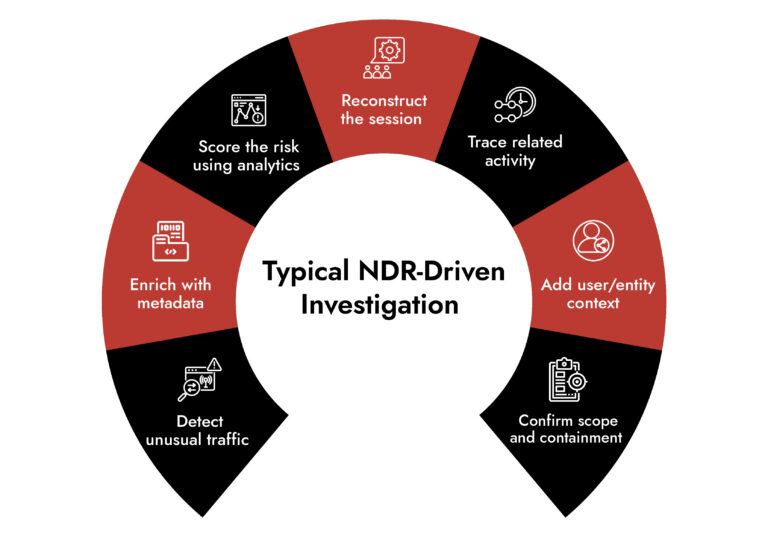
This workflow helps analysts avoid guessing. They can use enriched metadata, packet-level evidence, and session reconstruction to decide whether the activity is benign, suspicious, or confirmed malicious.
Compared with standalone packet analyzer tools, NetWitness is designed for SOC-scale detection and investigation. Packet analyzer tools are useful for inspecting traffic, but a SOC needs more than inspection. Analysts need metadata enrichment, threat intelligence, behavioral analytics, session reconstruction, correlation, prioritization, and response context in one investigation workflow.
User Behavior Analytics: The Behavioral-Risk Layer
Attackers do not always need malware to move through an environment. In many cases, they use valid credentials.
That creates a detection challenge. If a legitimate account logs in, accesses a system, pulls files, or authenticates to a new service, the activity may not immediately look malicious. The real question is:
Is this normal for that user, peer group, asset, and point in time?
That is where user behavior analytics becomes important.
NetWitness UEBA is a purpose-built, big-data-driven user and entity behavior analytics capability. It uses unsupervised machine-learning algorithms to detect unknown threats based on behavior, without requiring analyst tuning. It also uses network capture, log collection, endpoint visibility, and unified metadata enrichment to baseline users, user groups, entities, and organization-wide behavior.
This supports detection for activity such as:
- Compromised accounts
- Account takeover
- Privileged account abuse
- Abnormal system access
- Insider threat detection
- Lateral movement
- Data exfiltration
- Malware activity
- Suspicious user behavior
This is especially useful when a cyber threat does not look like malware at first. A failed login by itself may not matter. A successful login from an unusual location, followed by access to systems the user has never touched, followed by abnormal outbound traffic, is much more meaningful.
NetWitness analytics also uses unsupervised ML and peer-group analytics to uncover high-risk user behavior and advanced threats. Baselines can start within hours, and no manual algorithm tuning is required.
Why Packets and Behavior Work Better Together
Full packet visibility and user behavior analytics solve different parts of the same threat detection problem.
Packet visibility answers: What happened on the wire?
User behavior analytics answers: Was this normal for the user, entity, device, or peer group?
Together, they give analysts a stronger signal.
A network alert may show that a host is communicating with an unusual destination.
User analytics may show that the associated user does not normally access that system.
Packet and session reconstruction may show that the session involved suspicious transfer behavior, abnormal protocol use, or activity consistent with lateral movement.
That changes the investigation. The analyst is no longer reviewing a generic network event. They are investigating a behavioral anomaly backed by packet-level evidence.
This matters for advanced threat detection because sophisticated attacks often span multiple telemetry sources. A single alert may not be enough. A stronger investigation comes from correlating logs, packets, endpoint activity, cloud telemetry, identity context, behavioral baselines, and threat intelligence.
NetWitness Threat Detection and Response brings together modules such as NDR, EDR, SIEM, SOAR, and UEBA as part of a unified security platform approach.
Benefits for SOC Teams
The main benefit is not simply “more data.” The benefit is better investigation quality under pressure.
With NetWitness, SOC teams can:
- Detect threats that do not match static rules
Behavioral analytics and peer-group baselining help surface risky activity even when an attacker uses valid credentials, low-noise techniques, or unfamiliar infrastructure.
- Validate alerts with packet-level evidence
Full packet visibility and session reconstruction help analysts confirm whether a suspicious event is real, benign, or part of a larger attack path.
- Improve network threat detection
Network traffic visibility helps analysts identify suspicious communication patterns, lateral movement, command-and-control behavior, abnormal outbound flows, and potential data exfiltration.
- Support faster threat hunting
A strong cyber threat hunting solution should let analysts pivot across users, hosts, sessions, protocols, destinations, and metadata. NetWitness helps analysts move through that workflow with enriched packet and behavioral context.
- Strengthen insider threat detection
User behavior analytics helps identify activity that may be risky even when it comes from a legitimate account, such as abnormal access, privileged misuse, unusual peer-group deviation, or suspicious data movement.
- Reduce investigation guesswork
Packet capture, metadata enrichment, session reconstruction, risk scoring, and behavioral baselines give analysts a clearer starting point for triage and response.
Frequently Asked Questions
1. How does full packet visibility improve threat detection?
Full packet visibility improves threat detection by giving analysts access to the actual network evidence behind an event. Instead of relying only on logs or alerts, analysts can inspect enriched packet data, metadata, and reconstructed sessions to understand what happened, how systems communicated, and whether the traffic was malicious.
2. Why is packet analysis important for SOC teams?
Packet analysis is important because it helps SOC teams understand what actually happened in the session. Analysts can review protocol behavior, destinations, timing, extracted metadata, and session details to confirm whether an event is benign or malicious.
3. How does full packet capture help with threat investigations?
Full packet capture helps with threat investigations by preserving detailed network evidence. When an alert is triggered, analysts can reconstruct sessions, review activity, trace related communications, and support breach scoping with a stronger forensic context.
4. What types of threats can user behavior analytics detect?
User behavior analytics can help detect
- compromised accounts,
- account takeover,
- privileged account abuse,
- abnormal system access,
- insider threats,
- lateral movement,
- data exfiltration,
- malware activity,
- suspicious behavior patterns.
5. Why is packet-level visibility important for cybersecurity?
Packet-level visibility is important because many cyber threats leave evidence in network traffic. Logs and endpoint alerts fail to show the full session. Packet-level visibility gives SOC teams deeper evidence for network threat detection, threat hunting, forensic investigation, and incident response.
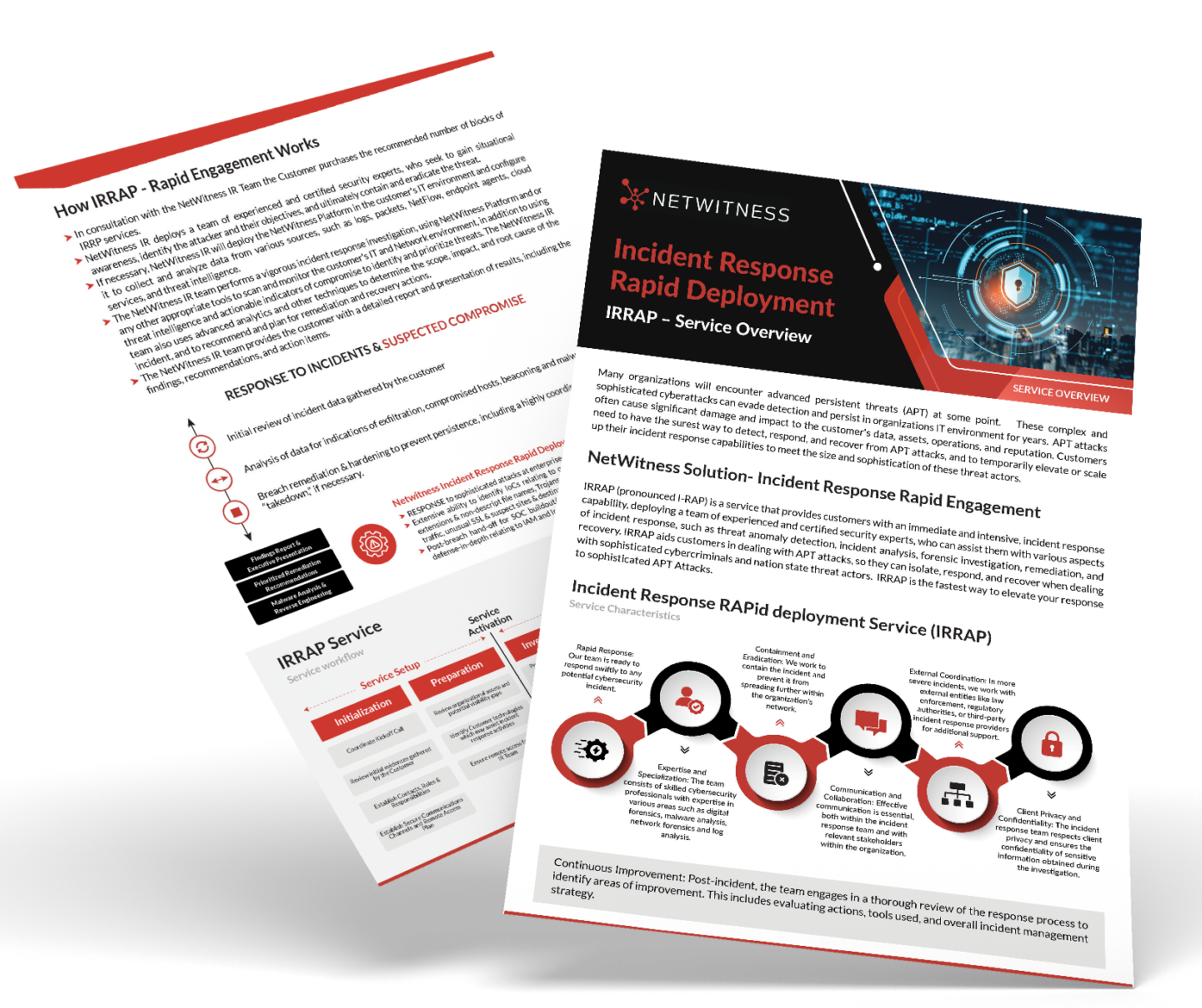
Respond to advanced cyber threats faster with expert-led incident response and unified enterprise visibility.
- Rapid investigation and containment for ransomware and advanced attack
- Unified visibility across network traffic, endpoints, and security logs
- Deep forensic insights to identify lateral movement and attack scope
- Streamlined workflows from threat detection to remediation and recovery