Introduction
Most security incidents don’t start with a bang. They start quietly. A login that doesn’t look right. A system changes no one remembers approving. Traffic that feels off but doesn’t trigger an alert.
Those moments live in logs.
Every environment produces massive amounts of log data, whether teams actively look at it or not. The difference between catching an incident early and discovering it months later often comes down to how well those logs are managed.
That’s why log management in cyber security still matters, even though it’s rarely the most exciting part of a security stack. Logs provide the context that other tools depend on. Without them, security teams are guessing.
This guide looks at why are logs important, how security log management works in practice, and why logs continue to play a central role in incident management and compliance.
Why Log Management Exists in the First Place
Log management wasn’t created for threat hunting or compliance checklists. It exists because systems fail, users make mistakes, and attackers leave traces behind.
At a basic level, log management is about collecting, storing, analyzing, and monitoring records generated by systems, applications, and network devices. In reality, it’s about understanding what changed, who touched what, and when things stopped behaving normally.
Here’s the problem. Log data is exploding. On average, organizations saw log volumes grow 250% year over year. Most of that data is never reviewed, correlated, or acted on. That’s where problems begin. That’s where problems begin.
Unused logs don’t improve security. Managed logs do.
Log Collection: Where Everything Starts
Log collection is simple in theory and messy in practice. Servers, firewalls, routers, applications, databases, and cloud services all produce logs in different formats and at different volumes.
Each log entry represents a single event. A login attempt. A blocked connection. An application error. On its own, it doesn’t say much. Over time, those entries form a timeline.
That timeline is what makes logs valuable for incident management. When something goes wrong, logs show what led up to it, not just the aftermath.
Log Storage: Why Integrity Matters More Than Volume
Storing logs isn’t just about disk space. It’s about trust.
If logs can be altered, deleted, or overwritten without control, they lose their value. Strong security log management depends on centralized, protected storage where access is restricted and changes are tracked.
This matters most during investigations and audits. When teams need answers, they need to trust that the data hasn’t been touched.
Centralized storage also saves time. Instead of pulling logs from scattered systems, teams can work from a single source of truth.
Log Analysis: Where Logs Become Useful
Most logs are boring. That’s the point.
The value of log analysis comes from finding what doesn’t fit. Repeated authentication failures. Access from unusual locations. Configuration changes outside maintenance windows.
This is where log management in cyber security actually earns its place. Analysis connects events across systems and surfaces behavior that wouldn’t stand out in isolation.
Without analysis, logs are just records. With it, they become signals.
Log Monitoring and Alerting: Paying Attention at the Right Time
Logs are most useful when they’re seen early.
Database monitoring tools watch incoming log data and trigger alerts when something crosses a defined threshold. Too many failed logins. A service restarting unexpectedly. A sudden spike in traffic.
This is especially important in cloud environments, where infrastructure changes constantly. That’s why logging and monitoring are important in a cloud environment. Without real-time awareness, issues spread faster than teams can respond.
Why Log Management Still Matters in Cybersecurity
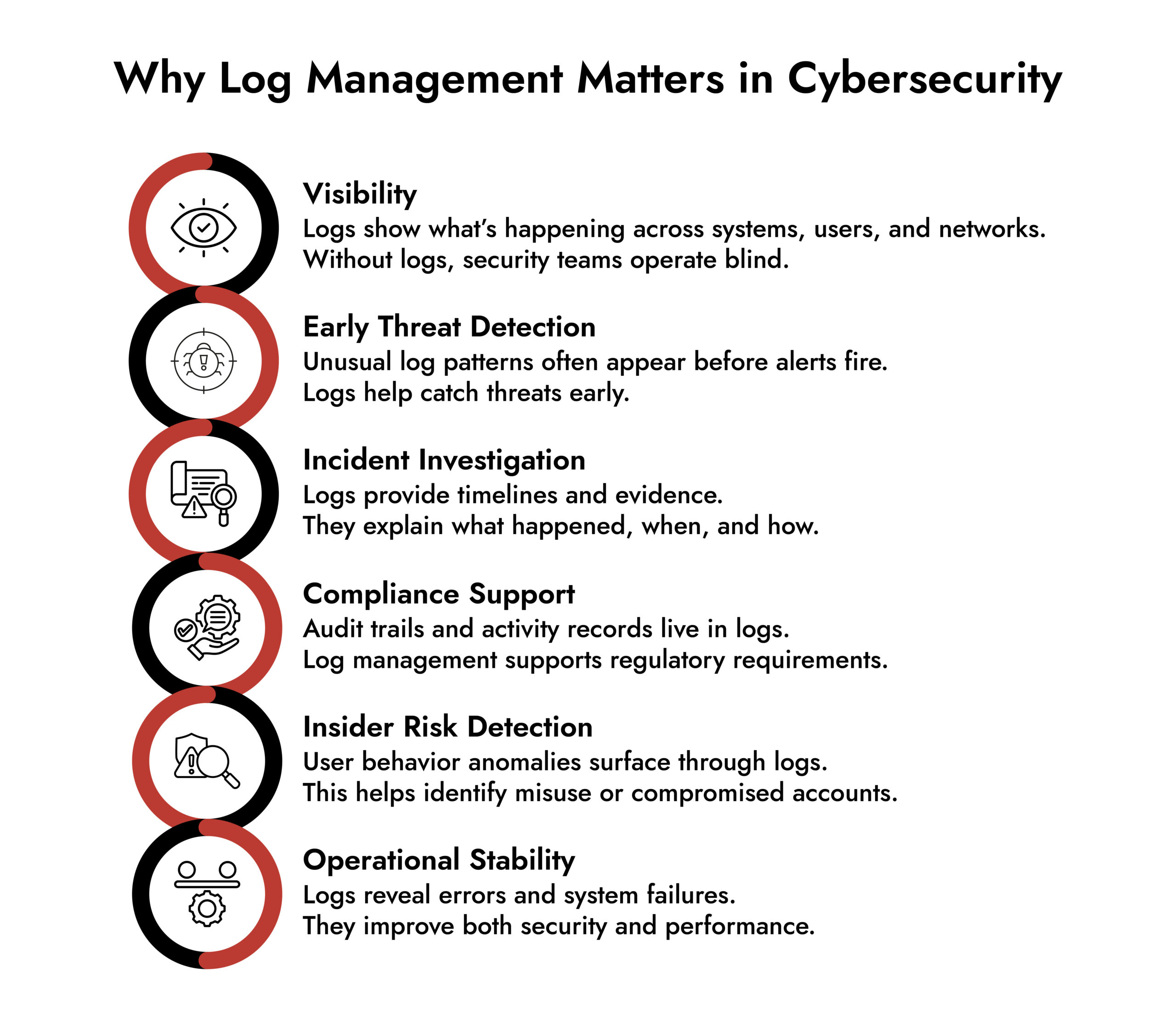
It’s fair to ask why logs still matter when there are so many modern security tools available. The answer is simple. Most of those tools still rely on logs.
Logs support early detection because attackers rarely succeed on the first attempt. They probe. They test. Those attempts show up in log data long before an incident becomes obvious.
Logs also anchor investigations. When alerts fire, logs provide the timeline teams use to understand scope and impact. Without them, incident response turns reactive and incomplete.
From a compliance standpoint, logs are non-negotiable. Regulations expect evidence. Security log management provides that evidence in the form of audit trails and activity records.
Internal risks show up in logs too. Misuse, mistakes, and compromised credentials often leave subtle patterns that only log review reveals.
And beyond security, logs expose performance issues and system instability that affect day-to-day operations.
Log Management Best Practices That Actually Hold Up
Good SIEM log management isn’t about logging everything. It’s about logging what matters.
Clear logging policies help teams avoid drowning in noise. Centralized collection makes correlation possible. Secure storage protects integrity.
Logs need to be reviewed, not just archived. Automation helps, but it doesn’t replace judgment. Alerts should prompt action, not fatigue.
Retention policies should be practical. Long enough to support investigations and audits. Short enough to avoid unnecessary risk.
As environments scale, many teams turn to advanced log management solutions to keep this balance intact.