Financial institutions are 300 times more likely to be targeted for a cyberattack than any other institution! Additionally, due to the massive amounts of sensitive financial and personal data they handle, they are required to comply with regulatory requirements of maintaining an audit trail, which requires strong tool support.
SIEM (Security Information and Event Management), therefore, becomes an indispensable tool for financial institutions. It forms the first layer of defense for a resilient cybersecurity posture and supports compliance needs. Beyond this, SIEM also helps in proactive threat detection and boosts SOC efficiency.
In this blog, we will look at SIEM use cases in your financial organizations and how NetWitness SIEM helps in improving the Security Operations Center (SOC) efficiency.
Why SIEM Is Critical for Financial Institutions
The average data breach cost for financial firms is $6.08 million. It is 22% higher than the global average. Therefore, cybersecurity is crucial in financial institutions like banks, insurers, and payment providers.
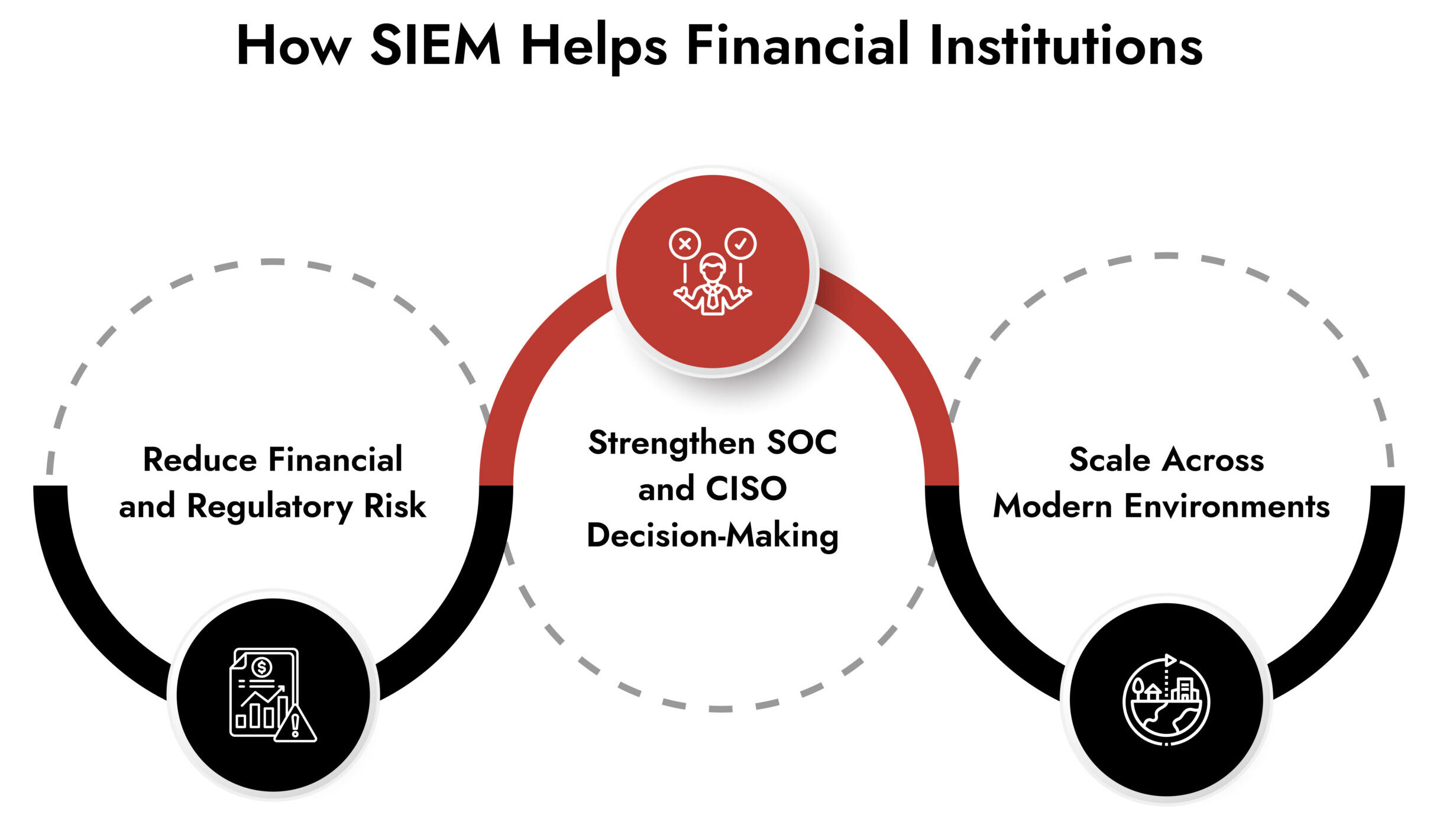
SIEM for finance institutions helps enable centralized visibility, detect threats proactively, support regulatory compliance, provide a forensic trail, and improve SOC efficiency.
Proactive Threat Detection
Financial organizations face threats from both internal and external factors. SIEM solutions monitor logs in real-time to identify threats like identity theft, privilege misuse, fraud, and sophisticated supply chain attacks proactively before they escalate.
Centralized Visibility
Most financial organizations operate across a mix of on-premises data centers, cloud platforms, SaaS applications, and mobile banking systems. SIEM for financial services unifies this fragmented data into a single central location. This empowers SOC teams to refer to up-to-date data for efficient threat analysis.
Compliance and Audit Readiness
Financial institutions are required to comply with regulations such as PCI DSS, SOX, GDPR, DORA, HIPAA, and local financial compliance standards. SIEM platforms provide audit trails and automated reporting to support both internal governance and external audits.
Enhancing SOC Efficiency
SIEM helps SOCs prioritize and automate repetitive tasks, reduce alert noise, and enable analysts to focus on high-impact threats.
Common SIEM Use Cases in Financial Institutions
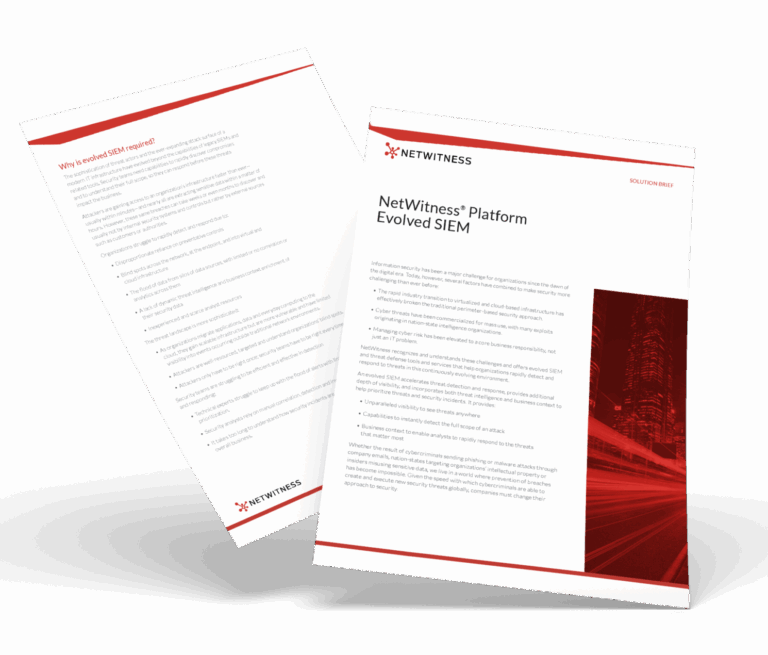
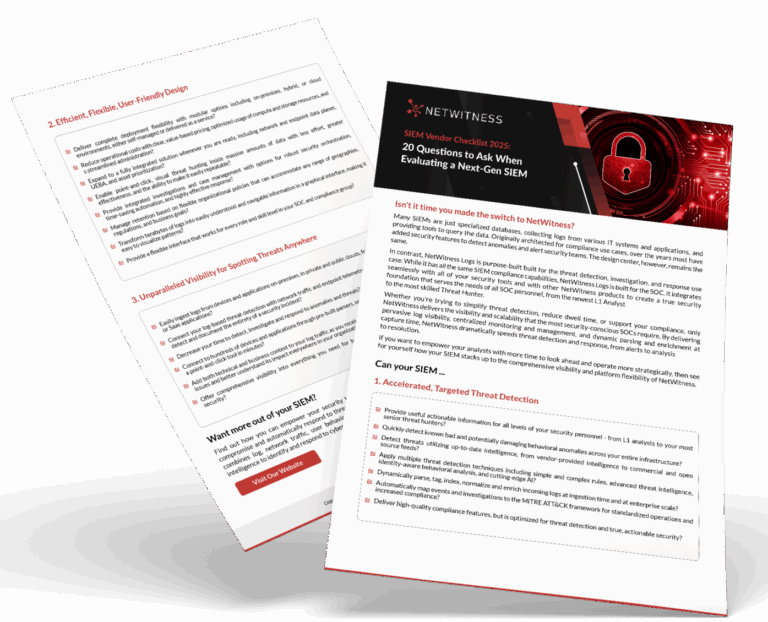
At NetWitness, our security experts have worked with financial institutions to implement SIEM effectively at scale. Based on this experience, they’ve identified the most impactful SIEM use cases in that.
Insider Threat Detection and Privilege Monitoring
Studies show that up to 18% of security threats are caused by internal factors. Internal threats leverage legitimate user access to misuse systems or data, either intentionally or unintentionally. Insider threats often manifest in subtle behavioral drift, where legitimate access is misused gradually over time.
SIEM establishes behavioral baselines for users, roles, and privileged accounts, and detects deviations over time. By correlating behavioral signals over time, SIEM provides early, high-confidence indicators of insider risk. This enables faster intervention, and putting a stop to data misuse and regulatory violations.
Account Takeover Detection
SIEM solutions collect event logs in real-time to assess behavior patterns across identity, device, and application activities. It correlates logs, such as
- Changes in authentication behavior
- Logins through abnormal access paths, transaction behavior, or privilege usage
SIEM instantly flags these anomalies or shifts in behavior patterns and helps reduce fraud exposure and enables faster containment.
Lateral Movement and Pre-Breach Detection
Many financial breaches are not a one-time event that occurs immediately. But the attackers lurk in the background and move laterally to escalate access before data exfiltration.
SIEM monitors the east-west traffic for anomalies and internal reconnaissance behavior, like
- Abnormal communication between services
- Repeated authentication attempts across systems
- Unauthorized attempts to access core banking systems
- Internal scanning or credential reuse
By correlating these behaviors across multiple systems and timelines, SIEM lateral detection enables early detection of pre-breach activity, before attackers reach sensitive financial data.
Regulatory Compliance and Audit-Readiness
Financial institutions are under constant pressure to comply with guidelines from PCI DSS, SOX, DORA, GDPR, and other local financial bodies. In addition to log aggregation, SIEM applies contextual enrichment and behavioral correlation helping institutions demonstrate continuous security oversight.
Automated reporting, long-term behavior tracking, and contextual audit trails significantly reduce audit effort and lower the risk of compliance gaps.
Third-party and Supply Chain Risk Visibility
Financial institutions need services from fintech partners, SaaS platforms, or other services to support digital banking, payments, analytics, and customer engagement. This expands the attack surface beyond traditional boundaries and across hybrid environments.
- Modern SIEM extends behavioral analysis to third-party users, service accounts, and APIs—entities that often fall outside traditional monitoring models: Vendor access outside approved scope
- Abnormal data access by service accounts
- API misuse or token abuse
By applying entity-based behavioral monitoring, SIEM helps financial institutions maintain control over third-party and supply-chain risk across hybrid environments.
SOC Efficiency
With data being generated across multiple systems in the network, the SOC teams can get overwhelmed. It directly impacts their efficiency and ability to respond to the right alerts. Modern SIEM cybersecurity improves SOC efficiency by prioritizing alerts based on accumulated behavioral risk rather than isolated events.
This behavior-driven approach enables:
- Fewer false positives
- Faster triage and investigation
- Context-rich alerts for easier analysis
- Improved MTTD and MTTR
As a result, SOC teams investigate fewer, more meaningful incidents—reducing burnout while improving detection confidence.
How Can Organizations Implement Effective Security Use Cases with SIEM?
To make SIEM work effectively for your financial organization, you need to go beyond just installing it. It needs a thorough strategy to make it work for you.
1. Risk Prioritization
No tool can solve all the problems in one day. So, understand high-risk scenarios for your organization and then implement that first.
2. Comprehensive Data
SIEM works most effectively when the data it receives is comprehensive. Connect it with your infrastructure across devices, servers, and applications in such a way that there are no blind spots.
3. Fine Tuning
The threat landscape or the infrastructure is constantly changing. You need to constantly refine to reduce false positives.
4. Integrate Incident Response
The logical extension for SIEM is responding to alerts. Automating common response workflows can help safeguard the institution as well as free up SOC bandwidth
NetWitness SIEM: Actionable Security Intelligence for Modern Enterprises
NetWitness SIEM is designed for modern enterprise complexity with capabilities that resonate deeply in the context of financial services cybersecurity.
Here’s how it helps financial institutions meet their cybersecurity goals:
- Unified and Enriched Data Collection: NetWitness enriches data with metadata and security context when it is captured. This reduces false positives and accelerates threat detection from the beginning.
- Centralized Monitoring and Compliance Reporting: It offers pre-built templates and reporting suited for frameworks such as SOX, PCI, HIPAA, and others.
- Flexible Deployment Models: NetWitness solution can be deployed on cloud, on-premises, and hybrid environments.
- Enhanced Visibility and Contextualization: Netwitness SIEM enables SOC teams to detect known as well as unknown, sophisticated attack behaviors.
- AI-powered SOC Efficiency: NetWitness Detect AI applies machine learning to ensure high-fidelity anomaly detection to empower the team to work with fewer false positives and noisy alerts.