What is network risk management?
Network risk management is the continuous process of identifying, assessing, prioritizing, and reducing cybersecurity risks affecting network-connected assets, services, users, and communications.
Effective network risk management combines business criticality with dynamic factors such as asset exposure, vulnerabilities, behavioral changes, active threat activity, attack paths, potential blast radius, and observed network evidence.
The objective is not simply to identify high-value assets. It is to determine which risks require action first.
A domain controller is critical. So is the payment API. The backup infrastructure is critical. The identity platform, cloud management plane, ERP system, customer database, virtualization layer, and privileged access infrastructure probably are too.
None of those labels are necessarily wrong. They are simply not enough to tell a SOC what deserves attention first.
This is one of the harder problems in network risk management. Asset inventories, business impact assessments, CMDBs, and risk registers are good at describing what matters to the organization. But once dozens or hundreds of assets carry the same criticality rating, that information stops being useful for operational prioritization.
The question security teams need answered is different: Which critical asset is under the greatest risk right now?
Answering that requires moving beyond static criticality and looking at what is actually happening around an asset: how exposed it is, whether its behavior has changed, whether attackers appear interested in it, where compromise could lead next, and how confidently the SOC can validate the activity.
That leads to a more useful principle: Criticality tells you what matters to the business. Risk tells you what requires attention now.
This principle should sit at the center of an effective network risk management program.
What Happens When Every Asset is Critical?
There is nothing inherently wrong with classifying a large number of systems as critical.
Large enterprises genuinely have complex dependencies. A supposedly ordinary authentication service may support several revenue-generating applications. A backup server may determine whether ransomware becomes a recoverable incident or a prolonged business outage. An API gateway may sit in front of multiple services that would otherwise be assessed separately.
The problem begins when criticality becomes the primary mechanism for deciding what the SOC should investigate.
Imagine the queue contains activity involving three assets:

The labels have confirmed that all three matter but have not created an order.
This distinction is reflected in established risk-management thinking as well. NIST Cybersecurity Framework guidance separates asset prioritization based on factors such as criticality and mission impact from the broader assessment of threats, vulnerabilities, likelihood, and potential impact that informs risk response. Business importance remains an essential input but cannot be the only one.
For day-to-day cyber risk management, the SOC needs a second layer: dynamic risk context.
How to Distinguish When Asset Criticality is Not Dynamic?
Asset criticality is relatively stable. Network risk is not.
A business-critical system may retain the same classification for months or years. But the conditions surrounding that system can change continuously: new services are exposed, communication patterns shift, privileged access appears where it did not before, threat intelligence changes, or the asset begins interacting with systems outside its normal operating pattern.
None of these changes alter the asset’s importance to the business. They alter the urgency of the risk around it.
This is where static criticality begins to lose value as a prioritization mechanism. Two assets may carry the same “critical” label, yet one may be operating within its expected baseline while the other is showing increased exposure, anomalous behavior, suspicious connections, or signs of attacker activity.
A useful network risk assessment therefore needs to consider both dimensions:
- Business criticality tells you the potential consequence of compromise.
- Dynamic network context tells you how urgently that risk needs attention.
That context should include factors such as:
Operational Priority = Business Consequence + Exposure + Behavioral Change + Threat Pressure + Blast Radius + Evidence Confidence
The purpose is not to create another opaque score for analysts to trust blindly.
It is to establish a defensible reason why one critical asset should move ahead of another in the investigation queue. That requires looking at six signals that can break the criticality tie.
Six Signals That Help Break the Criticality Tie
When multiple assets have similar business importance, six questions help establish which one deserves immediate investigation.
1. What happens to the business if this asset is compromised?
Business consequence remains the anchor. The SOC needs to understand what depends on the asset.
Does the system support:
- revenue-generating transactions?
- identity and authentication?
- regulated customer information?
- operational recovery?
- production or safety processes?
- privileged administration?
- multiple downstream applications?
Interdependencies matter because the impact of compromising an asset may be much larger than its individual classification suggests.
This is where CMDB, GRC, business impact analysis, and service-mapping information remain valuable. But the next questions determine urgency.
2. How exposed is the asset in practice?
Asset inventories tell security teams what should exist. The network reveals what is actually communicating.
So, an asset may appear relatively constrained on an architecture diagram while network observations reveal numerous active services, external clients, remote administration relationships, cross-segment communications, or unexpected connectivity.
Exposure therefore needs to be assessed using observed behavior rather than architecture assumptions alone.
Useful signals include:
- number and type of active services
- internal and external clients
- inbound versus outbound communication
- internet connectivity
- communication across trust zones
- remote administration relationships
- unexpected ports and protocols
- connections to sensitive network segments
This is also where attack surface management and network monitoring should complement each other.
Attack surface management can identify exposed systems, vulnerabilities, and externally reachable infrastructure. Network observations add another dimension: how those assets are actually being used and what is interacting with them.
For NetWitness customers, NetWitness Insight is particularly relevant here. Passive asset discovery and profiling help establish what is present on the monitored network, while Activity Rank and Exposure Rank provide relative context around how active and exposed assets are based on observed communication.
3. Has the asset’s behavior changed?
Exposure alone still does not prove that something requires immediate response.
A heavily used internet-facing system may be operating exactly as expected. A less exposed server that suddenly begins behaving differently may be considerably more interesting. That makes behavioral deviation one of the strongest tie-breakers in network risk prioritization.
Look for changes such as:
- new protocols
- unusual destination ports
- first-time external destinations
- unexpected organizations or geographies
- sudden increases in traffic
- unusual data-transfer volumes
- changes in connection frequency
- activity inconsistent with comparable systems
- unusual user or credential behavior around the asset
A baseline turns raw activity into context. NetWitness Detect AI and UEBA are designed to establish behavioral patterns and peer context so changes can influence risk dynamically rather than waiting for someone to manually reclassify the asset.
4. Is there evidence of active threat pressure?
Consider two externally exposed servers with similar business value and comparable vulnerabilities. One has no signs of suspicious interaction. The other is generating unusual DNS activity, connecting to suspicious infrastructure, exhibiting possible beaconing, or running software associated with a vulnerability known to be actively exploited.
They should not receive equal priority. For vulnerability-driven prioritization, resources such as CISA’s Known Exploited Vulnerabilities catalog are especially useful because they help distinguish vulnerabilities known to be exploited from those that are merely theoretically exploitable.
But vulnerability intelligence should still be combined with what the network is actually showing.
5. What can an attacker reach from here?
Security teams often prioritize based on the potential damage to the compromised machine. That can miss the more important question: What does this machine give the attacker access to next?
An apparently ordinary server may be strategically important because it connects multiple network zones or has access to privileged infrastructure.
High-blast-radius assets often include:
- identity infrastructure
- jump hosts
- backup systems
- virtualization management systems
- administrative servers
- middleware
- orchestration platforms
- cloud management infrastructure
- systems with privileged credentials
- hosts communicating across otherwise separated environments
East-west network visibility becomes essential here. A SOC needs to see relationships between systems, not only isolated alerts associated with individual devices.
When investigating network risk, the asset serving as a bridge can be more urgent than the asset with the most obvious business label.
This is especially true for ransomware and multi-stage intrusions, where the observed system may not be the attacker’s destination. It may simply be the path to something more valuable.
6. Can the SOC validate the risk quickly enough to act?
There is another dimension that risk scores rarely capture well: evidence quality. Suppose an analytics engine ranks an asset as extremely risky.
What happens next?
If analysts spend hours gathering context from different tools before deciding whether containment is justified, the prioritization system has only solved half the problem.
High-confidence investigation requires the ability to move from:
priority → activity → evidence
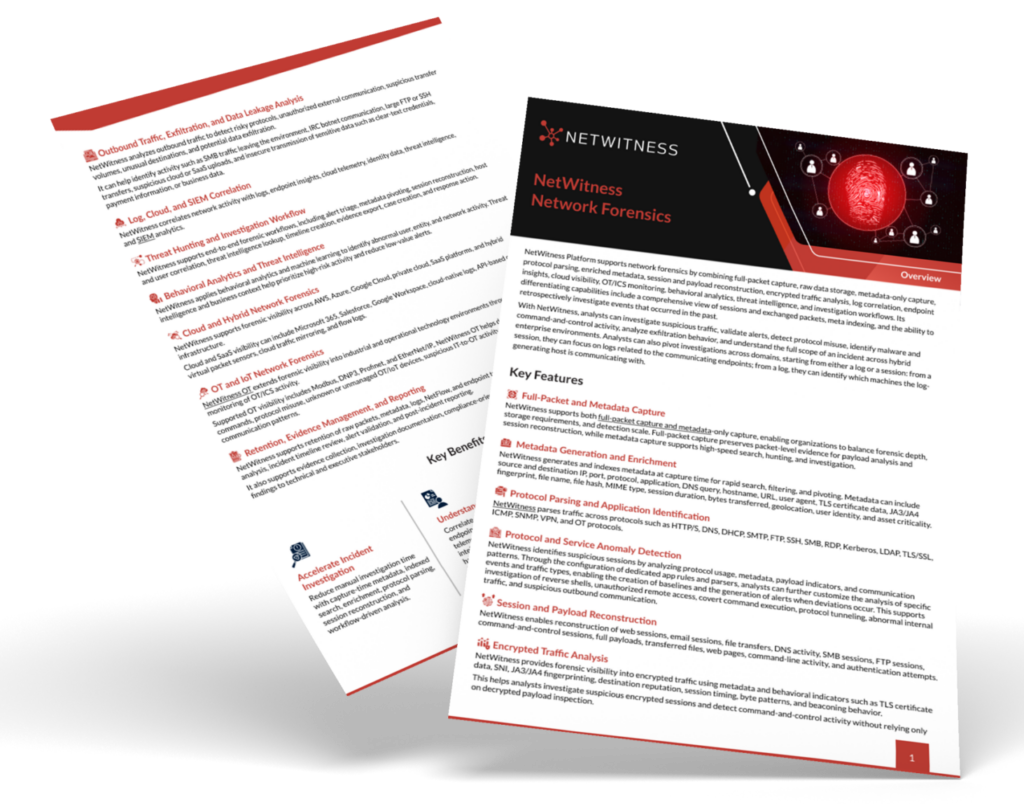
NetWitness NDR can combine network metadata, analytics, threat intelligence, east-west visibility, and, where full-packet capture is deployed, packet-level evidence and session reconstruction.
The differentiator is not simply producing another risk score. It is giving analysts a path from that score to the network evidence behind it.
Uncover the Full Truth Behind Every Cyberattack
- Reconstruct Network Activity
- Trace Attacker Behavior
- Recover Critical Evidence
- Strengthen Incident Investigations

How Does Network Visibility Help?
CMDBs and asset-management platforms remain essential components of enterprise cybersecurity. But they describe the environment from an inventory perspective. The network provides an operational perspective.
With sufficient network security monitoring, teams can observe facts that may not appear in static asset records:
- Actual relationships. Which machines, users, services, and external systems are communicating?
- Unexpected dependencies. Is an application communicating with a system nobody knew it depended on?
- Real exposure. Which services and connections are active rather than merely configured?
- Behavioral changes. Has an established system started acting differently?
- East-west movement. Is suspicious activity progressing across internal segments?
- Data movement. Are transfer patterns changing in ways that indicate collection, staging, or exfiltration?
- Unmanaged assets. Are systems operating on the network that are missing or incorrectly represented in inventory?
That makes network visibility valuable not only for threat detection, but also for better cyber risk analysis. The more clearly the SOC understands what an asset is doing and what depends on it, the easier it becomes to distinguish theoretical risk from immediate risk.
A Practical Example: Three Assets, All “Critical”
Consider the earlier environment again.
All three systems remain classified as critical.
But now add live network context.
| Asset | Observed Network Context | Operational Priority |
| Domain controller | Normal peer behavior, expected administrator activity, no unusual external communication | High |
| Payment API server | New external client pattern, unusual outbound destination, increased transfer volume, threat-intelligence match | Critical |
| Backup server | New SMB and RDP relationships across several segments, unusual privileged access | Critical |
Nobody needs to downgrade the domain controller. But it does not necessarily deserve the first analyst.
The payment API has business impact, exposure, behavioral deviation, and active threat context converging at once.
The backup server has another type of urgency. Even without a known malicious IOC, its unusual, privileged relationships and potential blast radius make it highly relevant to ransomware or destructive activity.
This is what useful cyber risk modelling should accomplish.
How NetWitness Turns Network Context into Priority
For this use case, NetWitness is best understood as a decision chain rather than a collection of separate capabilities.
Discover what is actually there
NetWitness Insight uses passive observation to discover and profile assets visible at monitored network collection points. That matters because network risk management is only as accurate as the asset population being evaluated.
Unknown and unmanaged assets create blind spots before prioritization even begins.
Understand activity and exposure
Activity Rank and Exposure Rank provide analysts with relative context around which assets are busiest and which appear more exposed based on observed network characteristics.
This adds an operational dimension that static asset importance cannot provide.
Detect meaningful change
Detect AI and UEBA introduce behavioral baselines, peer-group analysis, and dynamic risk context.
The same asset can therefore rise in priority as its behavior changes instead of remaining permanently buried inside a broad “critical” category.
Add threat and business context
NetWitness SIEM can correlate network, log, endpoint, behavior, threat-intelligence, and other security data while enriching investigations with additional context.
This helps separate security noise from events that combine technical suspiciousness with material business consequences.
Investigate the evidence
NetWitness NDR provides searchable network metadata and, where deployed, full-packet capture and session reconstruction.
Turn priority into action
NetWitness SOAR can help normalize alerts, enrich them with threat intelligence, prioritize cases, and drive repeatable response workflows.
That closes the gap between knowing something deserves attention and consistently doing something about it.
The workflow becomes:
Discover → Contextualize → Prioritize → Detect Change → Validate → Respond
NetWitness helps security teams determine which critical assets are experiencing the greatest threat pressure now and gives analysts the network evidence needed to understand why. That turns asset criticality from a static classification into one input within a continuously changing risk picture.
Prioritize the Critical Assets Under Real Threat
The hardest part of network risk management is rarely identifying things that matter. Large organizations already know they have a lot to protect.
The challenge is deciding where limited investigative and response capacity should go when multiple important systems are generating risk at the same time.
That requires a shift from static criticality toward dynamic prioritization.
Keep business impact.
Then add:
- observed exposure
- behavioral change
- current threat activity
- attack-path and blast-radius potential
- confidence in the available evidence
Together, those signals answer the operational question a “critical” label cannot:
Which asset needs us now?
NetWitness strengthens that decision with passive asset understanding, behavioral analytics, network and threat context, cross-domain correlation, and evidence-backed investigation.
Because prioritization should give the SOC enough context to explain the risk, enough evidence to validate it, and enough confidence to act.
Frequently Asked Questions
1. What are the best tools for network risk management in large enterprises?
Large enterprises typically need several complementary capabilities rather than a single network risk management tool.
These can include:
- CMDB and asset-management systems for ownership and business context
- GRC platforms for enterprise risk governance
- vulnerability management for weakness identification
- attack surface management for exposure discovery
- NDR for network visibility, behavioral detection, and investigation
- SIEM for cross-domain correlation and contextualization
- UEBA for behavioral risk analysis
- SOAR for response orchestration
NetWitness is particularly relevant when organizations need to combine live network observations with behavioral analytics, threat context, SIEM correlation, and forensic investigation. Its value in network risk prioritization is the ability to move from identifying a risky asset to understanding the network evidence that explains that risk.
2. How can organizations identify their most critical network assets?
- Start with the business function rather than the device.
Organizations should identify which assets support revenue, regulated data, authentication, recovery, safety, production, customer-facing services, and privileged administration.
- They should then map dependencies between systems.
A seemingly ordinary identity service, backup server, jump host, or management system may deserve higher criticality because multiple business-critical services depend on it.
Passive network discovery can complement CMDB and asset-management information by identifying unmanaged systems and relationships that may not be accurately documented.
3. What factors should be considered when prioritizing network risk?
At minimum, consider six factors:
- Business consequence: What happens if the asset is compromised?
- Exposure: How reachable and connected is it?
- Behavioral deviation: Is it behaving differently from its baseline or peers?
- Threat activity: Is there evidence of active attacker interest?
- Blast radius: What could an attacker access next?
- Evidence confidence: Can the SOC quickly validate what is happening?
For vulnerability-related risk, known exploitation and exploit probability can provide additional prioritization context.
4. How does network visibility help prioritize risk?
Network visibility shows how assets are actually communicating rather than relying only on static inventory records or intended architecture.
It can reveal active services, external clients, east-west connections, unusual protocols, new destinations, changing traffic volumes, lateral movement, and unexpected system relationships.
That gives security teams a live view of exposure and behavior.
For NetWitness users, this context can be combined with passive asset discovery, Activity and Exposure ranking, behavioral analytics, threat intelligence, SIEM correlation, and network evidence to determine which assets require investigation first.
See Every Packet. Understand Every Threat.
- Capture Network Traffic
- Reconstruct Attacker Sessions
- Uncover Hidden Threats
- Accelerate Investigations