What is the Network Forensics Tool Gap?
The network forensics tool gap occurs when security teams can detect suspicious activity but lack enough retained, searchable evidence to reconstruct what happened afterward. Common causes include alert-centric architectures, short retention, fragmented telemetry, insufficient protocol or session detail, and forensic data that is too difficult to investigate efficiently. Effective network forensics closes this gap by letting analysts move from an alert into historical metadata, relevant sessions, packet-level evidence when needed, and correlated endpoint, log, identity, cloud, and threat intelligence context.
Network forensics tools help security teams investigate what happened after a cyberattack by preserving and analyzing the network evidence beneath security alerts. An effective network forensic analysis should let investigators move from an alert into historical network metadata, relevant sessions, and, when deeper proof is required, full packet capture. It should then correlate those findings with logs, endpoint, identity, cloud, and threat intelligence context.
The gap appears when an organization can detect suspicious activity but cannot go back far enough, or deep enough, to reconstruct how the attacker entered, where they moved, what they accessed, what left the environment, and whether containment actually removed them.
Just Detection is Not Enough, Investigation needs Reconstruction
Imagine this scenario:
At 9:47 on a Monday morning, a SOC receives an alert for unusual outbound traffic from a critical application server.
The alert was on point because the destination is unfamiliar, the volume is outside the server’s baseline, and the security team has enough confidence to begin triage.
When the investigation begins, analysts need information about:
- What contacted that server before the outbound connection?
- Was the server the first compromised system, or simply the first one that generated a high-confidence alert?
- Did a privileged account authenticate to it earlier?
- Was there lateral movement from another host? What application or process generated the traffic?
- What information was transferred?
- Was there another communication path the detection rule did not flag?
- And when investigators look backward, are they dealing with 20 minutes of attacker activity or three weeks?
This is where detection architecture and investigation architecture begin to diverge. The problem appears when the SOC cannot go back to the underlying activity and interrogate it from a different angle once the attack becomes better understood.
An alert tells investigators what a security tool considered important at a particular moment. Forensic evidence allows them to ask questions nobody knew to ask when that activity first occurred.
Detection is constrained by the questions the security system knew to ask at the time. Forensics allows analysts to return to retained activity with questions developed after the incident became understood.
Security leaders eventually need a defensible account of what occurred, what was affected, how confidently the organization understands the scope, and whether the response actually closed the attack path.
The Five Questions Alerts Often Cannot Answer When Reconstructing an Attack
1. What Happened Before the Detection?
The first high-confidence alert is rarely proof of the beginning of an intrusion.
Perhaps the alert fires when a compromised server contacts unfamiliar external infrastructure. The activity that matters may have started much earlier with a stolen credential, exploitation of another host, remote administration, internal reconnaissance, or lateral movement over a legitimate protocol.
The investigative workflow therefore moves backward.
Analysts may need to trace:
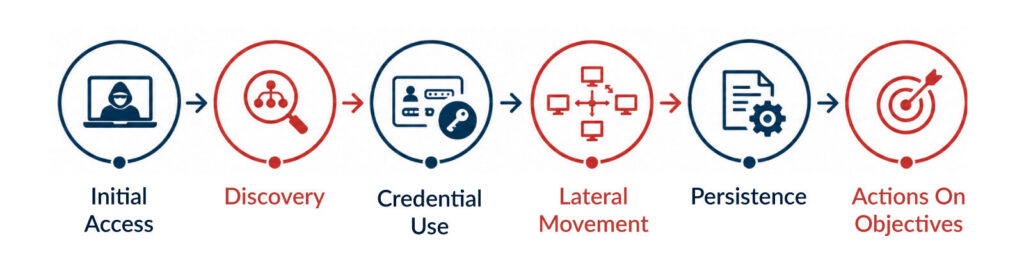
This is one reason retention strategy deserves more attention during a network forensics tools evaluation. Retention should not be determined only by how long a dashboard needs data. It should reflect how far investigators may realistically need to travel backward after an incident is discovered.
Otherwise, the team can identify the first activity it still has evidence for and mistakenly treat that as the first activity that occurred.
There is also an important distinction between retention depth and forensic depth.
Keeping months of communication records can be extremely useful, but retention alone does not determine how much investigators can learn once they reach the session that matters. A security team needs to answer two separate questions: How far back can we go, and how deep can we investigate when we get there?
A long history of low-detail telemetry and a short history of very high-fidelity telemetry solve different problems. Strong forensic architecture makes deliberate decisions about both.
2. What Actually Happened Inside the Connection?
Suppose the team knows that Host A connected to Host B at 02:14 and transferred a large amount of data.
Useful? Absolutely. Complete? Not necessarily.
Depending on the protocol, encryption, collection point, and available telemetry, investigators may also need to determine what service was involved, which domain was requested, how the session behaved, whether authentication occurred, what files or network objects appeared, which certificates were presented, whether commands or application transactions can be reconstructed, and what preceded or followed the communication.
There is a material difference between proving that two systems communicated and establishing what occurred during that communication.
That is where different levels of network evidence serve different purposes.
- Flow information can establish communication patterns and volume.
- Rich metadata can expose protocol, session, service, domain, certificate, file, and behavioral characteristics.
- Packet capture preserves the packet-level record available at the collection point for deeper inspection when investigators need more than a summarized representation of the session.
Full packet capture does not magically reveal the contents of properly encrypted application traffic. But encryption does not make packet-level data irrelevant. Captured traffic can still preserve observable session, protocol, certificate, timing, directionality, volume, and other characteristics available at the collection point, while retaining the underlying record that analysts can re-examine as investigative questions change.
Good network forensic analysis depends on understanding that distinction, rather than on promising that a single telemetry type reveals everything.
The advantage comes from preserving investigative optionality: analysts can begin with efficient, searchable context and retain the ability to move into deeper session or packet-level detail when the incident demands stronger evidence.
3. How Far Did the Attacker Move?
Real intrusions do not respect product boundaries.
An attacker may authenticate as one identity, connect from another host, move over SMB or RDP, access a file share, reach a database, create an outbound session from a server, and then use entirely different infrastructure later in the campaign.
Each activity may generate a different alert. Some may generate none. The forensic problem is to establish the relationships among them. This is why network evidence becomes significantly more useful when investigators can relate.
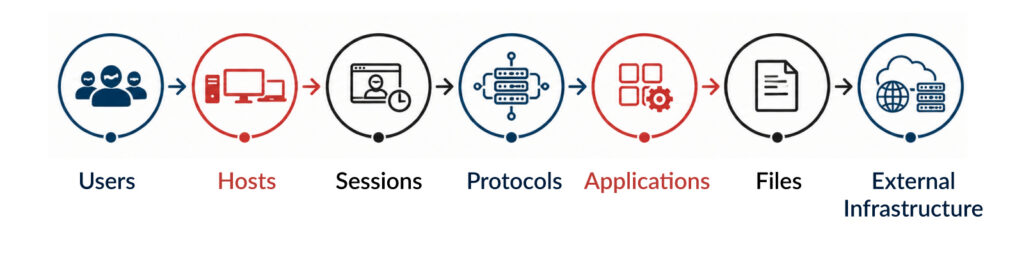
A collection of individual alerts may identify several suspicious moments. A reconstructed timeline explains whether those moments belong to the same attack.
This is also why the alert should not always be treated as the fundamental unit of an investigation. Depending on the incident, the more useful unit may be the session, the relationship between two hosts, the activity associated with an identity, or ultimately the attack timeline itself.
The objective is reconstruction: understanding how one observable led to the next and whether apparently separate events represent one continuous intrusion.
4. Was Sensitive Data Actually Accessed or Exfiltrated?
Imagine the SOC has an alert saying: Large outbound transfer detected from critical server.
That should trigger investigation, but it is not a breach-impact assessment.
The executive questions are much more specific.
- What system originated the transfer?
- Which session was responsible?
- What destination received it?
- Did activity occur immediately before the transfer that suggests data staging or collection?
- Can investigators identify relevant files, protocols, requests, or application activity?
- Is there corroborating evidence in endpoint, application, database, SaaS, identity, or cloud telemetry?
This can influence regulatory analysis, customer notification, legal strategy, materiality assessments, cyber-insurance discussions, executive communications, and the organization’s ability to challenge unsupported assumptions about breach scope.
Network forensics does not answer every one of those questions alone. What it can do is provide a critical evidence layer showing how systems communicated and what observable network activity occurred around the suspected transfer. Investigators can then correlate that evidence with the systems that understand data semantics, identities, applications, endpoints, and business context.
The objective is not to replace those sources. It is to stop making high-consequence decisions from an isolated alert.
5. Did Containment Actually Work?
Incident response teams are understandably focused on containment once they confirm malicious activity.
But containment creates another investigative question: Did the attacker actually stop?
If the team only watches for the same alert that triggered the incident, it may verify that the original observable disappeared while missing an alternate path. Historical and ongoing network traffic analysis can help responders compare activity before and after containment, identify residual communication, look for additional compromised hosts, and test whether attacker behavior moved elsewhere.
That makes network forensics relevant to recovery as well as investigation. The same reconstruction capability that helps establish how an intrusion unfolded can also help analysts determine whether the post-containment environment still exhibits activity connected to that attack story.
The evidence is not useful only for proving how the attack happened. It can also help establish whether the organization’s remediation changed what is happening now.
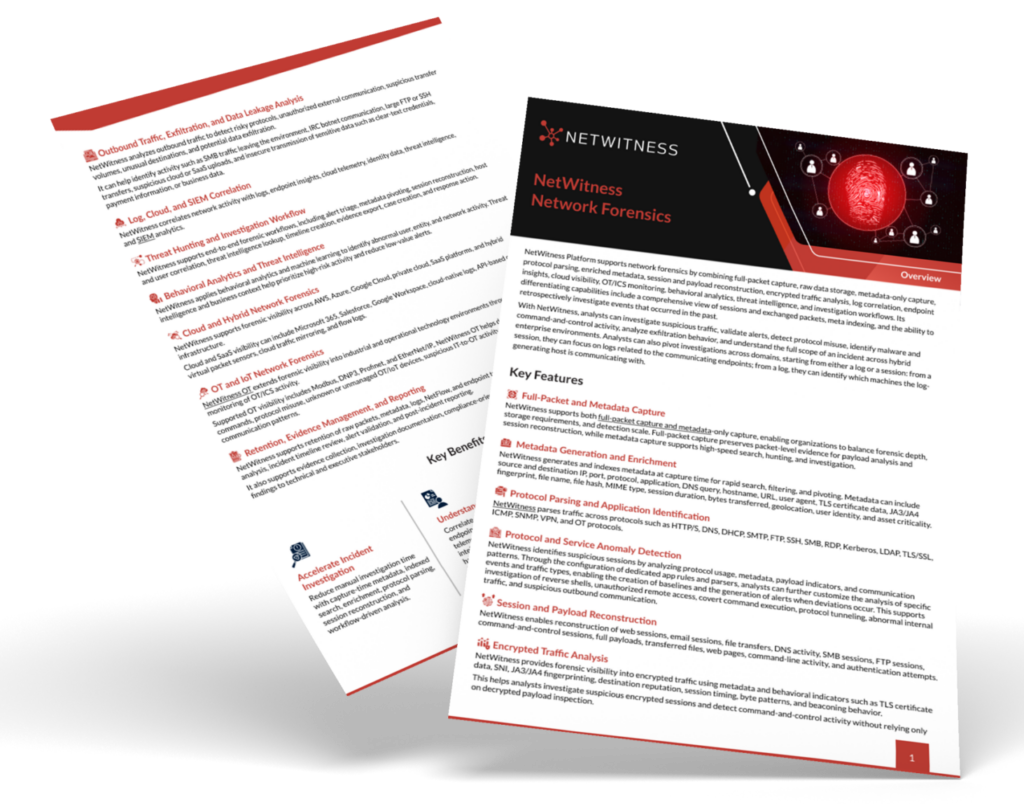
See Every Packet. Understand Every Threat.
- Capture Network Traffic
- Reconstruct Attacker Sessions
- Uncover Hidden Threats
- Accelerate Investigations
Where the Network Forensics Tool Gap Comes From
Most organizations do not intentionally design an architecture that makes investigations difficult. The gap usually develops over time as detection, storage, tooling, and operational decisions accumulate.
Four patterns appear repeatedly:
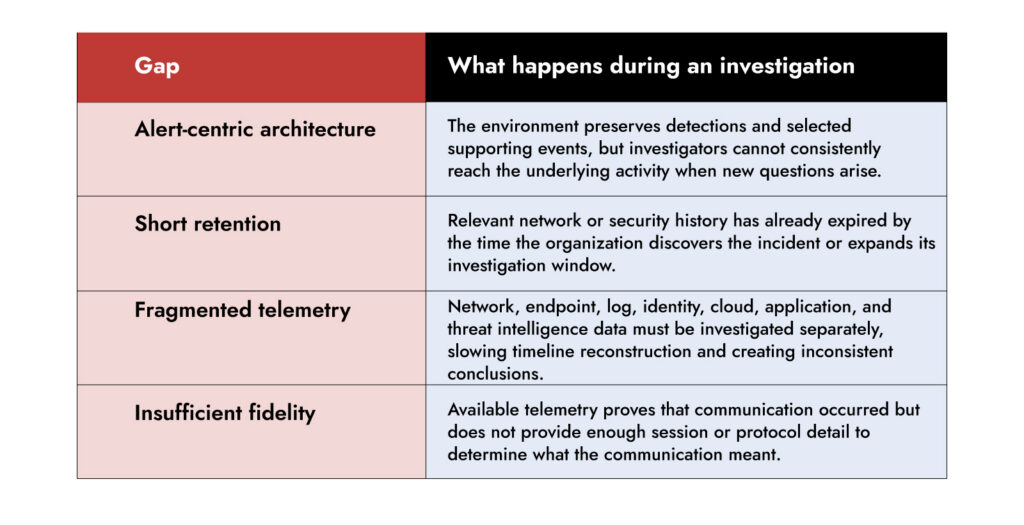
There is another issue worth adding: collecting evidence is not the same as making it usable.
A company can technically retain enormous quantities of network data and still have a forensic problem if analysts cannot search it quickly enough, pivot among related sessions, extract useful metadata, reconstruct activity, or correlate it with the rest of the incident.
Forensic readiness therefore has two dimensions:
- evidence fidelity and investigative usability.
- Ignoring either one creates a different kind of gap.
This is why forensic readiness should be evaluated across three dimensions rather than a single question about visibility or retention.
What Does Network Forensics Actually Need?
Full packet capture is an important forensic capability, but equating network forensics with “store all packets forever” is too simplistic for a large enterprise.
Networks are distributed. Traffic volumes are substantial. Encryption changes what can be observed. Storage economics matter. Privacy and data-handling requirements matter. Different network segments also carry different levels of investigative and business risk.
The better architecture gives analysts several levels of forensic detail and a practical way to move among them. Different investigative questions require different levels of evidence, and the important capability is being able to move from broad searchable context into progressively deeper evidence without losing the attack timeline.
Full Packet Capture: Retain the Highest-Fidelity Network Record Available at the Capture Point
Full packet capture provides a high-fidelity representation of network activity available at the point where the traffic is collected.
When an investigation reaches a session where summaries are insufficient, packets can allow analysts to inspect the underlying communication, validate protocol behavior, extract available network objects, investigate suspicious exchanges, or conduct retrospective analysis based on questions developed after the original activity occurred.
Its forensic value lies partly in preserving analytical options. The detection mechanism may not have considered a particular protocol field, packet characteristic, or interaction relevant when the traffic was first observed. Retaining packet-level data can allow investigators to revisit that activity after the attack hypothesis changes.
That is particularly important when evidence needs to be re-examined rather than merely accepted from the original detection.
Network Metadata: Make Massive Traffic Volumes Searchable
Packets provide fidelity. Metadata provides speed and navigability.
Parsing network traffic into structured metadata can expose useful attributes about hosts, protocols, services, sessions, domains, files, certificates, user agents, timing, and other observable characteristics.
Instead of manually inspecting raw captures until something interesting appears, analysts can search and filter structured information to reduce massive volumes of network activity to the hosts and sessions that deserve closer examination.
This is where the metadata-to-packet progression matters. Metadata helps reduce the search space. Session-level and packet-level analysis provide additional depth where the investigation justifies it.
NetWitness NDR is built around this model, combining packet capture with rich metadata so analysts can search broad network activity and then move toward deeper session evidence when necessary.
Session Reconstruction: Move From an Observable to the Attack Sequence
A suspicious IP address, flow record, or alert represents one observation.
A reconstructed session can give investigators a more coherent view of the exchange that produced that observation. From there, analysts can place the session alongside earlier and later activity to determine whether it forms part of reconnaissance, credential abuse, lateral movement, command and control, data staging, exfiltration, or another phase of the intrusion.
Depending on the protocol and the evidence available, session reconstruction can help expose files, requests, commands, communications, and other relevant characteristics in context.
This matters because attackers operate through sequences, not isolated alerts. One DNS lookup may appear insignificant. One SMB connection may be routine. One authentication event may look legitimate. When those interactions are placed in sequence and connected to the same systems, users, and infrastructure, they can become part of a much more consequential attack story.
The investigative unit should therefore not always be the alert. It may be the session, the host relationship, or ultimately the timeline investigators are trying to reconstruct.
Analytics and Threat Intelligence: Find What Deserves Investigation
Collecting forensic telemetry without mechanisms to surface unusual activity simply creates a larger haystack.
Behavioral analytics, network threat detection, and threat intelligence help investigators identify sessions, infrastructure, behaviors, and deviations that deserve attention.
Their role should not be confused with the underlying forensic data itself.
Cross-Domain Correlation: Build the Attack, Not Just the Network Story
Even rich network telemetry remains one part of an enterprise intrusion.
Endpoint telemetry may explain the process that initiated a connection. Identity data may show whose credentials were used. Logs may expose configuration changes or application activity. Cloud records may identify changes to workloads, storage, or control-plane resources. Threat intelligence may reveal infrastructure already associated with a campaign.
This is why a strong network forensic architecture should not isolate historical traffic from the rest of the SOC.
The objective is not simply to put more telemetry into one console. It is to preserve the evidentiary relationship between what happened on the network and what endpoint, identity, log, cloud, and threat intelligence sources say about the same activity.
Starting from high-fidelity network observations and correlating outward helps investigators determine not merely that multiple security products produced related events, but how those events fit into the same attack sequence.
That is the difference between collecting security context and reconstructing an intrusion.
Five Forensic-Readiness Tests for Network Forensics Tools
Forensic capabilities are often evaluated as feature lists when they should be evaluated against the questions investigators need to answer under pressure.
If you are assessing network forensics tools, these five tests provide a more useful starting point.
1. How Far Back Can You Investigate?
Evaluate retention according to network segment, traffic volume, storage architecture, business criticality, and realistic incident-discovery timelines.
Do not settle for a headline retention number.
Ask what evidence will still exist when the organization realizes that the incident began two days, two weeks, or longer before the first alert.
2. How Deep Can You Go Once You Find the Relevant Activity?
Determine what investigators can access beyond communication records.
Can they move from flows or searchable metadata into relevant sessions and, where retained and necessary, packet-level detail?
The goal is investigative optionality. Analysts should be able to start with the most efficient representation of the activity without being trapped there when the incident requires deeper forensic analysis.
3. How Quickly Can Analysts Find the Evidence That Matters?
Retention and fidelity are of limited value if investigations stall because the data cannot be searched effectively.
Evaluate metadata indexing, protocol parsing, query performance, filtering, time-range analysis, and the ability to pivot from an interesting host, domain, certificate, file, or session characteristic into related activity.
The practical question is how quickly an analyst can reduce a large network history to the small set of interactions that materially changes the investigation.
4. Can Analysts Reconstruct the Attack Across Systems and Time?
Look beyond single-event inspection.
Can investigators follow activity backward and forward? Can they establish relationships among hosts, users, protocols, sessions, files, and external infrastructure? Can they connect network findings with endpoint, identity, logs, cloud events, and threat intelligence?
A mature network forensics capability should help the SOC move from “these events appear suspicious” to “this is how the attack progressed.”
5. Can the Organization Preserve and Communicate Defensible Findings?
Security teams eventually need to explain conclusions outside the SOC.
Evaluate case workflows, evidence export, access controls, auditability, retention policies, and support for incident reporting.
The ultimate forensic question is not whether an analyst found an interesting packet or session. It is whether the investigation can support a defensible account of what happened, what was affected, and why the organization believes its conclusion is correct.
How NetWitness Closes the Investigation Gap
At NetWitness, we approach network forensics from a simple premise: A detection should be the beginning of the investigation, not the limit of what the investigation can know.
The value is not any single telemetry type in isolation. NetWitness enables analysts to begin with rich, structured metadata to reduce the search space, move into the relevant sessions and packet-level data when deeper inspection is necessary, and connect those findings with broader security telemetry. That progression helps preserve both investigative speed and evidentiary depth.
In practical terms, it supports the progression from detection to reconstruction:
Alert → metadata → session → packet-level detail → cross-domain context → reconstructed attack story
NetWitness NDR combines full-packet capture, rich metadata, protocol analysis, behavioral analytics, threat intelligence, and session reconstruction to help analysts investigate suspicious activity beyond the original detection. The broader NetWitness platform also allows relevant network findings to be examined alongside log, endpoint, cloud, and other security context.
- Full-packet capture preserves high-fidelity traffic data for deeper forensic analysis. When analysts need more than a summarized event or metadata representation, they can examine the packet-level record retained at the capture point.
- Rich metadata makes large volumes of network activity searchable. Analysts can use structured protocol and session context to narrow the investigation before deciding which activity warrants deeper inspection.
- Session reconstruction helps turn isolated communication into investigative context. Rather than treating network observations as separate events, analysts can examine relevant exchanges and place them within the broader progression of attacker activity.
- Behavioral analytics and threat intelligence help analysts identify where to focus. Detections and enrichment can reduce the search space while retaining access to the historical activity required for retrospective investigation.
- Cross-domain investigation helps reconstruct the broader attack. Network findings can be examined alongside relevant endpoint, log, cloud, and other security telemetry so investigators can understand how activity across different control points relates to the same incident.
This combination is important because forensic readiness requires more than retaining a long history, more than collecting high-fidelity traffic, and more than providing fast search. Investigators need all three dimensions working together: retention depth, evidence depth, and investigative usability.
That is also why we do not view packets and metadata as an either-or choice. Metadata gives analysts the speed to navigate enormous volumes of network activity. Packet-level data preserves deeper forensic options when the investigation reaches a session where summarized information is no longer enough. Session reconstruction and cross-domain context then help turn those observations into an attack timeline.
The evidence that appears insignificant during detection can become the critical detail that establishes what happened later in the investigation. Security teams cannot know in advance which detail that will be. Preserving investigative optionality is what keeps that question answerable.
In Conclusion
Detection is necessary. Good detections can dramatically shorten the time between attacker activity and SOC action. But detection and reconstruction solve different problems.
An organization can therefore detect an intrusion successfully and still struggle to establish how the attacker entered, where they moved, what they accessed, whether data left the environment, and whether containment actually worked.
That is the network forensics tool gap security leaders should care about.
For CISOs, forensic readiness should be evaluated through three questions: How far back can we investigate? How deep can we go once we find the relevant activity? And how quickly can our analysts turn that information into a defensible attack timeline?
The real measure of forensic readiness is not how many alerts the architecture produces. It is whether the organization has retained enough usable detail to answer the questions that emerge after those alerts.
An alert can tell you where the investigation started. Your forensic architecture determines how much of the attack story you can ultimately prove.
Frequently Asked Questions
1.What are the Best Network Forensics Tools for Analyzing Cyber Attacks?
The best network forensics tools are those that match the depth and scale of the investigations an organization needs to perform. For enterprise environments, look for capabilities such as historical traffic retention, scalable metadata search, protocol analysis, session reconstruction, packet-level investigation where required, threat hunting, and correlation with endpoint, identity, log, cloud, and threat intelligence data.
Rather than ranking tools only by how much traffic they capture, evaluate how effectively analysts can move from an initial detection to a defensible reconstruction of attacker activity. NetWitness is designed for this enterprise investigation model by combining full-packet capture, metadata enrichment, network analytics, session reconstruction, and cross-domain security context.
2. How Do You Choose the Right Network Forensics Tools?
Start with the questions about the incident your security team must be able to answer, then work backward into architecture requirements.
Evaluate evidence fidelity, network coverage, retention, search performance, protocol depth, metadata extraction, packet availability, session reconstruction, encryption visibility, storage requirements, threat hunting, evidence export, integrations, access controls, and cross-domain investigation workflows.
Most importantly, test the platform against a realistic attack scenario rather than a feature checklist. Give analysts an alert and ask them to reconstruct what happened before and after it.
3. What Attacks Can Network Forensics Help Investigate?
Network forensics can support investigations involving
- command-and-control communication,
- lateral movement,
- credential abuse visible through network protocols,
- malware activity,
- ransomware,
- insider activity,
- data staging and exfiltration,
- suspicious remote access,
- exploitation,
- compromised infrastructure,
- unusual DNS behavior,
- protocol abuse,
- attacks that move across multiple internal systems.
Its value is particularly high when analysts need to establish how separate systems and sessions are related over time.
4. Can Network Forensics Help Investigate Attacks After They Happen?
Yes. Retrospective investigation is one of the primary reasons organizations retain network evidence.
If appropriate traffic, metadata, and related telemetry were preserved, analysts can return to historical activity after an alert, a newly discovered indicator, or new threat intelligence becomes available. They can search earlier sessions, reconstruct timelines, identify related infrastructure, investigate lateral movement, assess suspected data transfers, and determine whether previously unnoticed systems were involved.
The limitation is straightforward: investigators can only interrogate evidence the organization retained. Once relevant traffic or telemetry has aged out, been overwritten, or was never collected, no analytics engine can recreate evidence that no longer exists.
Uncover the Full Truth Behind Every Cyberattack
- Reconstruct Network Activity
- Trace Attacker Behavior
- Recover Critical Evidence
- Strengthen Incident Investigations