Earlier this year I sat in a 12-hour breach simulation in São Paulo with CISOs, CIOs and CTOs. The scenario was a customer-facing web server at a bank. The alerts looked real, but they also looked like a misconfiguration. Then the story hit social media, and the share price started to fall. One person in the room had minutes to decide whether to take that server down.
What that person needed was information, fast, and accurate enough to act on. That is what we built NetWitness 12.6 around.
The Challenge for SOC Teams Today
Attackers are using AI to move faster, and we have to match them. But the skills behind configuration, investigation, and threat hunting are scarce. Many SOC teams are one to three people, and hiring an expert is expensive anywhere in the world. Most teams have a couple of people who can do the hard work and have a long queue waiting for them.
I heard the same pain from SOC teams across industries and regions. So, for NetWitness version 12.6, we focused on putting AI across the analyst workflow, from an autonomous SOC to faster search, rules and reports, on widening detection, on holding up in regulated environments, and on bringing IT and OT into one view.
How NetWitness Autonomous SOC works
I compare AI to power tools. A screwdriver became a plug-in drill, then a cordless one, and each let you do far more at the same time. None of them makes you an architect. AI is the same. Use it every day, but check its work, because some of what it provides may not be accurate.
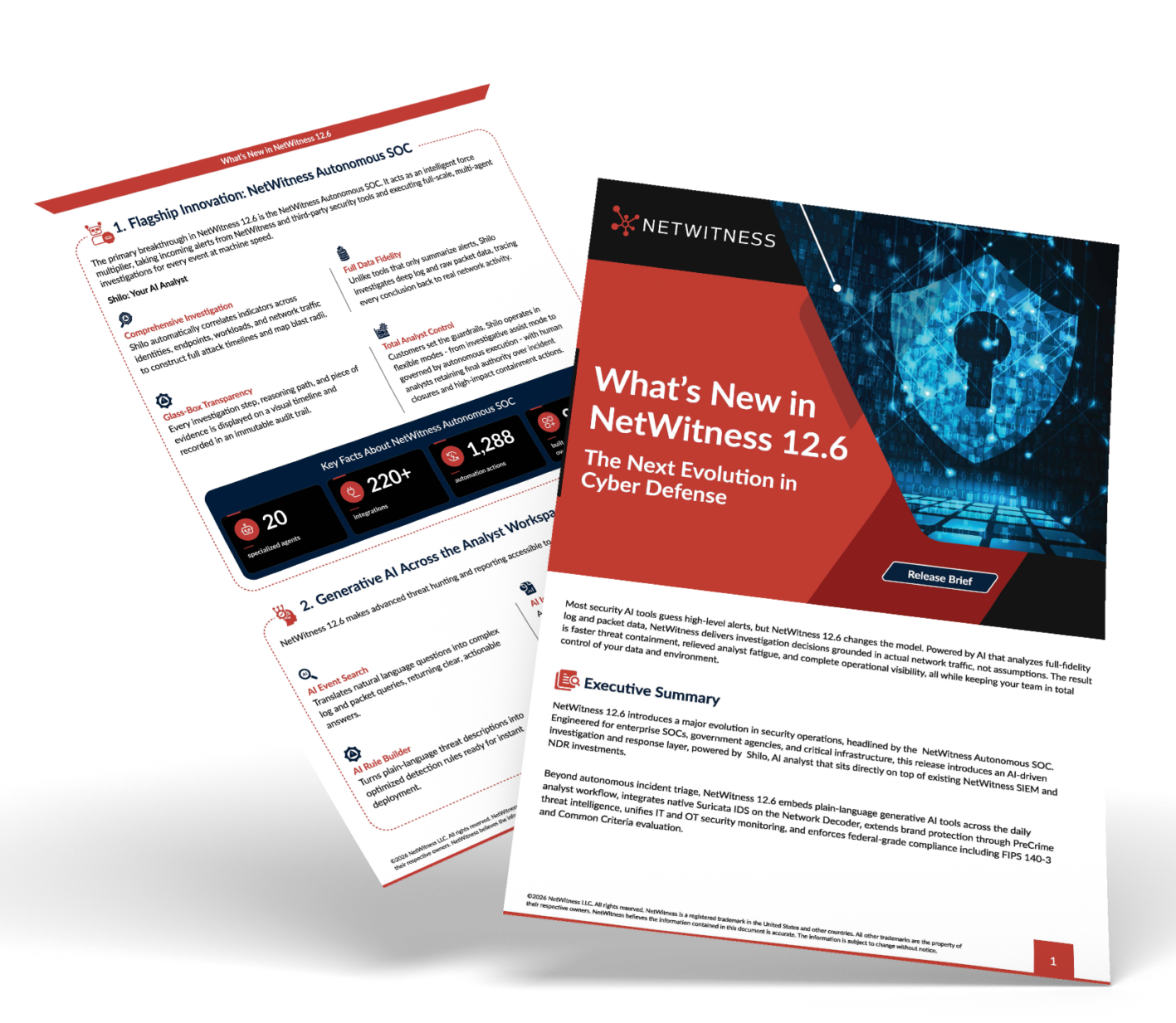
That is the view that shaped Shilo, the AI analyst inside NetWitness OmniSense. Shilo is a mesh of 20 specialized agents that investigate together, ingest data across the whole stack, and work through a five-step loop of ingest, understand, decide, act, and learn. A live blast radius graph shows exposure paths, so the scope of an attack is visible quickly. The Action Center runs responses such as isolating a host or ending a session, backed by 220+ integrations.
The human stays in the loop throughout. Every response action needs approval by default, and the autonomy policy decides how far that goes. Teams can run assist mode or autonomous mode within governance limits. Important actions always need approval. Global scope actions never run automatically. An approval nobody answers expires instead of proceeding.
How NetWitness Keeps Humans in Control
Look at SOAR. When playbooks first appeared, few teams let them act, and rightly so, because nobody wants to take down a critical path by mistake. Over the years, five or six use cases such as phishing became things teams run without a second thought. AI will follow the same path. It is a maturity curve, not a switch.
So, we made each investigation a glass box. Before approving anything, the analyst can open the full timeline and a ‘What Shilo Used’ receipt, which shows the evidence and data behind each conclusion. That score is a signal for the analyst to weigh, not an accuracy rate. Analysts check in, confirm the finding or call it a false positive, and trust grows with evidence.
Why Packet Data And Logs Work Better Together
I describe packet data as the flight recorder of everything that crosses the network. Logs show telemetry you already know to collect. When an attacker does something clever that never appears in a log, you can go back and replay it on the wire.
That is why NetWitness blends both, and why Shilo reasons over both. The question I get most often is about encrypted traffic. We can fingerprint the handshake, since the certificate travels in the clear, and a certificate full of junk is a strong signal. With a partner such as Gigamon, we can also work on decrypted traffic.
How NetWitness 12.6 Improves Analyst Productivity
Picture a team of six: four junior analysts and two experienced professionals . With the right tools, the four can work much closer to the level of the two, and all six spend their time on high value work. In my opinion, this AI is not meant to take anyone’s job. It can make your existing team more efficient.
Here are three capabilities in NetWitness 12.6 that make that possible.
- AI Event Search (Investigate, Events): analysts ask for IPs, geography or any meta in plain language instead of writing a query.
- AI Rule Builder (Configure, Policies, Content): admins describe a detection in plain English and get rule syntax back. 12.6 adds application rules.
- AI Incident Reports (Respond, Incidents): analysts used to jump to VirusTotal and similar sites to double check. The report now stitches those lookups together with MITRE ATT&CK and known exploited CVE context, so they stay in one place. In our own analysis, a single investigative report saved at least 45 minutes.
A junior analyst still needs to know what they are looking for. The tools do not replace that judgment. They remove the friction around it.
Detecting More, Earlier
Customers asked for more detections, so Suricata IDS now runs as a plugin on the Network Decoder, the component that captures packet data. It needs no extra sensor, and its alerts enter the alerting pipeline immediately.
PreCrime Threat Intelligence with BforeAI starts from the brands and domains you register. I tested it on my own company. Someone registered a domain impersonating NetWitness, and I was alerted about an hour after it was created. When I called the person, they confirmed they had made it an hour earlier. In the product, each threat shows a score, an attack type and a takedown status. Access to the fake site can be disrupted through DNS services, which also protects people outside your company, and a takedown request can go to the hosting provider if you choose.
IT and OT Unification
IT and OT environments are converging, and customers keep asking for visibility. One large transportation customer sends all telemetry and packet data through a one-way transfer system into a fully offline SOC, and we reconstruct the full picture for them. A pharmaceutical customer runs sensors on the lines that make its drugs. If one of those devices is compromised, the people watching it are usually network operations, not security.
OT protocols are complex and often tied to vendors such as Siemens and General Electric. We first added OT visibility more than two years ago, and 12.6 keeps building on that: OT specific Unified Data Model updates, MITRE ATT&CK for ICS mapping and tighter integrations. Because the data model is explicit and not generic, natural language search works on OT data too. These workstreams are ongoing.
Security for Regulated Environments
Customers scan for vulnerabilities, so new capabilities have to sit on a hardened base. 12.6 brings FIPS 140-3 compliant services, TLS 1.3, AlmaLinux moving from 8.10 to 9.8, remediated library vulnerabilities, and Extended Meta so values can run past 256 bytes. Every earlier hotfix lands in one baseline. We have entered a Common Criteria EAL2 evaluation with Leidos, which is in progress and matters to our government, critical infrastructure, and military customers.
Deployment is available as SaaS, as a hybrid, or on-prem appliance. On the appliance, alerts and incidents stay on your infrastructure over an outbound-only connection. Shilo’s reasoning currently runs in the central platform cloud, with in-region reasoning on the roadmap. Air-gapped deployment is also on the roadmap.
What NetWitness 12.6 means for CISOs
CISOs measure on mean time to detect, mean time to respond and mean time to contain. They have to work together, because fast detection means little if the next steps are slow. In short, 12.6 delivers quicker time to visibility, more context through detection such as PreCrime, and automation through AI.
It also gives CISOs answers for the board and the auditor: an approval trail, a glass box record of every AI decision, and precise wording on where data sits.
Get started with NetWitness 12.6
At NetWitness we believe in see everything, fear nothing, and we stand behind it. We are just getting started, with a lot more coming over the next six months. The best way to judge 12.6 is a short proof of concept on your own alerts.
Want to Explore NetWitness 12.6 Further?
Contact our team to see how NetWitness 12.6 can help your SOC investigate threats, reduce analyst workload, and accelerate incident response. Contact us to learn more or book a demo.
Is Your SOC Ready for the Next Evolution in Cyber Defense?
Download our free SOC Modernization Readiness Checklist to identify operational gaps, evaluate AI-driven security capabilities, and discover opportunities to improve threat detection and investigation.