What is MTTR?
MTTR stands for Mean Time to Respond. It’s the average time a security team takes to act on a threat after it’s detected, calculated as total response time divided by the number of incidents. MTTR can also mean Mean Time to Recover, Remediate or Resolve, so define it before reporting it.
Introduction: Why MTTR Is No Longer Enough
Ask a security team how well they handle attacks and you’ll usually hear one number: Mean Time to Respond (MTTR). It’s easy to pull and easy to chart. It also leaves out most of what decides whether an incident stays small.
The gap is getting wider. IBM’s 2026 Cost of a Data Breach report put the average time to identify and contain a breach at 247 days, the first increase in five years. Cyber attack response now has to be measured across the whole lifecycle, not at a single point.
The Limitations of Mean Time to Respond (MTTR)
- No fixed definition. The R can mean respond, remediate, recover or resolve, and each starts and stops the clock at a different moment.
- Averages hide the tail. Thirty phishing cases closed in an hour and one nine-day ransomware event produce a healthy-looking mean.
- It invites gaming. Judge analysts on closure speed and tickets close fast, even when root causes are missed.
- It starts too late. The clock begins at the alert. IBM’s 247 days split into about 183 to identify and 64 to contain, so most of the delay happened before anyone responded.
- It ignores business impact. Four hours means something very different for a test server and a payment system.
Key Metrics CISOs Should Track Beyond MTTR
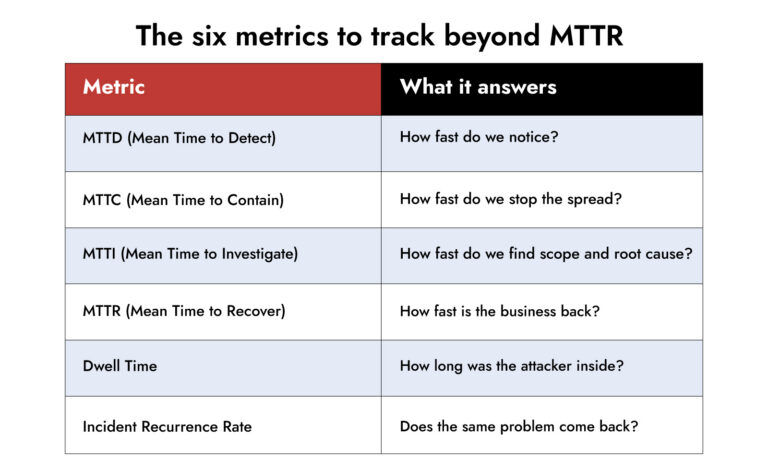
These incident response metrics cover the stages Mean Time to Respond skips. Track each as a median with a 90th percentile beside it.
Mean Time to Detect (MTTD)
The lag from when your team first knows about malicious activity to when it starts. It’s the most valuable number in threat detection and response, because every later stage depends on it. Use it with the percentage of incidents detected internally to those reported by an outsider.
Mean Time to Contain (MTTC)
Duration of time following the confirmation to stop transmission. Directly compare it to the speed of the attackers in a network. If lateral movement takes minutes, a containment target measured in hours is a hope, not a control.
Mean Time to Investigate (MTTI)
The duration of the triage to the validated scope and root cause. Note the acronym clash: IBM uses MTTI for time to identify, so label yours clearly. A short investigation time points to good logging and well-rehearsed playbooks.
Mean Time to Recover (MTTR)
Yes, the same letters again. In this context its meaning is: time to restore normal operation, as measured against the recovery time objective, per critical service. Test your backup, as a backup that has not been tested is a guess. Explain the Mean Time to Respond you are referring to on each dashboard.
Dwell Time and Lateral Movement
Time in which an attacker remains undetected in your environment. Monitor it as a median and compare against public benchmarks such as those from threat reports such as Mandiant’s M-Trends. Also record how many systems an intruder interacted with prior to containment; this illustrates the effectiveness of segmentation.
Incident Recurrence Rate
The share of incidents that return from the same root cause within a set period, usually 90 days. A high rate means the team is treating symptoms. It’s the best check against a flattering Mean Time to Respond.
Measuring the Effectiveness of Incident Response
Speed measures activity. Effectiveness measures outcomes. In the case of cyber security incident response, a couple of quality checks should be included:
- The number of serious incidents that were accurately identified the first time.
- Reopen rate: closed cases that had to be reopened.
- Playbook coverage: How many scenarios are likely covered in a playbook that someone has used?
Follow through on exercise action items from previous tabletop. So does performance of the Security Operations Center (SOC). The more tickets that get closed per analyst, the more easy alerts will be pushed out.
How to Align Incident Response Metrics with Business Risk
Boards don’t care that MTTC fell 20 percent. They care whether orders ship. Translation is the job of security incident management and cybersecurity risk management together.
Agree with finance, before any incident, on what an hour of downtime costs for each critical system. Then report improvements in those terms. Say the median time to restore your payment platform dropped from 14 hours to 9. With a known hourly cost, that’s a figure a CFO can use.
IBM’s data supports the framing: breaches with lifecycles over 200 days averaged $5.65 million, against $4.32 million for those contained sooner. Regulation adds clocks of its own.Track time from discovery to materiality decision as its own metric.
Building an Incident Response Metrics Dashboard
A helpful dashboard provides answers to three questions: Are we getting faster? Are we getting better? What is it costing us?
- Define all the clocks first. Record the starting and stopping points of each metric and the owner of the timestamp.
- Keep it to 8-10 metrics in detection, response, recovery, impact and readiness. However, do not show only the mean; show the 90th percentile as well as the median.
- Automatically fetch information from the SIEM, EDR and case management system. The metric is made up by hand.
- Include targets and trend lines, each one with an attacker speed or business downtime tolerance.
- Maintain two perspectives: one technical (SOC) and one one-page high-level (executives) in dollars and days.
Best Practices for Improving Cyber Attack Response Performance
- Conduct twice-yearly tabletop exercises and convert to tracked tasks.
- Look at automation of repetitive triage, then measure the error rate of the automation.
- Fill in gaps in the system first. Address gaps in the system first. A lot of the delay in the lifecycle is there.
- Pre-approve containment actions to ensure no one waits for permission in an attack.
- Restore works with rehearsed and does not support backups.
- Review and document change for all significant incidents within 2 weeks.
- Re-evaluate goals each quarter, as attackers’ pace changes.
Conclusion: Moving From Response Speed to Response Effectiveness
Mean Time to Respond isn’t useless. It just can’t carry the whole story. Add detection, containment, investigation, recovery and recurrence, tie them to business cost, and you’ll have a measurement system that guides budget and holds up in front of a board.
Frequently Asked Questions
1. What are the best tools for cyber attack response and recovery?
No single product wins. Build by function: EDR or XDR for isolation, a SIEM for correlation, SOAR for playbooks, identity controls that disable accounts fast, immutable backups, and case management with clean timestamps.
2. How to create an effective cyber attack response plan?
Name an incident commander, define severity levels, write playbooks for ransomware, email compromise and stolen credentials, list legal and executive contacts, pre-approve containment steps, and test twice a year. NIST’s incident response guidance and Cybersecurity Framework 2.0 are good starting points.
3. What is cyber attack response, and why should CISOs measure it?
It’s the coordinated work from the first sign of an attack through containment, recovery and review. CISOs should measure it because unmeasured work is hard to fund and harder to defend to boards, insurers and regulators.
4. Why is MTTR not enough to measure incident response effectiveness?
It lacks a fixed definition, hides outliers in an average, rewards fast closure over real fixes, starts after detection, and says nothing about business impact.
5. How can CISOs measure the business impact of a cyber attack?
Agree on hourly downtime costs with finance in advance, then track downtime against recovery objectives, lost revenue, response and legal spend, fines and customer churn. Report ranges and update them after each incident.
6. How should CISOs build a cyber attack response measurement framework?
Define each clock, choose eight to ten metrics across the lifecycle, baseline with medians, set targets from attacker speed and downtime tolerance, automate collection, and review quarterly with business owners.
Know What Happened. Take Control After a Breach.
- Identify the Initial Point of Compromise
- Uncover the Full Attack Scope
- Trace Attacker Movement
- Strengthen Incident Response