What are the biggest cybersecurity risks in modern network protocols?
Modern network protocols such as DNS, TCP/IP, SNMP, VPN protocols, and the network file system protocol (NFS) create significant cybersecurity network risks when they rely on outdated trust models, weak authentication, or poor segmentation. Enterprise network security teams increasingly focus on network traffic analysis, encrypted traffic analysis, and advanced threat detection to identify protocol abuse, reduce network traffic security gaps, and improve threat detection and response across hybrid environments.
Introduction
Most security teams are chasing CVEs while the real exposure sits in plain sight. The network protocols running your infrastructure every single day, DNS, TCP/IP, BGP, SNMP, NFS, were built for a cooperative internet that no longer exists. In 2026, with AI compressing the gap between vulnerability discovery and active exploitation, the cybersecurity network risks buried inside foundational protocols are no longer theoretical.
This is not a patch list. It is a field-level look at where the actual exposure lives and what the security industry consistently gets wrong about it.
DNS: The Most Abused Network Protocol Nobody Watches Closely
DNS is high-volume, low-suspicion, and allowed through virtually every corporate firewall. That combination is exactly why attackers treat it as a preferred channel.
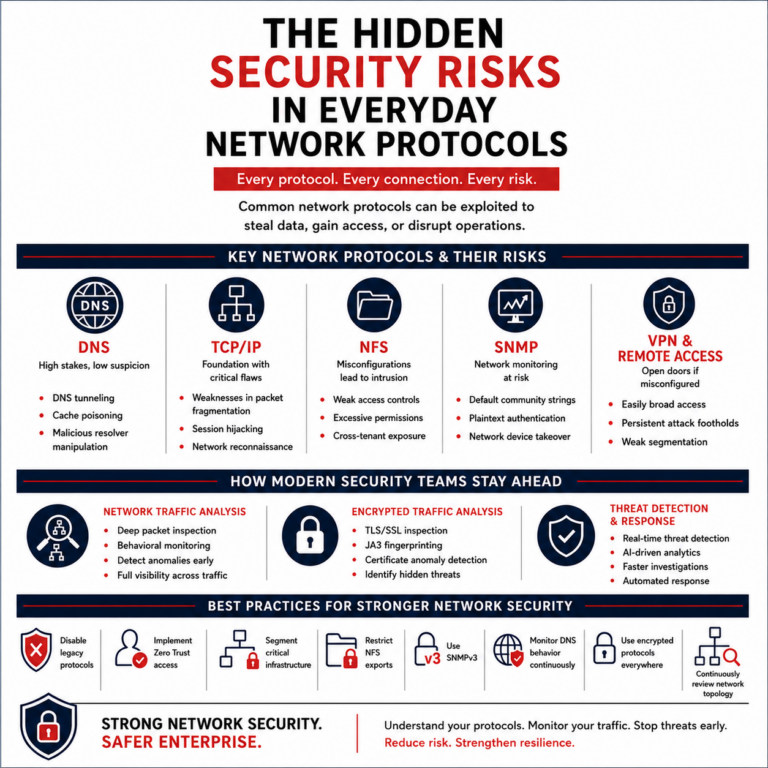
DNS tunneling encodes exfiltration data inside queries and responses, exploiting the fact that most organizations never do deep inspection on port 53. DNS cache poisoning injects forged responses to redirect users to attacker-controlled infrastructure without any visible warning. Both techniques abuse trust baked into the protocol at design time. Because DNS is a foundational network protocol, security teams often assume its traffic is benign, creating a blind spot that attackers routinely exploit for command-and-control communications and data exfiltration.
The severity of DNS vulnerabilities as a network protocol risk is consistently underrated. In May 2026, Microsoft patched CVE-2026-41096, a heap-based buffer overflow in the Windows DNS Client triggered by malicious DNS responses. No authentication. No user interaction. Anyone with a man-in-the-middle position or a rogue DNS server could achieve remote code execution on virtually any Windows machine. That is a wormable vulnerability inside the protocol every endpoint uses to resolve every domain.
Deploying DNS over HTTPS or DNS over TLS is the right move for network traffic security, but it solves interception, not resolver trust. Encrypted DNS to a compromised resolver is just a private tunnel to someone already deceiving you. Those are separate problems requiring separate answers.
TCP/IP and Authentication Protocols: When Core Infrastructure Carries Wormable Bugs
The TCP/IP stack is not a single protocol. As the foundational network protocol suite powering internet communications, weaknesses within TCP/IP can have consequences that extend far beyond a single system or application. Vulnerabilities can exist at multiple layers simultaneously, and fixing one does not close exposure at another.
CVE-2026-40415, also patched in May 2026, was a use-after-free in the Windows TCP/IP stack allowing unauthenticated remote code execution with no user interaction. The caveat was that exploitation required low-memory conditions on the target. That sounds reassuring until you realize attackers can deliberately engineer those conditions before triggering the exploit.
IP fragmentation adds another dimension to network security risk. Packets delivered in pieces that security appliances cannot correctly reassemble allow malicious payloads to pass through perimeter inspection and reconstruct on the target. Firewalls and IDS systems that handle fragmentation inconsistently become an asset to the attacker rather than a defense.
Authentication protocols carry a different kind of exposure. CVE-2026-41089 was a stack-based buffer overflow in Netlogon. Unauthenticated attackers could execute code on domain controllers via crafted network requests. No credentials required. Compromise one domain controller on a flat network and you have compromised the entire Active Directory environment, every user account, every group policy, every trust relationship.
The harder truth about authentication protocol risk is that the dangerous paths are often not zero-days. They are legacy protocol fallback mechanisms left in place for compatibility. CISA’s Known Exploited Vulnerabilities Catalog shows this consistently. Attackers return to documented weaknesses in widely deployed protocols because those weaknesses stay exploitable long after patches exist.
The Network File System Protocol: Misconfigurations That Become Intrusions
The network file system protocol (NFS) is deployed across virtually every enterprise Linux environment and carries an access control problem that gets far less attention than it deserves.
NFS relies on the UID and GID reported by the client to make access decisions. An attacker who reaches an NFS share with a crafted client claiming to be root can read and write files that should be completely inaccessible. The protocol does not independently verify that claim. This weakness highlights how a trusted network protocol can become a security liability when its original trust assumptions no longer align with modern enterprise environments.
Export misconfigurations scale this risk across the network. An NFS share exported to an entire subnet rather than specific trusted hosts is accessible to any compromised machine on that network. In multi-tenant cloud environments, this has produced documented cross-tenant data exposure. It is not an edge case. Broad exports are the path of least resistance when an administrator wants a team to have access without the friction of specifying individual IPs.
The fixes are known: scope exports to specific addresses, enforce root squash, move to NFSv4 with Kerberos. The gap between knowing this and actually implementing it across a long-running infrastructure is where most organizations are stuck.
SNMP: The Network Monitoring Protocol Attackers Find Wide Open
SNMP is one of the foundational network monitoring protocols, managing routers, switches, firewalls, and servers across virtually every enterprise environment. Despite its importance, this network protocol remains one of the most frequently misconfigured components within enterprise infrastructure.
SNMPv1 and v2c authenticate through community strings transmitted in plaintext. Default values, “public” for read and “private” for write, remain unchanged on a significant portion of deployed devices. Read access gives an attacker full device configurations and internal network topology. Write access is worse. SNMP write access to a router is configuration control. Routing tables can be modified. Traffic can be redirected. Changes can persist through reboots.
SNMPv3 addresses this with real authentication and encryption. The operational reality is that most environments run SNMPv3 on newer devices and SNMPv1/v2c on older hardware that cannot be upgraded, making the overall posture of network monitoring infrastructure only as strong as its oldest device.
Make Smarter Security Investments—Faster
- Standardize vendor evaluation with a comprehensive RFI checklist.
- Compare platforms based on real-world detection, visibility, and response capabilities.
- Reduce risk by identifying gaps before deployment.
- Empower security leaders with actionable insights from NetWitness.
VPN Protocols and BGP: Structural Flaws at the Architecture Level
Traditional VPN design grants network access before asking what that access should actually include. Once authenticated, users typically reach broad network segments because VPN protocols have no meaningful model of what a specific user should be permitted to touch. More than 90% of security leaders report concern about VPNs leading to breaches. Over half of organizations experienced a VPN-related cyberattack in the past year.
Ivanti Connect Secure and Fortinet SSL-VPN vulnerabilities throughout 2024 and 2025 demonstrated the compounding problem. Attackers exploited these protocol-level vulnerabilities and installed persistence mechanisms that survived patch cycles. You patch the VPN. The access remains.
BGP operates at a different scale but carries the same foundational weakness: trust without verification. Route announcements carry no cryptographic proof of legitimacy by default. A network that advertises IP prefixes it does not own can redirect internet traffic through infrastructure it controls for interception or disruption. RPKI provides cryptographic route validation and is the closest thing to a real fix the routing community has, but adoption remains incomplete across major operators.
Zero Trust Network Access is the architectural correction to VPN’s structural flaw. Microsegmentation and identity-based controls inside the network are not optional improvements. They are the design response to a category of problem that VPN protocol architecture cannot solve on its own.
Network Traffic Analysis and the Encrypted Traffic Problem
Here is where enterprise network security strategy most consistently falls short. Signature-based detection does not catch protocol abuse. DNS tunneling, ICMP covert channels, and HTTPS-wrapped command-and-control traffic look like legitimate protocol behavior at the packet level. Catching them requires knowing what normal looks like for your environment specifically and building detection around deviations from that baseline.
Understanding how each network protocol behaves under normal conditions is essential for identifying abuse, lateral movement, and covert communications that traditional security controls often miss.
Effective network traffic analysis means capturing full packets at line rate and extracting rich protocol metadata rather than relying on shallow flow data. What was queried in DNS. Which hosts communicated with which, for how long, in what volume, at what times. When this Network visibility is natively correlated with Logs and Endpoint telemetry across the SOC Visibility Triad, a suspicious DNS query stops looking like noise and starts looking like the opening move in an attack that plays out over days.
Encrypted traffic analysis is the capability most teams have not fully operationalized yet. Tools using JA3 fingerprinting, TLS certificate characteristic analysis, and behavioral pattern detection identify anomalous traffic without decrypting it. This matters because full SSL inspection is operationally expensive and carries its own security tradeoffs. Behavioral analysis of encrypted traffic is the more sustainable approach for ongoing network traffic security. Security teams should evaluate the behavior of each network protocol individually because attackers increasingly hide malicious activity within legitimate protocol communications rather than relying on easily detected malware signatures.
Advanced threat detection at the protocol level means treating protocol behavior as a primary signal. A DNS resolver queried with unusually long domain names. NFS accessed at 3 AM by an unfamiliar host. SNMP queries originating from a workstation. These alerts do not fire on signatures. They fire on understanding baseline behavior and catching deviations from it. That is what threat detection and response looks like when it is actually working.
The Bottom Line
The CVE-chasing model does not work. Organizations are expected to treat each new vulnerability as a discrete emergency requiring an emergency response. That approach cannot keep pace with a threat environment where AI is accelerating discovery on both sides.
Cloudflare’s security team used AI coding agents for self-vulnerability analysis and uncovered CVE-2026-22813, a CVSS 9.4 flaw allowing unauthenticated RCE. Attackers are applying identical techniques to find networking protocol bugs faster than defenders patch them. The time between vulnerability existence and active exploitation is compressing.
The organizations that got through May 2026’s 138-CVE Microsoft patch cycle without an incident were not the ones who patched fastest. They were the ones that had already segmented their networks such that a wormable Netlogon bug could not propagate from one compromised endpoint to the entire domain.
Architectural decisions made years before a CVE is disclosed determine whether that CVE is a catastrophe or a maintenance item. Microsegmentation. Least-privilege access. Disabled legacy protocols. Continuous network traffic analysis feeding into threat detection and response workflows. These are not responses to specific vulnerabilities. They are the structural conditions under which specific vulnerabilities stop being existential.
The organizations building real resilience are treating network protocol security as an ongoing architectural discipline. Everyone else is managing a backlog that keeps growing.
Frequently Asked Questions
1. What are network protocols?
Network protocols are standardized rules that allow devices, applications, and systems to communicate across networks. Common examples include DNS, TCP/IP, HTTP, SNMP, and the network file system protocol (NFS).
2. What are the most widely used network protocols in enterprise environments?
Enterprise environments commonly rely on TCP/IP, DNS, HTTP/HTTPS, SNMP, SSH, SMB, and NFS for communication, monitoring, authentication, and file sharing.
3. How do I choose the best network protocol for a small business setup?
Choose networking protocols based on security, scalability, and operational needs. Small businesses should prioritize encrypted protocols, secure remote access, strong authentication, and compatibility with network security monitoring tools.
4. Which network protocol is recommended for secure remote access by leading cybersecurity providers?
Most cybersecurity providers recommend secure remote access through Zero Trust Network Access (ZTNA), IPSec VPNs, SSL/TLS-based protocols, and SSH with multi-factor authentication.
5. Which network protocols are commonly targeted by attackers?
Attackers frequently target DNS, SNMP, SMB, RDP, NFS, VPN protocols, and legacy authentication protocols because they often contain weak configurations or outdated trust models.
6. How do attackers exploit network protocols?
Attackers exploit network protocols through DNS tunneling, cache poisoning, credential theft, protocol misconfigurations, packet fragmentation, weak authentication, and unencrypted communications to gain unauthorized access or move laterally across networks.
What to Look for in a Unified Security Platform
- Cut through tool sprawl with a practical evaluation framework.
- Compare platforms based on visibility, detection accuracy, and automation.
- Validate real-world performance across hybrid and cloud environments.
- Make confident, risk-aligned security decisions.