How does cybersecurity for technology companies support secure software development?
Cybersecurity for technology companies supports secure software development by protecting developer identities, repositories, build infrastructure, cloud environments, secrets, endpoints, and deployment systems.
Threat detection and response complement preventive application-security controls by identifying misuse, compromised credentials, suspicious build activity, and post-deployment threats. Incident findings can then be used to improve access controls, development policies, architecture, logging, dependency management, and secure software development practices.
Cybersecurity for technology companies must preserve and connect evidence across identities, endpoints, networks, cloud services, APIs, repositories, and development infrastructure so security teams can determine how an incident started, how far it spread, what data was accessed, and what needs to be contained.
To do that, tech companies require an investigation-ready security architecture that brings together various tools like SIEM, network detection and response, endpoint detection and response, behavioral analytics, threat intelligence, digital forensics, and incident response workflows.
Technology companies have a peculiar security problem. The infrastructure that creates business value is often the same infrastructure attackers want to exploit. Source code repositories contain intellectual property. Developer accounts hold powerful permissions. CI/CD pipelines can distribute software to thousands of customers. APIs connect sensitive services. Cloud platforms host both production systems and the data required to operate them.
A compromise does not have to remain inside the company. It can move into customer environments, partner ecosystems, managed services, or software updates.
For instance, Privacy Rights Clearinghouse recorded 658 distinct breach incidents in the first quarter of 2025, potentially affecting more than 32 million people. Hacking accounted for 61% of those incidents, while business services organizations represented 28% of the total.
Those numbers point to a larger reality: technology companies cannot assume every incident will begin with obvious malware on a managed endpoint. It may begin with a developer credential, an exposed token, or a trusted vendor connection.
What is Investigation-Ready Security?
Investigation-ready security is the ability to detect suspicious activity and immediately reconstruct what happened using accessible, correlated, and sufficiently retained evidence.
An alert-ready security operations center can tell you that something suspicious occurred. An investigation-ready security operations center can tell you:
- Which user, workload, process, or service initiated the activity.
- How access was obtained.
- Whether authentication was legitimate or compromised.
- What systems the attacker contacted.
- Which privileges were used or escalated.
- Whether source code, customer records, secrets, or production data were accessed.
- How the attacker maintained persistence.
- Whether information left the environment.
- Which assets need to be isolated, revoked, rebuilt, or monitored.
In our view, an alert without enough supporting evidence is not a completed detection. It is an invitation for the SOC to start searching through disconnected tools, hoping the relevant telemetry still exists.
Experienced attackers understand those gaps. They move between identity, network, endpoint, application, and cloud layers because they know many security teams cannot follow them cleanly across all five.
Why Technology Companies Face a Different Investigation Problem
Cyberattacks are difficult to investigate in any industry. Technology environments add several complications that make evidence collection and correlation particularly challenging.
Product Infrastructure and Corporate Infrastructure Overlap
For many technology companies, there is no clean separation between “the business” and “the product.”
The corporate environment may contain employee identities, finance applications, collaboration tools, and internal endpoints. The product environment may contain customer databases, APIs, Kubernetes clusters, cloud workloads, build systems, repositories, and deployment platforms.
But the two environments are connected. Developers access cloud consoles. Support personnel access customer systems. CI/CD services retrieve secrets. Engineering tools communicate with production resources. Privileged administrators operate across multiple regions and platforms.
The investigation therefore has to cross organizational and technical boundaries without losing the timeline.
Development Speed Can Work Against Evidence Preservation
Technology companies are built to change quickly.
Infrastructure is deployed through code. Developers rotate between projects. New SaaS services appear. Logging configurations change. Test environments become production dependencies. Temporary access becomes permanent access.
All of this is good for delivery speed. It is less helpful during digital forensics.
For instance, by the time an incident is confirmed, a developer may have force-pushed over a suspicious commit.
Investigation readiness has to be designed for this reality. Evidence collection cannot begin after the incident has already removed the evidence.
Identity Logs Do Not Tell the Whole Story
Identity systems are central to technology-company security, but a successful login record is not a complete investigation.
It may show that a user authenticated. It does not necessarily show:
- What the user did after authentication.
- Which internal services were discovered.
- What data moved across the network.
- Whether a process used the credentials.
- Whether the session came from a compromised developer endpoint.
- Whether the account accessed an unusual repository or cloud workload.
- Whether an API token was replayed from another system.
That is why identity data must be correlated with endpoint activity, application logs, cloud events, network sessions, repository activity, and behavioral context.
Identity tells us who appeared to connect. The rest of the telemetry tells us what that identity actually did.
Software Supply Chains Expand the Blast Radius
Technology companies depend heavily on third parties, including cloud providers, open-source components, code libraries, SaaS platforms, identity providers, contractors, development tools, and managed services.
They are also third parties to their own customers.
That creates risk in both directions. A technology company can be compromised through a supplier, or it can become the route through which an attacker reaches its customers.
Technology Companies Have More Than Data to Lose
Data breaches matter, but technology companies also need to protect:
- Source code and product roadmaps.
- Proprietary algorithms and models.
- Build and signing infrastructure.
- Customer tenant data.
- API keys, certificates, and secrets.
- Cloud management planes.
- Administrative portals.
- Product telemetry.
- Research and engineering documentation.
- Software update mechanisms.
A security incident involving one of these assets may affect product integrity, customer confidence, contractual obligations, future revenue, or company valuation.
That is why investigation-ready security is not simply a SOC efficiency initiative. It is part of product assurance and business resilience.

“In fast-moving technology environments, evidence has a shorter shelf life than most security teams realize. If the SOC waits until an incident is confirmed to begin collecting evidence, part of the attack story may already be gone. Investigation readiness is about preserving the right telemetry early enough, and for long enough, to reconstruct what happened with confidence.”
— Colby Hansen, Sales Engineer, NetWitness
What Evidence Should a Technology Company Be Able to Reconstruct?
A mature incident investigation should connect activity across the entire attack path.
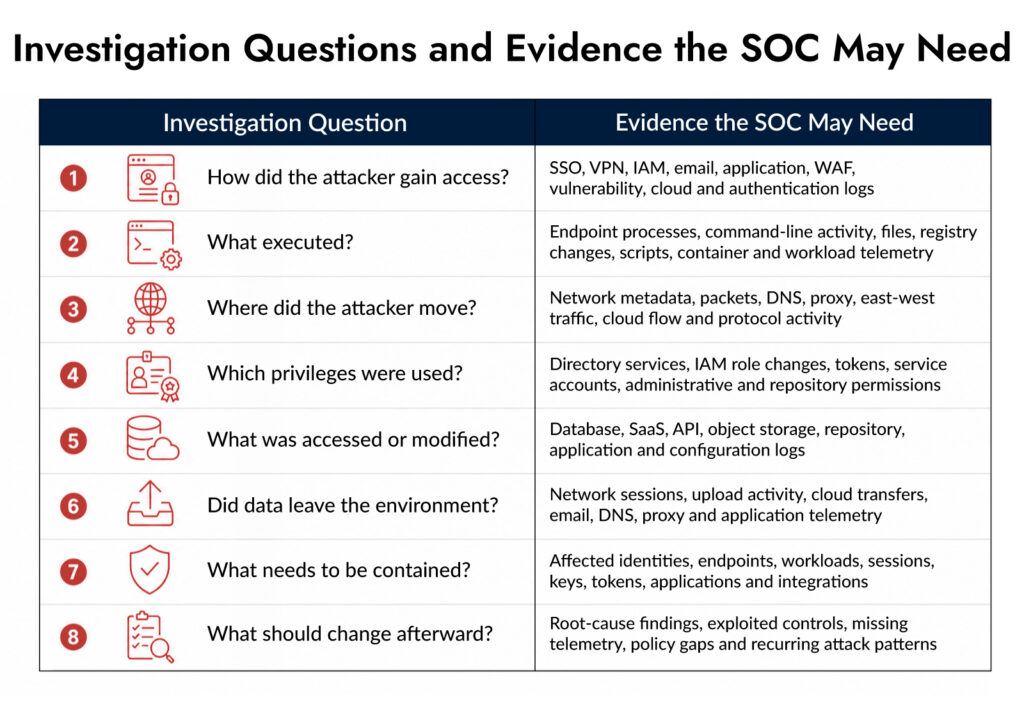
No single tool provides all of that evidence.
This is where many enterprise cybersecurity programs run into trouble. They may have excellent prevention controls and dozens of monitoring products, but the evidence remains divided among teams, consoles, storage systems, and cloud accounts.
Capabilities an Investigation-Ready Security Platform Should Provide
When evaluating cybersecurity for technology companies, we would look beyond the number of detections a platform claims to generate.
The more useful question is: What will the platform let our analysts prove after a detection occurs?
Broad Telemetry Collection
The platform should collect evidence across on-premises, cloud, SaaS, network, endpoint, identity, application, and development environments.
For technology companies, this may include:
- Cloud control-plane and workload logs.
- Authentication and directory activity.
- Network traffic and network metadata.
- Endpoint processes and system changes.
- API gateway and application telemetry.
- Repository and CI/CD events.
- Container and orchestration activity.
- Database and object-storage access.
- Email, proxy, VPN, DNS, and firewall data.
- Threat intelligence and external indicators.
Coverage should reflect the actual attack surface, not the organizational structure of the security team.
Forensically Useful Evidence Retention
Retention should be based on investigation requirements, not merely on the lowest compliance threshold.
A log retained for seven days is not useful when an intrusion is discovered three weeks later. Network metadata without adequate history may show the current activity but miss the initial access. Endpoint telemetry that records detections but not the surrounding process tree may leave the analyst without root cause.
Technology leaders should ask three direct questions:
- How far back can our analysts investigate?
- How quickly can they retrieve that evidence?
- Does the retained data contain enough detail to support a conclusion?
Storage volume matters. Retrieval performance matters just as much.
Cross-Domain Correlation
The platform should connect events around shared entities such as users, hosts, IP addresses, cloud resources, processes, domains, files, applications, and sessions.
This is where investigation platforms either earn their place or become another source of alerts.
An unusual Git repository login may not be meaningful on its own. It becomes meaningful when the same identity recently authenticated from a new location, used a previously unseen endpoint, accessed a secrets store, assumed a privileged cloud role, and initiated an unusual outbound session.
Threat Hunting Without Requiring a Pre-existing Alert
Not every meaningful incident begins with a high-confidence alert. Cyber threat hunting allows analysts to investigate hypotheses such as:
- Which developer accounts accessed production for the first time?
- Which endpoints contacted a newly observed external infrastructure?
- Where has a particular token, domain, certificate, or file hash appeared?
- Which workloads used an administrative protocol they do not normally use?
- Which service accounts began behaving interactively?
- Which internal systems transferred unusual amounts of data?
- Where did a compromised dependency communicate after deployment?
Investigation-ready security gives hunters access to normalized, searchable evidence rather than forcing them to request data from five different teams.
Attack Timeline and Session Reconstruction
Analysts should be able to move backward and forward from a suspicious event.
They need to see what happened before the alert, what occurred afterward, which systems were involved, and how the sequence changed over time.
NetWitness Platform correlates evidence across network, endpoint, cloud, logs, and threat intelligence. Its NDR capabilities include full-packet capture, network-session reconstruction, and visibility into attacker movement, while its EDR and SIEM capabilities add endpoint and log context.
That combination helps move the investigation away from isolated indicators and toward the full attack path.
Incident Workflows and Auditability
Investigation-ready security also needs operational discipline.
Analysts should be able to document decisions, assign actions, enrich indicators, preserve evidence, initiate containment, and maintain a record of what occurred.
That record matters when the incident reaches legal teams, executives, customers, insurers, auditors, regulators, or law enforcement.
NIST Computer Security Resource Center’s current incident response guidance emphasizes incorporating incident response throughout cybersecurity risk management so organizations can prepare more effectively and improve detection, response, and recovery.
14 Real Attacks. One Critical Lesson: Visibility Matters.
- See What Really Happened
- Reconstruct Attack Activity
- Uncover Hidden Threats
- Investigate with Packet-Level Evidence
How NetWitness Helps Technology Companies Become Investigation-Ready
At NetWitness, we approach threat detection and response as an evidence problem.
The SOC does not simply need more signals. It needs enough connected context to determine whether a signal represents compromise, understand the scope, and make a defensible response decision.
SIEM Provides Log, Identity, Application, and Cloud Context
NetWitness SIEM centralizes and analyzes log data across enterprise and cloud environments. That gives analysts access to authentication events, administrative activity, application records, cloud audit trails, and security-control telemetry.
This context is essential for establishing who accessed a service, which policies applied, what roles changed, and what the surrounding systems recorded.
NDR Shows What Moved Across the Environment
NetWitness NDR provides visibility into network activity, including full-packet capture, metadata, and session reconstruction.
That matters when:
- An endpoint is unmanaged.
- The application does not generate adequate logs.
- A cloud workload communicates unexpectedly.
- An attacker moves laterally.
- Credentials are used from an unusual system.
- Data is transferred over an allowed protocol.
- The SOC needs to reconstruct a communication session.
Network evidence often remains available even when the affected system did not recognize the activity as malicious.
Behavioral Analytics Exposes Misuse That Looks Technically Valid
A compromised account may authenticate successfully. A stolen API key may pass every access-control check. A privileged user may have legitimate permission to retrieve the data they are stealing.
Behavioral analytics helps identify deviations such as first-time access, unusual peer-group activity, abnormal data movement, unexpected destinations, or changes in how a service account operates.
This is particularly important in technology environments where legitimate users often have broad, rapidly changing access.
Orchestration Keeps the Response Consistent
NetWitness SOAR supports incident management, automation, enrichment, response workflows, and documentation.
Automation should not replace analyst judgment. It should remove repetitive work and ensure critical steps are not forgotten under pressure.
That may include retrieving threat intelligence, checking related indicators, disabling credentials, isolating an endpoint, creating a ticket, notifying stakeholders, or preserving evidence for further analysis. NetWitness integrates these capabilities within its broader threat detection and response platform.
Investigation-Ready Security is the Standard Technology Companies Should Demand
Technology companies will continue to adopt new cloud services, AI platforms, development tools, APIs, open-source components, and automation.
The attack surface will not become simpler.
The answer is not to collect every possible event forever. It is to make deliberate decisions about which evidence matters, retain it for a realistic investigation window, and give analysts a way to connect it quickly.
At NetWitness, we believe threat detection and response should reveal the full attack story across network, endpoint, logs, identity, cloud, and related security telemetry.
Because when an incident reaches production systems, source code, or customer data, “we received an alert” is not an adequate answer. The business will want to know what happened. Your security operations center should already be prepared to show them.
Frequently Asked Questions
1. What capabilities should an investigation-ready security platform provide?
An investigation-ready security platform should collect and correlate telemetry across logs, networks, endpoints, identities, cloud services, applications, and threat intelligence. It should:
- Retain evidence for a realistic investigation period
- Support cyber threat hunting
- Reconstruct attack timelines
- Provide digital forensics capabilities
- Maintain documented incident response workflows
It should also allow analysts to move from one entity to another, without repeatedly changing tools.
2. How can technology companies strengthen their cybersecurity posture?
Technology companies can strengthen their cybersecurity posture by
- Identifying critical assets
- Reducing excessive privileges
- Improving cloud and identity visibility
- Integrating siem, ndr, and endpoint detection and response
- Retaining sufficient forensic evidence
- Regularly testing incident response capabilities
Security monitoring should cover the entire path from developer access and build systems to production workloads and customer data.
3. How can technology companies prepare for cyber incidents before they occur?
Preparation should include maintaining an evidence map, validating telemetry coverage, establishing realistic retention periods, synchronizing system time, documenting ownership, developing investigation playbooks, and running tabletop and technical exercises.
Organizations should verify that their SOC can reconstruct initial access, privilege use, lateral movement, data access, persistence, and exfiltration before a real incident puts those capabilities under pressure.
4. How does cybersecurity for technology companies help prevent data breaches?
Cybersecurity for technology companies helps prevent data breaches by detecting suspicious identity use, compromised endpoints, abnormal network behavior, cloud misconfigurations, unauthorized data access, and attempted exfiltration before the attacker completes the operation.
Investigation-ready visibility also helps security teams determine the root cause of attempted or successful breaches, close the exploited gaps, and prevent the same attack path from being used again.
Keep Logistics Moving. Stop Cyber Threats.
- Detect Threats Across Distributed Networks
- Protect Critical Operations
- Investigate Security Incidents Faster
- Respond Before Disruption