What should CISOs prioritize for attack surface reduction in 2027?
Begin with points of attack. Target public facing devices and privileged user accounts. Then, validate the removal with clear proof of traffic. As per 2026 reports, vulnerabilities are the cause of 31% of breaches, so leaving exposed attacks without patches for weeks on end represents a much bigger risk. Limit exposure, monitor usage, and gauge results based on how much malicious traffic has been blocked.
Introduction
Most attack surface reduction initiatives kick off with a spreadsheet and finish with one. A team collects assets, ranks them by CVSS, creates incident tickets and the list of items at risk grows smaller on the pages but the real risk stays unchanged. The disparity between the list and truth is what troubles CISOs most in 2027 and it is speed that accelerates the urgency of the situation.
As reported in a 2026 report, vulnerability exploitation accounted for a total of 31% in terms of initial entry. According to Mandiant M-Trends 2026, the average time between the broker’s access and the time of transfer to the second party reduced from more than eight hours by 2022 to 22 seconds by 2025. Attackers get access to the system and transfer it within seconds after receiving credentials.

Attack Surface Reduction Fails When it Measures the Wrong Thing
Inventory-driven programs treat every reachable asset as equally risky. A forgotten staging host and a payment gateway get the same weekly scan. Attack surface discovery finds both, which helps, but it can’t tell you which one an adversary is actually probing.
Reachable and vulnerable are what scanners report. Touched is what traffic proves. A vulnerable service nobody contacts can wait for a sprint. A moderately risky one that draws thousands of unauthenticated requests from rotating addresses cannot. Attack surface intelligence, meaning who is scanning you, from where, and how often, only becomes useful when you tie it to the specific asset being hit. Attack surface monitoring that ignores observed behavior forces you to guess, and guessing gets expensive when access is resold in seconds.

Edge Devices Deserve the First Budget Line
Protection agencies and organizations in charge with preventing network disruptions employ multiple security devices. From firewalls to load balancers and file transfer systems, all of them have limited access to the outside world and are rarely equipped with any monitoring solutions. Telemetry data from endpoints does not provide any useful information about them. A categorization of vulnerabilities published in one of the reports states that major forms of attacks happen at the very edge of the network and require huge effort to be solved.
That is why executives should revise and change the way businesses operate after Mtrends 2026 report mentions the average timeframe between an attack and a counter measure as negative seven days. In such a case, it is useless to say that countering attacks through minimizing possible ways of attacks needs to imply removing vulnerable devices. Thus, organizations must disconnect all management interfaces from the internet, replace outdated VPN systems and put the file transfer systems behind a secure connection.
Identity is Part of the Attack Surface, and it Leaks Differently
Credential abuse dropped to 13% of initial access in the 2026 DBIR, but that figure only counts the first recorded step of a breach. Stolen credentials keep working long after the door is open. Identity exposure also rarely appears in a port scan. It looks like a service account authenticating from a country your company doesn’t operate in, an admin token that never expires, or a remote management tool that suddenly shows up on forty hosts. Coverage of the report cites remote management tool abuse up 240% year over year, which tells you attackers prefer tools you already trust.
Reducing this surface means cutting standing privilege and baselining how trusted tools and accounts normally behave, so a deviation stands out.
What to Prioritize First in Attack Surface Reduction
Attack Surface Reduction techniques should be applied in sequence. The following list is valid under pressure:
- Eliminate before you fix – Delist your management interfaces, remove your unused gateways, and block your inbound connections, which can’t be justified on paper.
- Sort your exposure by contact – Weight your scanning results using inbound connections, not just CVSS.
- Agentless is equal to first-class device – When your devices don’t have agents, monitor their traffic.
- Reduce privileged access – Baseline your remote management and service accounts.
- Test each change –Your closed port with inbound connections indicates incorrect configuration.
How to Prove Attack Surface Reduction Worked
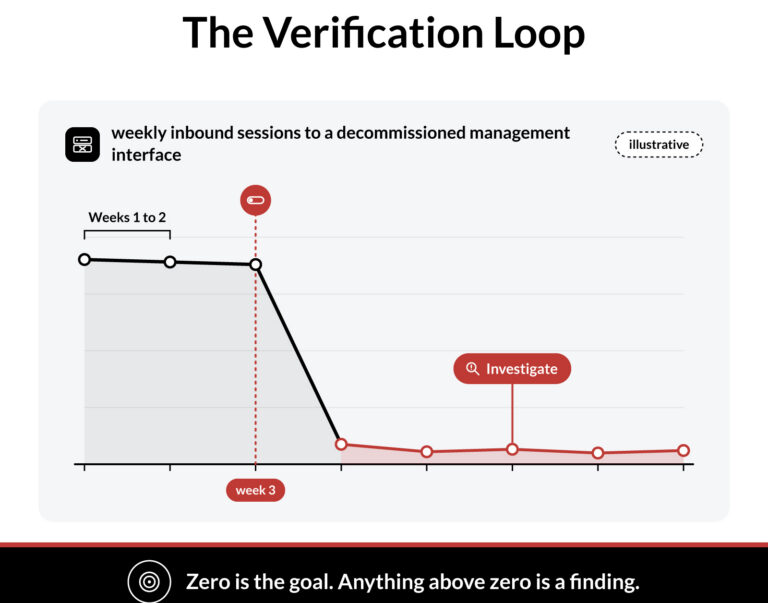
Closed tickets prove activity. Proof is a before and after comparison of traffic. Capture inbound sessions to an exposed service for two weeks, make the change, then compare. Sessions to a retired management interface should fall to zero. Whatever remains tells you something: a forgotten dependency, a partner integration, or an adversary who already got in.
This is where attack surface assessment and attack surface analysis earn their cost. They stop being quarterly reports and become a running measurement, which is the only form of cybersecurity risk management a board can verify. Report these:
- Exposed services with a documented business owner versus without
- Median days from discovery to removal
- Share of edge devices with session-level visibility
- Hostile inbound sessions still reaching retired assets
Where NetWitness Fits in Attack Surface Reduction
NetWitness takes a forensic approach to attack surface management. NetWitness Network captures full packets and enables analysts to piece together entire sessions across the network, including edge devices and gateways that cannot have an agent deployed to them. It is possible for an analyst to transition from a UEBA incident to packet capture to endpoint data on the infected machine all within the platform itself, thus a suspicious session will immediately lead to the host and ultimately the user account. This allows you to prove that your service stopped communicating when you shut it down or that traffic was still being received even after you stopped it.
The teams that win in 2027 won’t have the longest asset list. They’ll have the shortest list of things attackers can still reach, and the session records to back it up.
Frequently Asked Questions
1. What are the most effective attack surface reduction strategies?
Remove unneeded internet exposure first, especially management interfaces and legacy gateways. Rank what remains by observing traffic, cutting standing privilege, and retesting each change against real session data.
2. Why should CISOs prioritize attack surface reduction in 2027?
Exploitation now leads to initial access, and attackers hand off footholds in seconds. Less reachable surface means fewer chances for that speed to matter.
3. What is the difference between attack surface reduction and attack surface management?
Attack surface management is the ongoing discipline of finding, tracking, and monitoring exposure. Attack surface reduction is the outcome you pursue with it: fewer reachable, exploitable assets.
4. How does attack surface visibility help reduce cybersecurity risk?
Visibility shows which exposed assets are actually contacted, by whom, and how often. That turns a long vulnerability list into a short list of real priorities.
5. How can organizations reduce the attack surface created by identity risks?
Remove standing privileges, shorten token lifetimes, and baseline service accounts and remote management tools. Alert behavior that departs from the baseline rather than logins alone.
6. How can CISOs measure the success of attack surface reduction initiatives?
Track hostile inbound sessions to retired assets, days from discovery to removal, and the share of edge devices with session visibility. Falling traffic to remove services is the clearest proof.
The Hidden Cost of Incomplete Cyber Investigations
Incomplete investigations leave critical security gaps. Discover how missing evidence impacts threat detection, incident response, and enterprise security.