What is Cyber Threat Visibility and Why it Matters?
The concept of cyber threat visibility is defined as the ability to monitor and understand activities happening across endpoints, networks, and cloud environments in real-time. For organizations that are modern and have remote workers, cyber threat visibility is a critical concept that helps organizations detect and respond to potential threats in a timely manner.
For organizations that lack real-time visibility tools and SOC visibility solutions, they are more likely to experience vulnerabilities that are taken advantage of by hackers, making it difficult to detect advanced threats.
Introduction
In my role, I am fortunate enough to work with some of the brightest people working in security.
I recently penned a blog post about organizations embracing the idea of a dynamic workforce where employees can access resources and perform their job from anywhere. However, there are considerations that must be made to protect the organization from new cyber threat visibility challenges and vulnerabilities introduced by the model of remote work.
This blog post is inspired by the conversations I’ve had with Halim Abouzeid, System Engineer. He shared with me some perspective based on conversations with customers.
Cyber Threat Visibility: Key Insights for Security Operations Teams
Brian Robertson: Halim, we know with the current state of the world, a dynamic workforce is critical for keeping businesses running and productive. What is the one thing you would say is most important to have to make this successful?
Halim Abouzeid: In order to support a dynamic workforce, and keep malicious actors at bay, visibility becomes your best asset. Cyber threat visibility cannot only be within the physical confines of your organization, it needs to be extended to the end users everywhere.
How to Improve Threat Visibility Across Network, Endpoint, and Cloud
Robertson: Can you outline some things organizations should consider when trying to gain that visibility?
Abouzeid: There are six ways organizations can gain and improve their threat visibility:
- Organizations should consider monitoring packets that traverse the network from user device, across the network infrastructure and to the cloud, including VPN links and any other entry point into the corporate network. This strengthens network visibility.
- Organizations should monitor activity across all endpoints, on and off the network, for deep visibility into their security state, and properly prioritize alerts when there is an issue.
- Organizations can improve rule-based or signature-based threat detection systems with the addition of advanced machine learning techniques using user and entity behavior analytics and endpoint behavior analytics to detect anomalies that could suggest malicious intent and emerging threats, enabling advanced threat detection.
- In responding to an incident when it is detected, time is of the essence. Streamlining activities and processes within the security team is critical to quickly and efficiently getting to the heart of the problem.
- Context and threat intelligence are key, not only to increase detection capabilities based on known indicators, but also by providing confidence levels towards identified indicators and bringing in context around the identified attack and its threat actor.
- Organizations can even go as far as having machines automatically act on the security analysts’ behalf to mitigate incidents before they impact your organization.
How NetWitness Delivers Real-Time Visibility and Advanced Threat Detection
Robertson: How would you describe NetWitness Platform’s ability to help organizations focus on those areas?
Abouzeid: NetWitness Platform provides real-time visibility tools into network traffic across all internal (east-west), internet-bound (north-south), virtual infrastructure and cloud computing environments paired with deep process-level endpoint visibility.
This enables the platform to deliver SIEM/NDR visibility, helping detect intrusions as they are happening inside and outside the organization. Multiple types of behavior analytics detect anomalies across the network (whether on encrypted channels or not), suspicious activities of machines and users, as well as abnormal activities across applications, no matter where they reside.
Once detected, a prioritized and automated response to the full scope of the attack helps defend against current and future threats.
Use Case
Phishing Detection with Full Threat Visibility
Robertson: Can you provide a couple examples?
Abouzeid: A common one is phishing attacks. Phishing attacks take advantage of varying security awareness, lack of security controls or even bridging the home network to gain access to the corporate environment.
NetWitness Platform provides immediate threat visibility into the entire enterprise, at every step of the attack, with a synergistic view of log, network and endpoint data presented in a single pane-of-glass for security analysts, aligning with modern SOC visibility solutions.
Through respond functionality, it groups suspicious activities together into an incident for analysts to easily visualize.
Detect Unusual Process Activity with Endpoint and Network Visibility
NetWitness Endpoint allows an analyst to identify the email client application triggering a succession of processes and commands that it does not usually perform on a given workstation.
Having full payload access enhances network visibility, allowing analysts to reconstruct sessions and confirm threats quickly, improving advanced threat detection outcomes.
If the phishing attack was successful and the user machine was infected, an anomaly can be triggered due to abnormal encrypted communication between entities.
Automating the investigation and remediation process can be an enormous security multiplier for analysts, especially with the dynamic workforce opening new attack vectors.
Automating Response with SOC Visibility Solutions
NetWitness Orchestrator acts as a critical layer in modern SOC visibility solutions, enabling automation across detection and response workflows.
It can monitor a central mailbox, extract indicators, link them with threat intelligence, and automate response actions such as ticket creation, escalation, and notification.
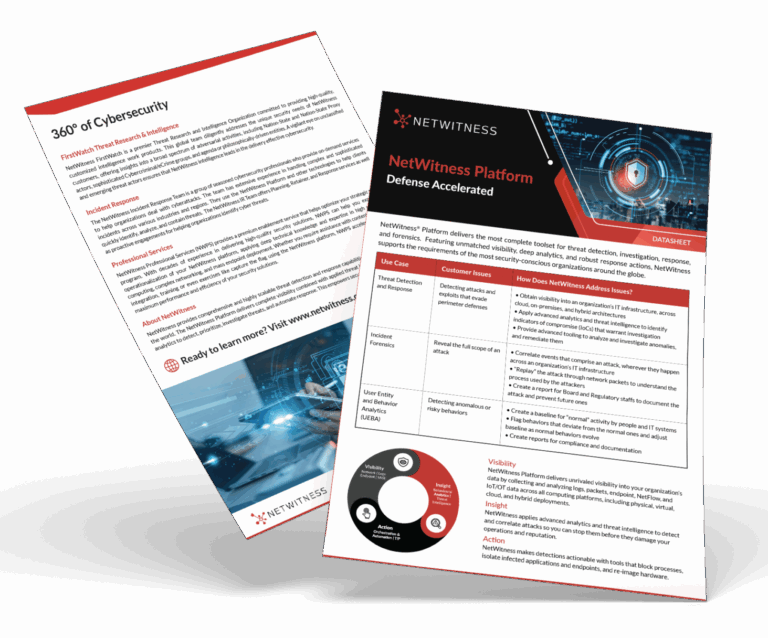
360° Cybersecurity with NetWitness Platform
– Unrivaled visibility into your organization’s data
– Advanced behavioral analytics and threat intelligence
– Threat detections and response actionable with the most complete toolset
Risks of Limited Visibility in Remote Work Environments
Another example is the risk created by employees working from home or outside the corporate facilities. With IT not being able to harden end-user devices, attackers exploit these gaps, creating visibility blind spots that weaken cyber threat visibility.
With an expanded remote workforce, it is critical to maintain strong network visibility and endpoint monitoring. NetWitness UEBA enhances SIEM/NDR visibility by identifying anomalies across logs, network traffic, and user behavior.
Conclusion: From Threat Visibility to Proactive Security
The need for cyber threat visibility with the dynamic workforce is becoming more critical to security operations. As employee access evolves, the attack surface continues to grow. Without strong real-time visibility tools, organizations risk delayed detection and response.
The key to minimizing risk lies in end-to-end threat visibility, from endpoint to network to cloud, supported by integrated SOC visibility solutions and advanced threat detection capabilities.
Frequently Asked Questions
1. Why is visibility important for security operations teams?
Visibility helps security operations teams monitor and respond to threats in real-time. In the absence of cyber threat visibility, security operations teams work in a reactive mode and compromise threat detection capabilities.
2. What causes visibility blind spots?
Blind spots occur due to encrypted traffic, unmanaged devices, cloud adoption, and fragmented tools. Lack of integrated SIEM/NDR visibility and poor network visibility are major contributors.
3. How can organizations improve visibility into unknown threats?
Organizations can deploy real-time visibility tools, integrate SOC visibility solutions, and use behavioral analytics like UEBA to enable advanced threat detection of unknown threats.
4. What role does encrypted traffic play in limiting visibility?
Encrypted traffic can obscure malicious activity, limiting network visibility. Advanced tools that analyze metadata and behavior patterns help restore cyber threat visibility without decrypting all traffic.
5. Do SIEM and NDR tools improve visibility?
Yes. SIEM and NDR tools deliver unified SIEM/NDR visibility that enables organizations to improve threat visibility and accelerate advanced threat detection by combining logs and network traffic.
Autonomous AI Defenders for a Smarter SOC