How can financial institutions defend against AI vishing attacks?
Financial institutions can reduce AI vishing risk by using phishing-resistant authentication, independent verification for sensitive requests, monitoring unusual authentication and user activity, and correlating network, endpoint, and identity signals. Network Detection and Response (NDR) can also help detect suspicious activity after an attacker gains access, providing visibility into account compromise, lateral movement, and other post-compromise behaviour.
On August 5, 2026, a coordinated wave of phone calls hit some of the biggest names in finance. Not phishing emails. Not malware. Phone calls, carrying voices employees recognized.
Citadel, Point72, Millennium Management, and Two Sigma Investments were all targeted in the same window, according to Bloomberg‘s reporting, along with several unnamed private equity firms. Attackers weren’t chasing a wire transfer, the classic goal of old executive-impersonation scams. They wanted credentials and internal access, and they were willing to call in as a trusted colleague to get it.
Two Sigma, which manages roughly $75 billion in assets, said it caught the attempt and shut it down before any data was touched. Point72 told investors it was attacked but found no evidence of stolen client data, with its review ongoing. Citadel and Millennium declined to comment on whether their defenses were breached.
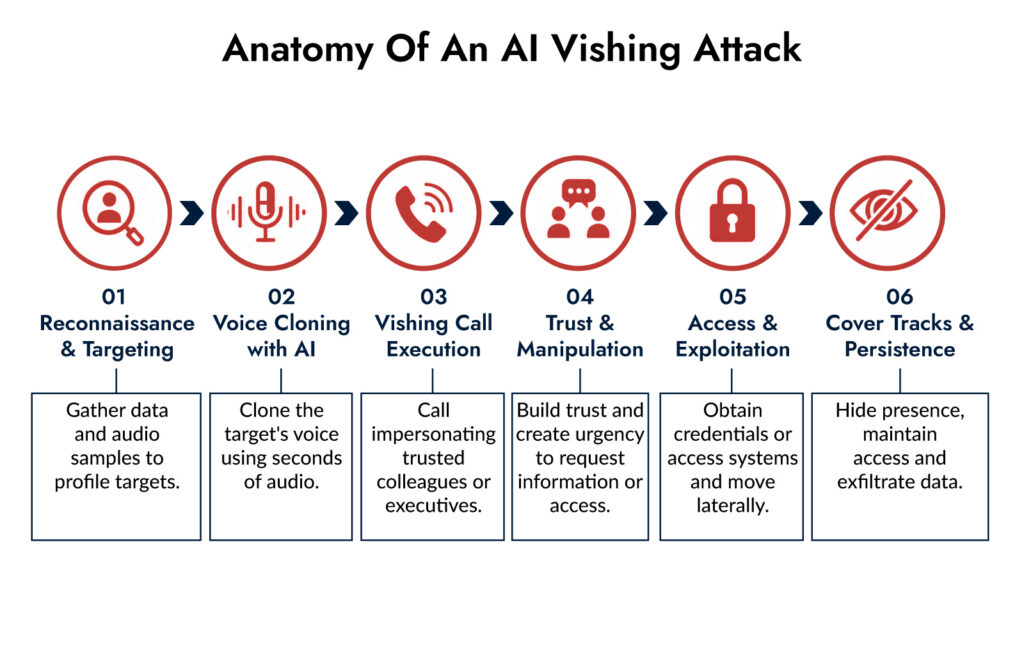
Vishing itself isn’t new. What’s new is what AI does to it: turning a slow, one-target con into something that hits an entire sector at once, using voices cloned from seconds of public audio.
Inside the Wall Street AI Vishing Attack
The mechanics were simple on paper. Attackers built synthetic audio modeled on executives, or colleagues or employees already trusted, then called in, often targeting help desks and IT support rather than random staff, because that’s where access gets granted.
A voice that sounds like your CFO asking for a password reset doesn’t raise the same red flags as a strange email does. That’s the point. Nothing here relies on technical vulnerability. It relied on people trusting a familiar voice on the phone.
What made this campaign notable was scale and timing. Attempts landed on multiple competing firms within days of each other, pointing to a planned campaign against a target list, not one attacker improvising. FINRA activated its Financial Intelligence Fusion Center in response, its first real-world test.
Why AI Makes Vishing Harder to Detect
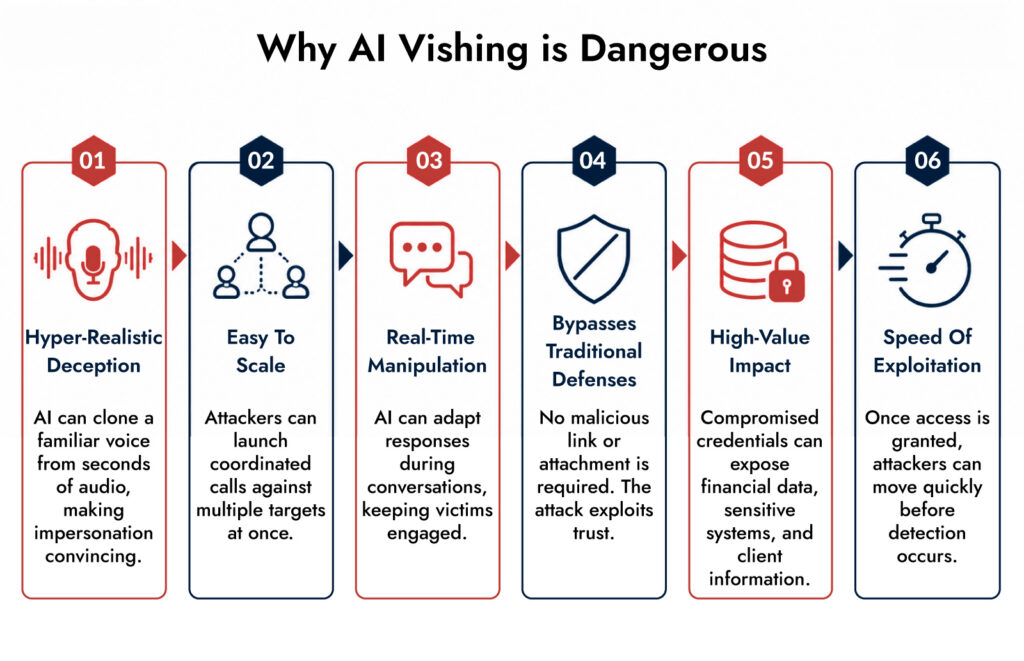
Old vishing leaned on scripts, easy to catch if someone asked an unexpected question. AI voice cloning removes that ceiling. Modern systems can generate a convincing clone from a few seconds of public audio, an earnings call, a podcast, and deploy it across hundreds of calls at once for the cost of a cloud subscription.
Worse, these systems can adapt in real time, adjusting answers based on what the target says. A suspicious follow-up question doesn’t necessarily break the illusion anymore. This is why standard phishing training doesn’t fully cover the threat. There’s no equivalent of “check the sender’s address” when the voice itself sounds exactly right.
What the Attack Reveals About Financial Sector Security
Strip away the headlines and this incident is really a stress test of assumptions security teams have been operating on for years. A few of those assumptions didn’t hold up.
Trust has become an attack surface. Security programs hardened networks and endpoints for years while treating trust between colleagues as a given. A cloneable voice ends that assumption. If a relationship built over years of phone calls can be faked in seconds, trust itself needs its own set of controls.
Identity verification cannot rely on voice alone. Any process that treats “the voice matched” as sufficient needs a callback to a known number or an out-of-band confirmation instead. Voice used to be a decent proxy for identity. It no longer is.
Help desks are becoming high-value targets. They exist to reduce friction for employees. Attackers exploit that same design, so credential-reset teams need verification steps matched to what they can approve, not the lightweight checks built for convenience.
Human detection has its limits. Even trained employees are being asked to catch something indistinguishable from a real colleague. That can’t be the last line of defense, no matter how good the training is.
Security teams need visibility beyond the endpoint. A vishing call trips no malware signature and touches no device directly. The compromise, if it happens, shows up afterward in login behavior and access patterns, which means the detection has to live there too.
How Financial Organizations Can Detect and Stop AI Vishing Attacks
Stopping every call before it lands isn’t realistic. What is realistic is closing the gap between a convincing phone call and actual account access, and catching what slips through faster.
- Move sensitive systems to phishing-resistant authentication like FIDO2 hardware keys, so a manipulated help desk interaction alone isn’t enough to get in.
- Require independent, out-of-band verification for any credential reset or access request tied to a phone call.
- Monitor for unusual authentication activity: new devices, odd hours, logins that follow shortly after a help desk ticket.
- Correlate network, endpoint, and identity signals together instead of reviewing each in isolation.
- Watch for post-compromise movement, since attackers still need to traverse systems to reach anything valuable.
- Build incident response workflows fast enough to match how quickly access can be exploited once it’s granted.
The Role of Network Detection and Response in AI Vishing Defense
Prevention will never be perfect. Employees are human, callers keep getting better, and eventually one call is going to land. That’s exactly why detection after the fact matters just as much as awareness before it.
Network detection and response doesn’t care how convincing the voice was on the call. It cares whether the behavior that follows looks normal for that user and that system. An account suddenly reaching systems it never touches stands out against a network baseline, regardless of how the attacker got in. That visibility needs to span users, applications, and infrastructure together, and it needs a forensic record behind it, because Point72’s ongoing review and Citadel’s silence both point to the same underlying problem: without that visibility, firms are often left guessing at their own exposure.
NetWitness’s approach to network detection and response is built around this kind of full visibility, correlating network, log, and endpoint data, so that unusual behavior following a social engineering attempt doesn’t go unnoticed inside normal traffic.
Building a Financial-Sector Security Strategy for AI-Driven Attacks with NetWitness
Fraud, phishing, impersonation, insider threat and account compromise are now more sophisticated, prevalent and tricky threats for financial institutions. NetWitness enables financial sector security teams to build more robust financial security by providing continuous visibility, behaviour analytics, threat detection, forensic investigation and proactive protection.
How NetWitness Works
NetWitness combines security capabilities to help financial organizations prevent fraud, ensure compliance, and maintain customer trust:
- Detect fraud in real time: NDR provides network visibility to identify suspicious traffic, command-and-control activity, data movement, and fraud patterns.
- Identify insider and account threats: UEBA detects unusual user behaviour that can indicate insider trading, compromised accounts, or fraudulent activity.
- Monitor critical financial systems: SIEM analyses logs from systems such as SWIFT to identify suspicious activity and support security investigations.
- Reconstruct attacks: Full-packet capture enables forensic investigation of network activity, helping teams understand how fraud or breaches occurred and validate evidence.
- Support compliance: Centralised security data and reporting help organisations meet requirements such as PCI DSS and other regulatory mandates.
- Disrupt threats proactively: BforeAI helps identify phishing sites, fake banking portals, and impersonation campaigns before they result in financial loss, reducing fraud risk and response costs.
Key Takeaways for CISOs and Security Teams
If there’s one thing this incident should change, it’s how security teams think about the line between a phone call and a breach. A few principles carry the most weight going forward.
- Authentication and trust are no longer synonymous. A familiar voice, even one that sounds exactly right, is not proof of identity anymore. Any process still treating “it sounded like them” as verification needs to be rebuilt.
- Every high-risk request needs independent verification. Credential resets, access changes, and anything touching money or client data should require confirmation through a channel separate from the one the request arrived on, a callback to a known number, a secondary approver, a pre-established code word.
- AI-powered attacks require layered detection. No single control, not training, not authentication, not monitoring, will catch every attempt on its own. The firms with the best outcomes are stacking several weaker checks rather than betting everything on one strong one.
- Financial organizations need visibility before, during, and after compromise. Stopping the call is the ideal outcome, but firms also need the forensic depth to answer, with confidence, whether an attempt that wasn’t stopped actually resulted in access. Uncertainty after the fact is its own risk.
- Speed of response matters as much as the strength of prevention. The gap between a successful vishing call and meaningful account access can be short, so incident response workflows need to move at that same pace, not the pace of a quarterly security review.
Conclusion: When a Voice Can Be Faked, Verification Must Be Independent
This campaign wasn’t a new kind of attack. It was an old trick, executive impersonation, run through a technology upgrade that changed its scale and credibility. Two Sigma stopped it. Others are still figuring out what happened. That gap says everything about where financial sector security needs to go next: decouple trust from familiarity, verify sensitive requests independently, and build the visibility to know quickly when something has actually gone wrong.
Frequently Asked Questions
1. What is AI vishing?
IoT Network Security protects connected devices, networks, and data from cyber threats using tools like network monitoring, IoT threat detection, encryption, and access control. It helps improve network visibility and overall IoT security.
2. Why is AI vishing a threat to financial institutions?
Financial institutions are high-value targets, and AI makes vishing more convincing and scalable. Attackers can use cloned voices to target employees who have access to sensitive systems and credentials.
3. How can organisations detect AI vishing attacks?
Organisations should monitor unusual authentication activity, abnormal user behaviour, and network activity following suspicious interactions. Correlating identity, endpoint, and network signals can help identify post-compromise activity.
4. How can financial institutions prevent AI vishing attacks?
They can use phishing-resistant authentication, require independent verification for credential resets and access requests, and strengthen monitoring for unusual authentication and post-compromise activity.
5. How does NetWitness help protect against AI-driven attacks?
NetWitness combines NDR, UEBA, SIEM, full-packet capture, and BforeAI capabilities to help financial organisations detect fraud patterns, identify abnormal behaviour, monitor critical systems, investigate incidents, support compliance, and disrupt phishing and impersonation threats.
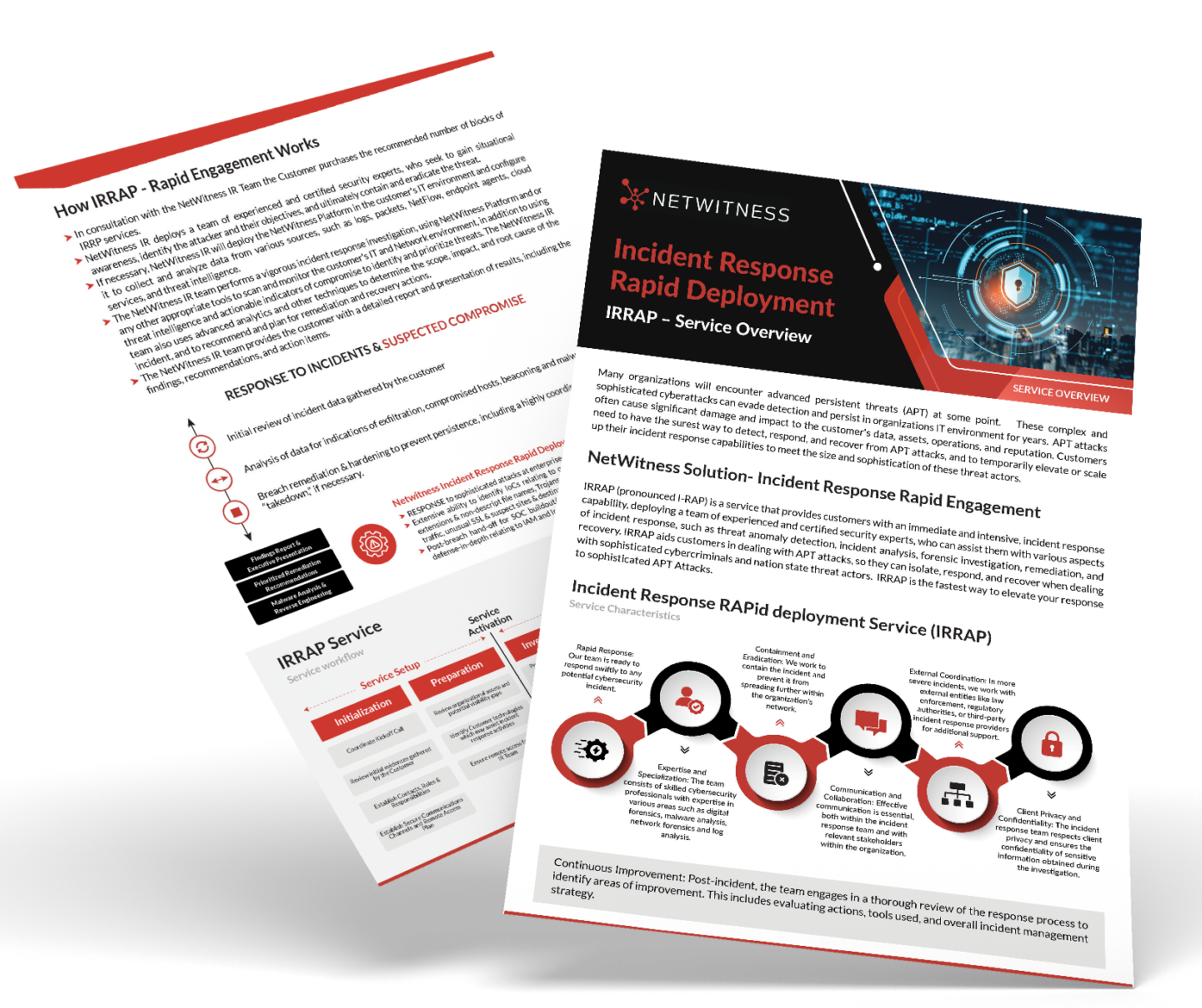
Respond to Advanced Threats Before They Escalate
- Deploy Expert Responders in Hours
- Identify Patient Zero
- Contain and Eradicate Attackers
- Reduce Attacker Dwell Time