What is identity threat protection?
Identity threat protection is the combination of controls, monitoring, behavioral analytics, detection, investigation, and response used to identify and reduce attacks involving user accounts, privileged identities, service accounts, credentials, sessions, and authentication tokens. Effective identity threat protection also evaluates what identities do after authentication so compromised but valid accounts can be detected.
A failed login is easy to understand. A successful one is more complicated.
If a user fails MFA repeatedly from an unusual geography, most security teams know where to look. But suppose the username and the password are correct; the authentication obviously succeeds. The device is also known, and nothing in the initial login looks sufficiently abnormal to trigger an immediate response.
Twenty minutes later, that same identity accesses a server it has never touched before.
It begins using SMB where its historical activity is predominantly SaaS access. An RDP session appears. LDAP activity increases. A privileged resource is accessed. Data begins moving between systems that normally have little reason to communicate.
Which event proves compromise? Often, none of them does independently. The identity becomes suspicious because of the sequence and context of its behavior.
That is the problem modern identity threat protection needs to solve.
Identity security cannot stop at establishing whether somebody was able to authenticate. Once credentials, tokens, sessions, or legitimate accounts are compromised, we need enough telemetry to ask a harder question: Does what this identity is doing still make sense?
That is where NetWitness has an important role to play.
Identity-Based Attacks Are Becoming a Post-Authentication Problem
Credential abuse is hardly new. What has changed is how well attackers can operate once they obtain legitimate access.
MITRE ATT&CK’s Valid Accounts (T1078) technique reflects exactly this problem. Adversaries may abuse domain, local, cloud, or default accounts for initial access, persistence, privilege escalation, and defense evasion. MITRE also notes that attackers may deliberately avoid malware or additional tooling when legitimate access already gives them what they need. That distinction matters operationally.
Security teams have spent years improving authentication through MFA, conditional access, SSO, privileged access controls, and identity governance. Those controls remain essential. But authentication systems primarily determine whether presented identity material satisfies the conditions required for access.
They cannot always determine whether the legitimate account is now being operated by the legitimate person for a legitimate purpose.
The gap is wider when MFA is satisfied rather than bypassed. If an attacker steals a valid session token, for example through infostealer malware or adversary-in-the-middle phishing, the authentication system sees an already-authenticated session. What remains is the behavior of that session.
The SANS 2026 State of Identity Threat Detection and Response found that 85% of surveyed organizations had ITDR capabilities deployed, yet 55% reported an identity-related breach in the previous 12 months. While 68% said they could detect identity attacks within 24 hours, only 55% could contain them within that timeframe.
This is why our approach to identity threat detection looks beyond the authentication event.
How We Use NetWitness to Reveal Identity Abuse
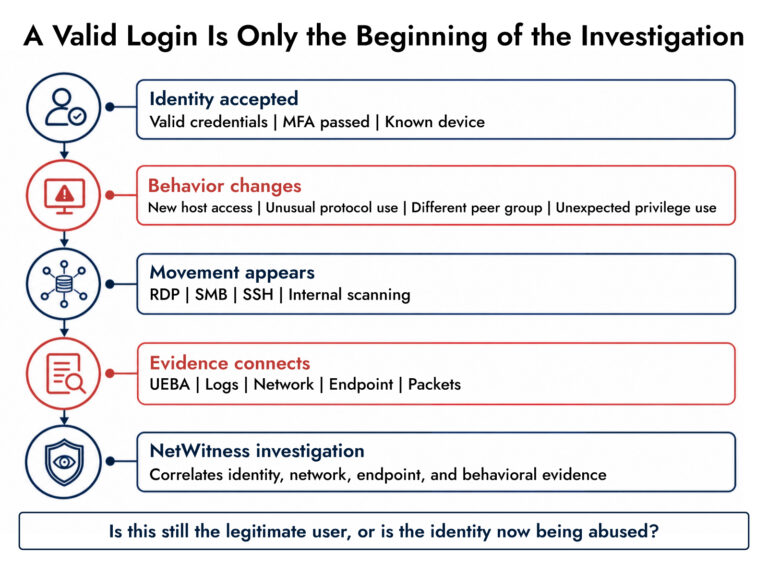
We do not rely on a single identity signal to decide whether a user is compromised. We look at the behavior around the identity.
NetWitness combines behavioral analytics with visibility across logs, network traffic, endpoint activity, and other security telemetry. Our platform is designed to let analysts move between those signals as part of the same investigation instead of treating identity, network, and endpoint activity as separate stories.
Here is how that changes an identity-abuse investigation.
1. Establish What is Normal for the User and Entity
Rules are useful when we already know what we are looking for. Identity abuse often sits outside that model.
A compromised employee account may use normal applications, approved protocols, and legitimate resources. What distinguishes the behavior may be that it is abnormal for that user.
NetWitness UEBA applies behavioral analytics and machine learning to telemetry collected by the platform to identify anomalous users and entities.
That gives analysts a way to investigate: “Is accessing server B normal for user A?” And: “Do other users with similar roles behave this way?”
The difference is important for compromised credentials and insider threat detection.
2. Put Authentication Activity Beside the Rest of the Logs
Authentication logs rarely tell the entire story. With NetWitness SIEM, we can bring log activity from across the environment into the same investigation so analysts can correlate authentication with other events.
That might include activity associated with:
- Active Directory
- remote access infrastructure
- cloud environments
- SaaS applications
- servers
- network infrastructure
- security controls
- endpoints
The sequence becomes more useful than the isolated login.
For example:
08:54: Successful remote authentication
09:02: Access to an unusual internal host
09:06: Privileged authentication
09:11: Multiple file-share connections
09:15: Endpoint process launches remote administration activity
09:23: Large outbound session begins
Any one event may be explainable. Together, they warrant investigation. That is the difference between collecting authentication logs and performing meaningful identity threat detection.
3. Follow the Identity onto the Network
This is where NetWitness becomes especially valuable. An attacker who has obtained legitimate credentials still has to interact with infrastructure. That activity creates network evidence.
MITRE specifically identifies legitimate remote services such as RDP, SMB, SSH, WinRM, and cloud services as mechanisms adversaries can use with valid accounts for lateral movement. Its behavioral detection guidance also recommends examining what happens immediately after remote authentication for example, uncommon commands, file manipulation, privilege escalation, or additional network connections.
NetWitness NDR analyzes network traffic, metadata, communication patterns, and behavioral changes to support lateral movement detection. We add full-packet capture, session reconstruction, metadata enrichment, and network forensics so analysts can move from detecting unusual communication to investigating what actually occurred.
It helps because identity abuse can look entirely legitimate at the authentication layer while looking highly unusual from the network.
Identity abuse also leaves specific traces on the wire, beyond generic east-west noise. Analysts can look for unusual Kerberos ticket requests, NTLM authentication where Kerberos is normally used, LDAP enumeration from hosts that do not usually query the directory, and replication requests toward domain controllers from systems that are not domain controllers.

“After a suspicious login, the useful question is rarely whether the password was valid. It’s where the account went next. An attacker can borrow an identity, but still has to cross the network to use it, and that path is the evidence worth having kept.”
—Dominik Czyz, NetWitness
4. Add Endpoint Context to Understand What Drove the Activity
Suppose UEBA identifies abnormal behavior and NDR reveals unusual lateral movement.
The next question is obvious: What happened on the endpoint?
- Was the network connection initiated through a standard administrative tool?
- Was PowerShell involved?
- Did an unusual process launch before the authentication event?
- Was a remote-access utility used?
- Did another process begin enumerating resources?
NetWitness Endpoint provides additional host and process-level context that can help analysts connect user activity with what was executing on the system. Our insider-threat approach specifically combines endpoint visibility with identity, logs, network telemetry, and behavioral analytics to investigate suspicious user activity.
This is valuable because user behavior and endpoint behavior are related but not interchangeable.
5. Use Packet Evidence When an Alert is Not Enough
This is one area where identity investigations benefit significantly from NetWitness. Alerts tell analysts that something crossed a detection threshold. Packets can help them determine what actually happened.
With full packet capture, an analyst investigating a suspicious identity can potentially reconstruct relevant network sessions, inspect metadata, review communication between systems, and determine whether activity that looked suspicious at the behavioral layer has supporting network evidence.
This helps find out which systems the account authenticated to, which network paths it moved through, which protocols it used, and which sessions it generated. For a SOC deciding whether to disable a privileged account, isolate an endpoint, or escalate an incident, that distinction matters.
Simplify audit readiness with complete security evidence and visibility. Discover where compliance gaps exist.
What an Identity Abuse Investigation Can Look Like in NetWitness
- Consider a privileged engineering account.
- The credentials are valid.
- The initial authentication comes through an expected access path.
- MFA succeeds.
- Nothing about the authentication itself creates enough confidence to declare compromise.
Then NetWitness begins connecting the surrounding evidence.
Behavioral context: UEBA identifies that the account is active at an unusual time and interacting with systems outside its normal pattern.
Log context: Authentication events show the account appearing across several systems over a short interval.
Network context: NDR observes RDP followed by SMB activity between systems that do not normally communicate.
Endpoint context: Endpoint telemetry shows unexpected remote administration activity on the initiating workstation.
Network evidence: Packet and session data helps the analyst reconstruct the communication path.
Threat context: Related indicators can be checked against available threat intelligence.
Instead of six disconnected alerts, the analyst has one investigation centered around the identity and its behavior.
That is how we think identity threat detection and response should work.
Identity Abuse and Lateral Movement are Closely Connected
For many serious intrusions, compromising an identity is not the destination. It is transportation.
Once an attacker controls a useful account, that identity can become the mechanism for accessing additional systems and privileges.
MITRE describes valid domain credentials as a pathway attackers can use across multiple machines and services. It similarly documents RDP, SMB, SSH, WinRM, cloud services, and other remote mechanisms under its lateral-movement techniques.
That makes lateral movement detection particularly important in an identity protection architecture.
We want to know when:
- an account begins touching systems it normally ignores,
- administrative protocols appear in unusual places,
- a user begins communicating across multiple network segments,
- privileged assets become involved,
- the same identity appears across endpoints unexpectedly,
- east-west communication changes,
- access spreads rather than remaining confined to the original system.
Without network visibility, defenders can identify a suspicious identity yet still struggle to determine how far the attacker traveled.
What Should You Look for in an Identity Threat Protection Service?
If you are evaluating identity threat protection or identity threat detection and response, look beyond the number of identity-specific detections a vendor advertises.
Ask whether the platform can support the investigation that starts after the alert.
| Capability | Question to Ask |
| Behavioral analytics | Can the platform establish baselines for users, peers, devices, and entities rather than relying only on static rules? |
| Cross-domain correlation | Can analysts connect identity events with logs, endpoint activity, network traffic, and threat intelligence? |
| Network threat detection | Can it identify unusual east-west communication and activity occurring after authentication? |
| Lateral movement detection | Can it follow RDP, SMB, SSH, and other internal movement patterns across systems? |
| Endpoint context | Can analysts see the process or host activity associated with suspicious identity behavior? |
| Evidence retention | Can the SOC go back and investigate what actually happened rather than relying entirely on an alert summary? |
| Investigation workflow | Can analysts pivot between user, host, IP, session, and related evidence without manually rebuilding the incident? |
| Response integration | Can validated identity incidents trigger or support containment workflows? |
Where NetWitness Fits in an Identity Security Architecture
NetWitness does not replace your identity provider, MFA platform, PAM controls, or identity governance program. Those systems control and govern identity. Our value becomes particularly clear when the SOC needs to determine whether a valid identity is being abused.
NetWitness brings together:
- UEBA to identify behavior that deviates from expected user and entity patterns.
- SIEM and log visibility to connect authentication with activity elsewhere in the environment.
- NDR for network threat detection, east-west visibility, behavioral analysis, and lateral movement detection.
- Full packet capture and network forensics to give analysts evidence behind suspicious network activity.
- Endpoint visibility to understand host and process activity associated with an identity.
- Threat intelligence and investigation workflows to enrich and connect the signals surrounding an incident.
That combination gives the SOC something an isolated login alert cannot provide: the story around the credential.
Frequently Asked Questions
1. What features should I look for in an identity monitoring service?
Look for
- behavioral baselining,
- peer-group analysis,
- authentication monitoring,
- privileged-account visibility,
- cross-domain correlation,
- network threat detection,
- endpoint context,
- lateral movement detection,
- investigation workflows,
- historical evidence,
- response integrations.
For enterprise SOCs, the ability to connect identity signals with network, endpoint, cloud, and log telemetry is particularly valuable.
2. How do identity threat protection services detect fraudulent activity?
Identity threat protection services typically analyze
- authentication events,
- access patterns,
- location,
- devices,
- privileges,
- historical behavior,
- risk signals.
More advanced approaches also correlate those signals with network and endpoint activity. This can reveal suspicious behavior even when an attacker has successfully authenticated using legitimate credentials or tokens.
3. How can organizations detect compromised credentials?
Organizations can detect compromised credentials by combining authentication monitoring with behavioral analytics. Look for unusual access times, new systems, unexpected privilege use, abnormal geographic or device patterns, lateral movement, unusual network communications, and changes in resource access. Correlating identity, network, endpoint, and log telemetry helps determine whether a successful login represents legitimate activity or account takeover.
4. How does user behavior analytics help detect identity abuse?
User behavior analytics establishes a baseline of expected activity for users and entities and identifies meaningful deviations from that baseline. It can surface behaviors such as unusual access times, first-time resource access, changes in peer-group behavior, anomalous system interactions, or unexpected network activity. In NetWitness, UEBA can be investigated alongside network, endpoint, and log evidence to provide additional context around suspected identity abuse.
Evaluate unified security platforms with confidence using a practical guide to essential capabilities.