How can technology companies improve cloud security visibility before threats spread?
With the ongoing expansion of cloud computing and SaaS solutions, the need arises for an all-around view of cloud security from the standpoint of a variety of different identities, workloads, networks, and applications to be possessed by security teams. Through the correlation of institutions’ cloud security data with that of endpoints, networks, and identity, security teams make it possible for enterprises to notice any threat sooner than before, thus decreasing the number of unobserved occurrences, and speeding up possible responses to incidents on time that attackers arrive at their targets.
Introduction
Technology firms are operating at a faster speed now than ever. Cloud workloads are launched in mere minutes, SaaS applications spring up almost instantaneously, and developers release updates continuously. This constant agility encourages innovation; however, it poses a significant challenge: maintaining visibility regarding the security of clouds.
Malicious actors do not have to compromise all systems; they just have to figure out a single overlooked workload, an unmanaged SaaS application, or a compromised identity. After getting in, they easily move through the whole cloud setups before security teams have enough time to act.
The average time taken by organizations to detect and fix a breach takes 258 days. Often, it takes significant time to assemble the pieces due to a lack of visibility rather than a lack of security equipment.
Why Cloud Security Visibility Matters
Cloud security visibility provides a complete picture of activity across cloud environments. Without it, security teams investigate isolated alerts instead of understanding the full attack chain.
Modern attacks rarely stay within one environment. A compromised account might first access a SaaS application, then escalate privileges in a cloud platform, and finally move laterally between workloads.
Without unified visibility, these events appear unrelated.
Strong cloud security monitoring helps organizations:
- Detect suspicious behavior earlier
- Identify compromised identities
- Monitor cloud workloads continuously
- Improve threat detection across hybrid environments
- Support faster incident response
The 2025 Verizon Data Breach Investigations Report continues to show that stolen credentials and vulnerability exploitation remain among the most common initial attack vectors, reinforcing the need for continuous visibility across users, applications, and infrastructure.
Where Technology Companies Lose Visibility
Most visibility gaps develop as cloud environments evolve rather than through a single security failure.
Common blind spots include:
- Shadow SaaS – Teams often adopt SaaS applications without security oversight. These platforms may contain sensitive data but remain outside existing monitoring processes.
- Identity sprawl – Employees, contractors, service accounts, and automated workloads all require permissions. Poor visibility into identity activity makes credential misuse difficult to detect.
- Multi-cloud complexity – Different cloud providers generate different logs, making it difficult to correlate activity across environments.
- Limited network visibility – Traditional perimeter monitoring provides limited visibility into east-west traffic between cloud workloads, where lateral movement frequently occurs.
Example: A developer’s Microsoft 365 account is compromised through phishing. The attacker accesses GitHub creates cloud API tokens and later connects to production workloads in AWS. Viewed separately, each event appears routine. Correlated through cloud security visibility, they reveal an active attack in progress.
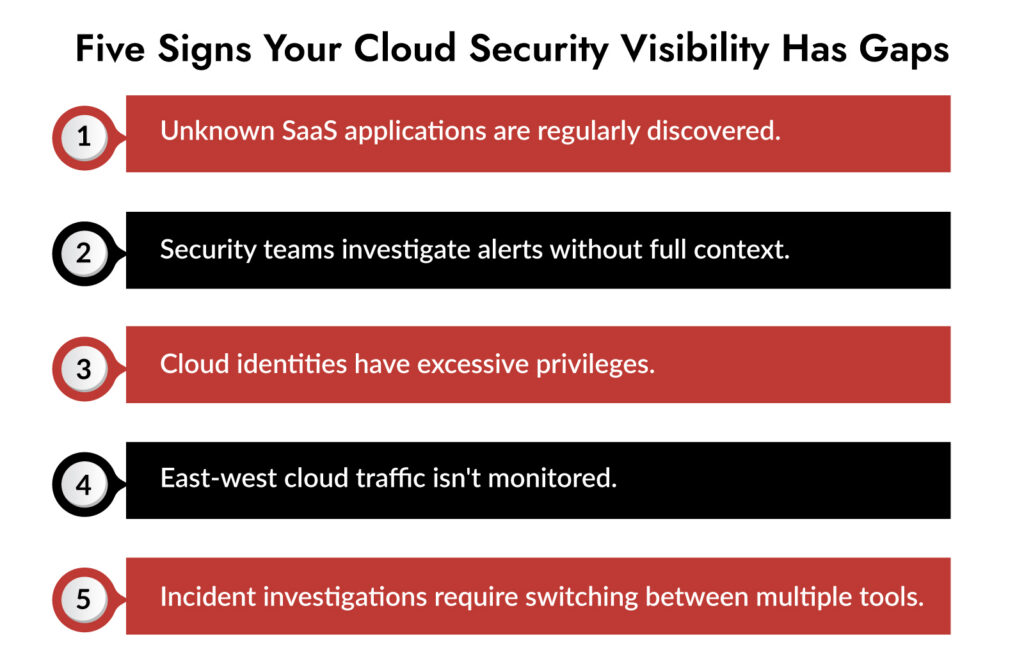
Five Ways to Improve Cloud Security Visibility
Closing visibility gaps requires continuous monitoring rather than periodic assessments.
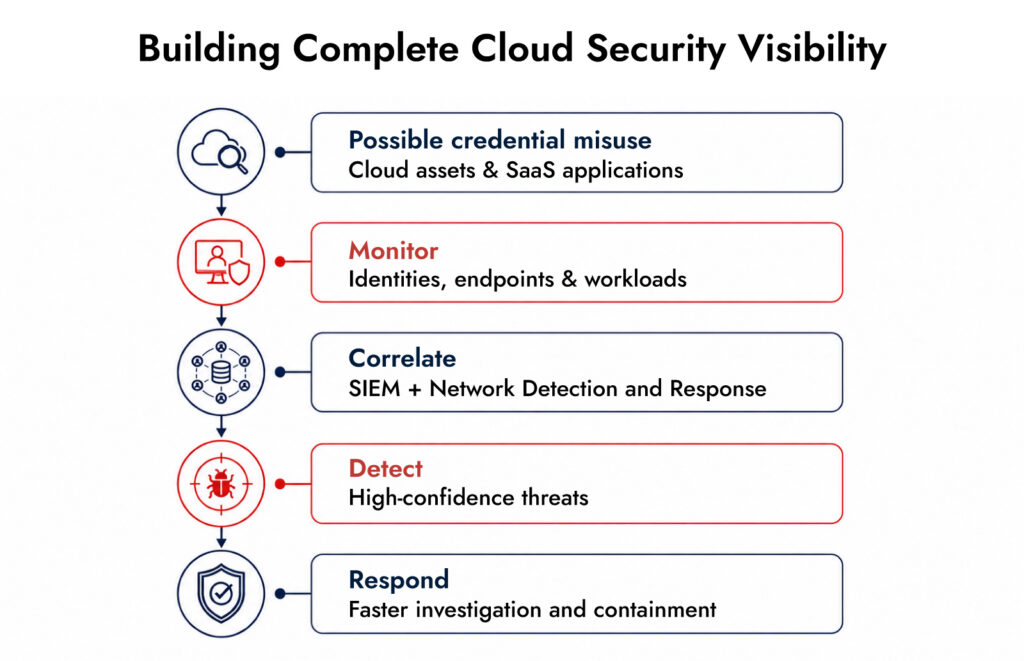
- Discover every cloud and SaaS asset – You cannot secure what you cannot see. Maintain an up-to-date inventory of cloud workloads, containers, APIs, storage, and SaaS applications.
- Monitor identities continuously – Most cloud attacks rely on valid credentials. Track authentication behavior, privilege changes, and risky sign-ins to support zero trust security.
- Correlate telemetry – Bring together logs, endpoint data, identity, network, and SaaS telemetry into one analytics platform. Correlation gives context that individual alerts lack.
- Enhance network visibility – Detection and response in the network provides behavioral context that log analysis lacks. East-west monitoring can help detect lateral movement before an attacker reaches important systems.
- Automate incident response – Connect security information and event management (SIEM) with incident orchestration and response processes. This will make your investigation quicker and shorten attacker dwell time.
Combined together, these methods will enhance visibility in the cloud environment.
How NetWitness Helps Improve Cloud Security Visibility
Effective visibility depends on connecting security data instead of managing isolated tools.
NetWitness supports cloud security visibility by correlating telemetry across cloud platforms, endpoints, networks, identities, and logs. This unified approach helps analysts investigate threats with greater context while reducing manual effort.
Key capabilities include:
- Centralized security information and event management (SIEM)
- Network detection and response for identifying lateral movement.
- Unified threat investigation across cloud, network, and endpoint activity.
- Behavioral analytics for detecting credential misuse.
- Rich forensic data to support faster incident responses.
Rather than generating more alerts, NetWitness helps security teams understand how attacks unfold across modern cloud environments.
Conclusion
As cloud technology adoption continues to accelerate, attackers are also adapting and evolving their techniques to target cloud environments.
If they depend on fragmented security solutions, businesses might not be able to establish connections between the events taking place in Cloud, identity activities, and network activity. Efficient visibility concerning security can fill in the gaps by enabling event-related information to be consolidated and making it possible to detect threats, investigate possible causes, and react to incidents more quickly.
For those involved in technology sector, having more visibility means more than just improving the security aspect – it has become one of the most vital instruments for ensuring reliable Cloud services, thus materially contributing to the advancement of businesses and lowering the risk of being attacked.
Frequently Asked Questions
1. How can technology companies improve cloud security visibility?
Technology firms can improve visibility in cloud security by constantly monitoring cloud workloads, SaaS apps, identities, endpoints, and network infrastructure while using correlation through SIEM and threat detection tools. The most efficient way to detect an SQL injection attack involves analyzing application log files, WAF alerts, database activity, and network forensics. Packet capture analysis can be used to determine any malicious SQL attacks, abnormal HTTP request, database errors, and signs of data exfiltration that cannot be seen from the logs.
2. How do you improve cloud security visibility in a multi-cloud environment?
Centralised cloud security monitoring that involves logs, identities, networks, and cloud-native information is a good way to do this.
3. What are the top cloud security visibility solutions for enterprises?
The best tools integrate SIEM, network detection and response, behavioral analytics, cloud monitoring, and automated incident response in one single security platform.
4. What role does SaaS security play in enterprise cybersecurity?
SaaS security helps protect cloud-based applications, identities, data, and integrations from misuse, unauthorized access, and credential-based attacks.
5. How can NetWitness help close cloud and SaaS visibility gaps?
NetWitness helps to enhance the visibility of the cloud environment by correlating telemetry of cloud, endpoint, network, identity, and logs.
14 Real Attacks. One Critical Lesson: Visibility Matters.
- See What Really Happened
- Reconstruct Attack Activity
- Uncover Hidden Threats
- Investigate with Packet-Level Evidence