How do you choose the right OT security provider?
Choosing the right OT security provider starts with understanding your operational technology environment, risk exposure, and security objectives. Look for OT cybersecurity solutions that provide asset visibility, OT threat detection, network segmentation, secure remote access, and OT risk management without disrupting operations. The most effective OT security platforms integrate with existing SOC tools and support industrial protocols used across manufacturing, energy, utilities, and critical infrastructure. Many organizations combine multiple OT security vendors to achieve stronger operational technology security through layered protection and improved incident response.
Introduction
OT cyber incidents put $329.5 billion per year at risk globally. In Q1 2025 alone, 708 ransomware incidents hit industrial entities, with manufacturing absorbing 68 percent of attacks. Ransomware groups targeting industrial organizations doubled from 80 to 119 between 2024 and 2025.
If you’re a CISO or security architect, you need operational technology security deployed now. The question is which OT security providers fit your environment and budget.
Here’s what the leading vendors deliver and where they actually win.
What To Look in Top Operational Technology Security Providers
OT security differs from IT security in one critical way: availability and safety come first. A forced reboot in IT is routine. In OT, an unplanned outage costs millions and risks lives. Any operational technology security platform must protect without disrupting operations.
OT networks run legacy devices with 15 to 25 year lifespans. These systems often can’t tolerate agents, network reconfiguration, or VLAN redesigns. Solutions requiring network downtime or inline appliances usually fail before deployment.
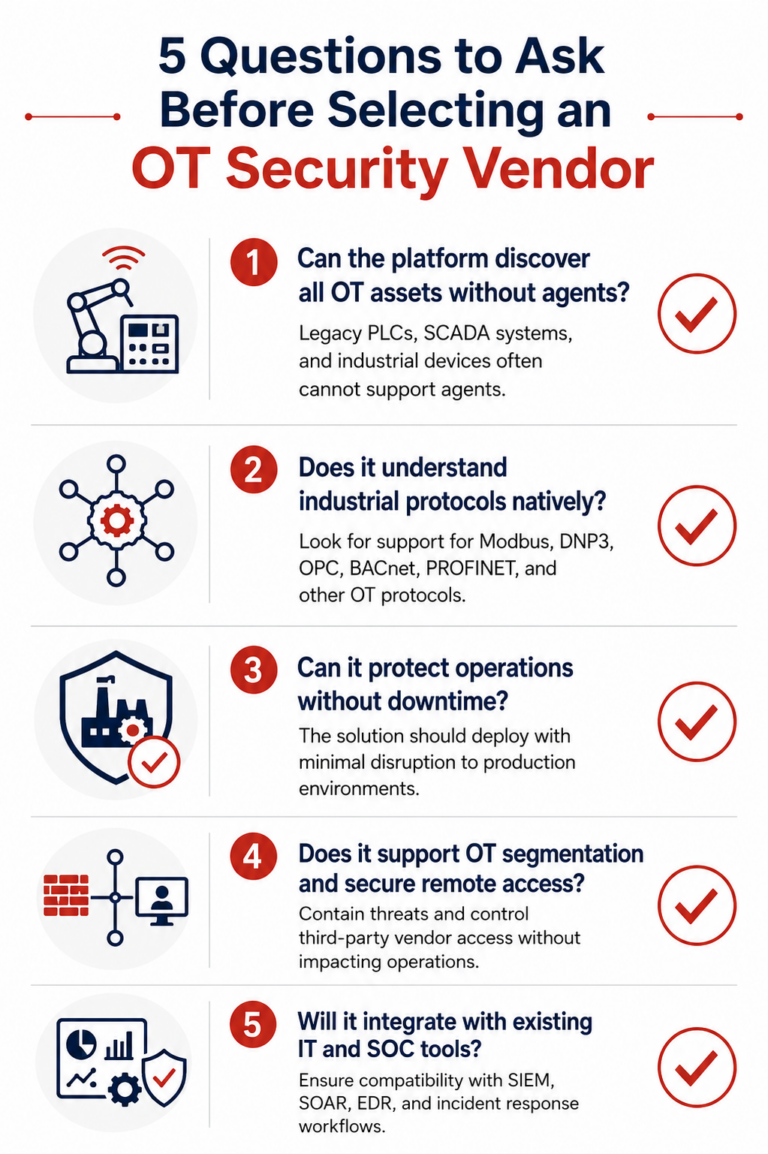
Before evaluating OT security vendors, ask yourself: Can this platform see what I’m protecting? Does it detect threats specific to industrial protocols? Can it enforce access controls without touching legacy controllers? Will deployment require a maintenance window? Does it integrate with what we already run? These questions eliminate most vendors quickly.
Most mature organizations deploy two or three complementary OT security providers, not one. One handles detection and visibility. Another handles segmentation and enforcement. Together, they create defense in depth that catches what moves and stops what shouldn’t move in the first place.
Top Operational Technology Security Providers Compared
Dragos
Best for: Critical infrastructure needing OT-specific threat intelligence and incident response.
Pros:
- Tracks 119 ransomware groups actively targeting industrial organizations; publishes industry-leading threat intelligence
- Understands 600+ ICS protocols natively; protocol-aware threat detection outperforms generic IT tools
- Dedicated incident response team with proven expertise handling major OT breaches
Cons:
- Higher cost; may be out of budget range for smaller deployments.
Pricing: Quote-based; typically six figures for enterprise deployments.
Nozomi Networks
Best for: Large enterprises with distributed OT operations across multiple sites or regions.
Pros:
- Protects 115 million assets across 12,000 installations; proven at scale with 96% customer retention
- AI-powered anomaly detection catches new industrial attack patterns; exceptional support quality
- Flexible deployment: cloud SaaS (Vantage) or on-premises sensors for air-gapped environments
Cons:
- Advanced modules require separate licenses, increasing total cost of ownership.
Pricing: Custom quote; cloud deployment and on-premises options available.
Claroty
Best for: Large enterprises managing complex OT, IoT, and medical device environments simultaneously.
Pros:
- Gartner 2025 Leader positioned highest for execution and completeness of vision among 17 vendors
- Handles OT, IoT, IoMT, and extended IoT across healthcare, manufacturing, and critical infrastructure
- Two deployment models (cloud xDome and on-premises CTD) provide architectural flexibility
Cons:
- Initial setup can be time-intensive; alert tuning requires effort in complex multi-OT environments.
Pricing: Custom quote; some sources indicate organizations pay up to $150,000 per user.
NetWitness
Best for: Organizations needing unified visibility across IT and OT infrastructure for threat detection and incident response.
Pros:
- Integrated SIEM/SOC platform with AI-driven detection across IT and OT simultaneously
- Answers critical questions about breach origin and lateral movement patterns
- Works well layered with specialized OT vendors to enrich SIEM data
Cons:
- Most effective when paired with dedicated OT threat detection and applicable for larger enterprises.
Pricing: Custom enterprise pricing; typically mid-to-high range for large deployments.
Network Intelligence
Best for: Organizations needing execution support, maturity assessments, and managed SOC services alongside detection.
Pros:
- Service-led model covers assessment, design, monitoring, and managed improvement
- Integrates proven tools (IBM QRadar, Palo Alto Cortex XDR, Darktrace) for comprehensive coverage
- Supports ISO 62443 and C2M2-aligned compliance; works across manufacturing, energy, utilities
Cons:
- Not a single product platform; requires more vendor management than traditional SaaS solutions.
Pricing: Custom and scope-based.
Fortinet
Best for: Organizations with Fortinet already deployed in IT seeking to extend into OT segmentation and remote access.
Pros:
- Cost-effective entry point; OT appliances start at $2,200-$4,000 with bundles scaling to $7,000-$10,000
- Strong microsegmentation and remote access control (FortiSRA) for third-party vendor management
- Ruggedized appliances built for industrial environments; low learning curve for Fortinet-familiar teams
Cons:
- Platform requires complex initial configuration and tuning across multi-product environments.
Pricing: Hardware $2,200-$4,000; bundles $7,000-$10,000 over multi-year terms; FortiGuard services $30,000-$50,000+ annually for enterprise.
CrowdStrike
Best for: Large enterprises wanting unified IT and XIoT visibility on a cloud-native platform.
Pros:
- Cloud-native architecture enables centralized management across distributed environments
- Unified visibility for engineering workstations and OT devices; reduces console sprawl
- Fast deployment with minimal friction; integrates well with existing Falcon environments
Cons:
- Protocol depth is limited compared to purpose-built OT vendors for pure industrial detection scenarios.
Pricing: Falcon Go $59.99/device/year; Falcon Pro $99.99/device/year; Falcon Enterprise $184.99/device/year. XIoT pricing via enterprise agreement.
Palo Alto Networks
Best for: Large enterprises already standardized on Palo Alto Networks seeking to extend IT security into OT.
Pros:
- Unified platform architecture; OT capabilities integrate seamlessly with existing Panorama and Data Lake infrastructure
- Strong for IEC 62443 zone-and-conduit segmentation; policy enforcement aligned with compliance standards
- Native integration reduces learning curve for teams already familiar with Palo Alto platforms
Cons:
- Higher total cost of ownership with hardware and licensing; not the most cost-effective entry point.
Pricing: IoT Security ~$9,500/year for ~1,000 devices (AWS Marketplace); NGFW appliances $5,000-$10,000+ depending on model.
Conclusion: How to Move Forward
OT security isn’t a single vendor decision. It’s a combination of detection, enforcement, and integration choices that fit your specific environment.
Start by identifying your primary problem. Are you struggling with visibility? Pick Claroty or Nozomi. Need threat intelligence and incident response expertise? Dragos leads. Already invested in a broader vendor like Fortinet or Palo Alto? Extend what you have rather than starting from scratch. Want unified IT and OT on one platform? CrowdStrike or NetWitness handle that.
Most organizations discover they need two vendors working together. One for detection, one for segmentation. That layered approach catches what moves and stops what shouldn’t move.
Don’t wait for the perfect plan. The organizations moving fastest are the ones that start with asset visibility, deploy microsegmentation to contain lateral movement, and then layer in threat detection. That sequence works. That’s proven.
Pick a vendor from this list, start with what you know needs protecting first, and build from there. The window between breach detection and lateral movement spread is measured in hours. Segmentation deployed today beats perfect architecture that’s still in planning next quarter.
Frequently Asked Questions
1. Who are the top operational technology security providers for industrial control systems?
Leading OT security providers include Dragos, Claroty, Nozomi Networks, Fortinet, Palo Alto Networks, CrowdStrike, and NetWitness. These OT security platforms deliver asset visibility, OT threat detection, network segmentation, and OT risk management capabilities designed for industrial control systems and critical operational technology environments.
2. Which are the best operational technology security companies for critical infrastructure protection?
The best operational technology security companies for critical infrastructure protection offer specialized OT cybersecurity solutions, threat intelligence, and continuous monitoring. Vendors such as Dragos, Claroty, and Nozomi Networks help organizations strengthen operational technology security across energy, utilities, transportation, and manufacturing sectors.
3. Which OT cybersecurity consulting firms specialize in manufacturing?
Several OT cybersecurity consulting firms specialize in manufacturing by providing OT risk management, security assessments, compliance support, and managed security services. Industrial cybersecurity vendors such as Network Intelligence help manufacturers improve OT security platforms and reduce cyber risk across production environments.
4. What features should an OT security platform include?
An OT security platform should include asset discovery, OT threat detection solutions, industrial protocol monitoring, network segmentation, secure remote access, risk assessment, threat intelligence, and integration with existing security operations tools. These features help improve operational technology security without disrupting industrial processes.
5. Can OT security solutions help prevent ransomware attacks?
Yes. OT cybersecurity solutions help prevent ransomware attacks through continuous monitoring, OT threat detection, asset visibility, and network segmentation. By limiting lateral movement and enabling faster response, OT security providers reduce the impact of ransomware and strengthen overall operational technology security.
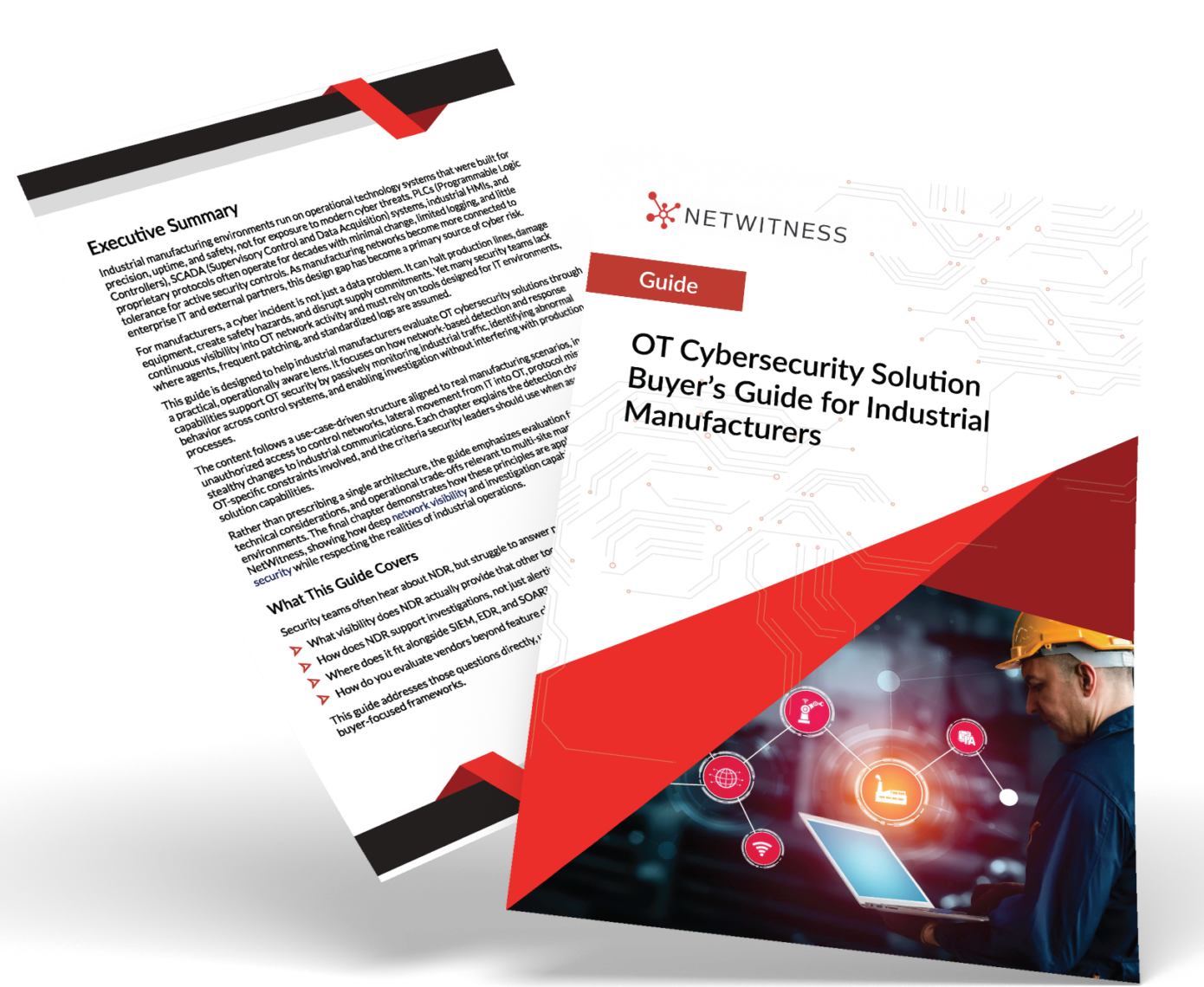
Find the right OT cybersecurity solution for your manufacturing environment.
- Assess critical security capabilities
- Compare OT security platforms
- Reduce operational risk
- Improve security visibility