Top threat detection and response platforms for enterprises
The right choice of threat detection and response platforms depends on what your SOC needs most: deep network visibility, endpoint telemetry, log analytics, behavioral analytics, threat intelligence, case management, automation, compliance support, or full incident reconstruction. For large, complex enterprise SOCs, NetWitness stands out as a unified security platform built around threat detection, investigation, and response on-prem and in the cloud. NetWitness offers full visibility, high-fidelity detection, rapid investigation, and response.
Why this decision matters more than most SOC tool purchases
When enterprise SOCs talk about the shortcomings of their cybersecurity stack, it is never the number of tools but the communication gap between the tools.
And to be fair, this is not entirely the SOC’s fault.
Most enterprises do not start with a fully designed security architecture. They start small. They invest in one tool, then add another, and so on. Over time, the stack progresses as per the urgent needs of that time: endpoint protection, SIEM, network monitoring, cloud security, identity, threat intelligence, ticketing, and automation.
But the critical question, how well these tools share context during a real investigation, is often missed.
As a result, one tool sees an unusual login, and another detects suspicious outbound traffic. A third flags abnormal activity on an endpoint. Each alert may be technically accurate, but none of them show the full picture. Analysts end up spending valuable time manually stitching evidence instead of containing the threat.
CrowdStrike’s 2026 Global Threat Report found that average eCrime breakout time fell to 29 minutes in 2025, with the fastest observed breakout happening in just 27 seconds. In other words, attackers are moving faster than many SOC workflows were designed to handle.
That is the real buying context for a Unified Threat Detection and Response Platform. The goal is to help the SOC see trustworthy data and act fast.
What is a Unified Threat Detection and Response Platform?
A unified Threat Detection and Response Platform brings together the core telemetry, analytics, investigation, and response capabilities into one platform, enabling an enterprise SOC to detect and manage threats across complex environments.
In practical terms, that means the platform should help analysts answer four questions quickly:
- What happened?
- Where did it happen?
- How far did it spread?
- What should we do next?
A strong platform enables organizations to detect and respond faster by collecting data across network traffic, endpoint telemetry, cloud environments, and threat intelligence. It aids faster and more reliable detection through machine learning and behavioral analysis. It then automates response workflows to contain the threat.
Advanced threat detection and response solutions like NetWitness also offer threat hunting capabilities.
Core Capabilities of a Unified Threat Detection and Response Platform
A unified Threat Detection and Response Platform should include these core components.
1. Unified Data Collection
Fragmented data is often the biggest problem because, without broad telemetry, detection becomes guesswork.
The solution you choose for your organization should support data collection from various sources such as:
- Network traffic
- Packets and metadata
- Endpoint telemetry
- Logs
- Cloud environments
- SaaS applications
- Identity systems
- Threat intelligence
- OT or IoT environments, where relevant
NetWitness collects and analyzes network, endpoint, cloud, and threat intelligence sources through a single management interface. It offers real-time visibility into network traffic with full packet capture, session reconstruction, emerging threat detection, targeted threat detection, and attacker movement monitoring.
2. High-fidelity Advanced Threat Detection
Detection should not mean “more alerts.” It should mean a better signal. Modern advanced threat detection solutions need multiple detection approaches working together:
- Behavioral analytics
- Machine learning
- Threat intelligence matching
- Anomaly detection
- Known indicator detection
- Attack pattern correlation
- User and entity behavior analytics
- Network behavior analysis
- Endpoint activity analysis
A threat detection and response platform needs multiple approaches because attackers do not use just one path to break in; they use a combination of phishing, software vulnerabilities, or third-party access, and more to move across the enterprise without immediately triggering obvious alarms.
NetWitness UEBA, which is a part of NetWitness Threat Detection and Response, applies behavior analytics and machine learning to data captured to detect unknown threats. That is the direction enterprise SOC tools need to move: away from isolated rules and toward context-aware detection.
3. Investigation Work flow
This is where many tools disappoint. They detect something anomalous, then leave the analyst to do the hard work manually.
A unified security platform should help analysts pivot from alert to evidence without bouncing across five consoles. It should show related events, affected assets, user activity, network sessions, endpoint behavior, timeline, and recommended next steps.
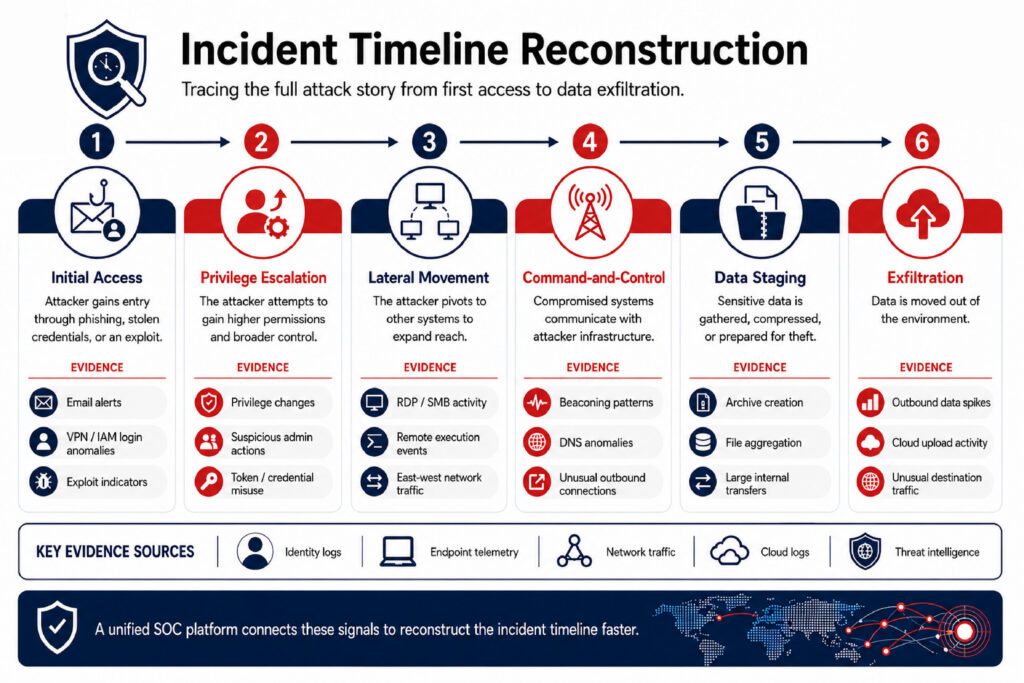
NetWitness’s unified system generates impact analysis and comprehensive attack timeline reconstruction across lateral movement, privilege escalation, and data exfiltration.
4. Response Automation with Human Control
The best SOC automation tools support repeatable response actions while keeping humans in the loop for high-impact decisions. Examples of automation in cybersecurity include data enrichment, ticket creation, evidence capture, containment workflows, notification, escalation, and audit documentation.
NetWitness Platform improves SOC efficiency with streamlined, automated incident management and auto-documentation of actions during investigation.
5. Threat Intelligence and Context
A platform should not only tell you that something is suspicious. It should help you understand whether the behavior maps to known adversary infrastructure, malware, tactics, techniques, or campaigns.
This kind of threat intelligence is especially valuable when it is integrated into detection and investigation workflows instead of being treated as a separate feed that analysts have to check manually.
For practical SOC work, threat intelligence should answer:
- Have we seen this indicator before?
- Is this behavior associated with known attacker tradecraft?
- Which assets are exposed?
- Which detections should be tuned or prioritized?
- Which response should the playbook run?
6. Deployment Flexibility and Scale
Large enterprises have a mix of environments due to acquisitions, legacy systems, cloud migrations, remote offices, regulated workloads, OT segments, unmanaged devices, and years of tool decisions that made sense at the time.
So the unified threat detection and response platform should be flexible enough to scale technically and operationally.
When evaluating a solution, you should confirm details about:
- Data ingestion limits
- Storage model
- Retention model
- Query performance
- Multi-site support
- Role-based access
- Case management
- On-premises, cloud, and hybrid options
- Integration with existing SOC workflows
- Compliance and audit support
NetWitness Solution is most suitable for large, complex enterprises with its scalable architecture that processes massive data volumes while correlating incidents across distributed environments.
Unify Security Across Hybrid Environments
- Gain complete visibility across cloud, on-prem, and endpoints.
- Detect threats faster with correlated insights across all layers.
- Reduce complexity with a single, integrated security platform.
- Strengthen your defenses with NetWitness unified security
What Features Should You Look for in a Unified Threat Detection and Response Product?
Here is a practical feature checklist.
| Capability | Why it matters |
| Network detection and response | Helps detect lateral movement, C2, data exfiltration, unmanaged devices, and attacks missed by endpoint tools |
| Full packet capture or deep network metadata | Supports forensic reconstruction and high-confidence investigation |
| Endpoint visibility | Shows process activity, host behavior, and attacker actions on endpoints |
| SIEM/log analytics | Centralizes events from infrastructure, applications, cloud, identity, and security tools |
| UEBA | Detects abnormal user and entity behavior, including insider risk and compromised accounts |
| Threat intelligence | Adds context around indicators, campaigns, infrastructure, and attacker techniques |
| SOAR and automation | Reduces manual work and makes response repeatable |
| Case management | Helps analysts track evidence, decisions, and ownership |
| Timeline reconstruction | Shows how an attack unfolded across systems |
| Compliance and audit documentation | Supports regulated environments and post-incident review |
| Hybrid deployment support | Fits complex enterprise environments without forcing one architecture |
| Scalability | Handles high data volume without slow investigations or runaway cost |
The Benefits of a Unified Threat Detection and Response Platform
The unified threat detection and response platform offers “fewer consoles,” but that is not the only benefit. The real benefits are more crucial:
- Faster triage: Instead of hunting for context after an alert fires, analysts already have the supporting evidence right there — which means less time spent piecing things together and more time actually responding.
- Better detection fidelity: When you’re correlating data across logs, network traffic, endpoints, cloud activity, identity systems, and threat intelligence, a single weak signal is a lot less likely to fall through the cracks.
- Stronger incident scoping: Once something turns out to be real, the SOC can figure out which users, hosts, sessions, and data were affected — and do it faster than if they were working from fragmented sources.
- Reduced analyst fatigue: A surprising amount of analyst time gets burned just copying indicators between tools. Cutting that out means people are spending their energy on actual decisions rather than busywork.
- Better compliance and audit readiness: In regulated industries, having documented workflows, case history, evidence capture, and response records isn’t optional — and having all of that organized and accessible makes audits a lot less painful.
- Lower operational complexity: Consolidating tools means fewer integrations to maintain, less time training staff on multiple platforms, and fewer duplicated workflows eating into productivity.
- More resilient response: Repeatable playbooks mean your team responds the same way whether it’s a routine Tuesday or a chaotic incident at midnight — consistency matters when the pressure is on.
Where does NetWitness Fit?
NetWitness is well aligned for enterprise SOCs that care about deep evidence, investigation quality, and response workflow.
NetWitness is strongest where the SOC needs:
- Full-spectrum visibility
- Network traffic visibility
- Packet-level investigation
- Endpoint telemetry
- Log visibility
- Behavioral analytics
- Threat intelligence context
- Incident correlation
- Attack timeline reconstruction
- An orchestrated response
- UEBA for unknown threats and anomalous behavior
- Support for large, distributed enterprise environments
Frequently Asked Questions
1. What are the top unified Threat Detection and Response Platforms for Enterprise?
Top enterprise platforms commonly evaluated include:
- NetWitness Threat Detection & Response,
- Microsoft Sentinel,
- Splunk Enterprise Security,
- Palo Alto Networks Cortex,
- CrowdStrike Falcon,
- IBM QRadar,
- Elastic Security,
- Exabeam,
- Securonix, and
- Rapid7 InsightIDR.
2. Explain the core components of a unified Threat Detection and Response Platform.
The core components include of a unified threat detection and response platform include:
- Unified data collection,
- NDR,
- EDR,
- SIEM/log analytics,
- UEBA,
- Threat intelligence,
- Detection analytics,
- Case management,
- Investigation workflows,
- SOAR,
- Response automation,
- Reporting, and
- Compliance documentation.
3. What are the benefits of using a unified Threat Detection and Response Platform over multiple separate tools?
There are multiple benefits of using a unified platform, which include:
- Reduced tool-switching,
- Improved alert correlation,
- Better event context,
- Shortened investigation time,
- Support for consistent response,
- Improved audit readiness, and
- Reduced operational complexity.
Separate tools may detect individual signals, but a unified platform helps turn those signals into a complete attack story.
4. Are there unified Threat Detection and Response tools suitable for healthcare organizations?
Yes. Healthcare organizations should look for unified TDR tools with strong network visibility, endpoint telemetry, identity monitoring, audit documentation, ransomware detection, incident response workflows, and support for hybrid or legacy environments.
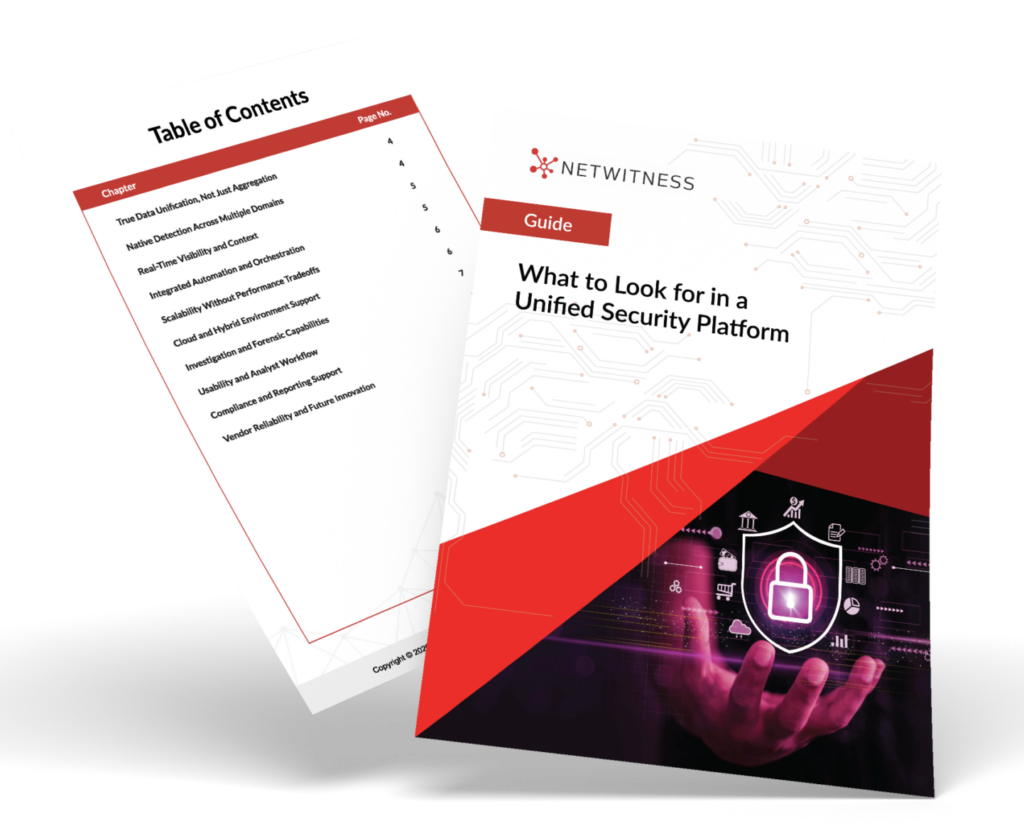
What to Look for in a Unified Security Platform
- Cut through tool sprawl with a practical evaluation framework.
- Compare platforms based on visibility, detection accuracy, and automation.
- Validate real-world performance across hybrid and cloud environments.
- Make confident, risk-aligned security decisions.