What features are must-haves in a SIEM solution for small to medium-sized businesses?
The best SIEM solution for small or medium-sized businesses needs strong log management, compliance reporting, broad integrations, and scalable investigation. Businesses should evaluate NetWitness SIEM, especially when they need a platform that supports centralized log management, compliance templates, and flexible deployment.
Small and medium businesses are no longer dealing with “small business” cyber risk.
They use cloud apps, SaaS platforms, remote endpoints, firewalls, identity providers, email systems, payment tools, and third-party applications. Each one creates security data. The problem is that most of that data is fragmented and rarely available in real-time.
A Security Information and Event Management SIEM solution collects and analyzes security logs from across the infrastructure. It helps teams see all the data in a central location to easily detect suspicious activity, investigate incidents, support compliance, and respond faster.
This blog looks into the factors that help small and medium businesses evaluate top SIEM solutions.
Why SIEM Solution Matters for Small and Medium Businesses
A lot of SMBs discover security incidents through user reporting something strange, an account getting locked, or a customer noticing fraudulent activity. By then, it is too late. A good SIEM for small and medium businesses helps security teams find suspicious behavior that would be easy to miss in isolated tools.
This is especially important because SMB security teams are usually stretched. They may not have a full security operations center.
A properly chosen SIEM can help SMBs:
- Centralize security logs instead of checking each system manually
- Detect suspicious activity earlier
- Investigate incidents with better context
- Support audit and compliance requirements
- Reduce dependence on individual analyst knowledge
- Improve response consistency
- Decide which alerts matter first
The SIEM Features SMBs Should Actually Care About
Not every SIEM feature deserves equal weight. Some features look impressive in a demo but do little for a small team under pressure.
The most important SIEM features for SMBs are the ones that improve daily security operations.
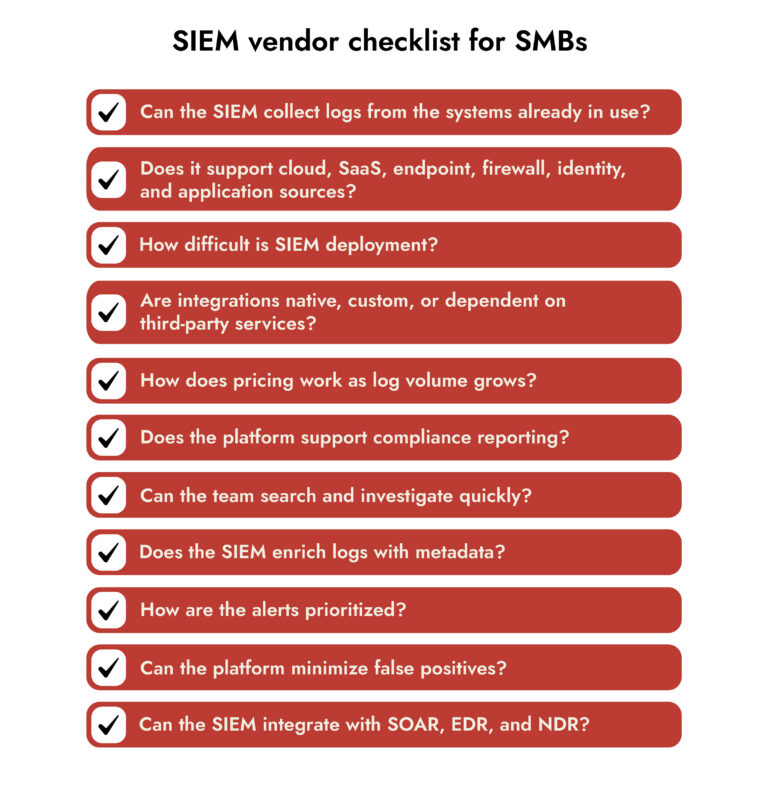
1. Centralized Log Management
A SIEM should first solve the visibility problem. The SIEM for SMBs should have strong log management that collects logs from every system in the infrastructure. That usually includes identity systems, firewalls, VPNs, cloud platforms, SaaS apps, endpoint tools, servers, databases, and business-critical applications. And this log should be available in a centralized location for the SOC teams to access easily.
2. Useful Threat Detection
A SIEM that generates a high volume of low-value alerts is a strict red flag. Instead, it should help improve threat detection for small businesses.
That means detection rules should be tuned to the business environment. The SIEM platform should help identify suspicious logins, privilege changes, unusual access patterns, malware indicators, policy violations, lateral movement signals, and other behaviors that matter to the organization.
This point matters for SMBs. A smaller team cannot afford an alert volume that does not lead anywhere.
3. Faster Investigation
A SIEM should make it easy to ask practical questions:
- Who logged in?
- From where?
- Was MFA bypassed?
- Was the login followed by privilege escalation?
- Did the same user access sensitive files?
- Was there outbound traffic after the event?
- Which systems were touched?
This is where search quality, metadata, filtering, dashboards, and investigation workflows matter. SMB teams need SIEM platforms that go beyond log storage and help them understand what happened faster.
For a growing business, investigation speed can help them contain an incident before it becomes a larger breach.
4. Compliance-ready Reporting
Many SMBs buy a SIEM because of compliance pressure.
That pressure may come from PCI DSS, HIPAA, SOX, NERC, ISO 27002, FISMA, cyber insurance, customer security reviews, or vendor risk assessments. A SIEM supports compliance by enabling logging, monitoring, and reporting. It also helps gather the evidence needed to support compliance guidelines.
NetWitness SIEM includes prebuilt reporting templates and use cases for frameworks such as SOX, PCI, HIPAA, NERC, FISMA, and ISO 27002.
5. Flexible Deployment
SMBs do not all operate the same way.
Some are cloud-first. Some still run important systems on-premises. Some have hybrid environments because of acquisitions, legacy systems, industrial environments, or regulatory requirements.
A good SIEM deployment model should match the business architecture. This flexibility is key for SMBs because they grow gradually, yet they need to comply with regulations.
6. Integration With the Wider Security Stack
An ideal SIEM solution for SMBs should connect with endpoint detection, network monitoring, cloud platforms, identity tools, ticketing systems, threat intelligence, and response workflows. SMBs build their tool stack gradually; therefore, a SIEM solution that can grow as its security program matures is preferred.
Simplify Log Management and Threat Detection with NetWitness® Logs
-Centralize and analyze logs from across your environment in one platform.
-Detect threats faster with real-time visibility and automated correlation.
-Reduce noise through advanced filtering and context-driven analytics.
How NetWitness SIEM aligns with SMB requirements
NetWitness SIEM is often discussed in the context of complex enterprises, but many SMBs are now running complex environments too. A mid-sized healthcare provider, financial services firm, manufacturer, regional insurer, SaaS company, or retail chain may have the same visibility problem as a larger enterprise, just with a smaller team.
NetWitness SIEM aligns well with SMBs that need:
- Centralized log management across cloud, SaaS, and on-prem environments
- Ingestion from a broad set of sources
- Compliance-ready reporting
- Flexible deployment options
- Metadata enrichment at capture time
- Faster investigation from enriched log context
- Room to expand into broader threat detection and response
NetWitness SIEM can monitor and manage logs from 350+ sources across on-premises, cloud, and hybrid environments, with dynamic parsing, compliance templates, cloud-ready deployment, customizable reporting, and automated log source discovery.
For SMBs, the strongest fit is not necessarily the smallest organization with only a handful of systems. The stronger fit is the growing or regulated SMB that has outgrown basic log collection and needs a serious SIEM without fragmenting detection, compliance, and investigation across disconnected tools.
Frequently Asked Questions
1. What is a SIEM solution?
A SIEM solution is a security platform that collects, centralizes, and analyzes logs and event data from across an organization’s IT environment. It helps security teams detect suspicious activity, investigate incidents, generate alerts, and support compliance reporting.
2. Why do small and medium businesses need a SIEM?
Small and medium businesses need SIEM because their security data is usually spread across
- cloud apps,
- endpoints,
- firewalls,
- identity systems,
- servers,
- SaaS tools.
A SIEM brings that data together, enabling the teams to investigate and detect threats faster.
3. What key features should SMBs look for in a SIEM solution?
SMBs should look for
- centralized log management,
- broad integrations,
- threat detection,
- alert prioritization,
- fast search,
- compliance reporting,
- flexible deployment,
- threat intelligence enrichment, and
- support for managed or co-managed operations.
4. How does integration impact SIEM effectiveness?
Strong SIEM integration tools help the SIEM collect data from cloud platforms, identity systems, endpoints, firewalls, SaaS apps, and security tools. Weak integration creates blind spots and forces analysts to investigate manually across disconnected systems.