Most SOC teams are not short on alerts. They are short on answers. Dashboards are full. Alerts keep coming. Detection rules are firing exactly as designed. Yet attackers still persist inside environments longer than anyone is comfortable admitting. Investigations take too long. Context is incomplete. And threat hunting often becomes reactive instead of proactive.
This is the disconnect most security leaders eventually face. Detection tools are working. But detection alone is not enough. Because attackers do not operate in alerts. They operate across systems.
An attacker might authenticate through identity infrastructure, execute tools on endpoints, and move across the network. Each step leaves evidence in a different place. When those signals are not connected, the attack remains invisible in plain sight.
This is why unified security visibility has become essential. It transforms fragmented signals into a connected attack narrative. And that shift is what enables real cyber threat hunting.
Why Alerts Alone Cannot Support Modern Threat Hunting
Alerts are event-driven. Threat hunting is behavior-driven. This difference matters more than most teams realize.
An alert typically represents a single detection event. It might flag suspicious execution, unusual authentication, or anomalous network activity. But attackers rarely stop at one action. They move through environments in stages.
Initial access leads to privilege escalation. Privilege escalation leads to lateral movement. Lateral movement leads to persistence and data access. Each step may generate signals. But those signals are scattered across tools. Without unified visibility, investigations become slow and incomplete.
| Investigation Question | Alert-Based Visibility | Unified Visibility |
| Where did the attack start? | Requires manual investigation | Immediately visible through correlated telemetry |
| How did the attacker move? | Difficult to trace across systems | Clear attack progression across endpoints and network |
| What systems were affected? | Partial visibility | Full attack scope visible |
| Is the threat ongoing? | Uncertain | Real-time visibility into attacker activity |
Threat hunting cyber security strategies depend on answering these questions quickly and accurately. Unified visibility makes that possible.
What Unified Visibility Actually Changes for Threat Hunting
Unified visibility shifts security operations from isolated detection to continuous observation. Instead of responding only when alerts fire, threat hunters can proactively search for behavioral indicators across systems.
This includes identifying:
- Authentication anomalies indicating credential abuse
- Endpoint behavior indicating persistence or privilege escalation
- Network traffic indicating lateral movement or command-and-control communication
- Data access patterns indicating potential exfiltration
Threat hunting visibility depends entirely on access to this correlated telemetry. Without unified visibility, threat hunters see fragments. With unified visibility, they see the full picture.
How SIEM, NDR, and EDR Integration Enables Threat Hunting Visibility
Threat hunting requires multiple vantage points. This is why SIEM NDR EDR integration forms the backbone of unified visibility. Each technology answers a different investigative question.
| Technology | What It Reveals | Key Threat Hunting Value |
| SIEM | Authentication events, log activity, and historical timelines | Helps identify suspicious access patterns |
| NDR | Network communication and lateral movement | Detects attacker movement across systems |
| EDR | Endpoint execution, processes, and persistence mechanisms | Confirms compromise at the device level |
Individually, each tool provides partial insight. Together, they enable unified threat detection.
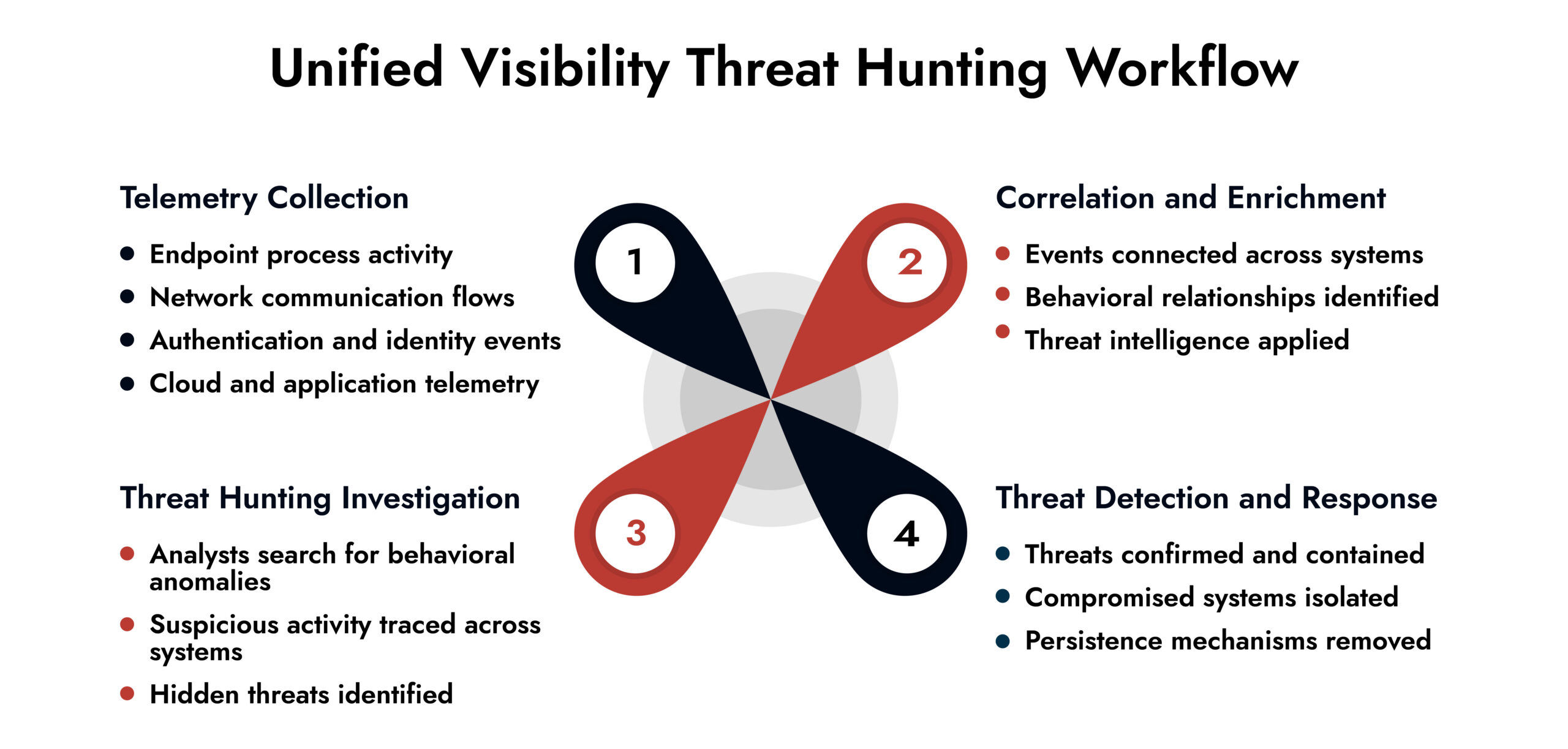
This integration allows analysts to pivot seamlessly across data sources. A suspicious login detected in SIEM can be correlated with network movement in NDR and endpoint activity in EDR. What begins as a simple alert becomes a complete attack timeline. This is what makes network threat hunting effective.
Why Threat Hunting Fails Without Unified Visibility
Threat hunting techniques rely on correlation. Without unified visibility, correlation becomes manual and unreliable. Several critical threat hunting activities become difficult or impossible.
Behavioral threat hunting requires understanding normal system activity and identifying deviations. Without unified telemetry, behavioral baselines are incomplete.
Hypothesis-driven threat hunting requires searching across multiple systems. Without unified visibility, threat hunters cannot validate hypotheses effectively.
Indicator-based hunting requires searching for indicators across endpoints, network traffic, and identities. Fragmented visibility limits search effectiveness.
Campaign tracking requires reconstructing attack timelines. Without unified visibility, attack sequences remain incomplete. These limitations reduce the effectiveness of threat hunting solutions. Unified visibility removes these barriers.