Introduction
Every organization knows a cyberattack is not a matter of if, but when. What separates a minor disruption from a full-scale breach often comes down to one thing – the incident response plan. A well-structured plan not only minimizes damage but also helps teams recover faster, preserve evidence, and strengthen defenses against future threats.
Here’s the thing: security incidents today unfold at machine speed. Without a clear, rehearsed plan, even the most advanced SOCs lose precious minutes trying to coordinate, communicate, and contain. This guide breaks down the five essential incident response steps, explains why each phase matters, drawn from frameworks like NIST and real-world enterprise experience – all through the lens of the NetWitness IR Team’s expert-led approach.
Why Does Incident Response Plan Matter?
A strong cybersecurity incident response plan does three things:
- Reduces operational and financial impact.
- Preserves digital forensics for post-incident analysis.
- Strengthens the overall security posture through lessons learned.
NIST’s Computer Security Incident Handling Guide (SP 800-61r3) remains the global reference for structuring IR plans but adapting it to your unique business context is where the real value lies — something NetWitness IR excels at through tailored, expert-led engagements.
Incident Response Plans Must Account for 2026 Regulatory Requirements
Incident response is no longer an operational concern. Regulatory requirements increasingly make timely investigation, documentation, and communication part of the response process.
For organizations subject to the SEC’s cybersecurity disclosure rules, a material cybersecurity incident generally requires an Item 1.05 Form 8-K filing within four business days after the organization determines that the incident is material. The requirement is tied to the materiality determination, not simply the moment the incident is discovered.
For organizations covered by NIS2, significant incidents require an early warning within 24 hours of becoming aware of the incident, followed by an incident notification within 72 hours. A final report is generally required within one month.
This makes a documented incident response framework more than a technical playbook. Teams need the ability to establish what happened, determine impact, preserve evidence, coordinate stakeholders, and produce reliable incident information under time pressure.
What Are the 5 Steps of an Incident Response Plan?
Step 1: Preparation – The Foundation of Effective Response
Objective: Establish the people, processes, technology, and resources required to respond effectively.
Key activities: Define roles, maintain asset visibility, test response capabilities, establish communication channels, and validate security data sources.
Who is responsible: The Incident Response Team, security leadership, SOC, IT, and designated business stakeholders.
Expected outcome: The organization has a tested and documented security incident response plan that clearly defines how teams will respond when an incident occurs.
Preparation defines how ready your organization is to respond to a cyber incident before it even happens.
This step includes everything from building your incident response team and defining roles to ensuring your tools – SIEM, NDR, EDR, and SOAR – are integrated and tested. Teams should have up-to-date contact lists, predefined communication channels, and quick access to critical playbooks.
Incident Response Checklist for Preparation
- Establish governance and assign clear ownership for incident response.
- Maintain an asset inventory to understand your attack surface.
- Conduct tabletop and red team exercises regularly.
- Validate data visibility across endpoints, networks, and cloud environments.
- Use compromises and other assessments to find vulnerabilities in your program.
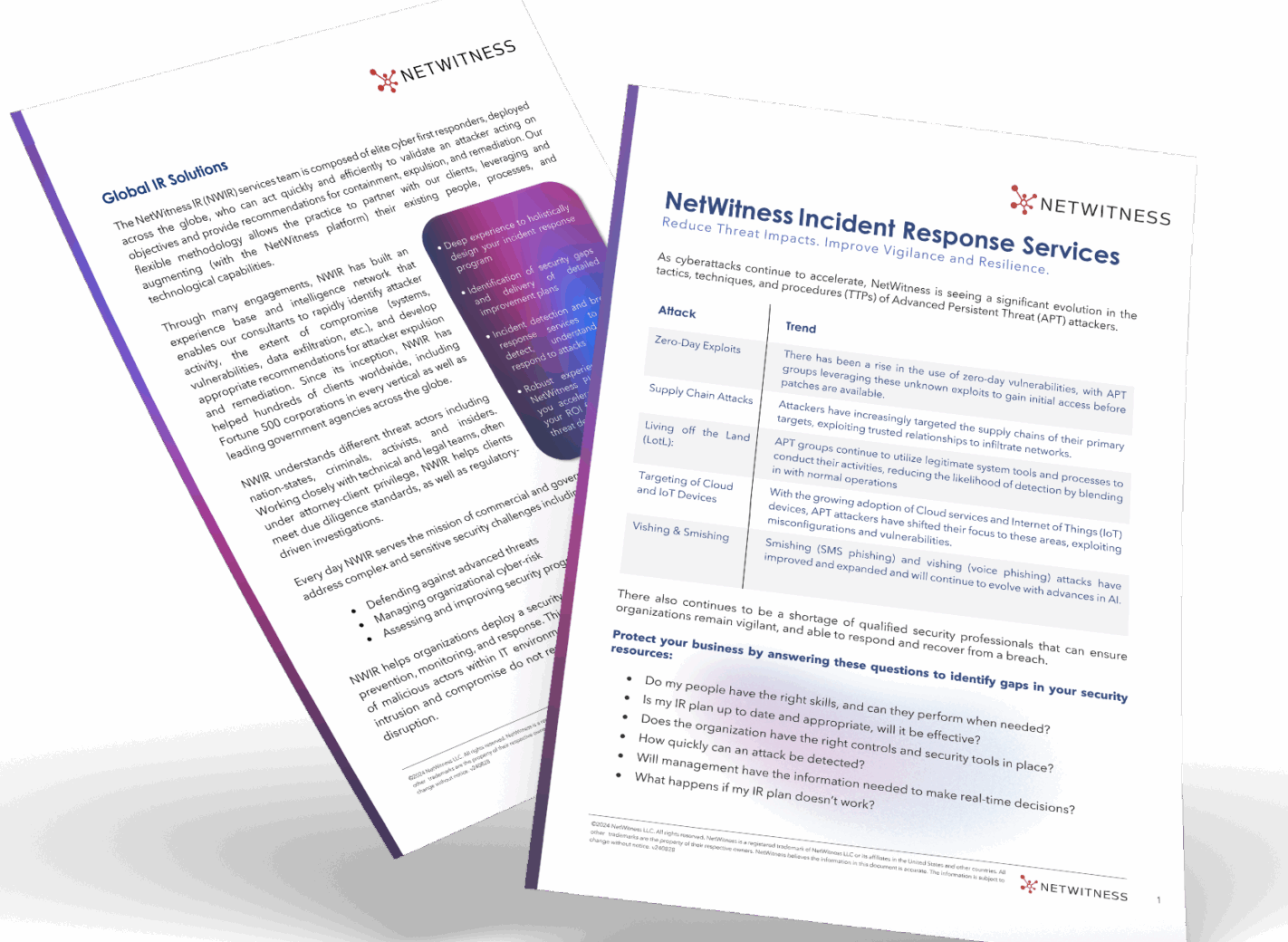
The best run security programs often mandate an incident response retainer from a 3rd party that specializes in Incident Response. Effective retainer programs integrate 3rd party and organizational resources around the topics above. NetWitness fields an independent, expert-led Incident Response team that helps organizations build, test, and utilize IRPs.
Step 2: Identification – Detecting and Confirming the Incident
Objective: Determine whether suspicious activity represents a genuine security incident and establish its scope.
Key activities: Triage alerts, correlate security data, validate indicators, and document evidence.
Who is responsible: SOC analysts, security operations teams, incident responders, and threat intelligence teams.
Expected outcome: A confirmed incident with an initial understanding of its scope, severity, and potential impact.
Identification is about quickly detecting abnormal activity, verifying its authenticity, and determining its scope.
An alert is not always an incident – analysts must differentiate false positives from true threats. The faster this happens, the lower the damage. A robust incident response plan framework defines how alerts are triaged and what qualifies as a security incident.
Incident Response Best Practices for Identification
- Correlate alerts using SIEM and NDR tools to reduce noise.
- Use threat intelligence feeds to validate suspicious indicators.
- Document every potential incident with timestamped evidence.
The most effective SOCs rely on unified visibility – correlating data from networks, endpoints, and cloud workloads. NDR solutions like the NetWitness platform enhance this stage by enabling analysts to distinguish between routine alerts and high-priority threats through behavioral analytics and contextual correlation.
Step 3: Containment – Limiting the Damage
Objective: Prevent the incident from spreading while preserving the evidence required for investigation.
Key activities: Isolate affected systems, restrict access, apply temporary controls, and preserve volatile evidence.
Who is responsible: Incident responders, SOC teams, network and endpoint security teams, with support from IT where required.
Expected outcome: The threat is contained, further damage is limited, and critical evidence remains available for investigation.
Containment focuses on isolating affected systems and preventing the spread of the incident.
Containment involves actions like disconnecting compromised endpoints or restricting network access. Your containment strategy may require more nuance as the goal is to keep the adversary from acting on their objectives without alerting them that you know they are there.
Incident Response Best Practices for Containment
- Segment infected systems to disable lateral movement.
- Apply temporary firewall rules or blocklists.
- Preserve volatile data for forensic analysis before system resets.
Strategically, this phase depends on speed and visibility. NetWitness Incident Response helps responders isolate compromised systems quickly while preserving critical evidence for further analysis, enabling both immediate action and post-incident learning.
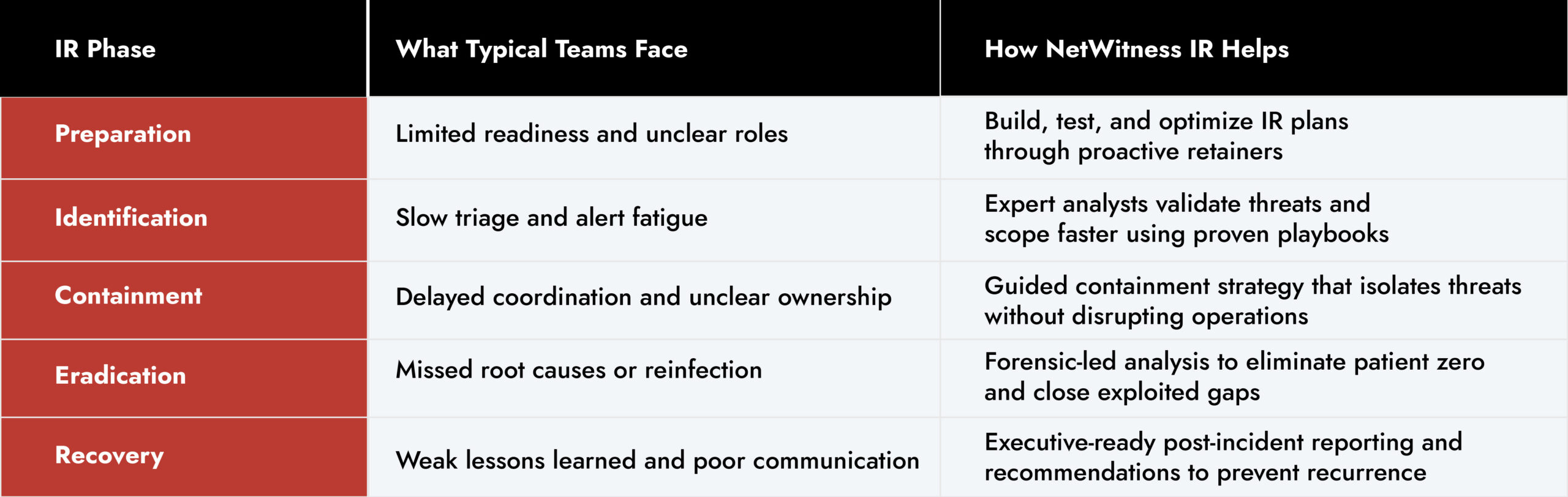
How NetWitness IR Accelerates Every Phase of Incident Response
Step 4: Eradication and Recovery – Restoring Trust and Operations
Objective: Eliminate the root cause of the incident and safely return affected systems to normal operation.
Key activities: Remove malware, close exploited vulnerabilities, rebuild affected systems, restore clean backups, and monitor recovered environments.
Who is responsible: Incident responders, IT operations, security teams, system owners, and relevant business stakeholders.
Expected outcome: The threat has been removed, affected systems are restored, and operations can resume with confidence.
Eradication removes the root cause of the breach, while recovery focuses on safely restoring systems and verifying normal operations.
After isolating the threat, responders identify patient zero, develop a timeline of events, eliminate malware, close exploited vulnerabilities, and restore clean backups. Once systems are back online, they must be closely monitored for any residual signs of compromise.
Incident Response Checklist for Eradication and Recovery
- Conduct vulnerability scans and patch exploited systems.
- Rebuild compromised servers or reimage endpoints.
- Validate recovery with continuous monitoring and testing.
- Communicate status updates to leadership and stakeholders.
Enterprise teams often integrate advanced analytics and historical data correlation to verify eradication success – areas supported by products like the NetWitness platform.
Step 5: Turning Incidents into Insights
Objective: Understand what happened and use the findings to improve future detection and response.
Key activities: Conduct post-incident reviews, examine evidence and communication gaps, update playbooks and detection rules, and train teams on identified TTPs.
Who is responsible: The Incident Response Team, SOC, security leadership, IT, and other stakeholders involved in the incident.
Expected outcome: Lessons learned are documented and used to strengthen future incident response plans, detection capabilities, and response readiness.
The final step of an incident response plan is to analyze what happened, why it happened, and how to prevent it next time.
This phase transforms a crisis into a catalyst for maturity. Post-incident reviews should be mandatory, involving all key stakeholders, from technical teams to executives.
Incident Response Checklist for Lessons Learned
- Conduct a post-mortem within two weeks of resolution.
- Review logs, communication gaps, and decision points.
- Update playbooks and detection rules based on findings.
- Train teams on newly identified tactics, techniques, and procedures (TTPs).
Organizations that document lessons learned consistently build resilience. Many integrate this phase with their threat intelligence programs, ensuring that new insights enhance both detection models and future IR readiness.
Who is Responsible for an Incident Response Plan?
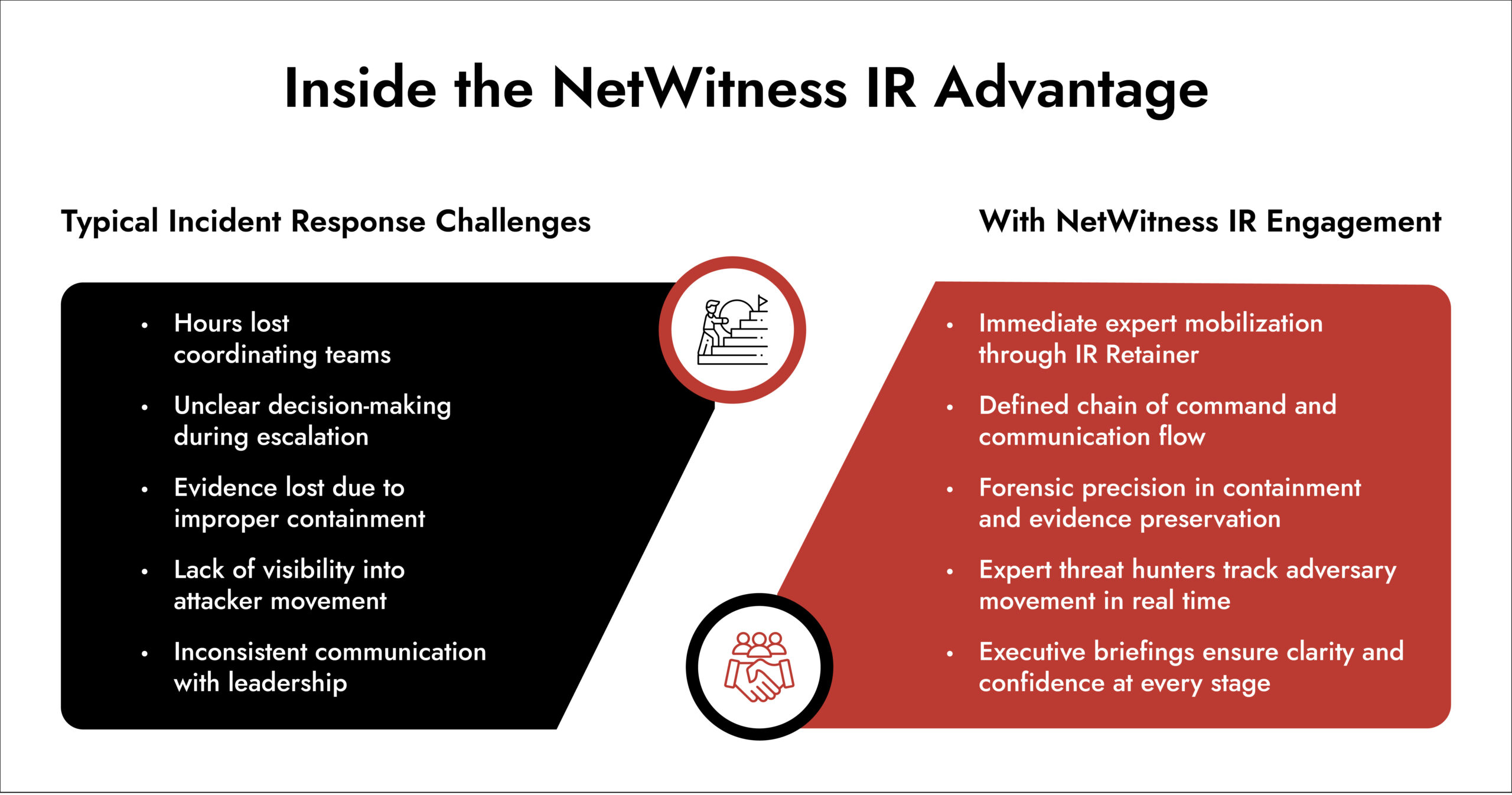
Responsibility for an incident response plan does not sit with one person or one security tool. The Incident Response Team typically coordinates the response, while security leadership, SOC analysts, IT teams, legal, communications, and executive stakeholders may have defined responsibilities depending on the incident.
The person or team responsible for maintaining the cyber security incident response plan should ensure that roles, escalation paths, communication procedures, and technical response actions remain current and tested.
Key Roles in Incident Response-
- CISO or Security Leadership: Provides oversight, establishes governance, and makes or escalates high-impact security decisions.
- Incident Response Team: Coordinates the investigation, containment, eradication, and recovery activities.
- SOC Analysts: Monitor alerts, investigate suspicious activity, and escalate confirmed incidents.
- IT and Infrastructure Teams: Support system isolation, remediation, restoration, and recovery.
- Legal and Compliance Teams: Advise regulatory, contractual, privacy, and notification requirements.
- Communications and Executive Teams: Manage internal and external communications when an incident has a significant business impact.
A documented incident response procedure should make these responsibilities clear before an incident occurs. It should also define who can authorize containment actions, who needs to be notified, and when external incident response expertise should be engaged.
Conclusion
An effective incident response plan isn’t static. It evolves as your business, threat landscape, and technology stack change. The goal isn’t just to react, it’s to anticipate, prepare, and be resilient.
When every second counts, visibility and coordination matter most. That’s where intelligent detection, extensive investigation, and expert-led Incident Response Services converge to make a measurable difference.
NetWitness IR, built on proven framework, discipline, and experience, delivers independent, expert-led proactive and reactive Incident Response services. Don’t wait for a breach, leverage NetWitness IR to protect your critical systems and turn every security incident into a strategic advantage.