Common Network Detection and Response Challenges Faced During Implementation: How NetWitness Solves Them

12 minutes read
Overview Icon

Common Challenges in NDR Implementation

  • Network detection and response challenges start with visibility gaps across hybrid, encrypted, and east-west traffic, not with technology labels. 
  • Most teams struggle with technical complexity, data integration, tuning, compliance, and operational ownership when deploying NDR solutions at scale. 
  • Strong network visibility, full packet capture where it matters, and intelligent analytics turn NDR from another noisy sensor into a strategic detection layer. 
  • NetWitness NDR focuses on deep visibility, high-fidelity detection, guided investigations, and services that simplify onboarding, tuning, and long-term network monitoring. 
  • When leaders treat NDR implementation as a program – people, process, telemetry – not a product, they close critical gaps in advanced threat detection tools and reduce business risk. 

Introduction 

Network detection and response challenges become obvious the moment teams move from slide decks to live traffic. Modern environments span on-prem data centers, multiple cloud regions, remote users, and increasingly, OT networks. Encryption is everywhere. Logs, flows, and packet data live in separate systems, often owned by different teams. 

While encryption limits indiscriminate payload inspection, mature NDR programs balance behavioral analysis with selective TLS/SSL decryption where visibility is required and permitted. 

At the same time, threats move faster. Recent incident response and threat intelligence reports show median attacker dwell time down to roughly 10 days, yet attackers compress their operations, use “living off the land” techniques, and abuse encrypted channels to avoid detection. If network monitoring and NDR solutions do not land cleanly, these attacks turn into quiet business‑level incidents that teams discover too late. 

This is where a pragmatic, experience‑driven approach matters: understand the common failure patterns in NDR implementation, then design around them with the right platform and services. 


What are the Most Common Network Detection and Response Challenges faced during implementation? 

Network detection and response challenges begin with architecture, not dashboards. The technical reality of modern networks makes NDR rollouts complex even for mature teams. 

1. Core technical hurdles

  • Instrumenting the right points- High-value signals exist across distributed data centers, cloud VPCs, remote access edges, and OT environments. Capturing everything everywhere is unrealistic, so teams must make deliberate decisions about where visibility matters most. 
  • Encrypted traffic- Most internal and external traffic is encrypted by default. Decrypting everything is neither feasible nor desirable but selectively decrypting high-risk or inbound TLS/SSL traffic remains a critical option for organizations that require payload-level visibility.
    Encryption therefore complicates detection strategies that rely on payload inspection alone. 
  • Throughput and packet capture- High-speed links can overwhelm poorly designed sensors. Dropped packets create blind spots, often at the worst possible moments during an incident. 
  • Complex hybrid topologies- Cloud traffic may never pass through traditional taps, and east-west traffic inside data centers often bypasses perimeter monitoring entirely. These network detection and response challenges show up as partial coverage, fragile span configurations, and sensors that only see a fraction of critical activity. 

These network detection and response challenges show up as partial coverage, fragile span configurations, and sensors that see only a subset of critical traffic. 

How NetWitness helps technically 

NetWitness NDR is built around flexible collection and intelligent packet capture. It ingests full packets and metadata from on-premises, virtual, and cloud environments, and it scales to high-speed networks without turning visibility into a bottleneck. 

By supporting both deep behavioral analysis of encrypted traffic and optional TLS/SSL decryption, NetWitness allows teams to choose the right visibility model for each network segment.
By combining selective packet capture with rich metadata, it preserves investigation depth while keeping storage practical. 


2. Data Integration and Telemetry Overload

The next layer of network detection and response challenges comes from data, not devices. Even when sensors work, NDR often lives in a silo. 

Where data integration breaks down: 

  • Logs live in SIEM, endpoint events in EDR, and network telemetry in separate tools, making it difficult to reconstruct attack paths. 
  • Identifiers such as IPs, hostnames, users, and cloud resources don’t always align. 
  • High-volume packet capture and network monitoring generate massive datasets with uneven analytical value. 

Leaders ask: How can I improve data integration issues during NDR system implementation? The answer starts with choosing NDR solutions that: 

  • Normalize network metadata into a consistent, queryable model. 
  • Integrate with existing SIEM, SOAR, and case management. 
  • Enrich network events with identity, asset, and threat intelligence context. 

How NetWitness addresses data integration 

NetWitness NDR operates as part of a broader threat detection, investigation, and response platform that correlates network data with endpoint, log, and threat intel sources. This helps analysts pivot from a suspicious connection to the associated user, host, and related events without leaving their investigation path.  NDR solution 

3. Alert Fatigue, Tuning, and Operational Ownership

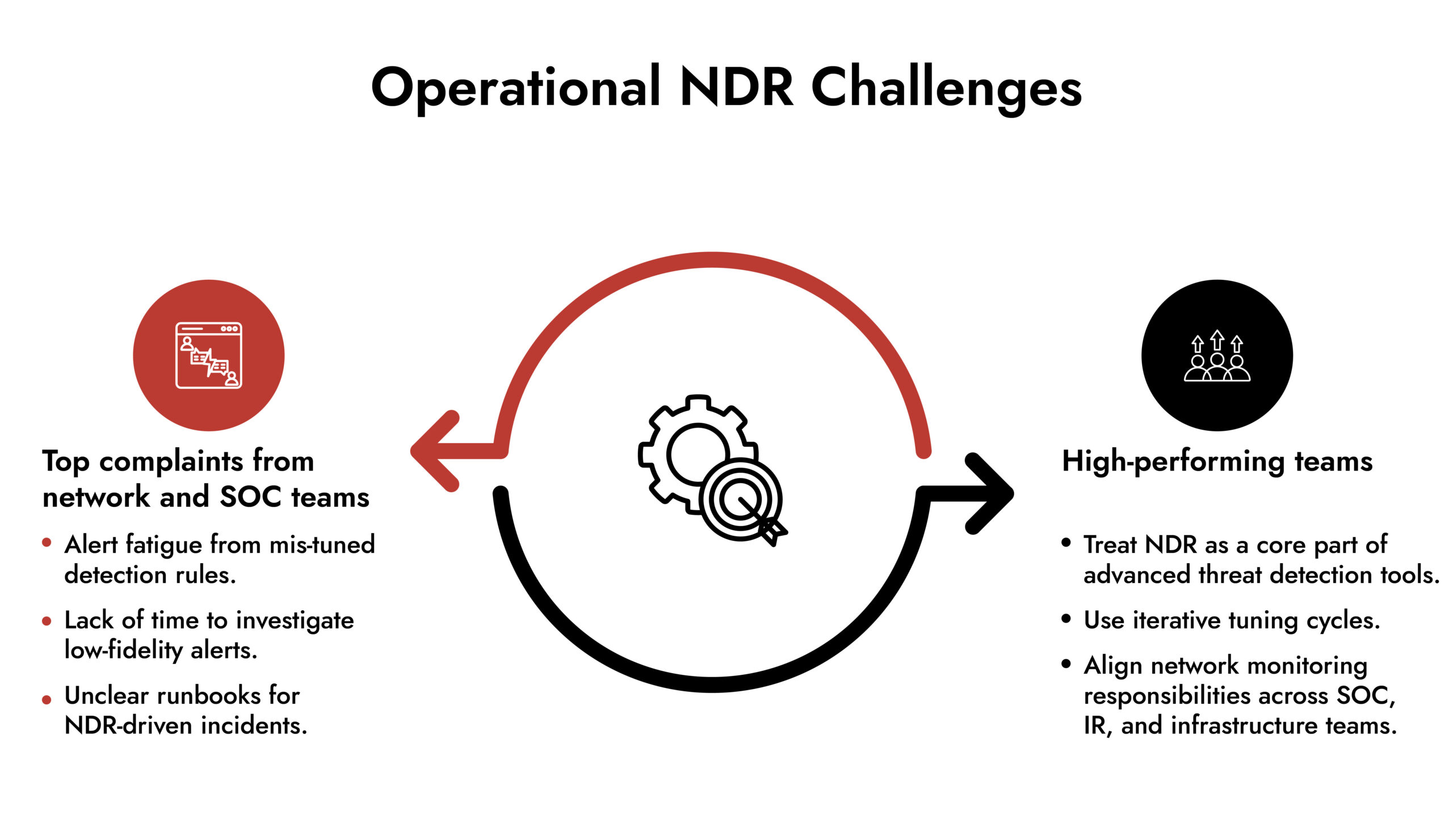
Many network detection and response challenges turn into human problems. NDR can generate thousands of alerts if teams do not tune it carefully. 

Operational pain points: 

  • Threshold‑driven noise  
  • Static rules flood analysts with alerts that rarely turn into real incidents. 
  • Limited tuning expertise  
  • Teams struggle to balance sensitivity and specificity across complex environments. 
  • Unclear ownership  
  • Network teams, SOC teams, and incident responders may disagree on who owns NDR tuning and response. 

This raises common questions such as: What services help with the deployment and management of network detection and response? Can I get recommendations for managed services that handle NDR installation and tuning? The most effective programs combine internal ownership with specialized services for design, tuning, and ongoing optimization. 

How NetWitness reduces alert fatigue 

NetWitness uses behavioral analytics, machine-assisted scoring, and threat intelligence to move beyond simple thresholds.
Analytics help surface the sessions, hosts, and users most likely to represent real compromise, reducing alert volume without hiding critical activity. 

It provides guided investigation workflows that shorten the path from alert to decision. Professional and managed services further help organizations stabilize operations and accelerate time-to-value. 
NDR Challenges

4. Compliance and Regulated Industries

Regulated sectors face additional network detection and response challenges. They must prove that controls exist and work, not just that tools are licensed. 

Key compliance pressures: 

  • Continuous monitoring expectations from frameworks and regulatory guidance 
  • Forensic evidence requirements for investigations and legal review 
  • Data protection and encryption constraints that limit indiscriminate decryption 

This makes selective TLS/SSL decryption especially valuable, enabling inspection of inbound encrypted traffic while maintaining alignment with privacy and regulatory requirements. 

Organizations in regulated industries need NDR solutions that support selective packet capture, strong access control, audit trails, and defensible retention policies. 

How NetWitness supports compliance 

NetWitness NDR uses full‑packet capture and detailed metadata to give teams forensic‑grade visibility into network events. At the same time, it supports controlled access, retention policies, and rigorous auditability, which helps regulated organizations align with modern guidance on breach detection and response. 
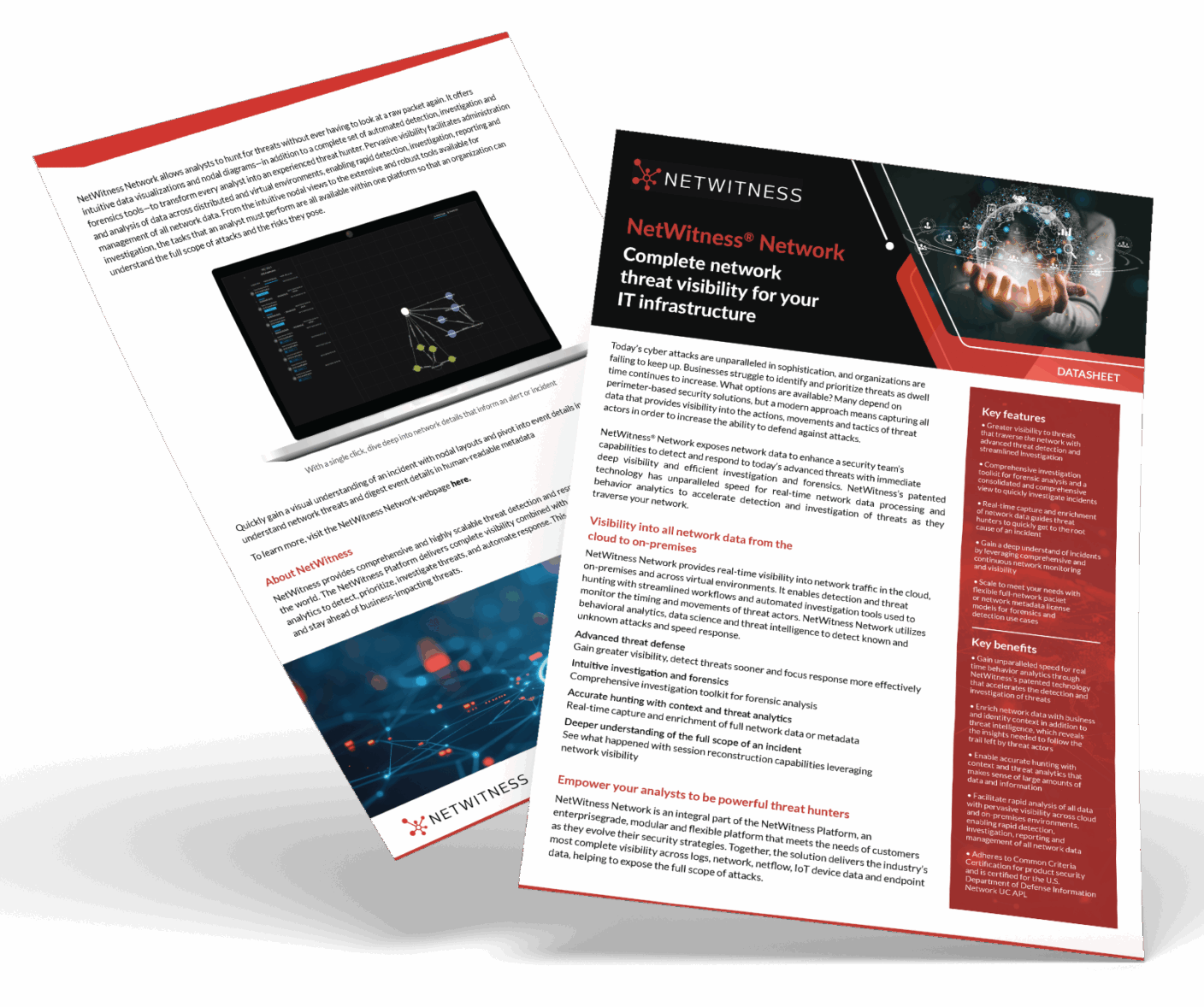
Proactive Network Threat Detection with NetWitness® NDR

-Spot threats fast with AI-driven analytics.

-See everything across your network and cloud traffic.

-Investigate efficiently with built-in forensic tools.

-Adapt and scale to meet growing security needs.

Lead Magnet Mockup NDR

5. Onboarding, Services, and Overcoming Deployment Challenges

Implementation speed is its own category of network detection and response challenges. Leaders want NDR value quickly, without multi‑year tuning projects. 

Common questions include: 

  • Which companies offer the best tools to overcome NDR deployment challenges? 
  • Which NDR providers are known for quick and efficient onboarding processes? 

While independent analyst reports evaluate the broader market, what matters in practice is whether an NDR platform: 

  • Provides clear deployment patterns for on‑premises, virtual, and cloud sensors. 
  • Offers reference architectures and playbooks aligned to common environments. 
  • Includes services and documentation that guide installation, optimization, and handover. 

How NetWitness approaches onboarding 

NetWitness designs its NDR deployments around modular architectures, with sensors and packet capture options that support data centers, cloud workloads, and remote segments. Teams can roll out incrementally, starting with high‑value segments and expanding coverage, while professional and managed services help with planning, rollout, and continuous improvement. 

Quote

You can’t manage risks in areas you can’t see. Most material security failures start in blind spots – what leadership never knew to ask about. In hybrid environments, visibility is often fragmented across on-prem, cloud, OT, and partner networks, which weakens oversight and accountability.
When incidents occur, delays rarely come from a lack of tools. They come from delayed access to trusted data. Centralized visibility and indexed forensic context reduce dwell time and materially improve MTTD and MTTR.
The same principle applies to supply chain risk. Organizations may not own a partner’s security controls, but they remain accountable for exposure. Visibility into third-party network connections is essential for managing that risk before it becomes a business issue.

Halim Abouzeid

How NetWitness Specifically Addresses NDR Implementation Challenges 

NetWitness addresses network detection and response challenges by combining deep network visibility with intelligent detection and guided investigations. 

Unlike approaches that rely exclusively on encrypted traffic analysis, NetWitness supports optional inbound TLS/SSL decryption alongside behavioral detection, giving teams payload visibility when risk, policy, and compliance requirements justify it. 

Full-packet capture and metadata are paired with analytics, correlation, and services that simplify both deployment and long-term operations. 

Key strengths: 

  • Visibility first- Full-packet capture and rich metadata across on-premises, cloud, and virtual environments, with strong support for high-throughput links. 
  • Detection that respects analyst time- Behavioral analytics, threat intelligence, and machine-assisted prioritization focused on high-risk activity such as lateral movement and command-and-control. 
  • Guided investigation and hunting- Seamless pivoting from alerts to related sessions, entities, and timelines across network, endpoint, and log data. 
  • Services and expertise- Deployment, tuning, and optimization services that reduce operational burden, especially for regulated environments. 

With this approach, NetWitness helps teams move beyond generic NDR pain points and build a sustainable detection program. 


Network Detection and Response Challenges in a Nutshell 

Network detection and response challenges stem from modern infrastructure realities: distributed systems, pervasive encryption, and constant threat pressure. When NDR implementations ignore these realities, they create noise instead of clarity. 

A more effective approach emphasizes deep visibility, deliberate packet capture, the ability to analyze encrypted traffic with or without decryption, integrated telemetry, tuned detections, and clear ownership. Platforms like NetWitness that combine NDR solutions, advanced threat detection tools, and services give organizations the structure to deploy and evolve NDR across complex environments. 


Frequently Asked Questions

1. Is NDR difficult to implement?

Network detection and response can be difficult to implement if teams treat it as a standalone box instead of a program. Complexity comes from sensor placement, encrypted traffic, data integration, and tuning, not from the concept itself. With a clear design, phased rollout, and expert services, NDR solutions become manageable and deliver strong value quickly. 

The most common network detection and response challenges include incomplete network visibility, encrypted traffic blind spots, integration gaps with existing tools, alert fatigue, and unclear operational ownership. Regulated industries also face additional pressure to align NDR deployments with stringent monitoring and evidence requirements. 

NDR cannot see what never crosses monitored network segments, and it cannot replace endpoint or identity controls. Encryption, traffic volume, and architectural blind spots all limit pure packet capture approaches. However, when organizations combine NDR with endpoint, identity, and strong network monitoring, they significantly improve detection and investigation capability. 

Network detection and response solves visibility and detection gaps that perimeter controls and log‑only systems leave open. It addresses network detection and response challenges such as lateral movement, stealthy command‑and‑control, and suspicious data flows by analyzing packets, flows, and behavior across internal and external communication paths. 

NDR identifies risks such as compromised accounts, rogue devices, lateral movement toward critical assets, encrypted exfiltration attempts, and misuse of standard protocols like DNS, HTTP, RDP, and SMB. By monitoring full packets and metadata, NDR solutions bring these hidden behaviors to light, so teams can respond before they turn into major incidents. 

FIN13: Inside a Fintech Cyber Attack

FIN13 is one of today’s most disruptive threat groups targeting fintech organizations with precision and persistence. This whitepaper breaks down their full attack chain—from reconnaissance and credential theft to lateral movement, data exfiltration, and evasion techniques. Gain insights into their TTPs, discover detection opportunities across the kill chain, and learn how NetWitness empowers faster response and mitigation.

Fin 13

About Author

Picture of Anusha Chaturvedi

Anusha Chaturvedi

Anusha Chaturvedi is a tech-focused content writer with a strong background in branding and communication. With experience across BFSI and cybersecurity, she creates informative, insight-driven narratives grounded in research. Her academic roots in mass communication, advertising, and marketing shape both her analytical and creative approach.

Related Resources

Accelerate Your Threat Detection and Response Today!