The Visibility Problem No One Wants to Admit
Security teams don’t talk about this enough. Most SOC teams believe they have visibility. Dashboards look full. Alerts keep firing. Reports are generated.
Yet incidents still escalate late. Threat actors still move laterally without being noticed.
Post-incident reviews still include the same line: we had the data, but we didn’t connect with it in time.
That gap between data and understanding is where SOC visibility breaks down. And in SOC cybersecurity, that gap is often the difference between containment and compromise.
What SOC Visibility Actually Means
SOC visibility is the ability to observe, correlate, and investigate security activity across the entire environment in context. It is not:
- A larger SIEM
- More alerts
- Another dashboard
It is:
- Network visibility that shows how traffic moves inside the environment
- Endpoint insight that explains what executed and why
- Log data tied to real users, systems, and timelines
- A single investigation path that shows cause, not just symptoms
When SOC visibility works, analysts answer questions quickly instead of guessing.
Where SOC Teams Lose Visibility
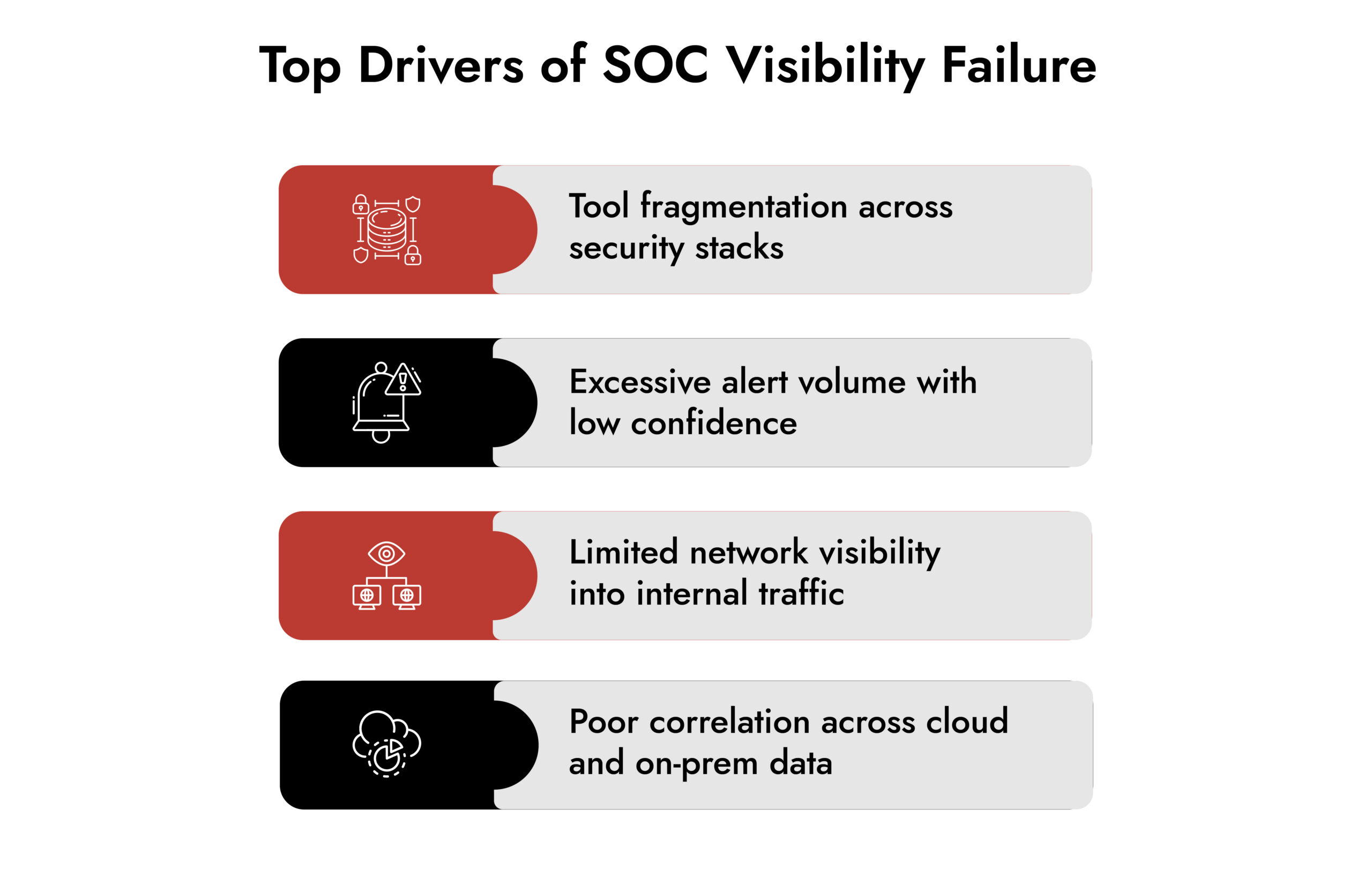
1. Tool Sprawl Without Correlation
Most SOC teams run dozens of security tools. Each one does its job well in isolation. Together, they create friction.
A common example:
- SIEM flags suspicious authentication activity
- EDR shows no malware execution
- Network tools sit elsewhere and never get checked
The alert closes. Two days later, data exfiltration shows up.
This is one of the most persistent SIEM visibility challenges. Logs arrive, but without network context or endpoint correlation, analysts miss the full story.
2. Alert Volume Masks What Matters
SOC monitoring challenges rarely come from a lack of alerts. They come from too many low-confidence ones.
According to IBM’s 2024 Cost of a Data Breach report, organizations with high alert noise experience significantly longer containment times. Analysts spend hours validating benign activity while real threats blend into the background.
What this looks like in practice:
- Analysts triage instead of investigating
- Alerts close based on assumptions
- Attack chains never get reconstructed
Visibility suffers not because threats are invisible, but because attention is misallocated.
3. Network Blind Spots Enable Lateral Movement
Endpoint tools are essential. They are not enough.
Many modern attacks avoid malware entirely. They rely on:
- Valid credentials
- Internal network movement
- Legitimate tools used maliciously
Without strong network visibility, SOC teams miss:
- East-west movement
- Command-and-control patterns
- Data staging before exfiltration
NIST continues to stress network telemetry as a foundational control for detecting advanced threats. When network data isn’t part of investigations, SOC visibility remains incomplete.
4. Cloud and Hybrid Environments Complicate Everything
Infrastructure now spans:
- On-prem data centers
- Multiple cloud providers
- SaaS platforms
Each generates different logs, formats, and timelines.
A realistic scenario:
- Identity activity shows risky behavior in a cloud app
- Network traffic suggests unusual data transfer
- No unified view connects the two
SOC teams investigate fragments instead of incidents. Visibility degrades, not because data is missing, but because it’s scattered.
5. Human Limits Get Ignored
Visibility tools often assume infinite analyst attention. That’s not reality.
When investigations require:
- Switching tools repeatedly
- Manually aligning timestamps
- Remembering context across screens
Mistakes happen. Burnout follows. CISA has repeatedly warned that analyst overload weakens detection and response, regardless of staffing levels.
SOC visibility must work with human limits, not against them.
The Real Cost of Poor SOC Visibility
Poor visibility doesn’t just delay response. It changes the outcomes.
Organizations experience:
- Longer attacker dwell time
- Higher breach impact
- Lower confidence in SOC findings
By the time leadership asks whether the SOC team can “see everything,” the damage is already done.
How SOC Teams Can Fix Visibility Gaps
1. Unify Telemetry Across Network, Endpoint, and Logs
The goal isn’t replacing tools. It’s correlating them.
Effective SOC visibility brings together:
- Network traffic and session data
- Endpoint behavior and execution context
- Logs tied to assets, users, and time
This directly addresses SIEM visibility challenges and reduces investigation time.
2. Shift From Alerts to Investigations
High-performing SOC teams don’t chase alerts. They investigate activity.
This requires:
- Grouping related events into incidents
- Showing attack progression visually
- Prioritizing based on impact, not volume
3. Strengthen NDR and EDR Visibility Together
NDR and EDR solve different problems. Together, they close critical gaps.
EDR answers “What executed on the endpoint”. NDR answers “How activity moved through the network”.
When combined, NDR and EDR visibility allow SOC teams to validate alerts, confirm lateral movement, and detect stealthy threats that bypass signatures.
4. Use Automation Where It Actually Helps
Automation should reduce cognitive load, not add complexity.
High-value automation includes:
- Enriching alerts with asset and user context
- Correlating network, endpoint, and log activity
- Guiding analysts through investigations
A 2024 SANS study showed SOC teams using investigation-focused automation reduced response time by nearly 40 percent.
5. Design Visibility Around Analyst Workflow
SOC visibility improves when tools support how investigations actually happen.
That means:
- Unified timelines
- Easy pivoting between data types
- Persistent context throughout the investigation
When analysts stay focused, visibility improves naturally.
Where NetWitness Fits into SOC Visibility
NetWitness focuses on deep, correlated visibility rather than isolated alerts.
From a SOC team perspective, the platform supports:
- Full-session network visibility for detecting lateral movement
- Correlation across network, endpoint, logs, and intelligence
- Analyst-driven investigations without constant tool switching
The emphasis stays on understanding attacker behavior, not just triggering alerts.
Conclusion
SOC teams don’t struggle because they lack skill, effort, or data. They struggle because complexity fractures visibility across tools, environments, and workflows.
Fixing SOC visibility means:
- Correlating telemetry across domains
- Prioritizing context over noise
- Supporting analysts with better workflows
When SOC visibility improves, threat detection and response follow. Confidence returns. And security operations move from reactive to deliberate.