Introduction
Security operations have fundamentally changed.
Enterprises are no longer defending a fixed perimeter. Their attack surface now spans hybrid cloud infrastructure, remote endpoints, SaaS applications, identities, and east-west network traffic. Every login, packet, process, and API call creates telemetry. Hidden inside that telemetry are early signals of compromise.
The role of top SIEM solutions for enterprises is to capture those signals, correlate them, and enable fast, confident response.
But here’s the reality most security leaders face. Many top SIEM tools still operate like log warehouses. They generate alerts without providing investigative clarity. They show symptoms, not root cause.
Modern enterprises need SIEM platforms that deliver:
- Full telemetry correlation across hybrid environments
- Scalable cloud SIEM solutions
- High-confidence investigations, not alert noise
This guide examines the best SIEM tools for enterprises in 2026, including platforms built for real SOC operations at enterprise scale.
What Defines an Enterprise SIEM Platform in 2026
Before evaluating vendors, it’s important to understand what makes a SIEM enterprise-ready in 2026.
Enterprise-grade SIEM security solutions must provide visibility across multiple telemetry layers:
| Telemetry Type | Why It Matters |
| Network traffic | Detect lateral movement and command-and-control activity |
| Endpoint telemetry | Identify malware execution and persistence |
| Identity activity | Detect credential abuse and privilege escalation |
| Cloud workloads | Monitor SaaS, IaaS, and container environments |
| Logs and events | Provide context across systems and applications |
| Threat intelligence | Correlate known attacker behaviors |
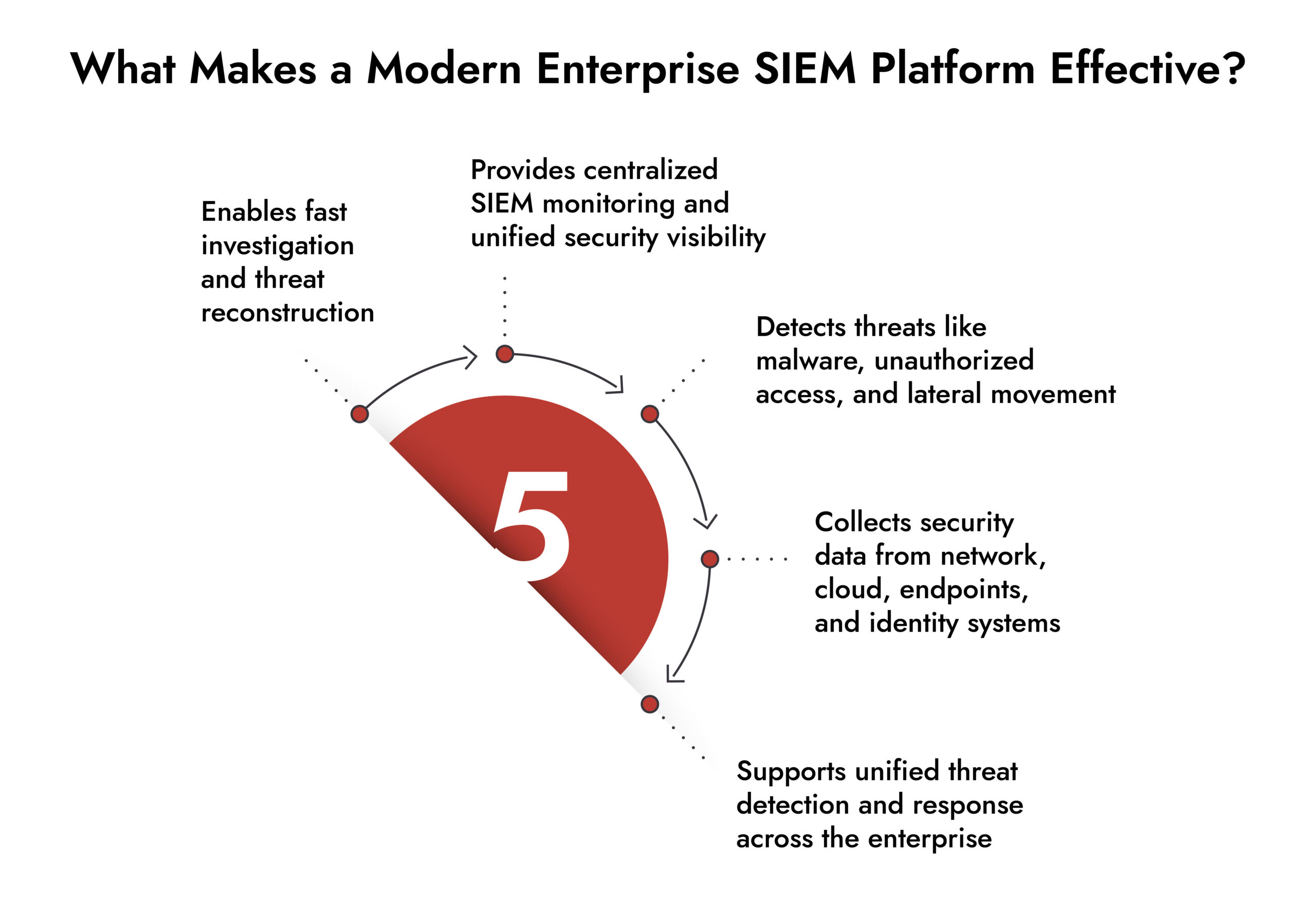
The strongest SOC SIEM platforms unify these sources into a single investigative workflow.
This enables security teams to answer the most important questions quickly:
- How did the attacker enter?
- What did they access?
- How far did they move?
- What is the business impact?
Top 10 SIEM Solutions for Enterprises in 2026
1. NetWitness Platform
Purpose-built for deep enterprise visibility and forensic-level investigations.
Unlike SIEM tools that rely primarily on logs, NetWitness captures and analyzes:
- Logs across infrastructure
- Endpoint telemetry
- User and entity behavior
This gives SOC teams the ability to reconstruct attacks with precision.
Key capabilities:
a. Full packet capture for network visibility
Most SIEM tools analyze summaries of network traffic. NetWitness analyzes full packets, allowing security teams to see exactly what occurred during an attack.
This enables detection of:
- Command and control communication
- Data exfiltration attempts
- Lateral movement
- Encrypted threat patterns
b. Unified visibility across network, logs, and endpoints
NetWitness integrates multiple telemetry layers into one platform. This eliminates investigative blind spots and accelerates root cause analysis.
c. Advanced threat detection and investigation
Security teams can trace attacks from initial compromise to impact using unified investigation workflows.
d. Enterprise scale and performance
Designed to handle high-volume telemetry environments across hybrid infrastructure.
Best for: Enterprises that require deep visibility, threat reconstruction, and advanced investigation capabilities.
2. Microsoft Sentinel
Microsoft Sentinel is a cloud-native cloud SIEM solution built on Azure.
It provides strong visibility into:
- Azure workloads
- Microsoft 365 environments
- Identity activity through Entra ID
- Microsoft Defender security telemetry
Strengths
- Native integration with Microsoft ecosystem
- Strong cloud visibility
- Built-in automation capabilities
- Scalable cloud architecture
Best for: Cloud-first enterprises using Microsoft infrastructure.
3. Splunk Enterprise Security
Splunk is one of the most widely adopted SIEM security tools in enterprise environments.
It provides flexible log ingestion, search, and analytics.
Strengths
- Powerful search capabilities
- Large integration ecosystem
- Flexible analytics engine
- Mature threat detection workflows
Best for: Large enterprises with dedicated SOC teams.
4. IBM QRadar SIEM
IBM QRadar provides strong event correlation and compliance-focused capabilities.
It is widely used in regulated industries.
Strengths
- Strong correlation engine
- Compliance reporting capabilities
- Threat intelligence integration
- Mature enterprise deployment support
Best for: Enterprises with strict regulatory requirements.
5. Google Chronicle Security Operations
Chronicle is built on Google’s cloud infrastructure and designed for speed and scalability.
Strengths
- Extremely fast search performance
- Long-term telemetry retention
- Strong cloud analytics capabilities
- High scalability
Best for: Large-scale cloud environments.
6. Palo Alto Cortex XSIAM
Cortex XSIAM combines SIEM, XDR, and automation into one platform.
Strengths
- Automated investigation workflows
- Integrated endpoint and network telemetry
- AI-driven threat detection
- Unified security operations
Best for: Enterprises seeking automation-driven SOC operations.
7. Cisco Secure Cloud Analytics
Cisco provides strong network telemetry and behavioral analysis.
Strengths
- Strong network visibility
- Behavioral detection capabilities
- Integration with Cisco infrastructure
Best for: Enterprises with Cisco network infrastructure.
8. Exabeam Security Analytics
Exabeam focuses heavily on user behavior analytics.
Strengths
- Behavior-based threat analysis
- Investigation timelines
Best for: Identity-driven detection strategies.
9. Securonix SIEM
Securonix provides AI-driven threat detection and analytics.
Strengths
- Behavior analytics capabilities
- Cloud-native architecture
- AI-based detection models
Best for: AI-driven security operations.
10. LogRhythm SIEM Platform
LogRhythm offers balanced SIEM functionality and automation.
Strengths
- Integrated automation
- Strong compliance reporting
- Flexible deployment options
Best for: Enterprises seeking balanced SIEM capabilities.

Enterprise SIEM Visibility and Investigation Capability Overview
| Capability | Why It Matters | NetWitness Advantage |
| Log analysis | Provides baseline visibility | Supported |
| Endpoint telemetry | Detect malware and persistence | Supported |
| Network telemetry | Detect lateral movement | Deep packet inspection |
| Threat reconstruction | Understand attack sequence | Full attack reconstruction |
| Unified investigation | Faster incident response | Integrated workflows |
| Hybrid environment support | Enterprise scalability | Fully supported |
This depth of visibility is critical for modern threat detection because most enterprise attacks unfold across multiple systems, not a single point of entry. Attackers may enter through a compromised credential, move laterally across the network, escalate privileges on endpoints, and access sensitive data in cloud workloads. Without unified visibility across these layers, security teams see only isolated alerts instead of the full attack sequence.
Deep, correlated telemetry allows SOC teams to reconstruct attacker activity, understand how the compromise occurred, identify what was impacted, and respond with precision. This reduces investigation time, improves detection accuracy, and prevents attackers from remaining undetected inside enterprise environments.
Why Enterprises Are Moving Toward Unified SIEM Platforms
A unified SIEM platform centralizes and correlates telemetry from multiple security layers including network traffic, endpoints, cloud workloads, identities, and logs into a single investigative and detection environment. Instead of operating as a standalone log management tool, a unified SIEM connects diverse telemetry sources to provide complete visibility and a single source of truth for security operations.
This unified approach allows security teams to detect threats faster, investigate incidents more accurately, and understand the full scope of attacker activity without switching between multiple tools.
Fragmented visibility creates risk.
Security teams often use separate tools for:
- Logs
- Network monitoring
- Endpoint security
- Cloud monitoring
This slows investigations and creates blind spots. Unified siem security solutions eliminate this fragmentation. They allow teams to detect threats faster and respond more effectively.
A unified SIEM platform does not necessarily replace the existing security stack; rather, it serves as an integration and a visibility layer that brings together telemetry across network, endpoint, cloud, identity, and application environments.
For enterprises, the goal is not tool consolidation on its own, but operational cohesion. A unified approach reduces investigative friction, improves cross-domain correlation, and enables analysts to pivot seamlessly across data sources without stitching context manually.
As environments grow more distributed, organizations are prioritizing platforms that enhance alerts fidelity, streamline detection workflows, and strengthen the response procedure which will ultimately improving overall SOC effectiveness and security posture.
Conclusion
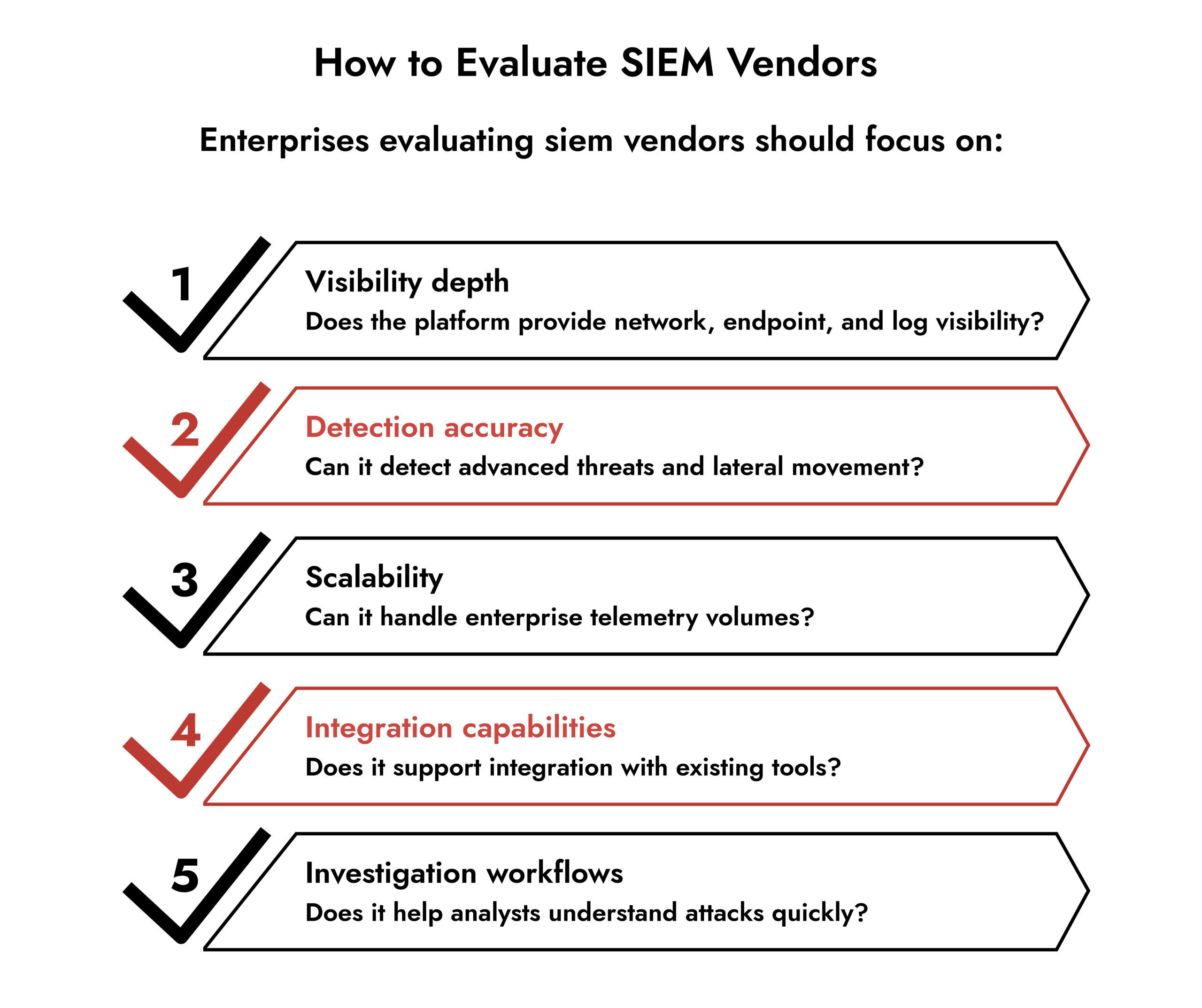
The effectiveness of a SIEM platform is measured by one outcome: how quickly and accurately it helps security teams detect and investigate threats.
Platforms that provide deep visibility across network, endpoint, and log telemetry enable faster investigations and stronger security outcomes.
For enterprises operating complex hybrid environments, SIEM platforms that deliver unified visibility and investigation capabilities provide the strongest foundation for modern security operations.