What is the biggest myth about AI in cybersecurity?
The biggest myth about AI in cybersecurity is that it will replace skilled SOC analysts. The reality is that AI assists SOC analysts only with their repetitive tasks, like log correlation. But AI is an assistant, and investigation, contextual judgment, and response decisions still require experienced analysts’ expertise.
Artificial intelligence is now a part of almost every cybersecurity conversation. Boards have questions about it. CISOs are expected to find ways to implement it. SOC teams are told it will help solve alert fatigue!
But alongside the excitement, there is also a lot of confusion. Some teams expect AI to solve every security problem overnight. Others worry it will introduce new risks or replace human analysts entirely.
But reality sits somewhere in the middle; therefore, it is useful to clear up a few common misconceptions.
In this blog, we break down ten myths about AI in cybersecurity and look at what’s really happening inside modern security operations.
Top AI in Cybersecurity Myths Busted
Myth 1: AI Will Replace SOC Analysts
Reality: Most SOCs are overwhelmed with repetitive and time-consuming tasks such as log correlations and alert enrichment. AI helps automate these tasks. That frees up analysts’ time to focus on investigation and response rather than sorting out raw data. AI, thus, is more useful as an assistant than a replacement.
Myth 2: AI Stops All Threats Automatically
Reality: AI automatically analyzes data and logs, thus accelerating the process of threat detection. However, it cannot eliminate the risk. Additionally, adversaries that continuously evolve tactics, techniques, and procedures to target blind spots in AI models also impact their efficiency. The truth is that, AI models need regular tuning and validation to stay relevant.
AI cyber threat detection systems work best when layered with:
- Strong visibility
- Threat intelligence
- Human validation
- Well-defined incident response workflows
AI reduces dwell time but does not guarantee complete immunity.
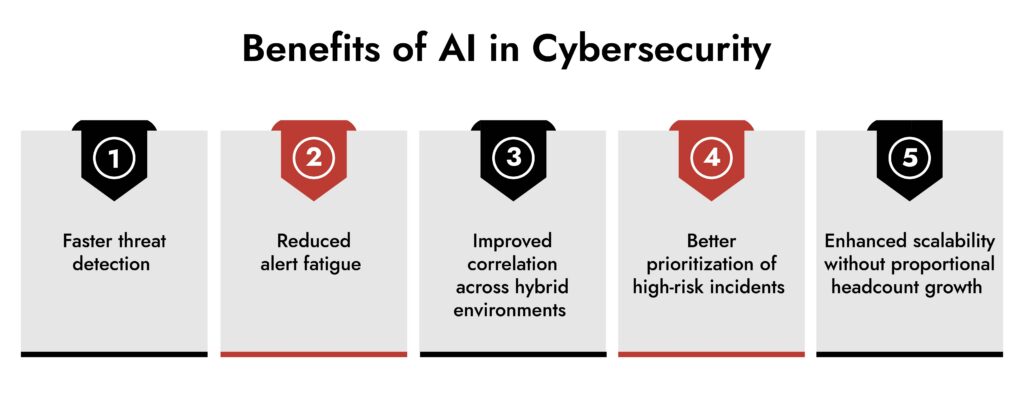
Benefits of AI in Cybersecurity
- Faster threat detection
- Reduced alert fatigue
- Improved correlation across hybrid environments
- Better prioritization of high-risk incidents
- Enhanced scalability without proportional headcount growth
Myth 3: AI Is Only for Large Enterprises
Reality: Most modern SIEM, XDR, NDR, and MDR platforms today include machine learning for threat detection. This helps small or mid-sized organizations as AI takes care when alert queues build up, or log review is inconsistent.
There is also a practical risk consideration. Smaller organizations are often targeted not because they lack continuous visibility and mature security measures. AI-based security tools can help improve signal clarity and reduce bling spots in such cases.
Myth 4: AI Understands Context as Humans Do
Reality: AI can help detect patterns but interpreting them needs human involvement. This is the function where AI cannot replace humans.
For example, a spike in outbound traffic may indicate two things: data exfiltration or a legitimate software deployment. AI may see it as a harmless activity, but a human analyst can determine attacker’s intent.

“In practice, the biggest value of AI in security is not that it independently discovers threats, but that it helps teams establish a baseline of normal activity and quickly surface meaningful deviations. By highlighting anomalies and providing additional context, AI enables analysts to focus on what truly matters while leaving the final investigative judgment to human expertise. It can also assist analysts in crafting more effective queries, helping them filter out noise and reach relevant signals faster. In this sense, AI should be viewed as a force multiplier for security teams, enhancing efficiency and accelerating threat hunting and response rather than replacing human decision making.”
-Ibrahim Badwi, Sales Engineer at NetWitness
Myth 5: AI Eliminates False Positives
Reality: AI in cybersecurity helps reduce the volume of false positives. It does so by correlating a large volume of logs at a rapid pace. But it does have an error-rate. A badly tuned AI model, for example, can increase false positives instead of reducing them.
Myth 6: AI Systems Cannot Be Manipulated
Reality: Just like every other technology, AI also has certain loopholes. It introduces a new category of risks that organizations were not aware of:
- AI detection models can be manipulated.
- Adversarial inputs may be crafted to slip past behavioral thresholds.
- Poorly governed training data can distort how threats are classified over time.
This is where the complexity begins. Security leaders have to take care of: How should detection models be updated after major infrastructure changes? Who reviews tuning decisions? Is there visibility into how third-party platforms retrain their analytics engines?
This is because, if model assumptions drift without oversight, alert quality degrades quietly. Confidence scores may look reassuring on dashboards, even as detection accuracy weakens.
AI in cybersecurity demands a higher standard of governance, validation, and architectural discipline.
Myth 7: AI Deployment Is Plug-and-Play
Reality: AI is not straightforward and requires good data, tuning, and operational alignment.
Many boards assume that AI-powered threat detection becomes effective immediately after deployment. In reality, strong outcomes require:
- Clean, normalized data
- Log and telemetry completeness
- Baseline behavior modeling
- Ongoing retraining
SOC teams must adapt workflows to integrate AI outputs. Without process alignment, advanced analytics simply produce advanced confusion.
Uncover the Dual Nature of AI in Cybersecurity
-Common AI misconceptions in cybersecurity
-Risks & limitations of AI-based tools
-Responsible AI adoption strategies

Myth 8: AI Is Only About Detection
Reality: AI capabilities are not limited to just detection, it supports the entire security lifecycle. While AI threat detection receives the most attention, AI in cybersecurity extends to:
- Automated triage
- Incident prioritization
- Risk scoring
- Threat hunting assistance
- Predictive analysis
- Query optimization
- Sophisticated signature detection
In mature environments, AI assists with exposure management and proactive defense strategies, not just reactive alerts.
Strategically, this allows boards and CISOs to shift from incident counting to risk reduction.
Myth 9: AI Makes Security Decisions Opaque
Reality: Modern AI models increasingly provide explainability. Concerns around “black box” AI are valid. However, many AI-powered SOC tools now include explainable outputs that show:
- Which behaviors triggered anomalies
- Confidence scoring
- Correlation logic
- Historical baseline comparisons
While transparency in AI is improving, organizations need visibility into detection methodology to meet compliance and audit requirements.
Myth 10: AI Adoption Guarantees Better Security Outcomes
Reality: While this is true, the success of AI Adoption depends on governance, integration, and maturity.
AI in network security delivers measurable improvements when it is:
- Aligned to business risk
- Integrated across environments
- Backed by skilled analysts
- Continuously evaluated
Organizations that treat AI as a strategic transformation initiative see reduced dwell time, faster containment, and improved analyst efficiency. Organizations that treat it as a trend often see marginal improvement.
Final Thoughts about AI in Cybersecurity
With AI assistance, SOC spends less time chasing low-value alerts and more time investigating real threats. CISOs appreciate improved risk visibility and measurable operational efficiency. In the future, AI in cybersecurity will continue evolving in behavior-based, integrating with identity, cloud, and endpoint telemetry, and responding to adversarial AI tactics.
Generative AI will assist with summarizing threat intelligence, drafting an incident report, and supporting detection engineering. But governance will become equally important. Model validation, bias management, and explainability will define responsible AI adoption.
Frequently Asked Questions
1. What is the future of AI in cybersecurity?
AI is quickly becoming a part of standard infrastructure in most security operations. It’s already handling anomaly detection and faster threat response, and as environments get more complex, that role will only expand. Human judgment, though, isn’t going anywhere. Analysts will still drive the investigation and final decisions.
2. How can generative AI be used in cybersecurity?
Generative AI can be used to draft incident reports, summarize threat intel, and build detection queries faster. That said, outputs still need a human eye before anything gets acted on.
3. How is AI used in cybersecurity?
Security teams are dealing with enormous data volumes across networks, endpoints, and cloud environments. AI helps in finding unusual patterns, connecting related events, and surfacing activity that actually warrants a closer look.
4. What are the limitations of AI in cybersecurity?
Two things trip up AI models consistently: model drift and data quality. Environments change, and models trained in old patterns lose their edge. Feed them poor data, and the alerts become unreliable fast. Neither problem fixes itself; both require ongoing attention.
5. How does AI help cybersecurity teams?
Mostly by handling the repetitive stuff. AI takes care of triage, alert prioritization, and pattern analysis so that they can spend time on the work that actually requires human thinking.
Unmask GenAI Threats — Get Ahead of the Curve