SIEM vs MDR: Understanding the Difference Between the Solutions

8 minutes read
Overview Icon

SIEM vs. MDR: What Are the Key Differences and Which One Is Right for You?

SIEM collects logs and events across endpoints, networks, servers, and applications. MDR is a fully managed security tool that detects and responds to threats, and the coverage across endpoints, networks, clouds, and identities varies as per vendor.

As enterprises are embracing digital adoption across cloud, SaaS, and hybrid environments, their attack surface is expanding rapidly. With more assets, identities, and data exposed, cybersecurity cannot be a back burner. 

IBM’s Cost of a Data Breach Report shows that the average cost of a data breach reached USD 4.45 million globally! 

Yet, acknowledging the need for security is the easy part. Choosing the right approach from the growing number of security solutions in the market is where most enterprises struggle. 

To simplify that decision, this article compares SIEM (Security Information and Event Management) and MDR (Managed Detection and Response). It looks at each of their benefits and the differences between each of the tools. Finally, we provide a practical questionnaire that can help you determine whether MDR or SIEM is the right fit for your organization.  


What is SIEM? 

SIEM solution is a security platform that collects data from every endpoint, network, server, cloud services, apps, and security tools. It then applies rules to correlate the data. It centralizes the data for the security team to effectively monitor, derive insights, and send alerts of possible attacks. 

Its primary goal is to provide 360-degree visibility, log management, and alerting. 

Benefits of SIEM: 

  • Automated Log Collection and Reporting: SIEM solution collates the logs from every system in your network and generates reports to analyze and further identify threat possibilities. 
  • Real-time Monitoring: SIEM monitors the logs and events 24/7 and shares real-time updates or alerts to avert attacks. 
  • Compliance Management: SIEM meticulously tracks and records all the event logs to comply with regulatory requirements. 


What is MDR? 

MDR is a fully managed security service that detects and responds to threats. Depending on the vendor, it provides coverage across endpoints, networks, cloud, and identities. 

MDR solution offers continuous monitoring and threat hunting, making it possible to identify and respond to threats instantly. 

Benefits of MDR: 

  • Threat Detection and Response: MDR monitors for threats in real-time, detects them, and automatically responds to them as well, keeping your system safe. 
  • Proactive Protection: MDR solution uses artificial intelligence, machine learning, and behavioral analytics to proactively look for threats and safeguard the systems before the damage. 

Differences between SIEM and MDR: 

Aspect SIEM (Security Information and Event Management) MDR (Managed Detection and Response) 
What it is A security platform that collects logs and events. It then correlates and analyzes them It is a fully managed security tool that detects and responds to threats 
Primary focus Centralized data visibility, log management, and alerting Threat detection and response 
Coverage SIEM solution collects logs from endpoints, networks, servers, cloud services, apps, and security tools Depending on the vendor, the MDR solution provides coverage across endpoints, networks, cloud, and identities 
How it works Ingests large volumes of data and applies rules, correlations, and analytics Combines security tools (often including SIEM/EDR) with human analysts in a 24×7 SOC (security operations center) 
Response included? No Yes 
Who operates the solution Your internal security or SOC team External security experts 
Skill requirement Requires highly skilled analysts for investigation Does not require highly skilled analysts 
Typical buyers Large enterprises with mature SOCs and compliance needs Organizations looking to outsource detection and response 


siem vs mdr

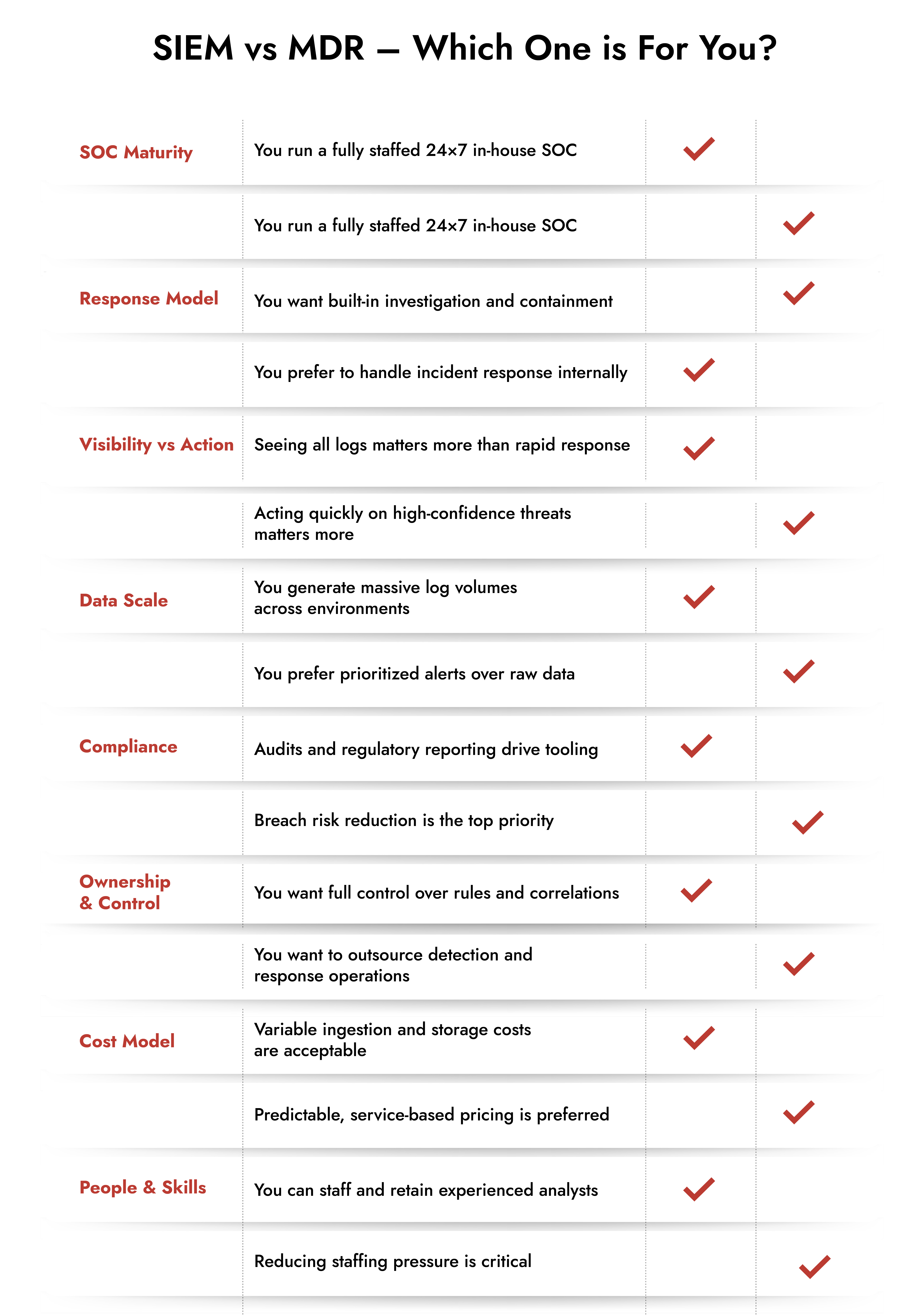
If most of your checks lean towards a certain solution, then that is the solution that is most suitable for you. 

SIEM security services are best for enterprises that have a mature SOC, heavy compliance requirements, and need raw data ownership. Whereas MDR security services are best when enterprises need rapid detection and response, want to reduce SOC’s workload, and prefer outcomes over ownership. 

If you have a balanced number of checks, consider both solutions that provide a combination of visibility, compliance, detection, and response.

Which security blind spot worries you the most right now?

NetWitness SIEM

NetWitness SIEM is a purpose-built solution for large and complex enterprises. It captures logs from 350+ sources, including AWS, Azure, Salesforce, etc., using Syslog, ODBC, SFTP, FTPS, and SNMP protocols. It enriches data by leveraging our patented dynamic parsing to add metadata for faster detection and investigation. It analyzes data, manages alerts, and generates reports using templates that comply with regulatory standards such as SOX, HIPAA, PCI, and NERC. 

Key features of NetWitness SIEM include: 

  • Centralized Log Management 
  • Dynamic Parsing & Metadata 
  • Cloud-Ready Deployment 
  • Customizable Reporting 
  • Automated Log Source Directory 

We will shortly be introducing NetWitness AI chatbots and AI SOC agents designed to support security teams by assisting with day-to-day security operations.  


Frequently Asked Questions

1. Does SIEM replace MDR, or vice versa?

No, SIEM and MDR cannot replace each other as they serve different purposes in the organization. A SIEM solution is a recording system for security event data. It collects data from varied sources and supports investigations and reporting. On the other hand, the MDR solution tracks threats proactively and responds on detection. 

Yes, SIEM and MDR work together and are a very effective pairing. SIEM works towards collecting data and event logs, which can be used by MDR for quicker analysis and response to the threat. SIEM and MDR together can strengthen your organization’s security. 

The choice between SIEM and MDR depends on many factors, such as: 

  • How skilled is the SOC of the organization? 
  • What are the requirements for visibility and action? 
  • What are the compliance requirements of the organization? 
  • How much control or ownership does the organization want to exercise on the solution? 
  • What kind of budget model is suitable for the organization? 

The table above can help you understand which solution is better for your organization. 

SIEM solution allows the organization to have more control over platform configurations, tuning, dashboards, and retention policies. Whereas the ownership of the MDR solution lies with the vendor, and depending on the agreement, the day-to-day data monitoring, triage, investigations, and containment workflows are shared with the organization. 

SIEM provides more control, and MDR provides coverage and execution. 

SIEM and MDR have different cost models. 

  • SIEM: For a SIEM solution, the organization pays for log ingestion, storage, analytics, and the analysts who tune the rules. SIEM requires fewer initial investments and costs scale with the data volume and number of people. 
  • MDR: For an MDR solution, pricing is typically subscription-based, depending on the endpoints, user, or workload, and includes tooling plus a managed SOC. MDR costs are scaled with the number of endpoints or users. 


Elevate Threat Detection and Response with NetWitness® SIEM

-Correlate data across users, logs, and network for unified visibility.

-Detect advanced threats with AI-driven analytics and behavioral insights.

-Accelerate investigations using automated enrichment and guided workflows.


Lead Magnet Mockup

About Author

Picture of Ashwini Kolar

Ashwini Kolar

Ashwini is a cybersecurity writer and researcher who combines strategic thought leadership with clear technical analysis to break down complex cybersecurity challenges. Her work spans the breadth of cybersecurity - from cloud and infrastructure security to threat detection and response. Through her writing, she aims to enable organizations to make informed, resilient security decisions.

Related Resources

Accelerate Your Threat Detection and Response Today!