Security Information and Event Management (SIEM) Explained: Guide for New Security Professionals

14 minutes read
Overview Icon

What is SIEM and Why is it Important?

Security Information and Event Management (SIEM) is a cybersecurity technology that helps organizations monitor, detect, investigate, and respond to cyber threats by collecting and analyzing security data from multiple sources. 

It is important because modern cyberattacks generate evidence across networks, endpoints, cloud platforms, and applications. SIEM software brings this data together, correlates related events, and identifies threats that individual security tools may miss. 

The primary benefits of SIEM include: 

  • Faster threat detection  
  • Centralized log management  
  • Continuous security monitoring  
  • Simplified compliance reporting  
  • Improved incident response  
  • Better visibility across hybrid IT environments  

As cyber threats become more sophisticated, SIEM has become a core technology within every modern Security Operations Center (SOC). 

Introduction 

Starting your cybersecurity career? Here’s the thing: if you’re going to master one technology that sits at the heart of every enterprise security operation, make it SIEM. 

Security Information and Event Management isn’t just another acronym. It’s the nerve center. The difference between catching threats early and cleaning up disasters later. But here’s what most guides won’t tell you: understanding SIEM goes beyond learning the technology. You need to understand why it exists, where it wins, and where it fails. 

Let’s break it down in this SIEM guide.

What Is Security Information and Event Management (SIEM)?

SIEM in cybersecurity is your organization’s security command center.  It’s a centralized platform that collects log data from your entire IT infrastructure, analyzes that data for suspicious patterns, and alerts your security team when something looks abnormal. 

Picture this: every device, application, and system in your environment generates logs constantly. Servers log user access. Firewalls log connection attempts. Applications log errors and transactions. Without SIEM, these logs exist in isolation, scattered across hundreds or thousands of individual systems. 

SIEM in cybersecurity brings all that scattered information into one place. Finally, you can make sense of it. 

The acronym breaks into two parts: 

  • Security Information Management (SIM): Long-term storage, analysis, and reporting of security data.
  • Security Event Management (SEM): Real-time monitoring, correlation, and alerting on security events.

Together, they give you immediate awareness and historical context. Both essential for protecting your organization from sophisticated threats.

Why Security Information and Event Management (SIEM) Matters More Than Ever 

Cyber threats aren’t simple anymore. A successful attack spans dozens of steps across multiple systems over weeks or months. An attacker compromises a user account, escalates privileges, moves laterally through your network, and steals data. All while leaving breadcrumbs across different log sources.

Without SIEM, you’re piecing together a puzzle in the dark. NetWitness lights it up, linking logs with NDR and EDR to reveal the full picture fast

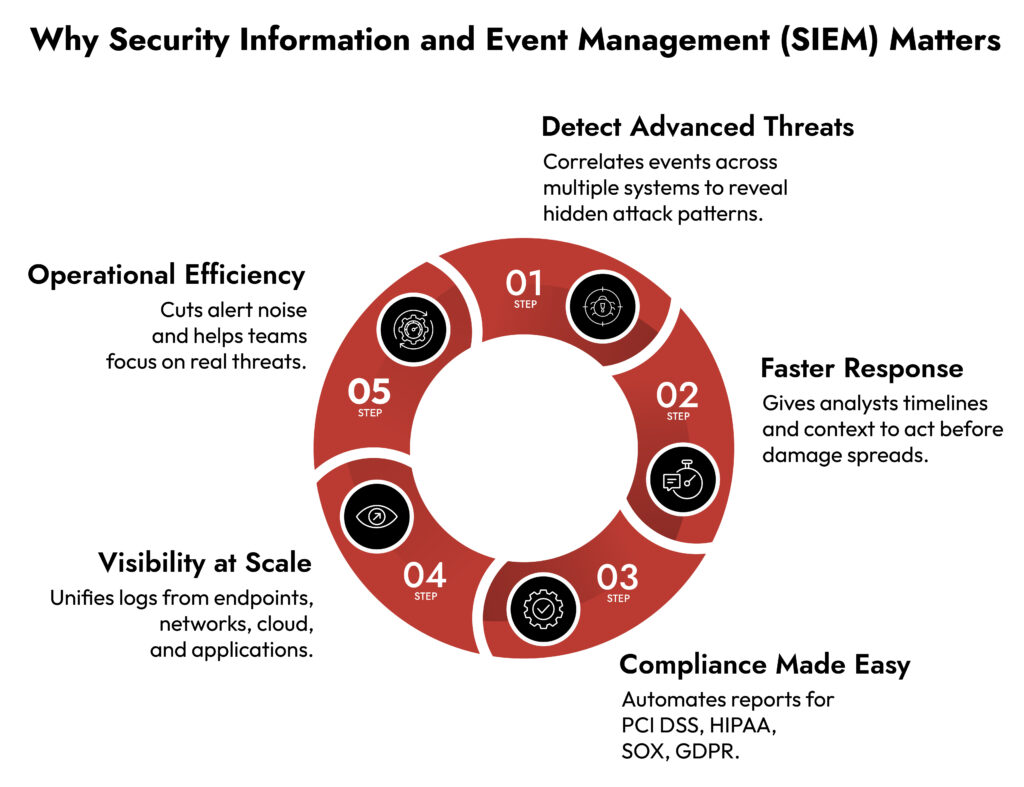
Security information and event management tackles three critical challenges: 

  1. Threat Detection: Modern attacks span multiple systems and timeframes. SIEM correlates unrelated events to reveal attack patterns human analysts miss. 
  2. Compliance Reporting: Regulations like PCI DSS, HIPAA, and SOX require detailed security monitoring and reporting. SIEM automates this process. 
  3. Incident Response: When something breaks, SIEM provides the timeline and context your response team needs. 

Here’s reality: A large enterprise generates millions of security events daily. Without SIEM software solutions to process and correlate that data, it’s just noise. With it, you identify the handful of events that indicate real threats. 
Security Information and Event Management (SIEM)

Core Components That Make SIEM Work

1. Log Management: The Foundation

Everything starts with data collection. Your SIEM platforms ingest logs from everywhere: Windows event logs, Linux syslogs, firewall connection records, application audit trails, cloud service logs. 

Each system speaks a different language. SIEM normalizes these diverse formats into a common structure it can work with. A Windows authentication log looks nothing like a Cisco firewall log. SIEM translates both into standardized events it can analyze. 

Raw logs are just the starting point. Real power comes from enrichment. When your SIEM sees a connection to an external IP address, it automatically checks that address against threat intelligence feeds, adds geographic information, and flags known malicious sources. Context transforms meaningless data points into actionable intelligence. 

2. Event Correlation: Connecting the Dots

This is where security information and event management gets interesting. Event correlation works like a detective who never sleeps, constantly looking for patterns across all your security data. 

Real-world example: someone tries to log into your VPN from an unusual location, then accesses a file server they’ve never touched before, then starts downloading large amounts of data. Individually, these events might not trigger alerts. Together, they paint a picture of potential data theft. 

The correlation engine uses rules, machine learning, and behavioral analytics to identify these patterns. It connects dots to reveal hidden attack sequences that would be invisible if you looked at each log source alone.

3. Alerting and Reporting: Taking Action

Real-time alerting is your early warning system. When the correlation engine identifies something suspicious, it immediately notifies your security team through dashboards, emails, or integration with ticketing systems. 

Here’s the challenge: you need alerts that matter. Not alert fatigue from constant false positives. The best SIEM software solutions balance sensitivity with accuracy, surfacing real threats while minimizing noise. 

Reporting handles your compliance obligations and executive communications. Need to show an auditor every privileged access attempt over the past year? SIEM generates that report in minutes instead of days.


How Security Information and Event Management (SIEM) Works 

Let me walk you through how this works in practice: 

  1. Data Ingestion happens continuously. Logs flow into your SIEM from across your infrastructure, getting parsed and normalized as they arrive. This process runs 24/7, often handling thousands of events per second.
  2. Analysis and Correlation runs in the background. Rules and algorithms identify anomalies and attack patterns. This engine processes events in real-time, looking for indicators of compromise and suspicious behavior patterns. 
  3. Incident Triage brings human expertise into the picture. When the system generates an alert, a security analyst reviews it to determine if it represents a real threat or a false positive. This step requires understanding both the technology and your organization’s normal behavior patterns. 
  4. Investigation and Response follows confirmed threats. Analysts dig deeper into the data, understand the scope of the incident, and coordinate the response. SIEM provides the detailed timeline and context needed for effective remediation. 
  5. Continuous Improvement means fine-tuning your rules and processes based on what you learn. Every false positive teaches you something about your environment. Every missed threat reveals a gap to address.


Key Security Information and Event Management (SIEM) Concepts 

  1. Rule Engine: The brain of your SIEM that defines conditions for triggering alerts. Rules can be simple (“alert when someone logs in from a blacklisted IP”) or complex (“alert when a user accesses more than 10 different systems within 5 minutes outside normal business hours”). 
  2. Use Cases: Specific detection scenarios your SIEM identifies. Common use cases include failed login attempts, privileged account usage, data exfiltration patterns, and malware infections. 
  3. Dashboards: Visual interfaces that display security metrics, alert summaries, and key performance indicators. Good dashboards help analysts quickly understand their security posture and identify trends. 
  4. False Positives and False Negatives: False positives are alerts that aren’t real threats – they waste time and cause alert fatigue. False negatives are real threats that don’t trigger alerts – they’re more dangerous but harder to measure. 
  5. Retention Policies: How long your SIEM stores different types of data. Raw logs might stay for 90 days, while summarized data might remain for years to support compliance requirements. 
Elevate Threat Detection and Response with NetWitness® SIEM

-Correlate data across users, logs, and network for unified visibility.

-Detect advanced threats with AI-driven analytics and behavioral insights.

-Accelerate investigations using automated enrichment and guided workflows.


Lead Magnet Mockup

Benefits of Security Information and Event Management (SIEM) 

  • Threat Detection: Correlates events across multiple sources to identify attack patterns.
  • Compliance Support: Automates reporting for PCI DSS, HIPAA, SOX, and other regulations.
  • Forensic Investigation: Provides detailed logs and timelines for incident analysis.
  • Real-time Monitoring: Alerts security teams to suspicious activity as it happens.
  • Historical Analysis: Enables trend analysis and long-term security posture assessment.


Limitations of Traditional Security Information and Event Management (SIEM) 

Here’s what most guides won’t tell you: SIEM alone isn’t enough anymore. 

Traditional security information and event management tools were designed for simpler environments and threats. Today’s challenges expose several limitations: 

  • Alert Overload: Many SIEMs flood analysts with alerts, creating fatigue and increasing the risk of missing real threats. 
  • Limited Context: Logs alone don’t tell the complete story. Without behavioral context or network-level data, detecting advanced threats becomes guesswork. 
  • Cloud Blind Spots: Legacy SIEM solutions struggle with dynamic cloud environments, containerized workloads, and serverless applications. 
  • Static Detection: Rule-based detection can’t keep pace with fast-evolving attack techniques. Sophisticated threats often bypass detection because SIEM logic hasn’t been updated. 
  • Operational ComplexitySIEM platforms require ongoing tuning, rule creation, and infrastructure management. Without mature processes, they become sources of noise rather than insight.


Modern Security Information and Event Management (SIEM) Architecture 

Smart organizations pair SIEM with complementary technologies: 

  • Network Detection and Response (NDR): Provides deep packet inspection and network behavior analysis that SIEM logs can’t capture. 
  • Endpoint Detection and Response (EDR): Offers device-level forensics and behavioral threat detection beyond what endpoint logs provide. 
  • User and Entity Behavior Analytics (UEBA): Detects insider threats and account compromise through behavioral modeling. 
  • Security Orchestration, Automation, and Response (SOAR): Automates repetitive tasks and streamlines incident response workflows. 

These technologies provide the context and automation that traditional SIEM often lacks. They create a more effective defense ecosystem. 


How Security Professionals Use SIEM 

Working with SIEM means wearing several hats: 

  • SIEM Administration: Keep the system running smoothly. Manage data sources, update correlation rules, and maintain performance. 
  • Security Analysis: Triage alerts, investigate incidents, and determine which threats require immediate attention. 
  • Use Case Development: Create new detection rules for emerging threats and refine existing ones to reduce false positives. 
  • Threat Hunting: Use SIEM data to proactively search for threats that automated detection might miss. 

Practical example: You want to detect credential stuffing attacks. Build a rule that triggers when the same external IP attempts to log into multiple user accounts within a short timeframe. Tune the thresholds based on your environment’s normal patterns. Test the rule to ensure it catches real attacks without overwhelming analysts with false positives.

Best Practices for Security Information and Event Management (SIEM) Implementation 

  • Clear Use Cases: Define specific threats you want to detect before configuring rules.
  • Quality Data Sources: Garbage in, garbage out – ensure you’re collecting relevant, high-quality logs.
  • Proper Tuning: Balance detection sensitivity with false positive rates.
  • Skilled Personnel: SIEM works only as well as the people operating it.
  • Integration Strategy: Plan how SIEM fits with other security tools and processes.


Future of Security Information and Event Management

SIEM technology continues evolving rapidly. Cloud-native architectures handle massive data volumes more efficiently. Machine learning improves detection accuracy while reducing false positives. Integration with SOAR platforms automates response actions. 

Here’s what won’t change: the need for skilled professionals who understand both the technology and the threat landscape. Security information and event management tools are powerful. But they’re only as effective as the people operating them.

What this means for your career: SIEM gives you a foundation for understanding how enterprise security operations work. Master it well, and you’ll understand data flows, threat detection logic, incident response processes, and compliance requirements that apply across the entire cybersecurity field.


Why Enterprise Organizations Choose NetWitness SIEM 

Many organizations evaluating Security Information and Event Management (SIEM) platforms require more than centralized log management. They need complete visibility across users, endpoints, networks, cloud workloads, and security operations. 

NetWitness SIEM extends traditional SIEM capabilities by combining: 

  • Centralized log management across enterprise environments  
  • Advanced event correlation for multi-stage threat detection  
  • Native integration with Network Detection and Response (NDR) and Endpoint Detection and Response (EDR)  
  • Deep investigation and forensic capabilities  
  • Threat intelligence enrichment  
  • Hybrid and multi-cloud visibility  
  • Compliance reporting and long-term log retention  
  • Scalable architecture built for enterprise SOCs  

Rather than operating as a standalone log management platform, NetWitness SIEM helps security teams investigate, prioritize, and respond to complex threats from a unified platform. 

Final Thought

SIEM isn’t just a technology – it’s a window into how modern organizations defend themselves against sophisticated threats. Whether you’re analyzing alerts, building detection rules, or investigating incidents, SIEM skills translate into career opportunities across security operations, incident response, threat hunting, and compliance.

The learning curve is steep. But the foundation it provides is invaluable. In a field where threats evolve daily and technology changes rapidly, understanding how to collect, analyze, and act on security data gives you skills that remain relevant regardless of which specific tools you’re using. 

That’s why security information and event management deserves a place at the top of your learning priorities.


Frequently Asked Questions

1. What features should I look for in Security Information and Event Management (SIEM) tools?

The best Security Information and Event Management (SIEM) tools should provide centralized log management, real-time threat detection, event correlation, threat intelligence integration, compliance reporting, cloud visibility, automated alerting, scalability, and native integration with EDR, NDR, SOAR, and UEBA. 

Enterprise organizations should evaluate Security Information and Event Management (SIEM) solutions based on scalability, detection accuracy, investigation capabilities, cloud support, compliance reporting, automation, and integration with the broader security ecosystem. Platforms that combine SIEM, NDR, EDR, and advanced analytics help security teams detect and investigate sophisticated threats more efficiently. 

SIEM accelerates incident response by correlating security events from multiple systems, prioritizing alerts, and providing investigators with the context and timelines needed to understand and contain threats quickly. 

No. Modern enterprises typically combine Security Information and Event Management with Network Detection and Response (NDR), Endpoint Detection and Response (EDR), User and Entity Behavior Analytics (UEBA), and Security Orchestration, Automation, and Response (SOAR) for broader visibility and faster threat detection. 

When selecting an enterprise SIEM, evaluate deployment flexibility, scalability, event correlation, threat intelligence, cloud visibility, investigation capabilities, automation, compliance support, and integration with your existing security stack. The right platform should reduce analyst workload while improving detection accuracy and investigation speed. 

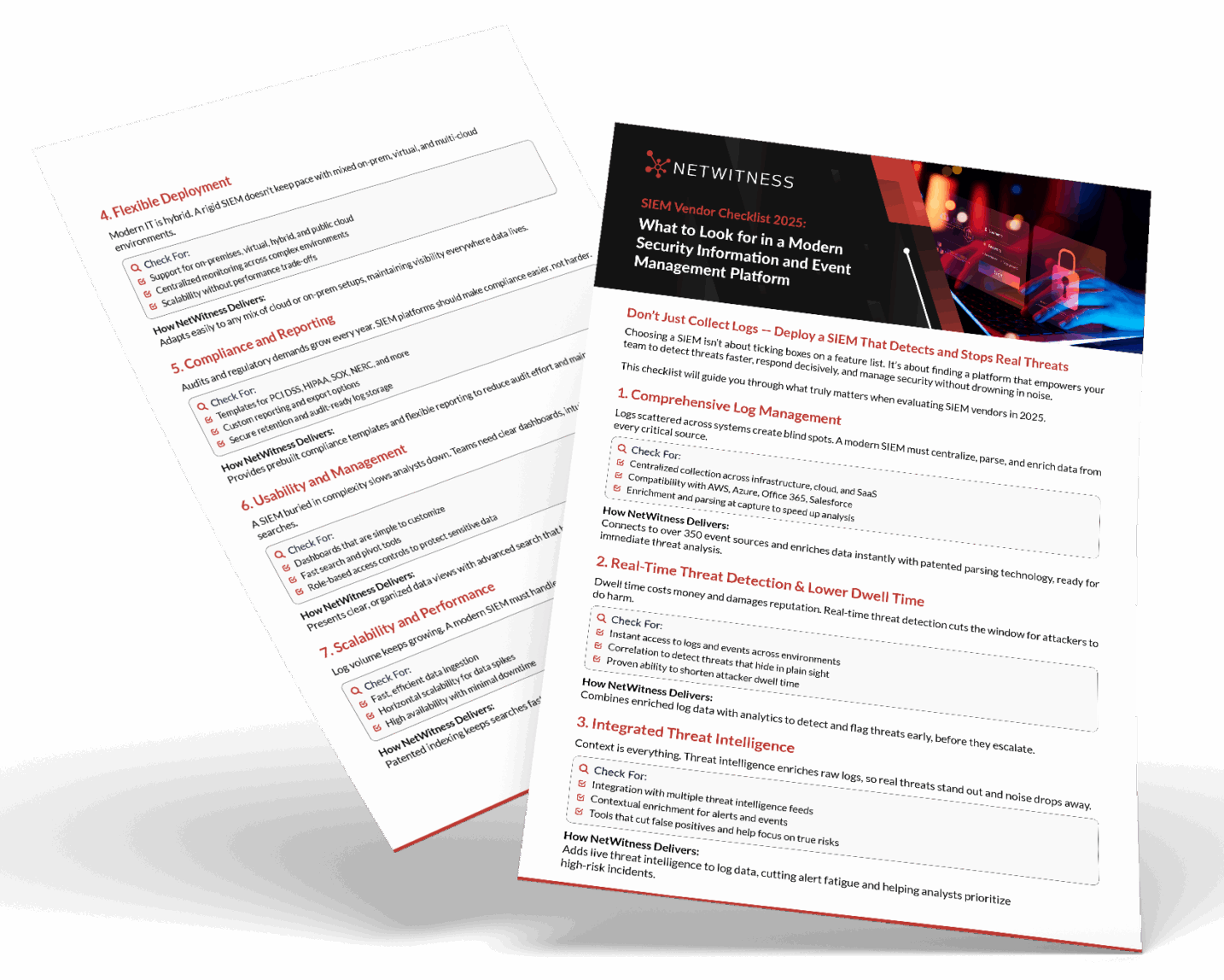
Choose the Right SIEM with Confidence

Evaluate vendors using a comprehensive, expert-built checklist.

Identify must-have SIEM features for complete visibility and faster detection.

Make informed decisions with NetWitness’ proven SIEM guidance.


SIEM Vendor

About Author

Picture of Anusha Chaturvedi

Anusha Chaturvedi

Anusha Chaturvedi is the Content Copywriter at NetWitness. She holds a postgraduate diploma in PR, advertising, and marketing from YMCA, and a bachelor’s in journalism and mass communication from Amity University, with experience in SEO, social media, and B2B content marketing. Connect with her on LinkedIn.

Related Resources

Accelerate Your Threat Detection and Response Today! 

Don't Want to be Stuck with the Wrong SIEM?

Then ask these 30 questions to your vendor!

Leaving Without The Ransomware Intel?

See which groups are targeting enterprises in 2026 and how to prepare before they strike.