How can logistics companies strengthen supply chain cybersecurity?
Logistics companies can strengthen supply chain cybersecurity by adopting a layered security strategy that combines cybersecurity supply chain risk management, Network Detection and Response (NDR), operational technology security, continuous security monitoring, and rapid incident response. Organizations should secure third-party vendors, segment IT and OT networks, monitor network activity in real time, and proactively detect advanced persistent threats before they disrupt operations. Regular risk assessments and threat hunting also help reduce the impact of supply chain attacks.
Why State-Sponsored Cyber Threats Are Targeting Logistics and Supply Chain Networks
Ports don’t look like military targets. Neither do freight carriers or warehouse networks. That’s precisely the appeal for a nation-state actor looking for leverage without leaving fingerprints.
Compromise one shipping terminal, or one freight scheduling platform, and the fallout doesn’t stay contained. It spreads to manufacturers who needed that cargo, retailers waiting on inventory, defense contractors who trusted the wrong vendor. None of them saw it coming because none of them were the actual target.
That’s the logic driving most state-sponsored cyber threats today. Why attack a hardened target directly when you can go after the logistics backbone it depends on? It costs less, it’s harder to trace back to a government, and the damage multiplies well past one company’s walls.
Understanding Supply Chain Cybersecurity Risks
Supply chain cybersecurity used to mean securing your own perimeter. That’s not enough anymore. Every vendor, every carrier, every piece of third-party software touching your systems is now part of your risk surface, whether you audited it or not. Cybersecurity supply chain risk management needs to account for vendors, software dependencies, carriers and connected infrastructure.
Most logistics companies are running a patchwork. Legacy scheduling systems next to modern cloud platforms, connected through integrations nobody fully documented. Each connection point is a door, and attackers only need one unlocked.
Supply chain cybersecurity risk management is how you deal with this before it becomes a headline. Map the dependencies. Figure out which ones actually matter. Put controls where the risk concentrates. Skip that work and you’re trusting your security posture to companies you’ve never inspected and probably never will.
How State-Sponsored Supply Chain Attacks Disrupt Logistics Operations
These attacks rarely look dramatic on day one. An adversary gets into a freight scheduling system and just… waits. Maps out routes. Studies cargo manifests. Learns the rhythm of the operation for months before pulling the trigger, often timed to a peak shipping season or a moment of geopolitical tension.
The damage isn’t only downtime, either. Falsified customs records. Manipulated shipment data. Deliveries that quietly vanish or arrive late enough to break a contract. When the cargo involves hazardous materials, the stakes go beyond financial loss entirely. From a supply chain attacks cybersecurity perspective, logistics networks are particularly vulnerable because logistics networks are so tightly interconnected, one breach at one node can blind an entire region’s supply chain to what’s actually moving where.
Key Vulnerabilities in Modern Logistics and Supply Chain Networks
Effective logistics network security starts with understanding where operational, third-party and infrastructure vulnerabilities intersect.
Third-party vendors and software dependencies. Freight brokers, customs platforms, tracking software, they’re all extensions of your own network whether you think of them that way or not. A breach on their end often walks right into yours.
Operational technology and industrial systems. Port cranes, conveyor lines, warehouse automation. Most of it was built for reliability, not for resisting cyber threats, and a lot of it still runs on firmware that hasn’t been updated in years.
Connected warehouses, IoT, and transportation infrastructure. Sensors, RFID tags, fleet tracking systems. They generate mountains of useful data, and just as much exposure, since half of them were never designed with monitoring in mind.
Cloud platforms and remote access. The shift to remote operations happened fast. Security controls didn’t always keep up with it, and a lot of logistics platforms still carry that gap.
Limited visibility across distributed environments. You can’t secure what you can’t see, and most logistics networks span so many sites, vendors, and clouds that a single unified view of activity is rare to find.
How to Protect Logistics and Supply Chain Networks from State-Sponsored Cyber Threats
Strengthen supply chain cybersecurity risk management. Keep a living inventory of every vendor and system touching your network. Rank them by exposure. Revisit it often, not once a year when the audit rolls around.
Secure operational technology and critical infrastructure. Segment IT and OT so a breach on one side can’t just walk into the other. Patch what you can patch, and watch closely everything you can’t.
Implement Network Detection and Response for early threat detection. This is where subtle, low-and-slow movement gets caught, the kind state-sponsored actors depend on to stay invisible for months at a time.
Keep security monitoring continuous, not periodic. Threats built to blend into normal traffic don’t announce themselves on a quarterly review schedule. They need eyes on them constantly.
Improve third-party and vendor security controls. Set a baseline, then actually verify vendors meet it instead of taking their word for it. Contracts should include audit rights and clear breach notification timelines.
Build a faster, coordinated incident response strategy. A logistics breach often touches more than one company at once, so figure out who talks to whom, and how fast, before an actual incident forces that conversation under pressure.
Use threat intelligence to catch advanced persistent threats. APTs move slowly and deliberately by design. Intelligence feeds tied to known state-sponsored tactics help teams spot the early signs before an attacker escalates.
Validate security through continuous testing and threat hunting. Don’t wait for an alert. Go looking for what attackers left behind, because sometimes nothing ever triggers an alarm at all.
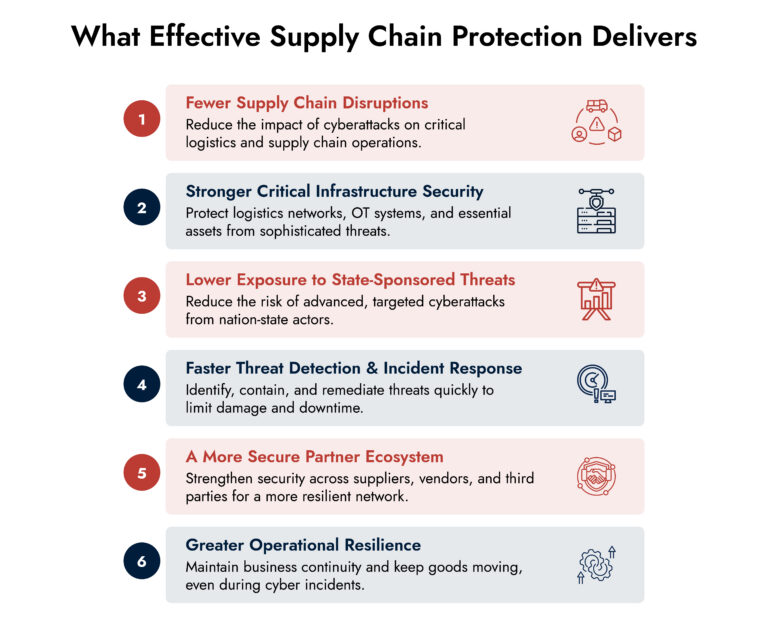
Best Practices for Long-Term Logistics Network Security
- Adopt a Zero Trust model. Verify every user and device, don’t assume internal traffic is automatically safe.
- Segment IT and OT environments so one compromise can’t spread across the whole network.
- Reduce monitoring and response time for shrink detection and containment by automating.
- Run supply chain cybersecurity risk assessments regularly across vendors, software, and hardware.
- Test incident response plans with tabletop exercises that mirror real multi-party breach scenarios.
How NetWitness Protects Logistics and Supply Chain Networks
Fragmented, multi-vendor environments tend to hide more than they reveal. NetWitness closes that gap. Its Network Detection and Response capabilities watch traffic across both IT and OT systems, picking up the quiet, persistent activity that state-sponsored actors rely on to stay unnoticed.
Full packet capture matters here too. Security teams aren’t stuck guessing from metadata, they can reconstruct exactly what happened during an incident, which counts for a lot when a breach spans several organizations at once.
Network, endpoint, and log data live on one platform instead of a dozen disconnected tools. For logistics security teams already stretched thin across distributed operations, that unification is what turns noise into something actionable.
Conclusion
Logistics networks sit in an uncomfortable spot: high value to attackers, low visibility for defenders. State-sponsored threats aren’t slowing down, and they’re getting more patient, not less. The organizations that hold up under this pressure aren’t the ones stacking the most security tools. They’re the ones with clear visibility, tight vendor controls, and an incident response plan that actually works when it’s tested for real. Building that now is a lot cheaper than rebuilding trust after a breach takes down half your supply chain.
Frequently Asked Questions
1. What are the best cybersecurity solutions for protecting supply chains?
The most effective supply chain cybersecurity solutions combine Network Detection and Response (NDR), Security Information and Event Management (SIEM), endpoint protection, operational technology security, security monitoring, threat intelligence, and incident response. Together, these technologies provide visibility across logistics networks and help detect, investigate, and contain cyber threats before they disrupt operations.
2. What are common cyber threats to global supply chains?
Global supply chains face ransomware, software supply chain compromises, phishing, credential theft, advanced persistent threats (APTs), insider threats, attacks on third-party vendors, and operational technology attacks. State-sponsored actors often exploit trusted suppliers and interconnected logistics systems to gain access to critical infrastructure.
3. Which companies specialize in supply chain cybersecurity services?
Several cybersecurity vendors offer solutions that help protect supply chain environments, including NetWitness, Palo Alto Networks, Cisco, Microsoft, CrowdStrike, Fortinet, Trellix, and IBM. Organizations should choose providers that offer comprehensive visibility, Network Detection and Response, threat intelligence, incident response, and operational technology security capabilities.
4. What are the most common cyber risks facing supply chain organizations?
Supply chain organizations commonly face risks such as compromised third-party vendors, vulnerable OT environments, unsecured cloud platforms, ransomware, limited network visibility, outdated software, and sophisticated advanced persistent threats. Without continuous security monitoring, these risks can lead to operational disruption, financial losses, and data breaches.
5. How can logistics companies strengthen supply chain cybersecurity?
Logistics companies can improve supply chain cybersecurity by implementing cybersecurity supply chain risk management, securing third-party vendors, segmenting IT and OT networks, deploying Network Detection and Response solutions, enabling continuous security monitoring, and maintaining a well-tested incident response plan. Regular threat hunting and vulnerability assessments further reduce the risk of successful cyberattacks.
Reduce alert fatigue with smarter detection strategies that help analysts focus on real threats.