Where Government Cyber Resilience Stands Heading Into 2027
- The number of ransomware attacks on governments has increased dramatically up to 2026. Increasingly, cybercriminals bypassed the use of ransomware and simply took information from government networks and demanded ransom for its return.
- Ineffective infrastructure, low budgets for cybersecurity and shortages in staff are the top-three obstacles to the advancement of governments in their cybersecurity maturity levels.
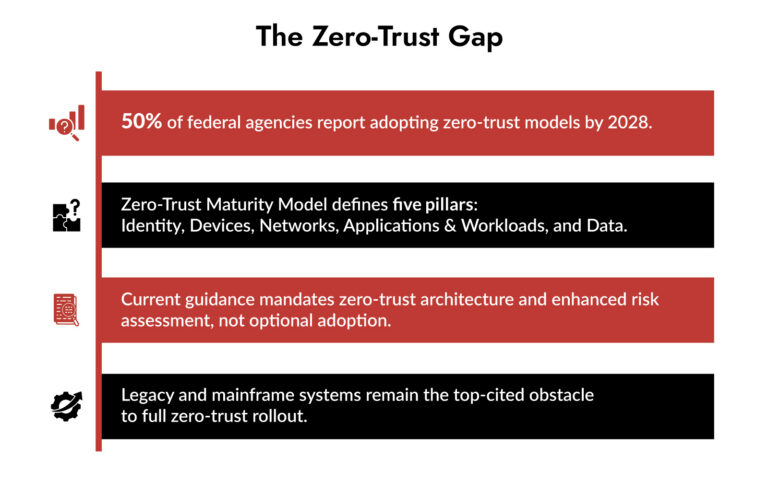
- Although federal government entities have made progress toward adopting zero-trust principles, implementation remains incomplete.
- Today, it is not enough just to prevent any cyberattack because the resilience level of government entities is determined by the speed of investigation and recovery after the attack.
- Visibility and unification of threat detection have become necessary conditions.
Introduction
If you ask any state CISO what has been altered in those three years since 2023, it will not be that more attacks occurred, but rather that attacks have become different. The former attacker who encrypted your files in return for money does not even bother anymore but takes all your data and then threatens to leak it on a website before your incident response teams even realize what was hit. This single change already changes everything when thinking about defensive strategies for governments in 2026.
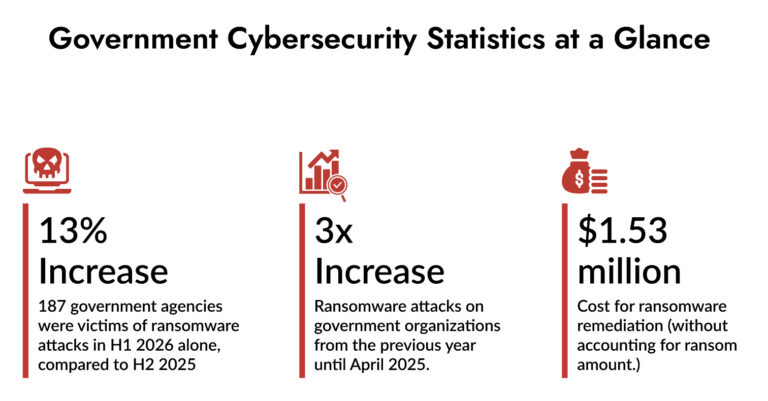
Government cybersecurity has never been a niche concern. It’s the plumbing that keeps benefits of payments running, courts operating, water systems online, and classified defense programs intact. And the plumbing is under sustained pressure. Most recent tracking found 187 government organizations hit by ransomware in just the first six months of 2026, a 13% jump over the back half of 2025. Researchers reported ransomware attacks against government entities more than tripled year over year through April 2025, pushing government into the top ten most-targeted sectors globally. These aren’t abstractions. Each entry on that list is a city payroll system, a court docket, a permitting office, or a defense contractor’s engineering files.
The Threats Facing Government Cybersecurity Programs Right Now
The threat picture facing government cybersecurity teams has three distinct layers and treating them as one problem is where a lot of programs go wrong.
- Nation-state espionage and APTs – State-sponsored actors aren’t looking for a quick payday. They want sustained access to classified communications, defense research, and critical infrastructure control systems, and they’re willing to sit dormant for months to keep it. Detecting a campaign like this requires visibility that goes well beyond endpoint logs.
- Ransomware and extortion – Average ransom demands against government targets actually declined in 2025, down 15% year over year to roughly $1.55 million. But that’s not good news. Attackers are compensating with volume and speed, and Sophos found average recovery costs, excluding any ransom paid, still landed around $1.53 million per incident. Downtime, not the ransom itself, is usually the bigger line of item, and it’s exactly why ransomware protection has to include fast detection and recovery, not just prevention.
- Insider risk and supply chain exposure – Defense programs run on contractor ecosystems, and every subcontractor with network access is a potential entry point. A vulnerability in a vendor’s environment doesn’t stay the vendor’s problem once it’s a foothold into your government cybersecurity perimeter.
Layer legacy IT on top of that. A lot of agencies are running systems built before “cloud” was a category, patched around rather than replaced because rip-and-replace budgets rarely survive a funding cycle.
Where Government Cybersecurity Governance Still Falls Short
Compliance does not equal security, which is precisely the reason why many government cybersecurity governance programs fail. FISMA compliance, NIST 800-53 compliance, or even CMMC certification may prove that the necessary controls have been implemented. It doesn’t mean that these controls are actually able to detect a live intruder at 2 a.m.
Here is what three gaps frequently appear in government cybersecurity programs’ assessments:
- Lack of visibility. A set of security tools added over ten years of development doesn’t necessarily work together, and this means that the analyst needs to compile the whole picture of the threat landscape from five screens instead of seeing one.
- Lagging from detection to response. When a threat sits dormant for several weeks before generating an alert, it means that the SOC was unable to stop it in just several hours.
- Zero trust on paper, not in reality. Half federal agencies reportedly adopt zero trust models after analyzing recent frameworks, but adoption doesn’t mean full implementation of both identity and network segmentation controls.
None of this is to be considered criticism of those managing such initiatives. This is rather an issue of resources and architecture, which can be solved.
Building Real Government Cybersecurity Resilience: What’s Actually Working
Cyber resilience isn’t a single product purchase. It’s an operating posture, and the government cybersecurity programs making real progress are converging on a few consistent practices.
- Consolidate threat detection and response – Instead of running separate tools for network, endpoint, and cloud telemetry, mature government cybersecurity programs are unifying that data into one correlated view. This is what makes threat detection and response fast enough to matter, rather than fast enough to look good in a quarterly report.
- Build a SOC that can actually keep pace – A security operations center is only as good as the data feeding it and the automation reducing analyst fatigue. Alert fatigue is a real driver of missed detections, and it’s a solvable one with better correlation and AI-assisted triage.
- Treat incident response as a muscle, not a document – An incident response plan that’s never been tested under pressure is a plan that fails under pressure. Tabletop exercises, red team engagements, and after-action reviews turn a binder into a capability.
- Move zero trust security from concept to architecture – For government cybersecurity programs, that means identity verification, micro-segmentation, and continuous monitoring across every access point, not just multi-factor authentication at the login screen.
- Formalize cyber risk management. Risk registers, asset inventories, and prioritized remediation based on actual exposure, not just CVSS scores, help government cybersecurity teams spend limited budgets where they reduce the most risk.
How NetWitness Supports Government Cybersecurity Resilience
Here’s when architectural considerations come into play more than sheer manpower. For government or defense-oriented cyber security solutions, those that are durable will have been designed with the understanding that there is no such thing as “patch it later”; that is, that they are suited to classified, air-gapped, and mission critical environments where blind spots are simply not an option. This is the case for NetWitness, and for government cyber security, there are a number of implications.
- Full data sovereignty – With on-premises or air-gapped options, agencies can be certain where their data is stored because in certain situations, regulatory oversight and classification are non-negotiable.
- Full packet capture for forensics – In case a reconstruction of an attack chain is required to be done weeks later, having detailed data from packets can make all the difference between a definite proof of something and a mere supposition.
- Consolidated detection within IT/OT and cloud environments – Collecting endpoint, network and cloud telemetry in a single console reduces time analysts spend switching among consoles during an incident.
- User and entity behavior analytics along with predictive analytics – Behavior-based detection will show those anomalies that signature-based systems will miss.
- Compliance framework support – Compliance frameworks that really matter are incorporated into the system – these are NIST 800-53/800-171, CMMC, and FISMA.
None of these replaces a skilled team. It’s built to make government cybersecurity teams faster and give them a complete picture instead of a partial one.
Where This Leaves Government Cybersecurity Leaders
The math for government cybersecurity in 2026 is straightforward even if the threat landscape isn’t: attacks are increasing, budgets aren’t increasing at the same rate, and the workforce gap isn’t closing on its own. Resilience is what closes that distance. Not the absence of incidents, but the ability to detect one fast, contain it faster, and keep essential services running while you do.
If your government cybersecurity program is still measuring success by compliance checkboxes, it’s time to ask a harder question: how long would it actually take your team to detect and reconstruct a breach today? For a lot of agencies, the honest answer is longer than they’d like to admit, and that gap is exactly where the next incident will live.
Frequently Asked Questions
1. What is the best cybersecurity software for federal government agencies?
No single cybersecurity tool fits every federal environment, from cloud-first agencies to air-gapped defense networks. Government buyers should prioritize platforms that support required compliance frameworks (NIST 800-53/800-171, CMMC, FISMA), offer on-prem and air-gapped deployment options, and unify network, endpoint, and cloud detection.
2. How do agencies comply with government cybersecurity regulations and standards?
Start compliance by mapping your environment to the right framework: NIST 800-53 for federal systems, NIST 800-171 and CMMC for defense contractors handling CUI, and FISMA for federal risk management and reporting. Then maintain it with ongoing risk assessments, documented controls, FISMA-aligned zero trust, and audit-ready logging – an operational requirement, not an annual checkbox.
3. How do I find cybersecurity consulting firms that specialize in government contracts?
Look for firms that specialize in government cybersecurity specifically, with a demonstrated track record supporting cleared environments, familiarity with FedRAMP and CMMC requirements, and experience in incident response and SOC operations for public sector clients. Vendor past performance on similar agency contracts is usually a stronger signal than general industry reputation.
4. What are the biggest cyber threats facing government and defense organizations?
The biggest threats to government cybersecurity today are nation-state espionage and advanced persistent threats targeting classified data and critical infrastructure, ransomware and extortion campaigns that increasingly skip encryption in favor of straight data theft, and insider or supply chain risk introduced through contractors and vendors with network access. Legacy systems and workforce shortages make all three harder to detect and contain quickly.
5. What are the key elements of a cyber resilience strategy?
A government cybersecurity resilience strategy includes unified visibility across network, endpoint, and cloud; a SOC for rapid detection and triage; a tested incident response plan; zero trust based on identity and segmentation; and continuous risk management prioritizing fixes by real exposure.
6. How does NetWitness help government and defense agencies improve cyber resilience?
NetWitness helps government cybersecurity teams with full-packet visibility, on-prem and air-gapped deployment for sovereignty-sensitive environments, and a unified platform correlating IT, OT, cloud, and endpoint data. Behavior-based analytics and support for NIST 800-53/800-171, CMMC, and FISMA speed incident investigation and response.
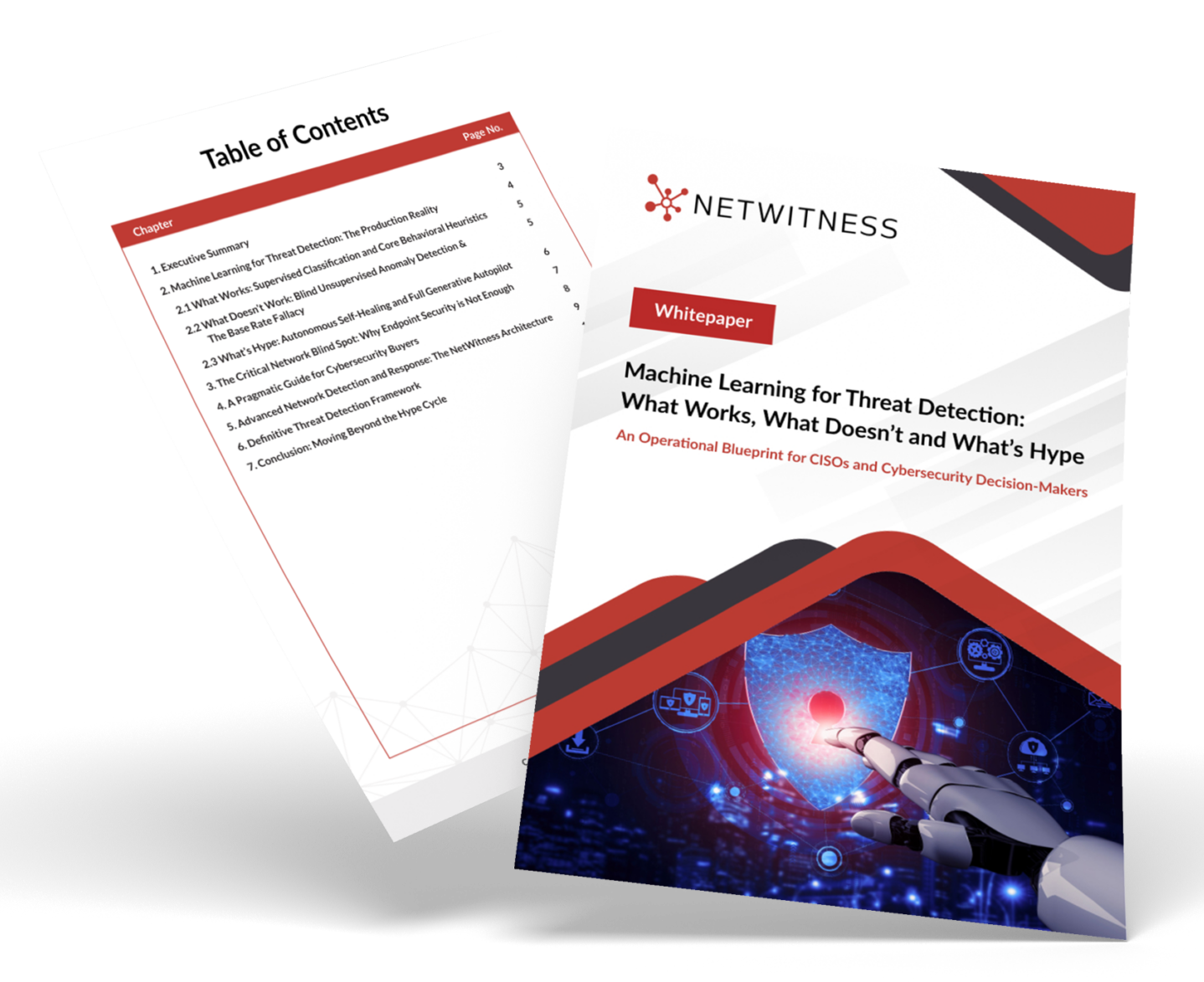
Cut through the AI hype and discover how machine learning strengthens modern threat detection.