Introduction
Event log monitoring has quietly become one of the most dependable ways to understand what actually happens inside enterprise environments. Not assumptions. Not summaries. Verifiable activity across systems, users, and networks.
Organizations do not struggle because they lack logs. They struggle because logs arrive fragmented, unstructured, and disconnected from investigations. This is why the event log analyzer has shifted from a backend utility to a core security capability.
As attack techniques become subtler and environments more distributed, the strength of your event log monitoring directly determines how early threats surface and how confidently teams respond.
Why Event Log Monitoring Still Matters
Logs preserve reality. They record authentication attempts, system changes, network connections, and application behavior exactly as they occur.
That matters because many modern attacks:
- Abuse legitimate credentials
- Avoid malware-based detection
- Blend into normal operational activity
The 2024 Verizon DBIR confirms that credential misuse remains a dominant breach pattern. Those actions rarely trigger traditional alerts. They surface through patterns visible only via consistent event log monitoring.
Without it, investigations rely on partial narratives instead of evidence.
Core Capabilities Every Event Log Analyzer Must Have
1. Broad and Reliable Log Collection
An event log analyzer must collect data comprehensively and consistently across the environment. Any gap becomes a blind spot when incidents unfold.
Effective collection includes logs from:
- Operating systems and endpoints
- Network devices and firewalls
- Identity platforms and access systems
- Cloud services, SaaS, and applications
- Security controls and infrastructure
Scale compounds the challenge. Gartner estimates that large enterprises generate terabytes of log data daily. A resilient log management solution handles that volume without dropping events or corrupting timelines.

2. Normalization and Contextual Enrichment
Raw logs rarely tell a story on their own. They arrive in different formats, structures, and vocabulary.
Normalization brings order by aligning data into a common schema. Enrichment adds meaning by attaching:
- User identity and role
- Asset criticality
- Geographic indicators
- Threat intelligence context
According to NIST SP 800-92, logs only become actionable when interpreted within operational context. Without this layer, event log monitoring becomes manual, slow, and error-prone.
3. Real-Time Correlation and Behavioral Analysis
Intrusions unfold as sequences, not single events. One login rarely signals compromise. A chain of related actions often does.
Advanced log monitoring software correlates events across:
- Users and identities
- Endpoints and servers
- Network traffic and sessions
- Time windows and behavioral baselines
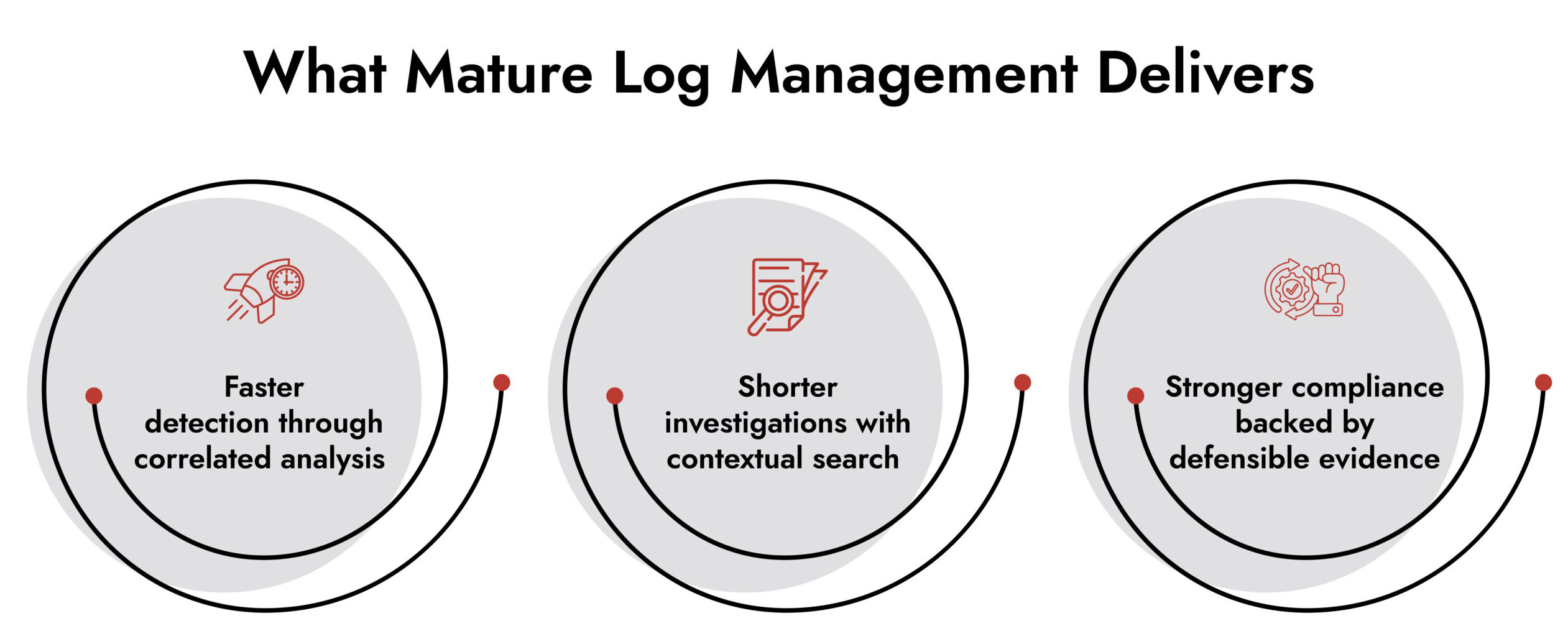
This allows security teams to identify patterns that reflect attacker behavior rather than isolated anomalies. Mandiant’s 2024 research shows that correlated log analysis significantly reduces breach detection timelines.
4. Flexible Search and Forensic Investigation
During an incident, dashboards matter less than answers. Analysts need to reconstruct what happened quickly and precisely.
A strong log analysis tool supports:
- Fast indexed search across long time ranges
- Field-level filtering and pivoting
- Timeline reconstruction
- Session and activity tracking
This capability supports both incident response and compliance. Searchable logs provide defensible evidence when regulators or auditors request proof of investigation.
5. Long-Term Retention Without Losing Fidelity
Attackers often remain undetected for months. Retention strategies that prioritize cost over accessibility increase risk.
Effective event log monitoring requires retention that:
- Preserves detail and timestamps
- Supports searchable archives
- Aligns with threat dwell time and compliance needs
A mature log management solution treats historical data as an investigative asset, not dormant storage.
6. Alerting That Supports Decisions
Alerting works best when it respects analyst attention.
High-quality log management software enables:
- Risk-based alert prioritization
- Asset- and identity-specific thresholds
- Noise suppression for known behaviors
- Context-rich alert payloads
Gartner’s 2024 research continues to list alert fatigue as a leading SOC challenge. Intelligent alerting reinforces trust in event log monitoring rather than overwhelming teams.
7. Compliance Reporting Built on Evidence
Auditors increasingly expect proof derived from real activity, not screenshots or spreadsheets.
A capable security log analyzer supports:
- Prebuilt and customizable compliance reports
- Immutable log storage
- Chain-of-custody documentation
- Alignment with PCI DSS, ISO 27001, and regional mandates
When compliance draws directly from event log monitoring, audits become faster and less disruptive.
8. Integration With Incident Response Workflows
Logs deliver the most value when they integrate with response processes.
An effective event log analyzer connects with:
- Case management systems
- Automation and orchestration platforms
- Threat intelligence feeds
- Ticketing and workflow tools
CISA’s 2024 guidance highlights integrated log analysis as a key factor in faster containment and stronger post-incident learning.
Where NetWitness Fits in Event Log Monitoring
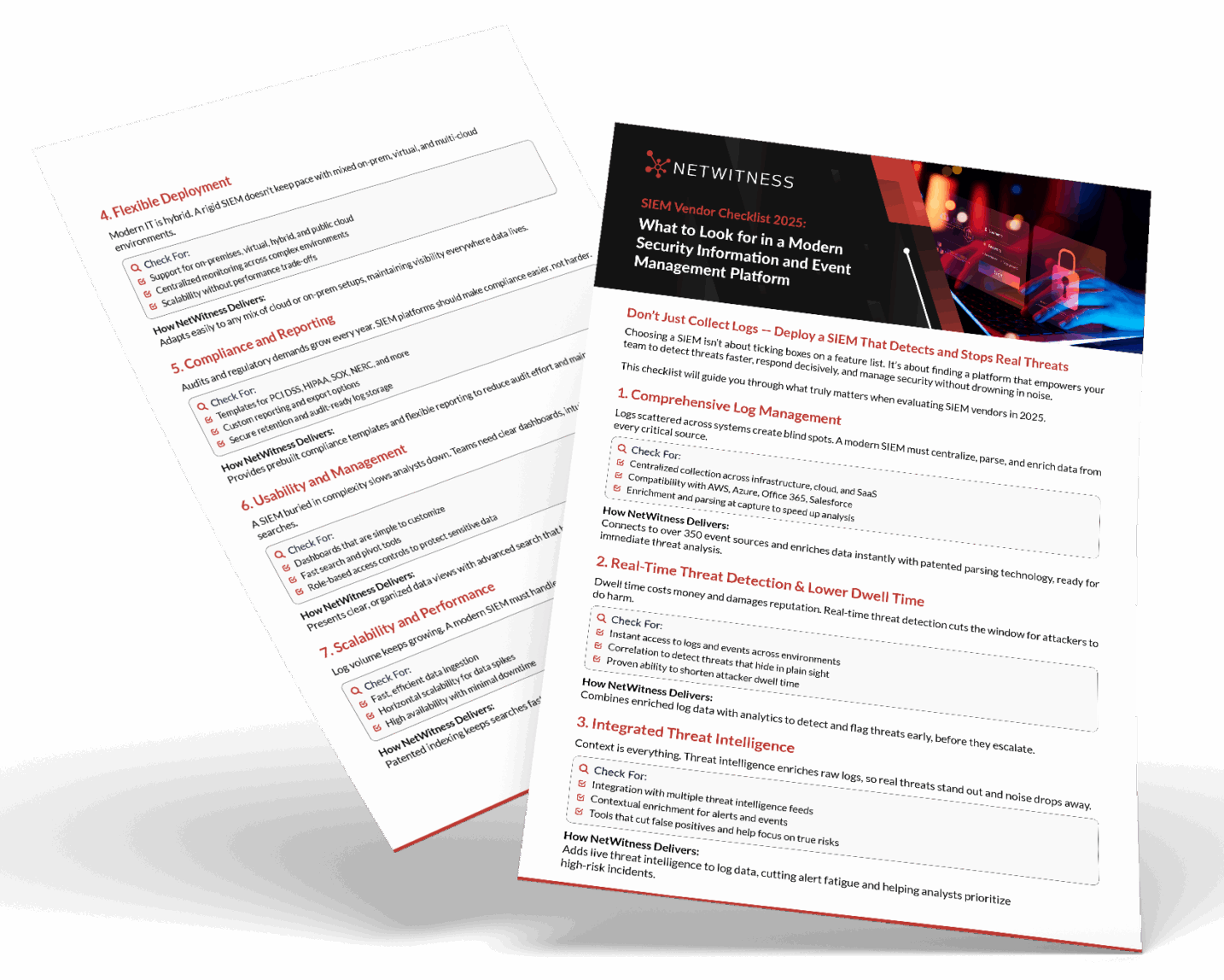
NetWitness approaches event log monitoring as a core detection and investigation capability rather than a standalone utility.
Its SIEM functionality emphasizes:
- High-fidelity log ingestion
- Deep normalization and enrichment
- Advanced correlation across users, endpoints, and networks
- Long-term forensic analysis aligned with incident response
This model supports teams that rely on logs as evidence, intelligence, and operational truth.
Conclusion
Strong event log monitoring does not come from collecting more data. It comes from collecting the right data, preserving it correctly, and analyzing it with intent.
When evaluating an event log analyzer, focus on:
- Visibility across the environment
- Correlation depth and behavioral insight
- Investigation speed under pressure
- Retention that supports real-world threats
Logs do more than explain what happened. They shape how confidently teams respond when it matters most.