Introduction
Just like a burglar breaking into your home and carefully examining locks before carrying off anything that belongs to you, ransomware works in much the same way in cyberspace. In 2023, there was a global rise in ransomware activity of 67%, with companies suffering losses amounting to $11,150 on average with an all-time high of $1.2 million during the worst-case scenario. Old techniques such as antivirus software are as ineffective as rusty locks that can be effortlessly picked up by skilled cyber thieves. This is when Network Detection and Response (NDR) play an important part as a preventative measure against ransomware infiltration. What is NDR in cybersecurity, and how can NDR effectively stop ransomware from spreading any further?
This article explains what NDR in cybersecurity means and highlights some corporate case studies for NDR implementation, how NetWitness improves NDR detection of ransomware, and answers FAQs about NDR.
What is NDR in Cybersecurity?
The Network Detection Response (NDR) is a modern cybersecurity solution that allows organizations to constantly monitor network traffic and protect their systems against potential threats. In contrast to other tools based on known malware signatures, NDR utilizes network threat detection software that employs AI, ML, and behavioral analytics to spot anomalies and prevent ransomware infections before they cause any harm. Based on research data, the worldwide NDR market is expected to develop rapidly because of cyber threats, and companies that use NDR see the time needed for detecting attacks shortened by up to 70%.
The effectiveness of NDR cybersecurity solutions is determined by their ability to detect anomalies within the network traffic, analyze their behavior, and conduct forensic threat detection. Thanks to the network-centric approach, it becomes possible to catch attacks that can avoid endpoint cybersecurity measures. If you want to know more about NDR basics, we recommend reading the following guide: Understanding NDR: The Foundation of Modern Cybersecurity.
How Network Detection Response Stops Ransomware
The ransomware usually enters the network using phishing emails, compromised credentials, or exploited vulnerabilities and lies dormant until the files are encrypted or data exfiltration occurs. Network detections enable the timely detection of ransomware by monitoring network traffic for any signs of suspicious activities that occur throughout the ransomware kill chain.
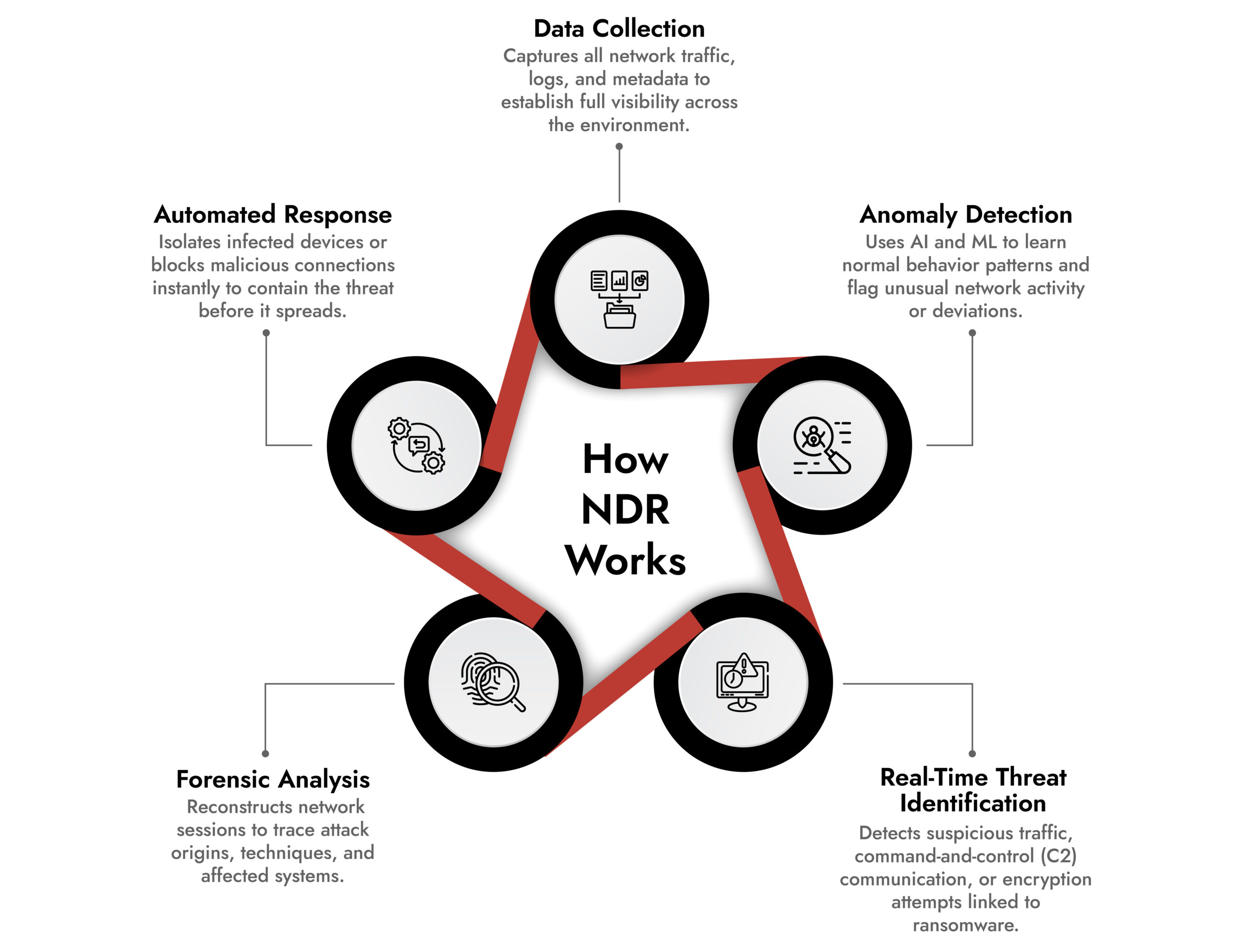
- Anomaly Detection: The NDR tool uses artificial intelligence and machine learning capabilities to build a baseline of the network. Once the baseline is set, it can easily detect deviations from the norm, including any data transfer that seems unusual and C2 server communications. For example, one of the NDR tools detected a Dharma ransomware attack and stopped it before it could perform any action on the targeted device by observing anomalies in RDP connections from rare IP addresses.
- Real-Time Threat Identification: NDR analyzes network packets to detect early ransomware attacks through such anomalies as unusual encryption patterns, connection attempts to suspicious domains, and sending ransom notes through the network. While an endpoint-only solution such as RansomWall achieved 98.25% accuracy in detecting crypto ransomware by monitoring the file system and host, NDR provides more extensive monitoring and analysis of network events. This enables the detection of any ransomware activities before. This allows it to identify and flag ransomware behaviors even before they reach endpoints, reducing dwell time and preventing encryption at scale.
- Forensic Analysis: fter detecting an attack, NDR provides extensive forensic logs and packet captures that help security analysts track where the attack came from, what the extent of the attack was, and how it occurred, which assists in preventing such attacks in the future.
- Automated Response: Advanced NDR platforms can isolate infected devices or block malicious connections autonomously, minimizing damage. Organizations with NDR solutions have reported containing threats before they reach the encryption stage, avoiding costly disruptions averaging 24 days per ransomware incident.
Step-by-Step: How NDR Detects Ransomware
- Unusual network activity appears: NDR establishes a baseline of normal network behavior and identifies deviations such as unusual connections, unexpected traffic volumes, or communication with suspicious destinations.
- Suspicious remote activity is detected: The system identifies unusual RDP, SMB, or other network connections that may indicate an attacker establishing access or moving through the environment.
- Lateral movement becomes visible: Instead of looking at one endpoint in isolation, NDR follows communication between systems to identify unusual east-west traffic and attempts to reach additional hosts.
- Command-and-control activity is identified: NDR analyzes network communications for connections and behavioral patterns associated with attacker infrastructure, helping analysts identify activity that may precede ransomware deployment.
- Ransomware behavior is correlated: Multiple indicators, such as lateral movement, unusual data transfers, suspicious connections, and abnormal traffic patterns, are correlated to distinguishing a potential ransomware campaign from an isolated anomaly.
- Response and investigation begin: Once the activity is identified, security teams can investigate the associated network evidence, isolate affected systems, block malicious connections, and use packet captures and forensic data to understand the scope of the attack.
How NDR Works: NDR Use cases
NDR’s ability to detect ransomware early makes it invaluable across industries. Below are three corporate use cases illustrating how network detection response protects organizations:
1. Healthcare: Protecting Patient Data
A major hospital network faced a ransomware attack targeting its electronic health record (EHR) system. The attacker used a phishing email to gain access, attempting to move laterally to encrypt critical servers. An NDR solution detected unusual network traffic patterns, including connections to a C2 server, and isolated the compromised device within minutes. This prevented data encryption and ensured patient care continuity. With healthcare attacks rising – hospitals were the fifth most targeted industry in 2023 – this use case underscores NDR’s role in safeguarding sensitive data.
2. Manufacturing: Securing Operational Technology
A manufacturing firm with legacy systems vulnerable to ransomware deployed an NDR platform to monitor its operational technology (OT) network. When a Medusa ransomware variant attempted to exfiltrate data via an FTP server, the NDR system flagged anomalous outbound traffic and blocked the transfer. This saved the company from potential production downtime, which can cost manufacturers millions, as the industry topped the list of ransomware targets in 2023.
3. Financial Services: Preventing Financial Loss
A financial institution experienced a ransomware attempt via a compromised RDP credential. The NDR solution identified unusual login attempts and blocked connections to a malicious domain, stopping the attack before encryption. With ransomware-related losses reaching $449.1 million in crypto payments in the first half of 2023, NDR’s proactive detection protected the firm from significant financial and reputational damage.
Case Study: Using NDR Against Ransomware
- Industry: Manufacturing. A mid-sized manufacturer with a distributed IT environment and legacy systems was targeted after an attacker gained access through a compromised remote access credential.
- Attack vector: The attacker established an initial foothold and began probing internal systems, followed by unusual SMB connections between workstations and critical servers.
- NDR detections: The network detection and response solution identified abnormal east-west traffic, rare internal connections, suspicious authentication activity, and communication with an external command-and-control destination.
- Timeline: Within minutes of the first anomalous lateral movement, the security team received an alert, investigated the associated network activity, and isolated the affected host before ransomware deployment could spread across additional systems.
- Ransomware forensics: Network metadata and packet-level evidence helped analysts trace the source of the activity, identify the systems involved, and understand the attack path.
- Outcome: The organization contained the intrusion before widespread encryption occurred, while the collected evidence supported remediation and post-incident investigation.
How NetWitness Enhances NDR for Ransomware Defense
NetWitness takes NDR cybersecurity to the next level with its comprehensive, real-time visibility and advanced analytics, specifically designed to combat ransomware and other sophisticated threats. Here’s how NetWitness stands out:
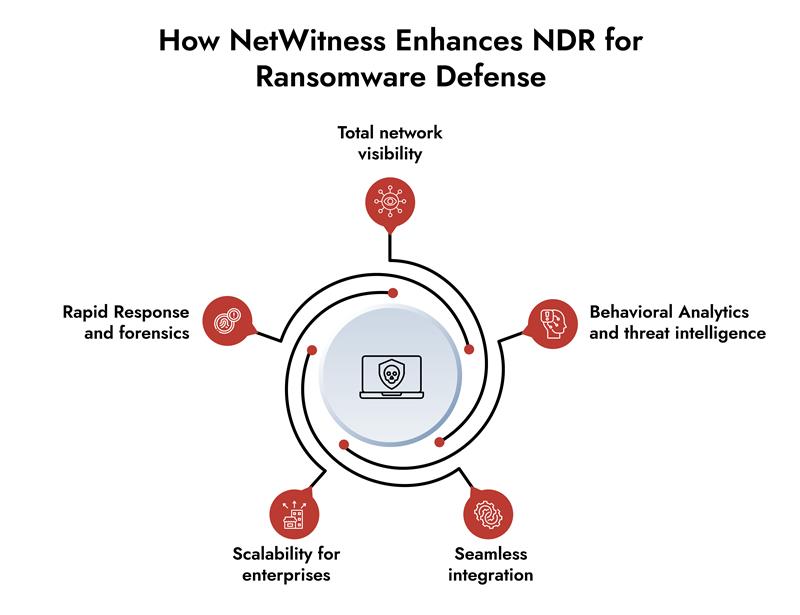
- Total Network Visibility: NetWitness captures all network traffic – on-premises, in the cloud, and across virtual environments – using deep data capture, metadata, and NetFlow. This ensures no ransomware activity goes unnoticed, providing pervasive visibility across hybrid IT infrastructures.
- Behavioral Analytics and Threat Intelligence: By combining behavioral analytics, data science, and threat intelligence, NetWitness detects both known and unknown ransomware threats, such as zero-day attacks, with high accuracy. It enriches log data with contextual information to prioritize high-risk threats and reduce false positives, enabling faster investigations.
- Rapid Response and Forensics: NetWitness reconstructs entire network sessions for forensic threat detection, allowing security teams to trace ransomware campaigns and understand attack vectors. Its automated response capabilities, such as isolating compromised devices, minimize dwell time, with users reporting satisfaction for its incident response efficiency.
- Seamless Integration: NetWitness integrates with SIEM, SOAR, and EDR solutions, creating a unified defense ecosystem. This interoperability ensures coordinated responses, making it ideal for complex enterprises. For example, NetWitness’s API enables seamless third-party integrations, enhancing SOC workflows.
- Scalability for Enterprises: Designed for large organizations, NetWitness supports scalable deployments across distributed networks, with large enterprises praising its flexibility and analytics capabilities.
With capabilities built for scale, precision, and speed, NetWitness’s approach has proven effective in real-world scenarios.