What Is Secure Access Service Edge (SASE)?
Secure Access Service Edge (SASE) is a cloud-delivered security framework that combines networking and security services into a single architecture. It brings together technologies such as SD-WAN, Secure Web Gateway (SWG), Firewall as a Service (FWaaS), Cloud Access Security Broker (CASB), and Zero Trust Network Access (ZTNA) to provide secure access to applications and data from any location. By moving security closer to users and devices, SASE security access service edge improves visibility, simplifies policy management, and protects modern hybrid work environments.
Introduction
Secure Access Service Edge (SASE) is a cloud-native architecture that combines networking and security into a unified secure access service. By delivering secure edge services such as Secure Web Gateway (SWG), Firewall as a Service (FWaaS), Cloud Access Security Broker (CASB), and Zero Trust Network Access (ZTNA), SASE helps organizations build a secure edge network for users, devices, and applications regardless of location. As enterprises continue adopting hybrid work and cloud environments, SASE security access service edge has become a preferred approach for simplifying security while improving visibility and performance.
How Secure Access Service Edge Works
A Secure Access Service Edge architecture secures users and applications by combining cloud networking with integrated security services.
- A user requests access to an application or business resource.
- The user’s identity and device are verified using Zero Trust principles.
- Traffic is routed through cloud-delivered secure edge services such as SWG, CASB, and FWaaS.
- Security policies are applied in real time based on user identity, device posture, and application context.
- Only authorized traffic reaches business applications, while suspicious activity is blocked or investigated.
This cloud-native approach enables organizations to deliver secure access service without relying on traditional VPNs or centralized security appliances, making it easier to secure hybrid work environments.
Key Technologies Behind Secure Access Service Edge
Before we get started, there are a few abbreviations that we’re going to go over to ensure full understanding.
Secure Web Gateways (SWG):
A secure web gateway is a network security solution that acts as an intermediary between users and the internet, providing security and control over web traffic. It combines web filtering, threat protection, data loss prevention, and other security capabilities to enforce security policies and protect organizations from web-based threats.
Firewall as a Service (FWaaS):
Firewall as a service is a cloud-based security service that provides firewall functionality to protect networks and control inbound and outbound traffic. Instead of deploying physical firewall appliances on-premises, FWaaS delivers firewall capabilities as a service from the cloud.
Cloud Access Security Broker (CASB):
A cloud access security broker is a security solution that acts as an intermediary between an organization’s on-premises infrastructure and cloud service providers. CASBs provide organizations with visibility and control over their cloud applications and data, ensuring security and compliance in cloud environments.
Zero Trust Network Access (ZTNA):
Zero trust network access is an approach to network security that requires strict authentication and verification for every user and device attempting to access network resources, regardless of their location or network perimeter. The Zero Trust model assumes that no other user or device should be inherently trusted, and access is granted based on continuous verification of identity, device health, and context.
HIPAA:
HIPAA is short for Health Insurance Portability and Accountability Act. It is a federal law enacted in the United States in 1996 with the primary goal of protecting the privacy and security of an individual’s personal health information. HIPAA’s provisions aim to safeguard individuals’ sensitive health information, ensure the privacy and security of PHI, and establish standards for electronic transactions in the healthcare industry. Compliance with HIPAA is essential for covered entities and their business associates to protect patient privacy, maintain data security, and avoid legal and financial consequences.
GDPR:
GDPR stands for General Data Protection Regulation. It is a comprehensive data protection and privacy regulation that was enacted by the European Union (EU) and became enforceable on May 25th, 2018. The GDPR aims to harmonize and strengthen data protection laws across the EU member states, ensuring the privacy rights of individuals and providing a framework for businesses to handle personal data responsibly.
PCI DSS:
PCI DSS is short for Payment Card Industry Data Security Standard. It is a set of security standards established by major credit card companies, including Visa, Mastercard, American Express, Discover, and JCB International, to ensure the protection of cardholder data during payment card transactions.
Core Components of a Secure Access Service Edge Architecture
Secure Access Service Edge integrates various network security functions into a cohesive cloud-based service. This includes features such as secure web gateways (SWG), firewall as a service (FWaaS), cloud access security broker (CASB), and other security measures. These services are delivered from the cloud and provide real-time threat detection, data encryption, and advanced authentication.
Secure access service edge incorporates WAN connectivity, such as software-defined wide area networking (SD-WAN), to optimize network performance. SD-WAN allows for dynamic traffic routing, application-level prioritization, and bandwidth optimization. This helps improve network agility, reduce latency, and enhance the overall user experience.
Lastly, secure access service edge embraces zero trust network access (ZTNA), which assumes that no user or device should be inherently trusted. ZTNA ensures secure access to network resources by verifying user identities and device compliance before granting access, and continuously thereafter. It applies policies based on contextual information such as user behavior, location, and device posture to determine the level of access granted.
By integrating these components, secure access service edge enables organizations to have a unified and comprehensive approach to network security and connectivity. It provides benefits such as increased flexibility, scalability, reduced costs, and simplified network management. Secure access service edge also aligns well with the growing trend of remote work and cloud adoption, as it allows organizations to secure and optimize access to resources for users located anywhere while leveraging the power of cloud-based services.
Benefits of Secure Access Service Edge
Implementing secure access service edge offers several advantages for organizations.
1. Enhanced Security:
Secure access service edge provides comprehensive security measures to protect network resources and data. By integrating multiple security functions into a unified cloud-based service, secure access service edge offers real-time threat detection, data encryption, advanced authentication, and other security features. This ensures that organizations have robust security measures in place to defend against evolving cyber threats.
2. Improved Performance:
Secure access service edge incorporates WAN optimization capabilities, such as SD-WAN, which we mentioned above, but it’s worth mentioning a second time. SD-WAN enhances network performance. It reroutes traffic, prioritizes critical applications, and by reducing latency, secure access service edge improves user experience and productivity. Users can access applications and resources efficiently, regardless of their location, which will result in faster response times and increased productivity.
3. Simplified Network Management:
Secure access service edge centralized network management and security policies in the cloud. This provides a unified view and control over the network, making it easier to manage and enforce security policies consistently across the entire organization. Additionally, cloud-based management offers scalability, faster deployment, and reduced hardware maintenance compared to traditional on-premises solutions.
4. Cost Savings:
Secure access service edge eliminates the need for multiple standalone security appliances and hardware investments at each branch location. Instead, organizations can leverage a cloud-based service, reducing capital expenditures and operational costs. Additionally, secure access service edge lets you scale your security and networking capabilities as needed, which means you can avoid overspending and other unnecessary expenses.
5. Flexibility and Scalability:
Secure access service edge provides organizations with greater flexibility and scalability in adapting to changing business needs. It enables seamless integration of new locations, remote workers, and cloud services into the network without compromising security. Organizations can easily add or remove users, applications, and resources as their requirements evolve, allowing for agile and scalable network management.
6. Regulatory Compliance:
Secure access service edge helps organizations meet regulatory compliance requirements more effectively. It incorporates security controls and policies that align with various industry regulations. By implementing secure access service edge, organizations can ensure that their network and data security practices meet these regulatory standards, minimizing the risk of non-compliance.
Overall, implementing secure access service edge provides organizations with a comprehensive, cloud-native approach to network security and connectivity. It offers enhanced security, improved performance, simplified management, cost savings, flexibility, and regulatory compliance. By adopting secure access service edge, organizations can better protect their networks, enable secure access to resources, and support their evolving business needs in an increasingly digital and distributed environment.
Why Enterprises Are Adopting Secure Access Service Edge
The shift to cloud applications, hybrid work, and distributed infrastructure has changed how organizations approach network security. Traditional perimeter-based security models struggle to provide consistent protection when users, devices, and applications operate beyond the corporate network.
A Secure Access Service Edge architecture addresses these challenges by delivering networking and security from the cloud. Instead of routing traffic through centralized data centers, users connect through a secure edge network where security policies are enforced closer to the point of access. This improves user experience while maintaining strong security controls.
Organizations also benefit from simplified operations, greater scalability, and consistent policy enforcement across cloud, branch, and remote environments. As a result, many enterprises now view SASE security access service edge as a strategic framework for supporting modern digital transformation initiatives.
Which Industries Benefit Most from Secure Access Service Edge?
Organizations across industries are adopting Secure Access Service Edge to strengthen security while supporting cloud adoption and remote work.
Healthcare
Healthcare providers use SASE to secure access to electronic health records, connected medical devices, and cloud applications while supporting HIPAA compliance.
Financial Services
Banks and financial institutions rely on secure edge services to protect sensitive customer data, secure digital banking platforms, and reduce cyber risk across distributed operations.
Manufacturing
Manufacturers can extend secure access across corporate IT and production environments while enabling employees, suppliers, and contractors to connect safely from multiple locations.
Retail and E-commerce
Retail organizations use Secure Access Service Edge to secure branch locations, cloud-based point-of-sale systems, and online customer transactions while maintaining consistent security policies.
Education
Educational institutions support secure access for students, faculty, and administrators across campuses and remote learning environments using a centralized secure edge network.
How to Evaluate Secure Access Service Edge Solutions
Choosing the right SASE platform requires more than comparing features. Organizations should evaluate how well the solution aligns with their existing infrastructure, security strategy, and long-term business goals.
Assess Existing Infrastructure
Review your current network architecture, cloud adoption strategy, remote workforce requirements, and existing security investments. Understanding your environment helps identify where Secure Access Service Edge can deliver the greatest value.
Evaluate Security Capabilities
Look for integrated capabilities such as SWG, CASB, FWaaS, SD-WAN, and Zero Trust Network Access. A complete secure access service should provide consistent security across users, devices, applications, and cloud environments.
Consider Compliance Requirements
Verify that the solution supports regulatory frameworks such as GDPR, HIPAA, PCI DSS, or other industry-specific requirements. Features such as encryption, audit logging, identity controls, and policy reporting are essential for maintaining compliance.
Measure Performance and Scalability
A Secure Access Service Edge platform should deliver low-latency connectivity while scaling to support additional users, branch locations, and cloud applications without compromising security or performance.
Compare Secure Access Service Edge Vendors
Not all secure access service edge vendors offer the same capabilities. Compare platforms based on global cloud presence, threat detection, integration with existing security tools, centralized management, and customer support.
Extend security visibility across remote users, cloud workloads, and encrypted traffic with seamless SASE integration.
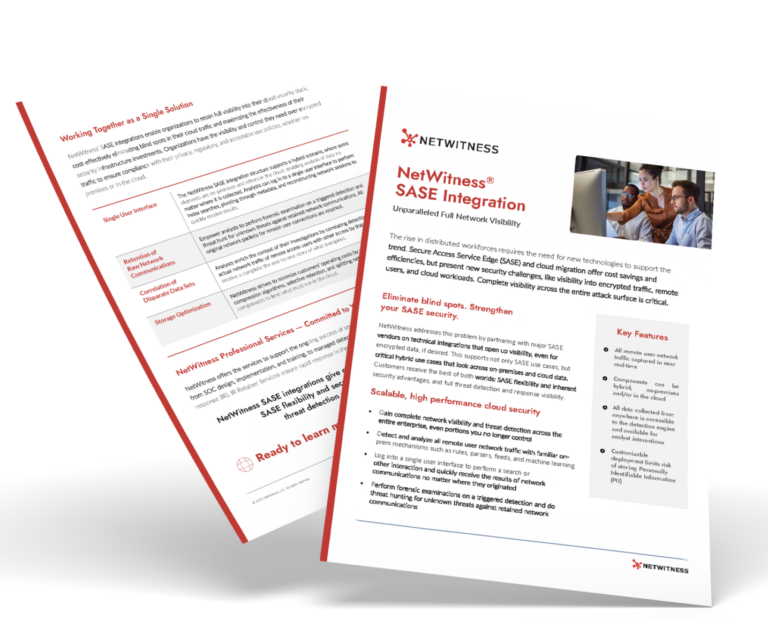
Extend Your Secure Access Service Edge Strategy with NetWitness
While Secure Access Service Edge strengthens network connectivity and access control, security teams also need deep visibility to detect, investigate, and respond to sophisticated threats. Encrypted traffic, hybrid infrastructures, and distributed users can create blind spots that traditional monitoring tools may miss.
NetWitness complements leading Secure Access Service Edge platforms by providing deep network visibility, advanced threat detection, and forensic investigation capabilities across on-premises, cloud, and hybrid environments. Through integrations with leading secure access service edge providers, NetWitness helps security teams analyze network activity, investigate suspicious behavior, and maintain visibility without disrupting existing SASE deployments.
By combining SASE with NetWitness, organizations can strengthen their secure edge network, improve threat detection, and gain the visibility needed to respond confidently to modern cyber threats.
Contact NetWitness today to learn more about how NetWitness can help you innovate with security.
Frequently Asked Questions
1. What are the key features of Secure Access Service Edge solutions?
Secure Access Service Edge (SASE) solutions combine networking and security into a single cloud-delivered platform. Key features include Secure Web Gateway (SWG), Firewall as a Service (FWaaS), Cloud Access Security Broker (CASB), Zero Trust Network Access (ZTNA), SD-WAN, centralized policy management, and continuous threat monitoring. These secure edge services help organizations build a secure edge network that delivers secure access to users, applications, and devices from anywhere.
2. What is Secure Access Service Edge and its core components?
Secure Access Service Edge (SASE) is a cloud-native framework that converges networking and security into a unified secure access service. Its core components include SD-WAN, Secure Web Gateway (SWG), Firewall as a Service (FWaaS), Cloud Access Security Broker (CASB), and Zero Trust Network Access (ZTNA). Together, these technologies create a SASE security access service edge architecture that protects users, applications, and data across hybrid and cloud environments.
3. Which companies offer Secure Access Service Edge platforms for enterprises?
Several leading secure access service edge vendors provide enterprise-ready SASE platforms, including Netwitness , Cisco, Palo Alto Networks, Netskope, and Cato Networks. When comparing secure access service edge providers, organizations should evaluate cloud coverage, Zero Trust capabilities, integration with existing security tools, scalability, and centralized policy management to select the solution that best fits their business needs.
4. What are the benefits of adopting a Secure Access Service Edge framework?
Adopting a Secure Access Service Edge (SASE) framework enables organizations to simplify security operations while improving network performance. A secure access server edge architecture provides consistent security policies, secure remote access, reduced infrastructure complexity, improved visibility across cloud environments, and stronger protection against evolving cyber threats. It also helps organizations scale their secure edge services as business needs change.
5. What are the top-rated Secure Access Service Edge products for cloud security?
The best Secure Access Service Edge products combine advanced networking with integrated security capabilities such as SD-WAN, SWG, CASB, FWaaS, and ZTNA. Rather than selecting a solution based solely on vendor rankings, organizations should evaluate secure access service edge vendors based on performance, threat detection, cloud integration, compliance support, and the ability to secure distributed users and applications.
6. How does Secure Access Service Edge improve network security for remote workers?
Secure Access Service Edge improves remote work security by delivering cloud-based security controls closer to users instead of routing traffic through traditional data centers. This secure access service continuously verifies users and devices using Zero Trust principles, encrypts traffic, and applies consistent security policies. As a result, organizations can maintain a highly secure edge network while providing employees with fast, secure access to business applications from any location.
7. How should organizations evaluate Secure Access Service Edge solutions for compliance requirements?
When evaluating Secure Access Service Edge solutions, organizations should ensure that secure access service edge providers support regulatory frameworks such as GDPR, HIPAA, PCI DSS, and ISO 27001. They should also assess encryption standards, identity and access controls, audit logging, reporting capabilities, data residency options, and integrations with existing security platforms. Choosing the right secure access service edge vendors helps organizations maintain compliance while strengthening overall cybersecurity.