How Does Network File System Protocol Become a Lateral Movement Risk?
Network File System Protocol is something that attackers use in order to achieve their goals. This protocol is overlooked by most businesses since they are usually preoccupied with securing endpoints, identities, and internet-facing services. However, it is the network file system protocol that attackers often use to access resources within enterprise networks, as there are many factors that may make it vulnerable.
Introduction
In most cases, gaining initial access to systems becomes easier compared to moving laterally without getting detected. Once a malicious actor gains access to one computer, they further escalate their privileges by credential theft, searching for valuable information, and accessing the critical systems through trusted channels such as the Network File System (NFS) protocol.
For years now, the NFS protocol has facilitated file sharing across the UNIX and Linux environment, application servers, development environments, research environments, virtual machines, cloud-based environments, and large-scale storage environments. In many cases, due to the importance of availability and accessibility, administrators end up making NFS an attractive channel for malicious actors. Improper configuration of NFS export, overly permission control settings, old-style authentication, and lack of visibility make it easier for threat actors to abuse administrative tools and file-sharing protocols instead of using malware. This makes lateral movement difficult to detect because perimeter defense solutions consider NFS traffic legitimate.
Why the Network File System Protocol Creates Opportunities for Lateral Movement
The network file system protocol was designed to simplify resource sharing across trusted systems. In many enterprise environments, that trust model still exists long after networks have grown more distributed and identities more complex.
When NFS configurations remain unchanged for years, attackers inherit privileges that administrators never intended to expose.
Common weaknesses include:
- Open or overly broad exports
- Weak host-based authentication
- Disabled root squashing
- Excessive file permissions
- Legacy NFS versions without stronger security controls
- Limited logging and auditing
- Shared service accounts with broad access
Each issue may appear minor in isolation. Together, they create an environment where attackers can move laterally without triggering obvious alerts.
Consider a typical scenario, an attacker compromises on a Linux application server through a vulnerable web application. Instead of immediately deploying ransomware, they inspect mounted NFS shares.
They discover an exported directory containing:
- Application configuration files
- SSH keys
- Backup archives
- Deployment scripts
- Service account credentials
Using legitimate system commands, the attacker authenticates to another server, copies additional tools into shared directories, and continues expanding access.
No malware needs to be downloaded. No firewall rules need to be changed.
From a monitoring perspective, every action resembles normal administrative behavior.
This explains why the network file system protocol frequently appears during post-incident investigations involving sophisticated intrusions.
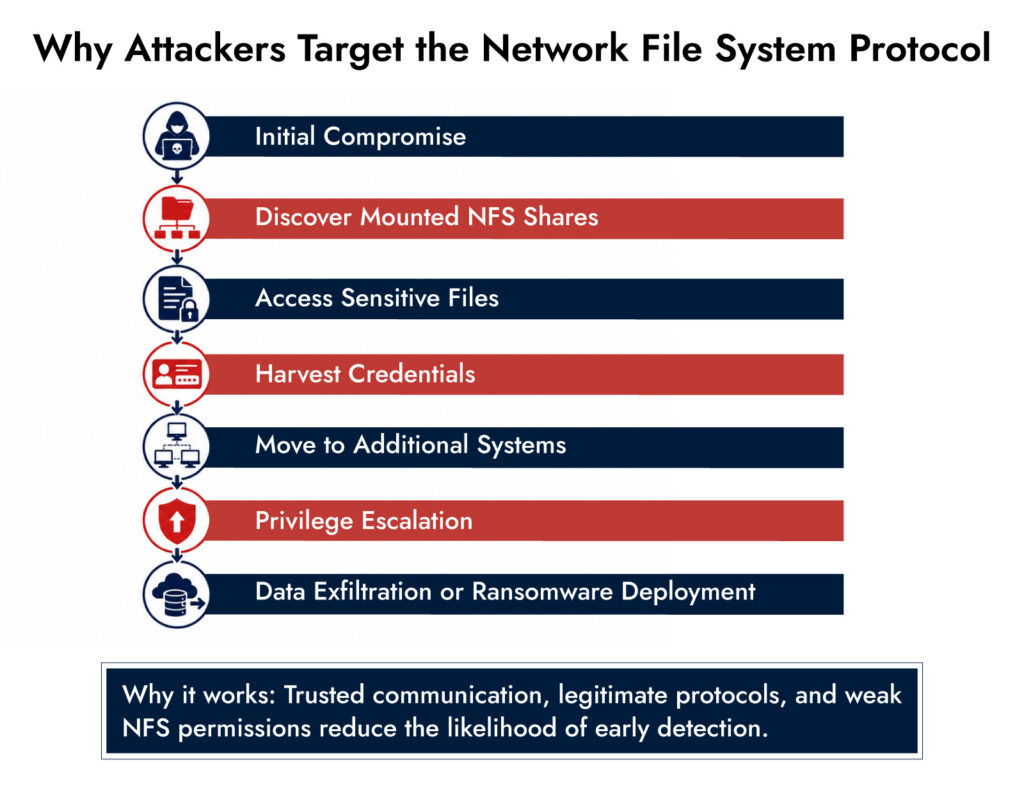
Common Network File System Protocol Misconfigurations Attackers Exploit
Most compromises involving the network file system protocol do not rely on software vulnerabilities. They exploit configuration mistakes that have accumulated over time.
Overly Permissive NFS Exports
Administrators sometimes export directories to entire network ranges for convenience.
Instead of limiting access to specific hosts, configurations may allow:
/data *(rw,sync,no_root_squash)
This effectively grants any authorized system within the network to access sensitive files.
If one system becomes compromised, every exported share becomes a potential steppingstone.
Disabled Root Squashing
Root squashing maps remote root users to a less privileged account.
When administrators disable this protection using no_root_squash, attackers who obtain root privileges on one machine can retain elevated privileges when accessing shared storage.
This dramatically increases the likelihood of successful lateral movement.
Weak Authentication
Older NFS deployments often depend primarily on client trust rather than strong identity verification.
Attackers who spoof trusted hosts or compromise legitimate systems can access exported resources without facing modern authentication controls.
While newer implementations support stronger security mechanisms such as Kerberos, many organizations continue operating mixed environments where legacy configurations remain active.
Excessive File Permissions
Shared directories frequently contain:
- Database backups
- Configuration files
- SSH private keys
- Automation scripts
- API tokens
- Cloud credentials
When file permissions become overly permissive, attackers can harvest credentials that unlock additional systems across hybrid environments.
This behavior aligns closely with techniques documented in the MITRE ATT&CK framework for credential access and lateral movement.
How Attackers Turn the Network File System Protocol into a Lateral Movement Channel
Attackers rarely treat a compromised host as the end goal. Instead, they treat it as a launch point. Once they establish persistence, they enumerate shared resources, identify trusted relationships, and look for opportunities to expand their access. The network file system protocol often becomes an ideal vehicle because file-sharing traffic is expected, trusted, and rarely blocked within internal networks.
A typical intrusion chain follows a predictable pattern:
- Gain initial access through phishing, an exposed application, or stolen credentials.
- Enumerate mounted NFS shares using native Linux commands.
- Search for shared directories for credentials, scripts, and configuration files.
- Reuse harvested credentials to authenticate additional systems.
- Copy tools or malicious scripts to shared storage for execution elsewhere.
- Expand privileges and continue moving laterally until critical assets are reached.
From a defender’s perspective, every step may appear legitimate. The attacker relies on existing trust relationships instead of exploiting noisy vulnerabilities.
Example: A Development Environment Becomes an Entry Point
Consider an organization with separate development and production environments connected through shared NFS storage.
A developer’s workstation becomes compromised through a vulnerable third-party package.
The attacker discovers an NFS mount containing:
- Deployment automation scripts
- Kubernetes configuration files
- Service account tokens
- Application secrets
- Infrastructure documentation
Rather than exploiting another vulnerability, the attacker simply reads the files, authenticates using exposed credentials, and pivots into production resources.
Nothing about this sequence requires advanced malware. The organization effectively provides the attacker with a trusted bridge.
This is why insider threats and external attackers often exhibit similar behavior once inside the network. Both rely on legitimate access rather than overtly malicious activity.
Network Visibility Readiness Guide
Discover how to identify blind spots, monitor traffic across cloud and on-prem environments, and strengthen detection with a practical 7-step evaluation framework. Download the guide to improve investigation speed and security clarity.
Why Traditional Security Tools Often Miss Network File System Protocol Abuse
Many security programmes prioritize endpoint telemetry and perimeter controls. While both remain essential, neither provides complete visibility into how attackers use the network file system protocol after gaining access.
Endpoint tools may detect malicious binaries but overlook legitimate file access.
Firewalls typically permit authorized NFS traffic.
Even a SIEM platform can struggle if logging focuses only on authentication events instead of file operations and network behavior.
The visibility gap becomes more pronounced when attackers:
- Use legitimate Linux utilities
- Access approved NFS exports
- Reuse valid service accounts
- Blend into administrator activity
- Perform slow, low-volume reconnaissance
These techniques generate little behavioral noise, making it difficult to distinguish from normal operations.
However, recent CISA guidance shows that threat actors often leverage authorized administrative tools and protocols to remain undetected following compromise. The MITRE ATT&CK framework also draws attention to the use of valid accounts and remote services in ransomware attacks and espionage operations.
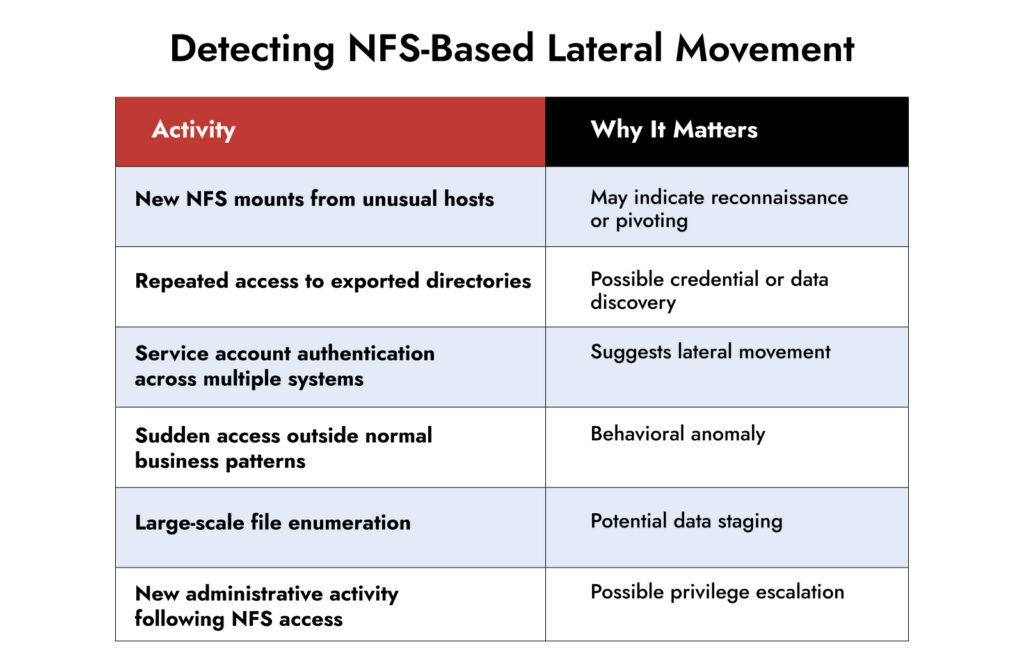
The key insight: Individual events may appear benign. Correlating them across identities, endpoints, and network traffic reveals the attack path.
Strengthening Network File System Protocol Security
Reducing risk starts with treating the network file system protocol as part of the attack surface rather than simply storage infrastructure.
Several practical improvements significantly reduce opportunities for attackers.
Restrict NFS Exports: Only export directories to authorized systems. Avoid wildcard exports and broad network ranges wherever possible.
Enable Strong Authentication: Use Kerberos-supported NFS deployments where practical and retired legacy authentication methods are used. Strong identity validation makes host impersonation significantly more difficult.
Apply Least Privilege: Review permissions regularly. Ensure users, service accounts, and applications receive only the access they genuinely require.
Enable Root Squashing: Root squashing should remain enabled unless a documented operational requirement justifies otherwise. Removing unnecessary root privileges limits attacker mobility.
Monitor Continuously: Configuration of hardening alone cannot stop every attack. Continuous network security monitoring helps identify unusual file access, abnormal authentication behavior, and suspicious communication patterns before attackers reach critical systems.
Detecting Lateral Movement with Network Detection and Response
Preventive controls reduce exposure, but determined attackers often find alternative paths. Detection therefore becomes equally important.
This is where network detection and response complement existing security investments.
Unlike isolated endpoint monitoring, network detection and response analyses communication patterns across the environment, helping security teams identify suspicious behaviors that span multiple systems.
Effective cyber threat detection for NFS environments includes:
- Monitoring unusual east-west traffic
- Correlating authentication events with network activity
- Identifying abnormal file-sharing behavior
- Detecting credential reuse across multiple hosts
- Mapping attacker movement across hybrid environments
When combined with endpoint telemetry and SIEM correlation, network-level visibility provides the broader context needed to investigate sophisticated intrusions faster.
Rather than focusing solely on individual alerts, defenders can reconstruct the entire attack sequence and respond before attackers achieve their objectives.
How NetWitness Helps Detect Network File System Protocol Abuse
Stopping lateral movement requires more than identifying isolated indicators of compromise. Security teams need visibility into how attackers move between users, systems, applications, and network resources.
NetWitness brings together network telemetry, endpoint visibility, logs, and behavioral analytics to help security teams investigate complex attacks involving the network file system protocol. With full packet visibility, security teams can examine network communications in greater detail, identify unusual NFS activity and east-west traffic patterns, and uncover signs of lateral movement that may otherwise appear as legitimate administrative activity.
Its capabilities support organizations by helping them:
- Monitor east-west network communications at scale.
- Analyze NFS traffic with full packet visibility to identify suspicious communication and file-sharing behavior.
- Correlate NFS activity with endpoint and authentication events.
- Detect behavioral anomalies associated with lateral movement.
- Investigate suspicious file-sharing activity through unified analysis.
- Accelerate incident response with richer forensic context.
Instead of analyzing disconnected alerts, analysts gain a clearer picture of the entire intrusion chain. By combining packet-level network visibility with endpoint, authentication, and behavioral context, NetWitness can help security teams detect and investigate NFS abuse before attackers reach critical systems.
Conclusion
The network file system protocol is still important for enterprise operations; however, convenience should never come at the expense of visibility and control.
Attackers do not always rely on noisy exploits after gaining initial access. Instead, they can use trusted relationships, legitimate administration tools, and weak configurations to move through an enterprise environment with minimal resistance.
Reducing this risk requires more than securing NFS exports. Organizations need continuous visibility across users, identities, endpoints, and network traffic to recognize abnormal activity and detect lateral movement before it develops into a larger incident.
Combining secure NFS practices with network detection and response, SIEM correlation, and full packet visibility can give security teams the context they need to identify suspicious activity, investigate attack paths, and respond before attackers gain access to critical information.
Organizations that are most effective at preventing lateral movement are not necessarily those that never get compromised. They are the organizations that can quickly detect abnormal activity, understand how an attacker is moving through the environment, and respond before a single compromised endpoint leads to a broader breach.
Frequently Asked Questions
1. What are the top companies offering network file system protocol solutions?
Several enterprise infrastructure providers offer solutions supporting the network file system protocol, including storage platform vendors, cloud providers, and enterprise operating system vendors. When evaluating solutions, prioritize security features, authentication support, scalability, and integration with existing security monitoring platforms.
2. Which network file system protocol products are best for enterprise use?
The best network file system protocol deployment depends on operational requirements. Enterprise environments should prioritize implementations supporting modern authentication, encryption where applicable, comprehensive logging, and compatibility with existing security controls.
3. How should organizations choose a network file system protocol service provider?
Look for providers that support secure configuration guidance, ongoing updates, enterprise scalability, strong authentication mechanisms, auditing capabilities, and integration with SIEM and Network Detection and Response platforms.
4. How can organizations secure Network File System environments?
Strong NFS security starts with restricting exports, enabling root squashing, implementing least-privilege permissions, using modern authentication such as Kerberos, patching systems regularly, and continuously monitoring network activity for unusual access patterns.
5. How do attackers exploit NFS misconfigurations?
Attackers abuse weak network file system protocol configurations by accessing overly permissive exports, harvesting credentials from shared directories, disabling privilege restrictions, and using trusted file-sharing mechanisms to support Lateral movement without triggering traditional security controls.
6. How can organizations detect lateral movement involving NFS?
Effective Lateral movement detection combines Network Detection and Response, endpoint telemetry, SIEM correlation, behavioral analytics, and continuous Network security monitoring to identify abnormal file access, credential reuse, and suspicious east-west traffic before attackers reach sensitive systems.
See Every Packet. Understand Every Threat.
- Capture Network Traffic
- Reconstruct Attacker Sessions
- Uncover Hidden Threats
- Accelerate Investigations