How can organizations improve cybersecurity hygiene?
Organizations can improve cybersecurity hygiene by following a comprehensive cybersecurity checklist that includes regular patch management, multi-factor authentication (MFA), continuous security monitoring, vulnerability assessments, strong access controls, endpoint protection, and network segmentation. These best practices help a security operations center strengthen threat detection, accelerate incident response, reduce cyber risks through effective cybersecurity risk management, and enhance enterprise cybersecurity and network security against evolving threats.
Introduction
A ransomware group doesn’t need a zero-day to get in. Most of the time, they just need one thing security teams forgot to check. An expired cert nobody rotated. A firewall rule that was “temporary” eighteen months ago. A laptop that left the network for a conference and came back infected.
This is the uncomfortable truth about breaches in 2026. They rarely start with something exotic. They start with hygiene. The boring, repetitive, unglamorous work of keeping systems patched, access reviewed, and networks visible. SOC teams know this. It’s still one of the hardest things to get right at scale.
Environments today span cloud, OT, remote endpoints, and legacy infrastructure all at once. Every one of those layers needs its own hygiene discipline, and every gap between them is a place an attacker can sit undetected for months. So before diving into tools and detection strategy, it’s worth stepping back and asking what cybersecurity hygiene actually means for a modern SOC, and why so many teams still struggle with it.
What Is Cybersecurity Hygiene?
Cybersecurity hygiene is the set of routine practices that keep systems, networks, and data in a secure, known state. Think of it as preventive maintenance rather than active defense. Patching, access reviews, backup testing, configuration checks. None of it stops an attack by itself, but all of it removes the easy openings attackers rely on.
For a security operations center, hygiene isn’t a side task. It’s the foundation that everything else sits on. Detection tools are only as good as the visibility feeding them. Incident response only works if the systems it’s protecting are documented and current. Skip hygiene, and even a well-staffed SOC ends up reacting to problems that could’ve been closed off weeks earlier.
Why Cybersecurity Hygiene Matters in 2026?
The threat landscape has shifted, and hygiene gaps matter more because of it, not less.
Attackers are using AI to automate reconnaissance, write convincing phishing content, and probe for weak points faster than human analysts can track manually. Ransomware-as-a-service has lowered the skill bar for launching an attack, which means volume is up even as sophistication varies. IoT and OT devices keep expanding the attack surface, often with weaker security controls than traditional IT assets.
Add to that the sheer scale of modern enterprise environments, hybrid cloud, remote workforces, third-party vendors, and the room for something to slip through unnoticed keeps growing. A SOC that treats hygiene as optional is choosing to defend a moving target with static assumptions. That gap is exactly where breaches happen.
Strong hygiene also has a compounding effect. Every patched vulnerability, every reviewed access permission, every tested backup makes the environment measurably harder to exploit. It’s not exciting work, but it’s the difference between an incident that gets contained in hours and one that spreads for months before anyone notices.
The Ultimate Cyber Hygiene Checklist for 2026
Here’s what a security operations team should have covered, in practice, not just on paper.
- Automated patching and updates
Set operating systems, applications, and firmware to update automatically wherever possible. Manual patchingdoesn’t scale, and delays create windows attackers actively scan for. - Continuous vulnerability scanning
Run regular scans across endpoints, servers, and network devices. A vulnerability youdon’t know about is one you can’t fix. - Risk-based patch prioritization
Not every vulnerability deserves the same urgency. Weigh CVSS scores against exploitability and business impact before deciding what gets patched first. - Full network visibility
Maintain a current inventory of every device, cloud instance, and OT asset on the network. Shadow IT and unmanaged devices are common entry points precisely becausenobody’s watching them. - Endpoint detection and response coverage
Deploy EDR across all endpoints, not just the ones IT remembers to include. Encryption and behavioral monitoring should be standard, not exceptions. - Multi-factor authentication everywhere
Enforce MFA on every sensitive account and access point, including legacy systems that teams often quietly exempt. - Password and identity hygiene
Use password managers, enforce strong password policies, and move towardpasswordless authentication where it’s practical. - Network segmentation and zero trust
Isolate sensitive systems and apply least-privilege access. A flat network gives attackers free movement oncethey’re in. - Regular, tested backups
Automate backups andactually test recovery. A backup that’s never been restored is a guess, not a safety net. - Ongoing security awareness training
Run phishing simulations and keep training current with the latest attack patterns. Employees are still one of the most commoninitial access points. - Access control reviews
Audit privileged accounts on a set schedule and remove accessimmediately when roles change or employees leave. - Documented and tested incident response plans
A plan that’s never been rehearsed will fail under real pressure. Run tabletop exercises and update playbooks after every incident, not just when there’s time. - Threat intelligence integration
Feed real-time threat intelligence directly into detection workflows so analysts aren’t chasing indicators that are already stale. - Cloud security configuration checks
Review cloud environments regularly for misconfigurations, encrypt data at rest and in transit, and monitor access across every cloud service in use. - Continuous security monitoring
Move away from periodic checks. Threats don’t wait for a quarterly review, and neither should detection.
How to Implement Cybersecurity Checklist
Start by auditing where you actually stand. Most SOC teams assume coverage they don’t have until they check. From there, prioritize the highest-risk gaps first, usually access control and patch management, since those tend to be the most exploited. Roll out changes in phases rather than all at once. Trying to overhaul everything in a month usually means nothing gets done well.
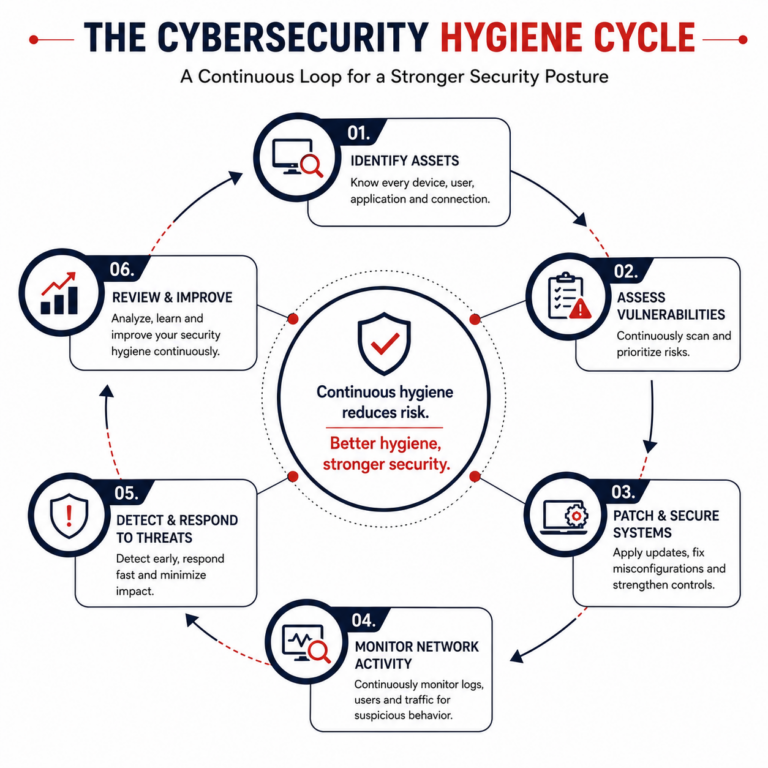
Automate wherever you can. Manual tracking for patch status, access reviews, and monitoring coverage doesn’t hold up once an environment grows past a certain size. Set a recurring review cadence, monthly for high-risk items, quarterly for broader policy checks, and treat hygiene as a continuous cycle rather than a project with an end date.
How NetWitness Can Help with Cybersecurity Hygiene
Many hygiene shortfalls are simply due to one issue: lack of visibility. Logs are lost, endpoints get silent and analysts are left piecing together incidents from partial data. NetWitness not only fills that void with complete packet capture, but with log and endpoint telemetry to provide SOC teams with ground-truth information about what’s actually occurring on the network, rather than what was logged.
This is important for nearly all items on this checklist. Seeing assets becomes more straightforward when packet data reveals that all the devices are actually communicating on the network, including those that hadn’t been remembered to be inventoried. Behavioral analytics not just a list of signatures makes threat detection more precise. And because the analysts can look at actual packet-level evidence, rather than an incomplete timeline, and incident response goes faster. In a world where teams are seeking to implement hygiene on a wide scale, that type of centralized insight can turn a lengthy checklist into a more manageable list.
Conclusion
Cybersecurity hygiene isn’t the part of the job that gets attention, but it’s the part that determines how bad a breach actually gets. Teams that stay disciplined about patching, access control, and visibility catch problems early. Teams that let hygiene slide end up managing incidents that could’ve been prevented entirely.
None of this requires a massive overhaul overnight. Pick the weakest point in your current setup, whether that’s patch cadence, access reviews, or network visibility, and fix it first. Hygiene builds on itself. Every gap you close makes the environment a little harder to break into, and a little easier to defend when it matters.
Understand today's most active ransomware groups, their tactics, and how to strengthen your defenses.
Frequently Asked Questions
1. Why is cybersecurity hygiene important for security operations teams?
Strong cybersecurity hygiene helps every security operations center reduce risk, improve threat detection, strengthen network security, and speed up incident response. It also supports proactive cybersecurity risk management by preventing common security gaps before attackers can exploit them.
2. What should a cybersecurity hygiene checklist include?
A cybersecurity checklist should include patch management, MFA, access controls, vulnerability assessments, endpoint protection, backup verification, security monitoring, log reviews, and regular audits. These practices strengthen enterprise cybersecurity and reduce cyber risks.
3. How often should organizations review their cybersecurity hygiene?
Organizations should review cybersecurity hygiene continuously through automated security monitoring, with formal assessments conducted quarterly or after major infrastructure changes. Frequent reviews improve threat detection and support effective cybersecurity risk management.
4. What role does multi-factor authentication (MFA) play in cybersecurity hygiene?
Multi-factor authentication (MFA) is a core part of cybersecurity hygiene because it adds an extra layer of protection against credential theft. It strengthens enterprise cybersecurity, reduces unauthorized access, and supports faster incident response.
5. How does cybersecurity hygiene support compliance?
Good cybersecurity hygiene helps organizations meet regulatory requirements by enforcing consistent security controls, continuous security monitoring, and proper access management. It also simplifies audits and improves overall enterprise cybersecurity.
6. What metrics can security teams use to measure cybersecurity hygiene?
Key metrics include patch compliance, vulnerability remediation time, MFA adoption, failed login attempts, incident response times, and threat detection rates. These indicators help measure the effectiveness of cybersecurity risk management.
7. How can security operations teams continuously improve cybersecurity hygiene?
Security teams can improve cybersecurity hygiene through continuous security monitoring, regular risk assessments, employee training, vulnerability management, and updates to their cybersecurity checklist. This strengthens enterprise cybersecurity and keeps defenses aligned with evolving threats.