How do I monitor OT networks without disrupting industrial operations?
You can monitor OT networks without disrupting industrial operations by using a passive, OT-aware monitoring architecture that observes industrial traffic, understands OT protocols, discovers assets, detects abnormal communication patterns, and forwards selected telemetry to a central security platform for analysis.
Introduction
Industrial environments demand a different approach to security than traditional IT networks. Production lines, substations, pipelines, manufacturing plants, utilities, and transportation systems depend on continuous operations, where even minor disruptions can have serious safety, financial, and operational consequences.
That’s why OT network monitoring must deliver visibility without impacting operations. Security teams need to detect threats, discover assets, and monitor industrial communications without intrusive scanning or unnecessary network traffic.
NetWitness OT, powered by DeepInspect, provides passive OT security monitoring by observing, enriching, and correlating industrial telemetry without scanning, polling, or interfering with control processes. This gives security teams visibility across PLCs, SCADA systems, HMIs, sensors, actuators, engineering workstations, and other OT assets while keeping production environments stable.
Simply put, NetWitness makes operational technology visible without getting in the way of industrial operations.
How OT Security Monitoring Differs from IT Security
Traditional enterprise security tools are designed for IT environments where endpoints, cloud applications, identity systems, email, and internet traffic are the primary focus. Industrial environments operate very differently.
OT security monitoring must account for predictable communication patterns, legacy devices, proprietary protocols, and systems that cannot tolerate unexpected traffic. A PLC typically communicates with the same HMI, historians collect data from known sources, and engineering workstations connect only during planned maintenance windows.
Because many industrial devices are sensitive to active scanning or frequent queries, applying IT-style monitoring can introduce operational risk. That’s why OT network monitoring relies on passive observation. Instead of probing devices, NetWitness monitors network communications, understands industrial protocols, discovers assets, and detects abnormal behavior without disrupting production.
This OT-aware approach gives security teams the visibility they need while preserving the safety, stability, and availability of industrial operations
Importance of OT Network Monitoring
No monitoring tool can promise to prevent every cyber-attack. But strong OT network monitoring can help organizations detect the conditions that often appear before an attack becomes a serious industrial incident.
These include:
- Unauthorized communication between OT assets
- Unexpected traffic between IT and OT segments
- New or unknown devices on the OT network
- Abnormal protocol activity
- Unusual engineering workstation behavior
- Baseline deviations from normal industrial operations
- Suspicious communication patterns across network segments
When these signals are visible, security teams can investigate earlier. They can contain risk before it spreads. They can validate whether the activity is authorized or suspicious. They can preserve forensic evidence for root-cause analysis.
This is how OT security becomes proactive. Without visibility, teams are forced to rely on assumptions. With NetWitness OT, we help replace assumptions with evidence.
What to Look for in an OT Network Monitoring Solution
Not every OT monitoring tool is designed for industrial environments. When evaluating an OT security monitoring solution, look for capabilities that improve visibility without introducing operational risk.
Key considerations include:
- Passive monitoring that observes traffic without scanning or polling industrial devices
- Industrial protocol support for protocols such as Modbus, DNP3, IEC 61850, PROFINET, and proprietary protocols
- Automatic asset discovery across PLCs, HMIs, SCADA systems, engineering workstations, sensors, and controllers
- Behavioral anomaly detection that identifies deviations from established communication patterns
- Support for air-gapped environments and remote industrial sites
- Integration with enterprise SIEM, NDR, and SOC workflows
- Granular traffic filtering to reduce bandwidth consumption and analyst noise
- Industrial-grade deployment options suitable for critical infrastructure environments
The right OT network monitoring solution should provide visibility across industrial assets without affecting safety, availability, or production continuity.
How NetWitness Enables OT Monitoring Without Disruption
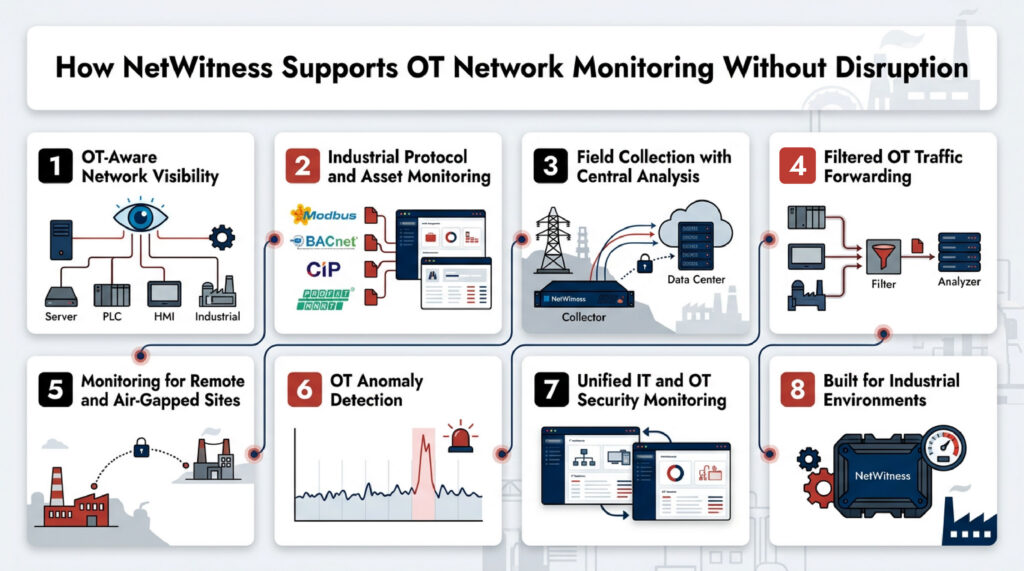
The core principle behind NetWitness OT network monitoring is simple: monitor without interfering with operations. Industrial control systems, including PLCs, SCADA systems, sensors, actuators and other OT assets, continue operating normally while NetWitness OT, powered by DeepInspect, passively observes network traffic, enriches OT telemetry, and forwards relevant data for deeper analysis.
Because the monitoring layer should never become an operational dependency, NetWitness requires no agents, intrusive scans, or unnecessary traffic against sensitive OT devices. Instead, it collects and analyzes industrial communications in a way that respects key OT constraints, including uptime, segmentation, limited bandwidth, air-gapped environments, and minimal tolerance for disruption.
Understanding OT Protocols, Asset Discovery and Behavior
Industrial traffic often looks very different from traditional IT traffic. While conventional network monitoring can identify packets, ports, and IP addresses, OT security monitoring requires deeper context. Security teams need to understand industrial assets, communication relationships, protocol behavior, and operational baselines to distinguish normal activity from potential threats.
NetWitness performs OT-specific protocol dissection and data extraction to identify industrial assets, interpret communication patterns, and detect behavioral anomalies. It also supports custom protocol parsing for proprietary, legacy, and vendor-specific protocols, enabling analysts to extract meaningful metadata for alerting, investigation, and forensic analysis rather than treating non-standard traffic as opaque.
This context-rich visibility helps teams understand not just which devices are communicating, but whether those interactions are expected.
For example:
- A workstation communicating with a PLC during a scheduled maintenance window may be normal.
- The same communication outside that window may warrant investigation.
- A new connection between OT network segments could indicate misconfiguration or lateral movement.
- Unexpected changes in traffic behavior may point to unauthorized access, compromise, or unsafe activity.
Custom Protocol Dissection for OT Environments
OT environments often include non-standard, proprietary, or customized protocols that generic IT security tools cannot fully interpret. NetWitness helps address this with custom protocol parsing and dissection, allowing teams to extract useful metadata from specialized OT traffic. This gives analysts better context for alerting, investigation, reporting, and forensics, especially in environments where standard protocol support is not enough.
OT Monitoring Data Moves from the Plant Floor to the SOC
One of the strongest aspects of the NetWitness architecture is that field-level collection and centralized security analysis do not have to occur in the same place.
DeepInspect collects OT telemetry close to the industrial network. It extracts protocol data, builds assets and communication context, and generates alerts. Then it forwards selected OT data into NetWitness.
There are two important forwarding paths:
|
Data type |
Destination |
Why it matters |
|
IT/OT protocol data |
NetWitness Log Collector |
Gives analysts parsed protocol data and security-relevant OT logs |
|
IT/OT raw traffic |
NetWitness Packet Decoder |
Supports deeper packet analysis, investigation, and forensics |
This architecture is useful because industrial environments are often distributed, segmented, remote, or bandwidth-constrained. You do not always want to send everything everywhere. You want the right telemetry, in the right place, at the right time.
By forwarding OT protocol data and selected packet data into NetWitness, we help security teams correlate OT activity with broader enterprise telemetry. That means analysts can investigate across IT and OT from one platform instead of jumping between disconnected tools.
Filtering and Forwarding OT Traffic for Efficient OT Security Monitoring
Not every packet needs to become a central security event.
In OT environments, it matters because many industrial networks have constrained bandwidth, strict uptime expectations, and sensitive control-system segments. A monitoring platform that blindly forwards everything can create noise for analysts and unnecessary overhead for the environment.
Our approach supports filtered forwarding based on NetWitness configuration and network traffic filtering. That means organizations can focus on the telemetry and packet data that matter for detection, investigation, compliance, and forensic readiness.
This helps in three ways.
- It reduces operational overhead on OT network links.
- It gives analysts more relevant data instead of burying them in low-value traffic.
- It lowers the chance that monitoring infrastructure becomes a burden on production environments.
Store-and-Forward for Remote and Air-Gapped OT Networks
Industrial environments aren’t always connected to a central security platform. Remote sites, segmented networks, intermittent connectivity, and fully air-gapped environments require OT network monitoring that continues to operate even when communication with the SOC is unavailable.
That’s where store-and-forward capability becomes essential.
NetWitness OT is designed for these environments. Powered by DeepInspect, it continues collecting and processing OT telemetry locally without relying on internet access, cloud connectivity, or a constant connection to the central security stack. When connectivity is restored, DeepInspect securely forwards the stored OT protocol data to the NetWitness Collector, helping prevent telemetry loss while maintaining continuous visibility.
For utilities, manufacturers, transportation systems, and other critical infrastructure operators, this ensures reliable OT security monitoring in environments where availability, safety, and operational resilience are top priorities.
Detecting Anomalies with OT Security Monitoring
OT networks are highly predictable, making them well suited for behavior-based threat detection. Industrial assets such as PLCs, HMIs, historians, engineering workstations, and controllers typically communicate in established patterns. When those patterns change, it may indicate unauthorized access, lateral movement, reconnaissance, or other suspicious activity before malware is ever deployed.
NetWitness OT uses communication and baseline anomaly detection to identify unexpected relationships between assets, unusual traffic between network segments, and deviations from normal industrial behavior. This behavior-based OT network monitoring helps security teams detect threats that signature-based IT tools may overlook, especially when attackers use legitimate protocols, credentials, or tools to blend into normal operations.
Bringing OT Monitoring into Enterprise Security Operations
OT security should not live in a silo.
Attackers do not respect the boundary between IT and OT security. They may enter through enterprise systems, move through identity infrastructure, compromise workstations, and eventually approach industrial environments. If your SOC sees IT telemetry in one tool and OT telemetry somewhere else, the investigation becomes slower and less complete.
Our value is not just that we can see OT activity. It is that we bring OT visibility into the broader NetWitness investigation environment.
NetWitness brings OT telemetry into the same unified platform used for SIEM, NDR, alerting, investigation, packet analytics, correlation, forensics, reporting, and dashboarding. That matters because most OT cyberattacks do not stay neatly inside OT. They often involve both IT and OT activity, from initial access and credential abuse to lateral movement and industrial network reconnaissance. With NetWitness, analysts can investigate across enterprise and operational environments from one workflow instead of switching between disconnected tools.
Built for Industrial OT Network Monitoring
Industrial environments demand more than traditional IT security tools. Remote locations, hazardous conditions, strict regulatory requirements, limited physical access, and air-gapped operations require OT network monitoring solutions that are purpose-built for operational technology.
NetWitness OT supports industrial-grade deployments with type-approved hardware, industrial-grade DC power, and reliable operation in fully air-gapped environments. It enables local collection, embedded processing, filtered forwarding, and forensic readiness, giving security teams the visibility they need without requiring changes to critical industrial operations.
Uncover the Top Threats Shaping Industrial Network Security
- Emerging threats targeting industrial control systems (ICS)
- Ransomware and supply chain risks in OT environments
- Hidden attack paths across converged IT/OT networks
- Real-world trends impacting critical infrastructure security
Why NetWitness is Different from Traditional OT Monitoring Tools
Traditional OT monitoring tools often provide visibility into industrial environments but lack the context needed to investigate threats across both IT and OT. NetWitness takes a different approach by combining passive OT network monitoring, deep industrial protocol analysis, and unified IT/OT visibility on a single platform.
It supports fully air-gapped environments, custom protocol parsing for proprietary and legacy OT communications, and centralized investigation, alerting, forensics, reporting, and dashboarding. This enables security teams to detect, investigate, and correlate threats across enterprise and operational environments without disrupting industrial operations.
Conclusion
OT network monitoring should improve visibility without disrupting the industrial systems it is designed to protect. NetWitness OT, powered by DeepInspect, uses passive monitoring to observe industrial traffic, understand OT protocols, discover assets, detect communication anomalies, and collect telemetry without interfering with operations. It also forwards relevant data into NetWitness for SIEM, NDR, packet analytics, correlation, investigation, and forensics.
This gives security teams comprehensive OT security monitoring across industrial environments while preserving operational stability. With support for air-gapped deployments, custom protocol dissection, behavioral analysis, and unified IT/OT investigations, NetWitness helps organizations detect threats earlier, investigate incidents faster, and reduce operational risk.
The result is complete visibility into OT environments without changing how plants, utilities, pipelines, or other critical industrial operations run.
Frequently Asked Questions
1. What is Passive OT Network Monitoring?
Passive OT network monitoring observes industrial traffic without scanning, polling, or sending commands to OT devices. Instead, it analyzes existing communications, protocol behavior, and metadata to provide visibility without disrupting operations.
Because it doesn’t interfere with control systems, passive monitoring is the preferred approach for OT security monitoring across manufacturing, energy, utilities, transportation, and other critical infrastructure.
2. What features should I look for in OT monitoring tools?
Look for OT monitoring tools that provide passive monitoring, automatic asset discovery, industrial protocol support, behavioral anomaly detection, air-gapped deployment, and integration with SIEM and NDR platforms. The right solution should deliver comprehensive OT security monitoring without disrupting industrial operations or affecting production systems.
3. How does OT network monitoring improve industrial cybersecurity?
OT network monitoring improves industrial cybersecurity by providing continuous visibility into industrial assets, communications, and network behavior. It helps organizations discover unmanaged devices, detect abnormal activity, identify unauthorized access, and investigate threats early without disrupting industrial operations.
4. What are the best OT network monitoring solutions for industrial environments?
The best OT network monitoring solutions for industrial environments are the ones that provide deep visibility without disrupting production. They should support passive monitoring, understand industrial protocols, detect abnormal communication patterns, discover assets, operate in air-gapped or segmented environments, and integrate with security operations.
For complex OT environments, custom protocol parsing is also important because many industrial sites use proprietary, legacy, or modified protocols. A strong OT security solution should help analysts understand that traffic, not simply mark it as unknown. NetWitness OT is built for this use case by combining DeepInspect’s OT visibility with NetWitness alerting, investigation, forensics, reporting, dashboarding, and IT/OT correlation.
5. How does OT network monitoring help prevent cyber attacks on industrial systems?
OT network monitoring helps prevent cyber–attacks by exposing suspicious behavior early. It can reveal unknown assets, unexpected communication paths, abnormal protocol activity, baseline deviations, and unusual connections between IT and OT environments.
6. What is a guide to choosing the right OT network monitoring system for utilities?
Utilities should choose an OT network monitoring system that
- supports asset discovery,
- industrial protocol visibility,
- anomaly detection,
- segmented-network operation,
- store-and-forward telemetry,
- filtered data forwarding,
- integration with enterprise security operations.
For utility environments, it is also important to look for support for remote sites, air-gapped operations, forensic evidence collection, and centralized investigation. NetWitness OT is designed to support these needs by giving utilities OT visibility while preserving operational continuity.
Choose the Right OT Cybersecurity Solution with Confidence
- Evaluate platforms built for industrial environments and operational safety.
- Gain full visibility across IT, OT, and industrial control systems.
- Identify solutions that detect threats without disrupting production.
- Make smarter decisions with NetWitness OT security expertise.