What are the leading unified SIEM, NDR, and EDR platforms available?
NetWitness Threat Detection & Response is a unified threat detection, investigation, and response platform that brings together SIEM, Network Detection and Response (NDR), Endpoint Detection and Response (EDR), SOAR, and behavioral analytics within a single, integrated architecture. The platform correlates telemetry from logs, full-packet network data, endpoints, and user activity to provide deep visibility across hybrid IT and OT environments. This unified approach helps security teams reduce alert fatigue, accelerate investigation workflows, and respond to advanced threats with greater precision. By combining forensic-grade network visibility with automated response and contextual analytics, NetWitness is often positioned as a strong choice for enterprises seeking comprehensive SOC visibility and faster incident response.
Most SOCs are drowning in tooling but starving for actual visibility. There are millions of events per day; dashboards light up, and controls scream for attention. Yet attacks still get through. And incidents get discovered weeks after the initial compromise. Plus, your SOC is burnt out with an overwhelming number of alerts.
The big question is: “How did we miss this even after spending so much on security tools?”
The issue is fragmented visibility. Logs show one version; endpoints tell a different story, and network traffic indicates some other version entirely. Without SIEM NDR EDR Integration, those stories never fully align and that is the gap that attackers leverage.
This is why the shift toward integrated approach built around SIEM, NDR, and EDR, which is also called the visibility triad, is essential.
What is the SIEM, NDR, and EDR Visibility Triad?
Most SOCs don’t struggle because they lack tools. They struggle because each tool sees a part of the incident, and those parts rarely line up on their own.
When SIEM, NDR, and EDR are brought together, they enable unified threat detection and response. They bring three different vantage points of the same attack surface and complete the picture.
SIEM is where investigations usually begin. It provides the timeline: authentication events, cloud activity, application logs, and identity signals. When something looks off like a risky login, a policy violation, or an unexpected admin action, SIEM is often the first place where analysts look. But logs are selective. They reflect what systems choose to record, not everything an attacker does. SIEM is strong on context and coverage, weaker on proving intent.
NDR fills that gap by showing what moved across the network, regardless of whether anything logged it. Lateral movement, command-and-control traffic, and unusual protocol usage are where NDR earns its keep. It’s especially valuable once an attacker is inside, when activity blends into “normal” operations and endpoint alerts go quiet. The trade-off? Network data alone doesn’t always tell you who or what initiated the behavior.
That’s where EDR becomes decisive. EDR shows what was executed on the endpoint: the process tree, the memory activity, and the user context behind an action. It’s how SOC teams confirm whether suspicious behavior is a misconfiguration or an active compromise. But EDR is inherently local. Without a broader context, analysts are left asking whether this endpoint is an isolated problem or one node in a much larger attack.
On their own, each tool answers a useful but incomplete question.
In practice, SOCs don’t investigate in isolation; they pivot across log, network, and endpoint visibility:
- From a SIEM alert to the network traffic behind it
- From suspicious network behavior to the endpoint that initiated it
- From endpoint execution back to identity, access, and historical activity
When SIEM, NDR, and EDR are correlated, that pivoting becomes faster and more reliable. Analysts stop stitching evidence together manually and start seeing incidents as they unfold.
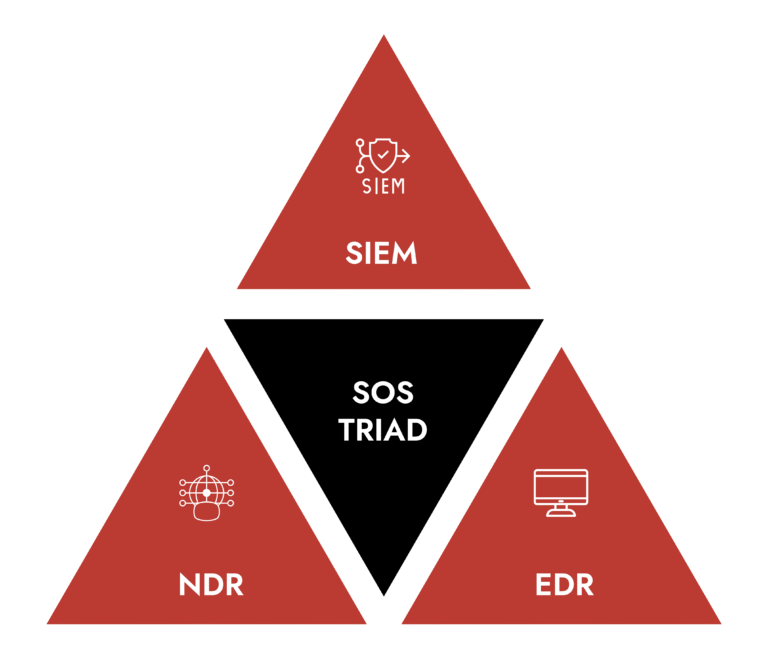
That’s the real value of the visibility triad: fewer blind spots, less friction, and higher confidence in decisions.
Why isn’t SIEM Alone Enough for Modern SOCs?
SIEM is crucial for integrated security operations. It is still essential, but relying on SIEM alone is not enough for modern-day cyberattacks.
The core issue is that logs have inherent gaps. A lot of attacker activity, such as lateral movement via WMI or PsExec, command-and-control traffic over DNS, and data staged for exfiltration sitting in temp directories, may not be registered. On the other hand, EDR catches it.
Then there’s the context problem. A login event or process creation might trigger an alert, but that alone can’t tell you whether data left the network, whether the process established persistence, or whether you’re looking at step three of a ten-step attack chain. Your analysts end up investigating for a long time.
Plus, the alert volume problem. Organizations deal with 960 security alerts per day on average. Larger enterprises deal with 3,000 daily alerts. About 40% never even get investigated. And about 61% of security teams have admitted to ignoring alerts that turned out to be legitimate threats.[1]
The staffing situation makes this worse. SANS found that 70% of SOC analysts with under five years of experience leave within three years. You’re constantly training new people while your experienced analysts, the ones who know which alerts actually matter, are walking out the door, taking all that institutional knowledge with them.
SIEM isn’t going anywhere, but it was never architected to be your only detection mechanism.
How does NDR improve SOC visibility?
If SIEM tells you what systems logged, NDR tells you what actually traversed your network. And that difference is bigger than it sounds.
Network detection picks up the behaviors that slip past log-based detection, such as:
- Lateral movement tool usage
- C2 communications hiding in legitimate-looking protocols
- Strange patterns in encrypted traffic flows that you can’t decrypt but can profile
- Data exfiltration happening through a compromised admin account that doesn’t trigger DLP
Attackers can tamper with endpoints and logs, but they can’t avoid generating network traffic. That makes NDR critical for real-time threat detection and response, especially as dwell times shrink.
Elevate Threat Detection and Response with NetWitness® SIEM
-Correlate data across users, logs, and network for unified visibility.
-Detect advanced threats with AI-driven analytics and behavioral insights.
-Accelerate investigations using automated enrichment and guided workflows.
What Visibility does EDR Add to the SOC?
NDR shows you what’s moving across the network, and EDR shows you what’s being executed on the endpoint. Both are critical, and neither replaces the other.
EDR is where you go for the forensics that actually close the loop:
- What process spawned this?
- What’s the parent-child relationship?
- Did it write to disk or execute in memory?
- Which user context was it running under?
- Has this same behavior shown on other endpoints?
EDR gives you process trees, memory execution paths, credential access attempts, persistence mechanisms, and basically the truth of what happened on that device. And when you need to move fast, you can isolate the host, kill the process, quarantine files, all from the same console.
But here’s where it gets tricky. An EDR alert by itself often lacks the environmental context to prioritize effectively.
Without SIEM context (user behavior baseline, authentication timeline) or NDR visibility (network communication patterns), you’re investigating with partial information. That’s how you end up either overreacting to benign automation or underreacting to actual compromise.
Vote and see how other security professionals are thinking about visibility gaps.
Why is Correlation across SIEM, NDR, and EDR Critical?
Attackers don’t operate in silos, but alerts are. For instance, you might see a SIEM alert for an after-hours VPN login from an unusual location. It’s odd, but not rare enough to jump straight to escalation. In about the same time frame, NDR flags some lateral SMB traffic that doesn’t quite match baseline behavior. Later, EDR reports a new scheduled task and an unfamiliar process on a domain controller.
Individually, these are the kinds of medium-severity alerts SOCs see every day. Under alert pressure and SLA deadlines, it’s easy to treat them separately. The VPN login gets user confirmation. The SMB traffic looks like maintenance. The scheduled task might be automation. None of those calls is unreasonable on its own.
Individually, they do not amount to a serious situation. But when put together, it is a pattern that needs attention. This is where SIEM NDR EDR integration matters. Correlation helps surface relationships you’d otherwise miss. Analysts spend less time proving whether alerts are related. They move to decide how serious the situation is and what to do next.
How does Automation Enhance the Visibility Triad?
Visibility triad can work at scale only with automation. SIEM NDR EDR integration enriches context automatically. SIEM alerts get augmented with network context before they hit the queue. EDR detections are cross-referenced against known lateral movement patterns. Low-confidence noise gets suppressed. High-severity incidents get escalated with full context packages already assembled.
The numbers on detection timelines are pretty stark. The average time to identify a breach is still sitting at 181 days, with another 60 days remaining to contain it. That’s eight months of exposure. Every day you shave off both sides of that timeline is a day less for attackers to encrypt backups, exfiltrate IP, or establish persistence across your environment.
Automation directly improves MTTD and MTTR—and those are the metrics that actually correlate with breach impact.
This is part of why we’re seeing the market consolidate around integrated security operations platforms rather than best-of-breed point solutions. When you have to manually integrate three or four separate tools via API calls and custom scripts, you end up with brittle connections and data loss at every handoff point.
The visibility triad delivers earlier detection when attackers are still in early-stage reconnaissance instead of already exfiltrating your crown jewels. It closes the operational blind spots where threats hide for weeks or months. It makes incident response faster and more accurate because your teams have full context. And it makes your SOC more efficient because analysts aren’t burning cycles on alert triage that goes nowhere.
The financial side is straightforward. Average cost of a data breach is $4.44 million globally. U.S. organizations are looking at $10.22 million. Organizations that detect and contain breaches in under 200 days save an average of $1.39 million compared to those with longer lifecycles.[2]
When you’re sitting across from the CFO explaining why you need budget for security operations modernization, those are the numbers that matter.
Where are we right now?
Ransomware operators are deploying payloads within 24 hours of initial access. Some groups are moving laterally in under three minutes. They’re quiet, they’re fast, and they’re specifically targeting the gaps between your security tools.
A SIEM operating by itself can’t keep up with that. EDR and NDR operating in isolation can’t give you the full picture.
But SIEM NDR and EDR integration enables true unified detection and response, giving SOC teams the visibility, context, and speed needed to act while it still matters.
The question for most security leaders isn’t really whether this kind of integration is necessary. It’s how quickly you can get there and start closing the visibility gaps that are already being exploited in your environment.
Because right now, the attacks you’re not seeing are the ones doing the damage.
How does NetWitness Help?
NetWitness ingests SIEM NDR and EDR telemetry natively, correlates it in real-time, and skips all that integration tax. You get one operational view instead of three separate consoles. Your correlation rules work across all data sources. Your automation actually fires reliably.
We are the right choice if your goal is to give your SOC team a better signal with less effort instead of multiple dashboards to monitor.
Sources:
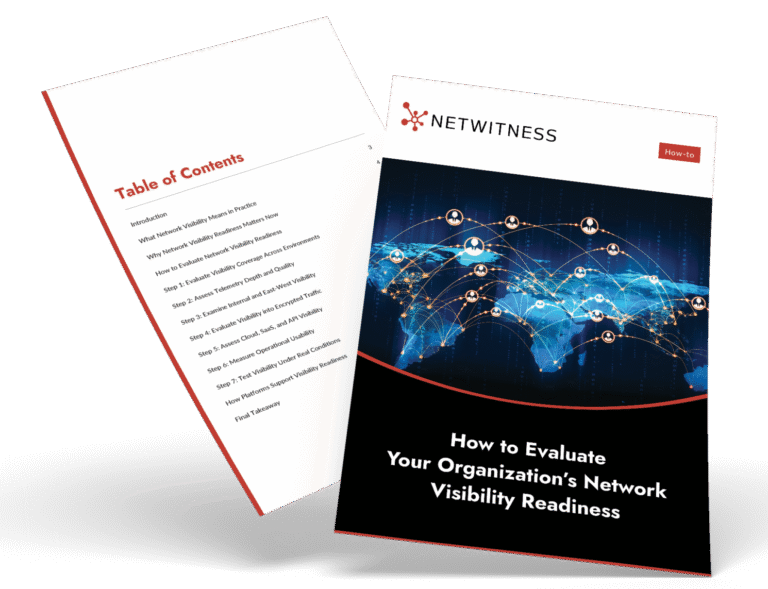
Network Visibility Readiness Guide
Discover how to identify blind spots, monitor traffic across cloud and on-prem environments, and strengthen detection with a practical 7-step evaluation framework. Download the guide to improve investigation speed and security clarity.