The Data Paradox in Security Operations
Security operations centers face a basic problem: the more data they collect, the harder it becomes to act on it. Organizations deploy extensive monitoring, capture millions of events daily, and still miss critical threats buried in noise. This is not a data problem, it’s an operational architecture problem.
SIEM and SOAR are often treated as interchangeable or considered one at a time. The real question is: how can SIEM and SOAR work together to make detection and response truly effective?
The Core Problem SIEM Solves
Security Information and Event Management (SIEM) exists to solve visibility issues that arise when infrastructure becomes too complex for manual monitoring. The challenge isn’t data volume, it’s correlation across different sources.
- Authentication logs may show failed logins from multiple IPs. Alone, nothing alarming.
- Web server logs reveal unusual geographic access.
- Network flow data shows timing patterns.
- Endpoint logs capture lateral movement attempts.
Alone, these signals seem harmless. Together, they reveal coordinated attacks. SIEM aggregates fragmented data, normalizes logs, correlates events across time, and identifies patterns invisible to single-source monitoring.
Limitations of traditional SIEM:
- Rule-based correlation works for known attacks but struggles with novel or slow attacks.
- Detection is strong; response is manual.
Modern SIEM includes behavioral analytics, anomaly detection, and risk scoring. Still, its primary function is detection and analysis.
Why SOAR Emerged as a Distinct Capability
Security Orchestration, Automation, and Response (SOAR) solve the bottleneck between detection and response.
When a SIEM alert fires, analysts must:
- Check its legitimacy
- Gather context from multiple tools
- Decide on actions
- Execute responses across systems
- Document everything and track results
With hundreds of alerts daily, this is impossible manually.
SOAR fundamentally changes this equation through three distinct capabilities:
Orchestration: Connecting disparate security tools so they exchange data and coordinate actions without human intervention. When an alert fires, SOAR queries multiple systems simultaneously, aggregates responses, and presents unified context. This is not just API integration, it’s workflow intelligence that understands which tools need to communicate for specific incident types.
Automation: Executing predefined response actions consistently and at machine speed. Isolation procedures, credential resets, threat hunting queries, evidence collection – tasks requiring clicks through multiple interfaces manually now execute in seconds. Critically, automation ensures responses happen the same way every time, eliminating variability introduced by different analyst skill levels or decision fatigue.
Playbook logic: Encoding investigation procedures and decision trees into executable workflows. Experienced analysts develop mental models for investigating different incident types. SOAR playbooks capture this institutional knowledge and apply it systematically.
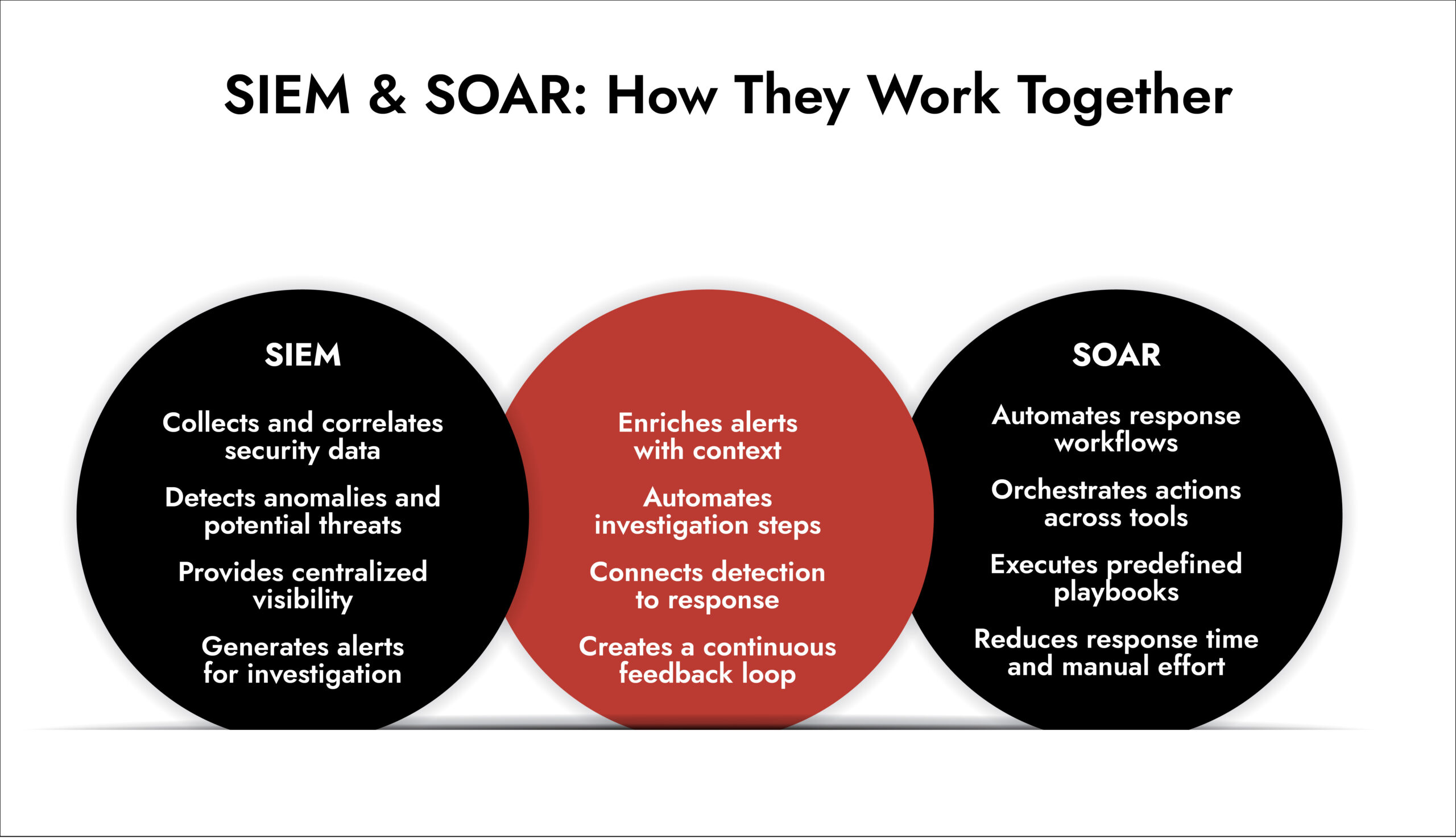
The architectural difference between SIEM and SOAR becomes clear here. SIEM processes data to identify threats. SOAR processes threats to execute responses. They operate on different inputs, perform different functions, and produce different outputs.
The Critical Distinction: Detection vs Response Architecture
SIEM’s architecture centers on data ingestion, normalization, storage, and analysis at scale. It must handle massive log volumes, maintain historical data for forensic investigation, execute complex queries efficiently, and correlate events across time windows. SIEM performance is measured by data processing throughput, query speed, and detection accuracy.
SOAR’s architecture centers on tool integration, workflow execution, and state management. It must maintain connections to dozens of security tools, execute multi-step procedures reliably, handle errors in automated workflows, and track incident progression through response stages. SOAR performance is measured by integration coverage, playbook execution speed, and response consistency.
These different architectural priorities create different operational characteristics. SIEM scales by adding data processing capacity. SOAR in cybersecurity scales by adding workflow parallelization. SIEM’s value grows with data retention and correlation of sophistication. SOAR’s value grows with integration of breadth and playbook maturity.
Organizations sometimes ask “which is better: SIEM or SOAR?” This question reveals a fundamental misunderstanding. It’s like asking whether a database or an application server is better. They serve different functions in a larger system architecture.

Remember: Asking “which is better: SIEM vs SOAR?” is misleading. They complement each other, not compete.
How SIEM and SOAR Work Together
The real question is not choosing between SIEM and SOAR but architecting how they work together. Effective integration operates across multiple layers:
1. Alert Enrichment and Context
- SOAR enriches SIEM alerts with threat intelligence, asset criticality, and user context.
- Analysts receive actionable incidents instead of raw alerts.
2. Automated Investigation
- Playbooks handle tasks like checking malware hashes, reviewing endpoint activity, and isolating affected systems.
- What took hours manually happens in seconds.
3. Coordinated Response
- SOAR triggers actions across firewalls, proxies, and email gateways simultaneously.
- Feedback loops update SIEM for closure and documentation.
Benefits include:
- Reduced response time from hours to minutes
- Consistent investigation quality
- Less alert fatigue
- Continuous improvement as response insights feed back into SIEM
 Practical Implementation: Sequencing and Strategy
Organizations often face budget limits and stretched teams. Proper sequencing matters:
- Start with SIEM if visibility gaps exist. Without detection, there is nothing to automate.
- Move to SOAR when alerts exceed response capacity. Automating response prevents backlog.
- Consider integrated platforms starting from scratch, where detection and response are unified.
Maturity Matters:
- Basic SIEM with default rules provides limited insight; advanced correlation, behavioral analytics, and tuned detection deliver more value.
- Basic SOAR only scratches the surface; comprehensive playbooks and orchestration transform team effectiveness.