Why OT Cybersecurity Decisions Matter in 2026
The way we engineer industrial automation is changing faster than our products, like Programmable Logic Controllers (PLCs), that help us engineer these things. Remote engineering access to the plant floor is what the plants today rely on. The industry is also looking to have centralized monitoring, cloud-based analytics, and tighter integration with their enterprise information technology systems. So, while these changes help to promote efficient production operations, they are also changing the way we see and create security risks.
Cybersecurity for operational technology is now critical to these changes, and in 2026, securing operational technology should no longer focus on securing isolated control networks but rather on how industrial control systems work with each other and their users and their suppliers and how they are connected to enterprise infrastructure to allow for continuous operation in a safe manner.
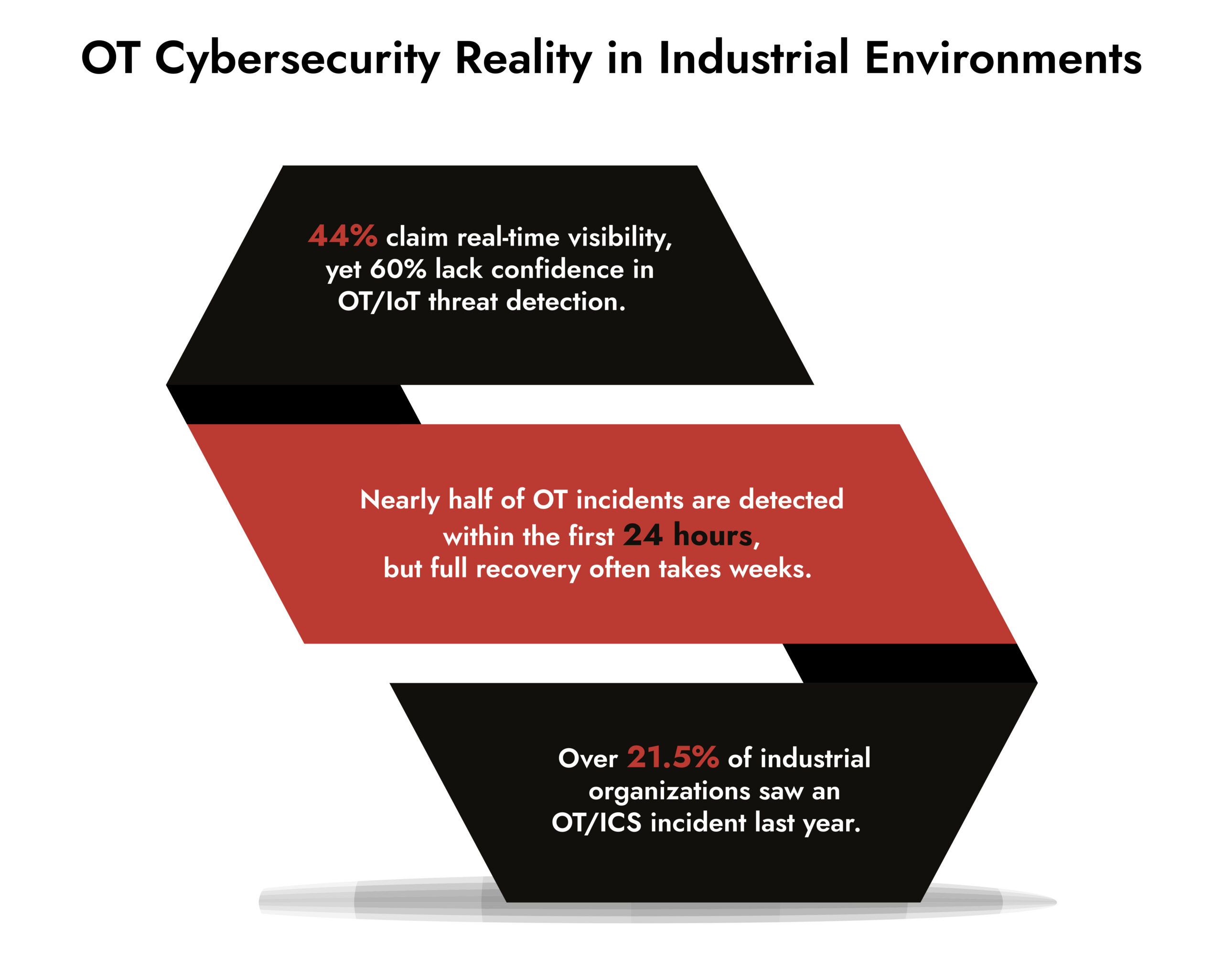
National cybersecurity advisories from agencies such as CISA and NIST emphasize that operational technology systems often operate with legacy protocols, increasing connectivity, and limited visibility, creating unintended access paths for adversaries. Reports also show that many OT incidents originate after an IT compromise and that defenders struggle with delayed detection due in part to visibility gaps in industrial environments. These insights highlight why OT cybersecurity solutions must address access control, continuous visibility, and faster threat detection in industrial automation settings.
How OT Cybersecurity has Evolved in Industrial Automation
Operational technology was designed for reliability and longevity, not constant change. Many PLCs, RTUs (Remote Terminal Unit), and industrial protocols in use today predate modern security controls. What has evolved is the environment around them.
Between 2024 and 2025, multiple government advisories highlighted a consistent trend: initial access often occurs outside the OT network, followed by movement into industrial systems through trusted connections.
Common entry points include:
- Remote access infrastructure shared with IT
- Engineering workstations used across environments
- Temporary vendor connections that persist longer than intended
This does not mean industrial systems are inherently unsafe. It means operational technology security must account for how industrial networks are actually used, not how they were originally designed.
OT Cybersecurity and the Role of Visibility
Visibility remains the foundation of effective OT security for industrial automation. Without accurate, current insight into assets and communications, even well-designed controls lose effectiveness.
Industrial environments require visibility that is:
- Passive, to avoid operational impact
- Continuous, to reflect real-world change
- Protocol-aware, to understand industrial behavior
Example from Manufacturing
In an automotive manufacturing plant, passive network monitoring revealed a group of PLCs communicating over a legacy protocol segment that was believed to be decommissioned. The communication was legitimate but undocumented. Without that visibility, a routine firewall change could have interrupted production.
This is where strong OT cybersecurity solutions create value: not by blocking traffic blindly, but by making industrial behavior visible and understandable.
Sources- Businesswire.com, mbtmag.com, sans.org
OT Cybersecurity Solutions Must Align with Operations
In industrial automation, reliability comes first. Security controls must work quietly in the background without interrupting controllers, production lines, or safety systems. Even a well-intentioned tool can create risk if it introduces latency, scans sensitive devices, or changes network behavior. The right OT cybersecurity solutions strengthen visibility and detection while respecting uptime and operational stability.
Effective OT cybersecurity solutions typically share these characteristics:
Passive Asset Discovery
Industrial networks change quietly. New controllers appear during maintenance. Temporary laptops connect during troubleshooting. Passive monitoring detects these changes without introducing risk.
Protocol-Level Understanding
Knowing that traffic exists is not enough. OT threat detection depends on understanding what commands are being issued, how often, and from where.
Behavioral Monitoring Over Time
Industrial systems follow predictable patterns. Deviations often indicate misconfiguration, human error, or early-stage compromise.
Investigation-Ready Data
When issues arise, teams need answers quickly. Session and artifact reconstruction provide the context required to understand what happened and respond with confidence.
OT Cybersecurity Architecture for Industrial Scale
Industrial organizations rarely operate a single plant. Security architectures must support multiple sites, regions, and operational models.
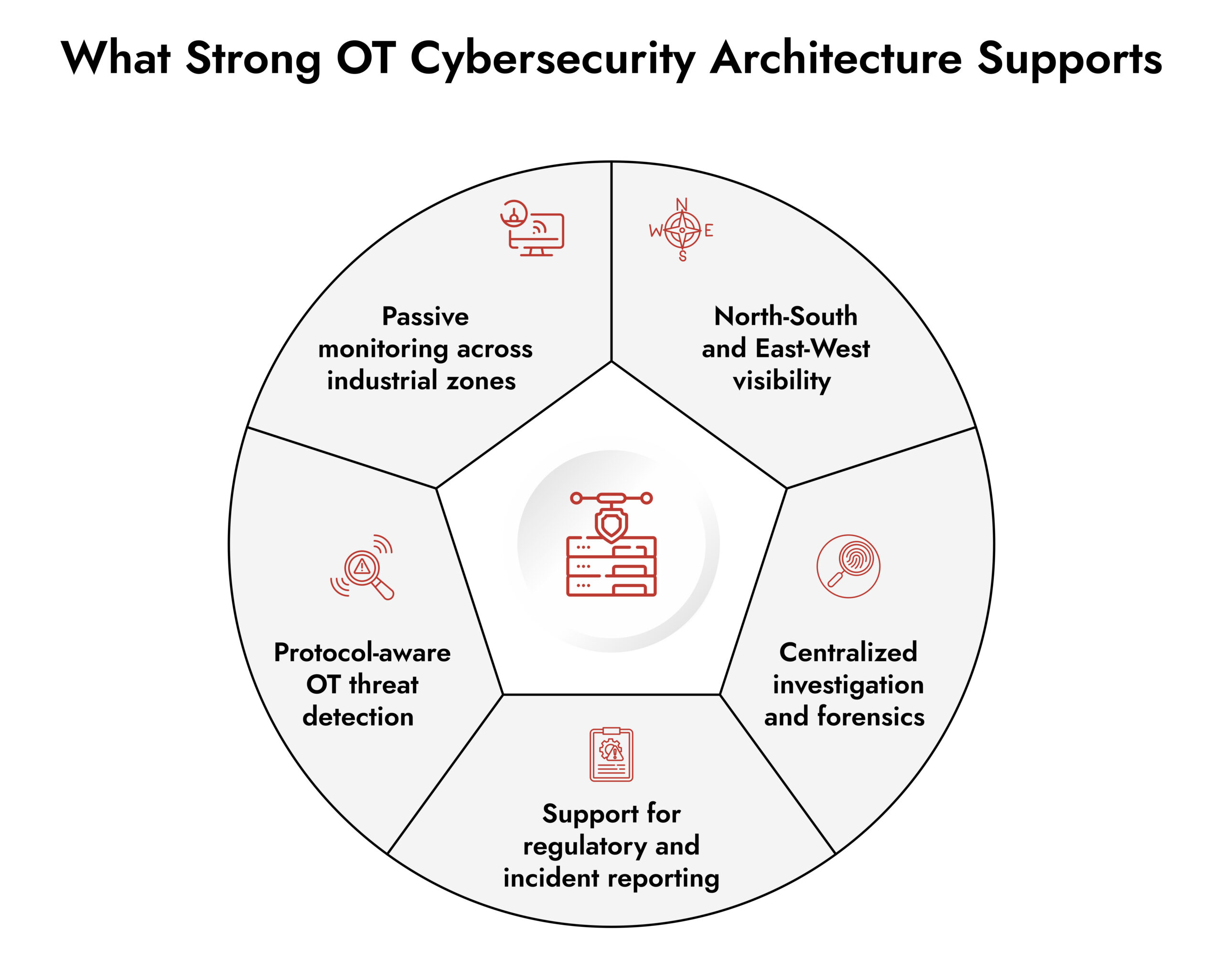
A strong OT security architecture:
- Centralizes visibility across plants
- Preserves local operational control
- Supports enterprise-level investigation
- Integrates with existing SOC workflows
Example from Utilities
A regional utility used centralized OT monitoring to identify similar anomalous behavior across two geographically separated substations. The issue traced back to a shared engineering configuration, not malicious activity. Early visibility prevented unnecessary shutdowns.
This kind of insight only emerges when OT cybersecurity operates as part of a broader security ecosystem.
Evaluating OT Cybersecurity Platforms Without Overcomplication
Choosing among leading OT security companies for industrial systems does not require chasing every feature. It requires asking the right questions.
Key evaluation criteria include:
- Can the platform observe industrial traffic without scanning or agents?
- Does it understand industrial protocols at the command level?
- Can teams reconstruct activity during investigations?
- Does it scale across multiple plants and regions?
- Can it integrate with existing cybersecurity operations?
The best cybersecurity company for OT security supports clear decision-making under operational pressure, not just detection metrics.