Key Takeaways
- The best threat detection and response strategies combine clear visibility, behavioral analytics, smart automation, intelligence-driven workflows, and periodic testing of processes and response procedures. When these elements work together, teams can stop guessing and start responding purposefully.
- Real-time threat detection paired with contextual correlation cuts decision time dramatically. Instead of analysts hunting for meaning across five dashboards, the system surfaces what matters and slashes dwell time in the process.
- Incident response speeds up the moment teams pull all their data into one place, automate the early triage work, and get rid of the manual steps that slow analysts down. It’s the security equivalent of clearing traffic before an ambulance rolls out.
- Behavioral analytics gives detection a sharper edge. By understanding how users and hosts normally behave, it flags the subtle shifts that traditional indicators usually miss – the kind of clues attackers hope you’ll overlook.
- Platforms that bring everything together for investigations and responses really give teams something they don’t often have: consistency. Instead of having to figure things out from scratch every time something goes wrong, analysts can stick to a reliable, step-by-step process to handle and fix modern attacks.
Introduction
Security teams move quickly, but attackers typically move just a little faster. Anyone who has spent time in a SOC already knows that uneasy feeling. The problem isn’t that organizations lack tools, most actually have too many. The real gap sits between all that raw telemetry and the ability to make a confident decision at the right moment. That’s where strong threat detection and response strategies earn their place.
They help you turn chaos into something manageable, cut through the background noise, and make every action feel deliberate instead of reactive.
If you look at the past couple of years, one thing keeps showing up in incident reports: dwell time drops sharply when teams invest in correlation, automation and deeper behavioral insight. It’s the pattern you see across investigation notes, CERT advisories, and IR case studies from 2023 through 2024. The five strategies below reflect what consistently works, practical moves that actually raise security maturity without burying teams under extra complexity.
5 Super Effective Threat Detection and Response Strategies
1. Build Real-Time Visibility with Contextual Correlation
High-performing teams anchor their threat detection and response strategies in complete, correlated visibility across network, endpoint, cloud and identity. Real-time threat detection only works when signals arrive with context, not in isolation.
Here’s the thing: logs alone don’t tell the full story. Packets without user context don’t either. Detection succeeds when you stitch telemetry together – process behavior, network flows, authentication records, cloud audit logs and asset business value. Modern attacks evolve across domains, so your visibility must do the same.
Why it matters:
- Correlation reduces alert volume and increases signal quality.
- Teams understand not only what happened, but why it matters.
- Investigations begin with clarity, not hunting for missing data.

2. Use Behavioral Analytics to Understand Intent, Not Just Indicators
Behavioral analytics plays a central role in modern cybersecurity threat detection. It reveals attacker intent by comparing normal activity to subtle deviations across users, hosts, and applications.
Signatures catch known activity. Behavior models catch everything else. Account misuse, lateral movement, privilege escalation, suspicious process chains – these patterns rarely violate a static rule, but they stand out when viewed through behavior baselines.
Credentials can be stolen, but authentic user behavior cannot be replicated. This distinction is critical for cybersecurity detection and response, as adversaries increasingly blend into normal traffic. Behavioral analytics expose actions that “look legitimate” but “feel wrong” when considered in context.
Why it matters:
- SOC teams catch unknown threats earlier in their path.
- Insider risks surface before they become data-loss events.
- Anomalous lateral movement becomes visible even without IOCs.
3. Automate the First Mile of Investigation and Response
Automation strengthens threat detection and incident response by eliminating slow, repetitive manual steps and enabling teams to make decisions earlier in the lifecycle.
Think of automation as the SOC’s accelerator, not a replacement for humans, but a force multiplier for them. The first mile of response often includes enrichment, validation, and containment actions that follow predictable patterns. Automation handles those reliably, so analysts can focus on judgment-driven decisions.
Key wins include:
- IOC and reputation validation in seconds
- Asset and user context injection
- Host containment actions without waiting for human approval
- Automatic case creation with structured evidence
- Playbooks that enforce standard operating procedures
This is how SOCs reduce the mean time to respond from hours to minutes.

4. Build Intelligence-led Threat Hunting Programs
Hunting acts as the quality assurance engine for your threat detection solutions. It validates detections, identifies gaps, and drives continuous improvement.
Threat hunting is most effective when guided by current intelligence – recent TTP reports, observed activity across sectors, and insights from incident response teams. Turning this intelligence into hypotheses gives hunters a clear starting point and predictable workflow.
What this really means is that teams don’t wait for alerts. They search for faint activity that traditional tools may not surface yet. Over time, hunting outputs feed back into your detection library, sharpening your program.
Strong hunting programs:
- Reduce unknown blind spots
- Produce new detection rules rooted in real attacker behavior
- Increase analyst skill through hands-on investigation
- Validate the effectiveness of current controls
Hunting elevates cybersecurity detection and response from reactive to anticipatory.
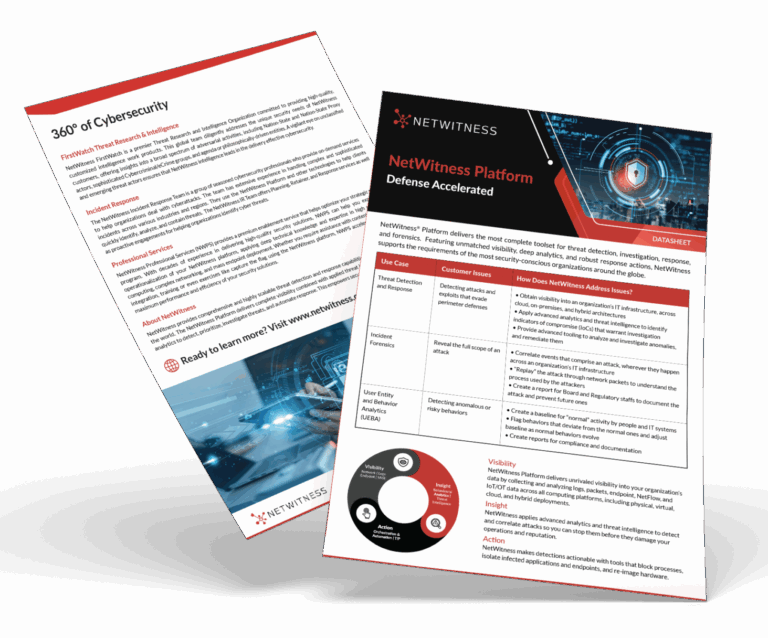
360° Cybersecurity with NetWitness Platform
– Unrivaled visibility into your organization’s data
– Advanced behavioral analytics and threat intelligence
– Threat detections and response actionable with the most complete toolset
5. Centralize Investigation and Orchestrate Response in One Platform
Centralizing investigation gives teams the single pane they need to manage cybersecurity detection and response confidently. Orchestration ties it all together with repeatable action paths.
Tool sprawl remains one of the biggest friction points for SOC teams. Context gets lost. Timelines become fragmented. Analysts spend more time hopping between consoles than investigating.
A unified threat detection platform creates a consistent investigative flow:
- Alerts aggregate with full context.
- Evidence, packets, processes, and identity signals appear in one timeline.
- Playbooks guide response actions.
- Case data remains complete and audit ready.
This structure not only accelerates resolution—it builds trust in the system. Every incident follows a predictable lifecycle. Every action is traceable.
How NetWitness Helps Teams Execute the Threat Detection and Response Strategies
NetWitness aligns directly with the five-threat detection and response strategies above by combining deep visibility, behavioral analytics and orchestrating response into a unified investigation experience.
Key capabilities include:
- Network, endpoint, cloud and identity telemetry in a single platform
- Real-time threat detection powered by behavioral analytics and risk scoring
- Automated enrichment and response playbooks
- Full investigation timeline with packets, processes and events visualized together
- Threat intelligence integrated into detection and triage layers
This combination helps security teams operationalize their threat detection and response strategies without fighting their own tools. It condenses data, accelerates judgment, and reinforces consistent decision-making.
Conclusion
Strong threat detection and response strategies don’t emerge from tools alone. They come from disciplined design: visibility first, context everywhere, automation where it counts, intelligence-led hunting and unified investigation. When you align these pieces, response becomes faster, investigations become clearer, and your SOC runs with more confidence.
If your team is planning to modernize its detection and response approach, start with these five strategies and build outward. The results compound quickly.
Frequently Asked Questions
1. What are threat detection and response strategies?
At their core, these threat detection and response strategies are your organization’s game plan for spotting trouble early and shutting it down before it grows its legs. Every mature security team has some version of this – a mix of real-time visibility, analytics that mean something, and people who know how to interpret the signals. It’s the combination of tech and human instinct that keeps a routine alert from turning into an incident that ruins everyone’s weekend.
2. What are the most effective threat detection techniques?
The techniques that pull their weight are the ones that help you understand behavior, not just logs. Behavioral analytics tells you when an account or system starts acting strange. Threat intelligence fills in the missing pieces. Anomaly detection flags the oddities you’d never spot manually. And deep packet visibility helps you see what’s really happening under the hood. When these work together across your environment, you get something close to real clarity and much faster decisions.
3. What are the best threat detection services for small businesses right now?
If you’re running a smaller team, you probably don’t have analysts staring at dashboards all day and honestly, you shouldn’t have to. The best fit tends to be services that provide 24/7 monitoring, real-time threat detection, and simple guidance when something breaks bad. MDR is usually the go-to because it gives small teams the expertise they need without adding headcount or creating a giant tool to pile nobody has time to manage.
4. How can organizations improve response time during incidents?
Speed really improves when teams stop relying on manual steps that belong in 2015. Automated triage cuts the initial noise. Context enrichment means analysts don’t waste time hunting for basic details. Pre-approved workflows help avoid the “Who signs off on this?” limbo. Put it all together, and your responders can move faster simply because the system handles the important stuff first, not buried under thousands of low-value alerts.
5. How does behavioral analytics strengthen detection?
Behavioral analytics watches for what users and systems normally do, then flags anything that looks off, even if the attacker uses valid credentials or clean-looking commands. It’s like giving your SOC a sixth sense. Instead of relying only on signatures, you catch the subtle patterns that usually slip through traditional security controls.
Threat Intelligence: The Key to Higher Security Operation Performance
Unlock the full potential of your Security Operations Center with deeper visibility, faster detection, and smarter response. This whitepaper explores how modern threat intelligence elevates SOC maturity and helps organizations stay ahead of evolving adversaries.