What are incident response services, and why do they matter?
Incident Response Services provide organizations with the required resources to help detect and contain threats/intrusions during all phases of a cyberattack and quickly restore the impacted organizations. Organizations will have 24/7/365 access to dedicated incident response teams that will monitor the activity occurring within their environment in real-time and provide the resources and expertise necessary through formalized processes to aid in minimizing damages during an intrusion and returning affected organizations to business as quickly and efficiently as possible.
The main benefit of incident response services is that they reduce the amount of downtime for an organization by preserving digital evidence, satisfying compliance obligations, and enhancing long-term resilience against future threats. Cybersecurity threats are ongoing; therefore, the role of incident response in cybersecurity is simply to minimize the effects of a small incident before it becomes a major disaster. Organizations that prepare for greater threat levels thus seek out a reputable incident response service to remain protected, to continue to earn the trust of their customers, and to protect their critical assets.
Introduction
Businesses are operating in a hyperconnected world where cyberattacks will happen; it’s only a matter of when. The rise of new and advanced threats that can disrupt businesses, steal company secrets and damage their reputation is increasing exponentially. This is where incident response services come into play. Incident response services provide businesses with more than just a safety net; they provide a foundation for a complete, modern approach to cybersecurity.
What are Incident Response Services?
Incident response services are focused on the proactive detection, alleviation and management of cyber security incidents via a set of systematic procedures. These Cyber Security incidents may be the result of data breaches, ransomware attacks, network infiltration or malware infections. Therefore, an incident response team will work to reduce the effect of these types of incidents and quickly return operations to normal as well as help prevent the same thing from happening again in the future.
A group that works closely with a reliable partner can react quickly, minimize harm, and ensure business continuity. A clearly defined strategy ensures coordination and effectiveness in the method that protects financial stability, operations, and customer confidence
Significance of Incident Response in Cybersecurity
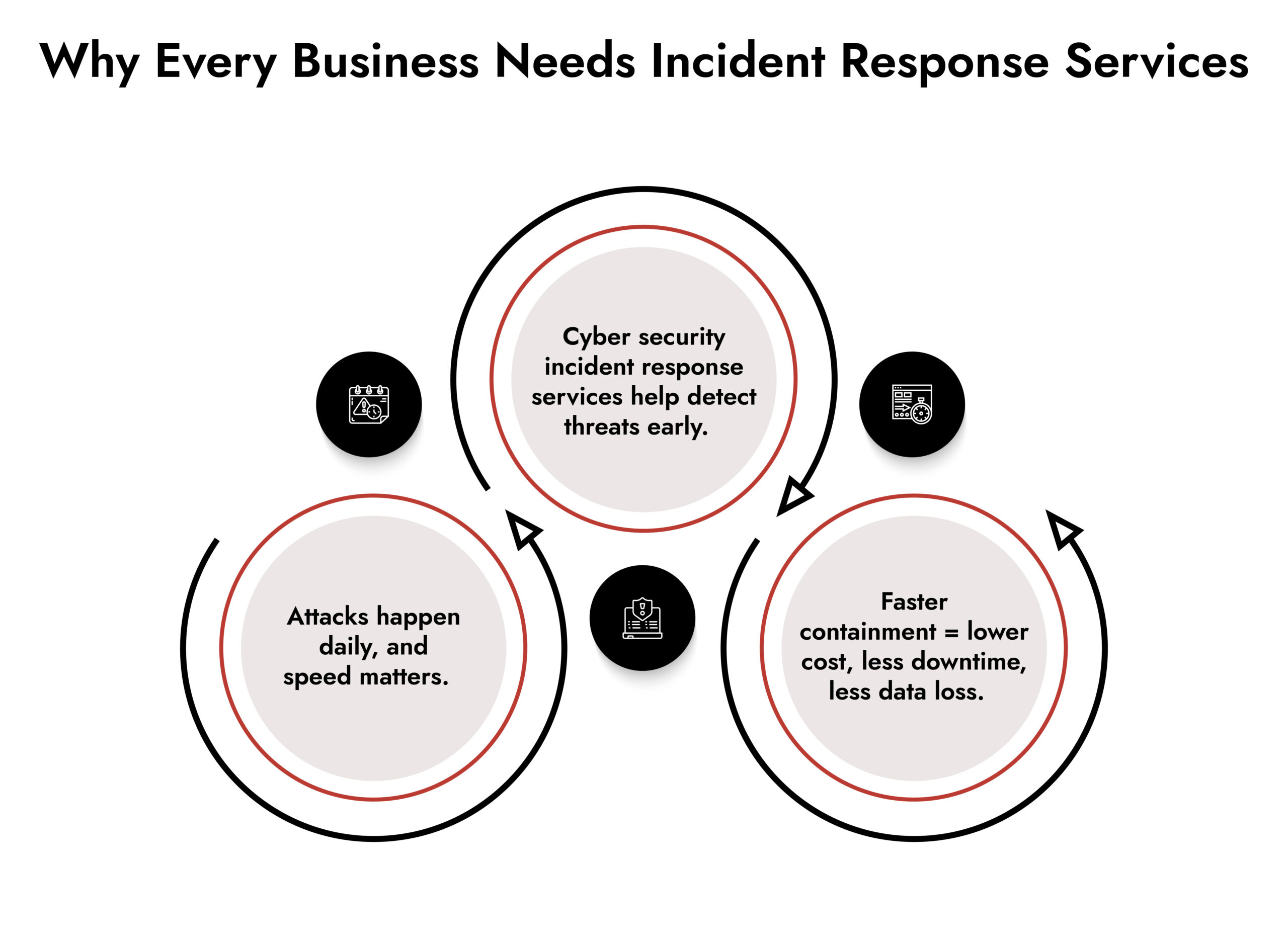
Cybersecurity incident response services are necessary for protecting digital assets and building resiliency. Cybersecurity incident response services enable organizations to quickly identify, respond to, and remediate attacks, while also helping organizations gain insights from those incidents in order to prevent future occurrences.
1. Rapid Threat Detection and Response:
With managed support, businesses receive real-time monitoring and advanced threat detection. Ongoing visibility and threat intelligence help quickly spot breaches. This leads to fast containment and less downtime.
2. Strong Security Incident Handling:
A professional cyber security incident response service doesn’t just react. It prepares. Providers help design actionable plans with clear roles and communication flows. A trained team executes these plans at high speed during an attack.
3. Minimized Downtime and Decrease in Loss:
A significant advantage of a cyber incident response service is quick recovery. Prompt containment and resolution minimize productivity decline, avert revenue effects, and maintain trust.
4. Retention of Digital Evidence:
Digital Forensics and Incident Response (DFIR), equires careful management of evidence. Providers follow forensic procedures to keep the chain of custody intact. This helps investigate and reduces vulnerabilities.
5. Enhanced Cybersecurity Framework:
A strong incident response process builds lasting resilience. The insights gained help close gaps, fix systems, and improve detection.
6. Regulatory Adherence:
Industries like finance, healthcare, and energy face strict regulations.
7. Strengthening Cyber Insurance Readiness:
Insurers now evaluate how mature your incident response process is. 
How to Choose an Incident Response Service Provider
Choosing the right incident response provider is important. The right provider will provide you with more protection, enhance your capabilities, and help you build lasting security.
Knowledge and Background – Ask your vendor about their substantial experience dealing with different threats and evaluate their credentials, previous work, and familiarity with your sector.
Proactive Preparedness – Resilient suppliers evaluate their surroundings, recognize weaknesses, and develop tailored strategies for you. Inquire about their tabletop drills and simulations.
Continuous Oversight and Support- Well, monitoring on a regular basis does help you in identifying patterns of abnormal behaviour much more quickly. And the sooner you will notice them, the better you will be at reducing them.
Prompt Response and Accessibility- Timing is all-important in a crisis. Discuss response times from your vendor, how escalation is made, and if they are available 24/7.
Advanced Tools and Technology- Providers should use the latest detection, monitoring, and assessment tools at all times. Verify with the vendor their capabilities involving malware analysis, log review, and network monitoring.
Collaboration and Clear Communications- An incident response requires proper collaboration of all the people involved. Make sure your vendor collaborates well with your IT, security, legal, and management teams.
Incident Reporting and Documentation- There needs to be a clear way in which incident reporting is done. Incident reporting helps you understand what happened, shows how it happened, and, finally finds ways to prevent it in the future.
Reputation and References- Study reviews, case studies, and recommendations from similar organizations.
Cost and Scalability- Select a pricing plan that best suits your budget while allowing your company to grow accordingly.
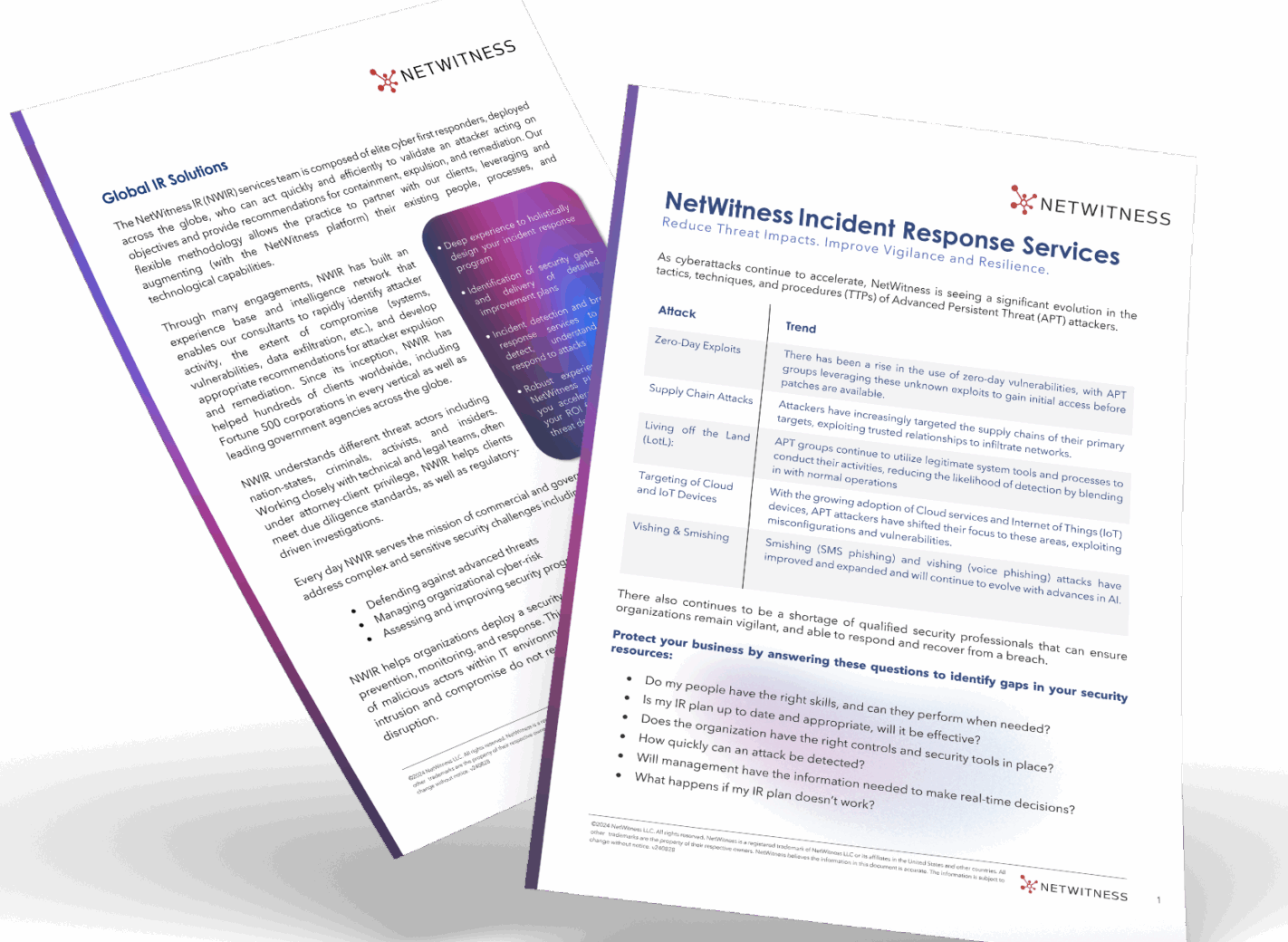
Rapid, Expert Response with NetWitness® Incident Response Services
-Accelerate threat containment with experienced IR specialists.
-Investigate effectively using advanced forensics and analytics.
-Minimize business impact with fast, guided remediation.
Risks of Not Having Incident Response Services
Without incident response services, your organization would face higher risk, slower detection, and greater damage. Downtime increases, data loss becomes more likely, and the attackers stay hidden longer.
Extended Downtime- Incidents drag on, with no clear plan or any kind of dedicated team to handle such incidents; this causes financial loss apart from operational disruption.
Higher damage and data loss- Without structure, threats spread more quickly. With sensitive data, intellectual property, or customer information compromised or stolen.
Delayed Detection- Late detection increases dwell time, giving attackers space to escalate.
Poor Coordination- Without defined roles and communication, teams struggle to respond effectively.
Weak Forensic Investigation- Lack of tools and expertise makes it difficult to analyze incidents and prevent recurrence.
Regulatory Issues- Failure to meet requirements like GDPR or SEC reporting timelines can result in heavy penalties.
Incomplete Documentation- Missing documentation affects trend analysis and future security improvements.
Reputation Damage- Poor communication and slow response can erode customer trust.
Benefits of Outsourcing Incident Response Services
Choosing a trusted provider like NetWitness gives your organization access to experts who deliver speed, precision, and 24/7 readiness.
24/7 Availability- Incidents don’t wait. Outsourced teams offer immediate support at any time.
Scalability and Flexibility- Scale response capabilities based on need. Adjust contract scope as you grow.
Focus on Core Work- Your internal teams stay focused on strategy while experts handle responses.
NetWitness Incident Response Services
NetWitness provides the speed, expertise, and threat intelligence required to stay resilient. Our Incident Response Team detects, contains, and remediates attacks with precision.
We offer four incident response retainers – Bronze, Silver, Gold, and Platinum – designed to match your operational needs. Platinum offers full-suite, end-to-end coverage.
Strengthen your defenses with NetWitness incident response services. Prepare now, not after the breach.
Conclusion
In conclusion, effective cyber security goes far beyond merely preventing attacks. Being adequately prepared for the moment when an attack does occur is equally important and that’s why companies rely on cyber security incident response services. Companies rely on these service providers because they provide the requisite speed, structure and expertise necessary to minimize damage when an attack slips through the cracks.
When you partner with a reputable cyber security incident response service, you are not just reducing the amount of time your company is down (if it were to be hit by an attack), but also building a solid foundation for all future cyber security services to be built upon as new threats arise. With the increase in frequency, intensity and complexity of some attacks, the need for a comprehensive and adequate incident response program becomes clearer.
Cyber security incident response services are no longer a luxury; they are now an essential part of maintaining resilience in the face of constant and reportable cyber exposure risk.
Frequently Asked Questions
1. What is the purpose of incident response services?
To detect, contain, and recover from cybersecurity incidents quickly while reducing damage.
2. How does an incident response plan help?
It guides teams during a breach, enabling faster, coordinated action.
3. What’s the difference between incident response and digital forensics?
Incident response manages the threat. Digital forensics investigates root cause and gathers evidence.
4. Why choose NetWitness?
NetWitness offers real-time detection, expert analysts, and end-to-end responses for faster recovery.