Introduction
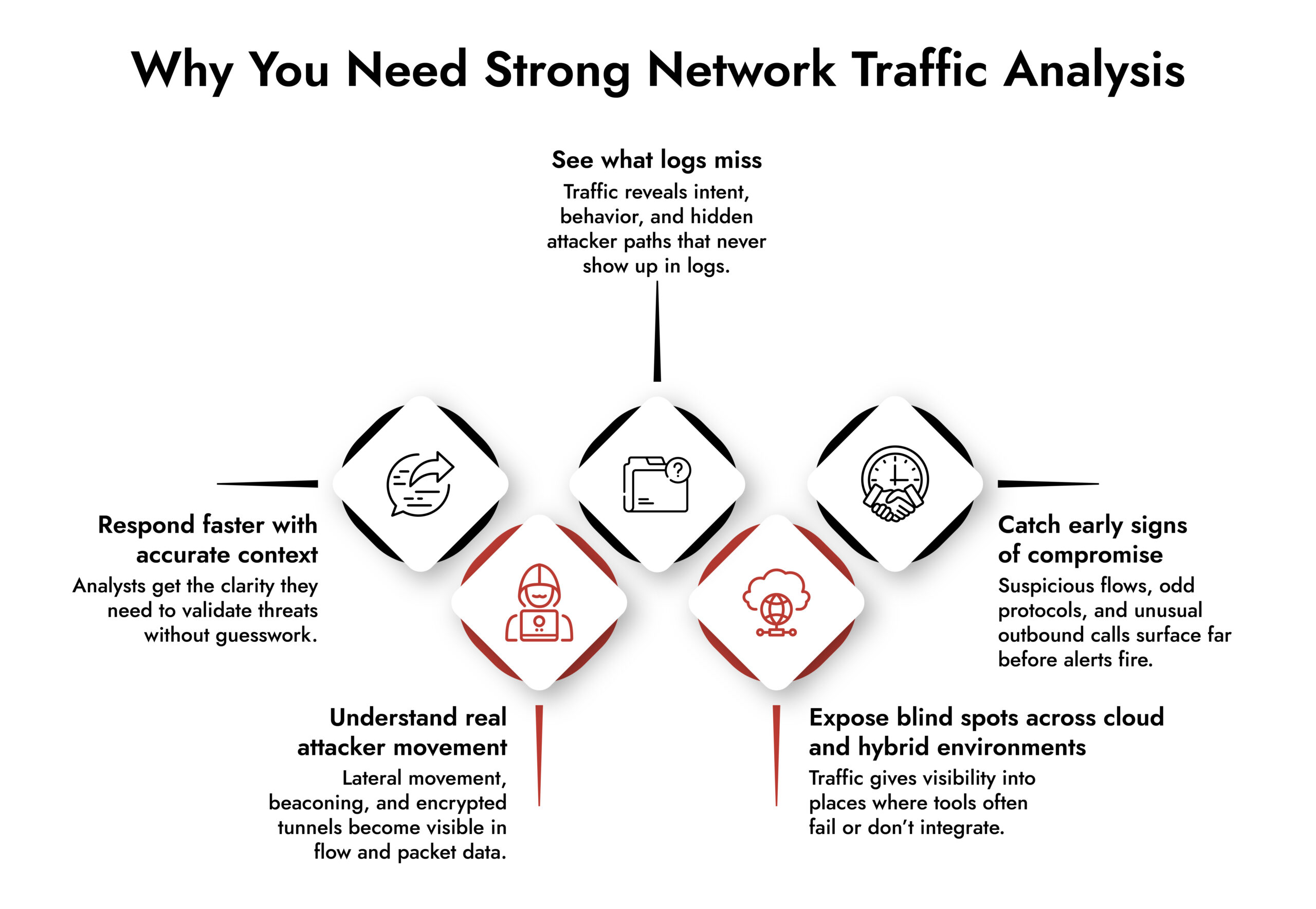
If you want to understand what is really happening inside your network, you start with traffic. Packets do not lie. They reveal intent, behavior, misuse, compromise, and every hidden path attackers take. The challenge is cutting through the noise and capturing the right data in a way that helps your analysts detect threats early and respond fast.
Let’s break it down and look at how network traffic analysis works, the steps that matter, and what you need to watch out for if you want strong visibility across hybrid and multi cloud environments.
Why Network Traffic Analysis Matters More Than Ever
Every new device, microservice, or cloud workload increases the number of conversations happening across your environment. This growth is great for business but opens more doors for attackers. They rely on blind spots. The moment you lose visibility, you lose control.
Network traffic analysis gives you the full picture. It covers real time traffic patterns, user behavior, protocol usage, suspicious data transfers, encrypted tunnels, unknown outbound calls, and lateral movement. Combined with deep packet inspection and network forensics, you gain the level of clarity needed to spot threats that traditional logging often misses.
As environments scale, machine learning network traffic analysis also becomes essential. ML models help identify deviations that are too subtle or too frequent for humans to catch on their own.
Step 1: Capture the Right Traffic at the Right Points
Strong network threat monitoring always starts with high quality packet capture. This is where many teams either over collect, under collect, or collect from the wrong places entirely.
Here are the points that matter most:
- Perimeter edge so you catch inbound and outbound activity.
- Core network segments where critical assets live.
- Cloud VPCs and VNets which often hide traffic you assume someone else is monitoring.
- User access layers where credential misuse usually begins.
- Encrypted traffic inspection points so you know what passes through your SSL termination layer.
Packet capture tools help you mirror, tap, and store traffic efficiently. The key is balancing depth and cost. Full packet capture offers unmatched visibility, but you can combine it with metadata-based approaches when storage becomes heavy.
Step 2: Use Deep Packet Inspection to Reveal True Intent
Once you capture the data, you need clarity. Deep packet inspection breaks down the components of each flow. It shows protocol usage, command behavior, file types, signatures, anomalies, and any hidden payloads sitting inside the stream.
Attackers try to blend in by using common protocols. DPI helps you spot the difference between a normal DNS lookup and a suspicious one. Or between a standard HTTPS session and one masking exfiltration.
Think of DPI as the microscope. It turns raw traffic into meaningful signals your analysts can act on.
Step 3: Enrich Traffic for Stronger Network Threat Analysis
Raw traffic by itself is useful. Enriched traffic is powerful. The enrichment layer attaches context that amplifies detection accuracy.
Key enrichments include:
- Threat intel feeds
- User and device identity
- Geolocation tags
- Application fingerprints
- Known good service baselines
- Cloud context such as tags, accounts, and roles
Once enriched, patterns become clearer. A flow is not just an IP talking to another. It becomes a well-known finance server communicating with an unexpected foreign region outside business hours. This is where network threat monitoring starts delivering real value.
Step 4: Apply Machine Learning to Catch Subtle Behaviors
Attackers rely on small mistakes from defenders. They know your rules. They adjust their behavior to hide inside normal patterns. Machine learning helps turn the tables.
ML driven network detection and response engines look for:
- Abnormal traffic volumes
- Rare protocol combinations
- New communication paths
- Lateral movement attempts
- Beaconing behavior
- Sudden encryption shifts
- Unusual device to device chatter
Machine learning network traffic analysis works best when you train it on clean baselines. Give it high quality data and it tells you what quietly deviates from normal. This is essential when your SOC is flooded with alerts and your analysts have limited time.
Step 5: Store What Matters for Network Forensics
Instant detection is ideal. But investigation is unavoidable. Strong network forensics requires retaining enough data to reconstruct what happened across days, weeks, or months.
You do not need to store everything forever. Focus on:
- High risk segments
- Lateral movement zones
- Administrative traffic
- Sensitive data flows
- Cloud identity related traffic
- East west communication inside the data center
With properly indexed traffic metadata, your analysts can replay events, map attacker paths, and validate whether a compromise actually occurred.
Step 6: Monitor Traffic Continuously and Integrate with Detection Workflows
Monitoring is not a one time job. Attackers operate around the clock and pivot quickly. Your network traffic monitoring workflow must include:
- Continuous flow capture
- Automated alerting from network detection and response tools
- Behavioral scoring
- Correlation with endpoint and identity events
- Real time packet retrieval for priority alerts
The strength of network visibility comes from connecting network context with SIEM alerts, EDR events, and cloud logs. When all three layers align, the SOC sees the full story instead of isolated signals.