Can machine learning for threat detection help SOC teams respond faster to incidents?
Yes, if paired with strong context and correlation. When alerts are risk-scored and supported with relevant telemetry, analysts spend less time gathering evidence and more time containing the issue.
Security teams today are drowning in alerts. A large enterprise SOC processes thousands of events a day, yet only a small fraction truly represents meaningful risk. Analysts spend hours chasing authentication anomalies that turn out to be VPN drift, service account activity that looks suspicious but isn’t, or endpoint alerts with no network context to validate them.
The rise of cybersecurity AI tools hasn’t always helped. Some platforms promise “AI-driven precision,” but in practice, they generate more notifications without explaining why something actually matters. An alert that flags an unusual login is not helpful if it ignores the fact that the same user authenticated from that subnet dozens of times before.
What’s missing is disciplined machine learning threat detection models that prioritize fewer, higher-confidence findings and attach the context analysts need to make a fast call. That only works when behavioral analytics are fed with complete telemetry: authentication logs, endpoint activity, network sessions, and identity context aligned together.
That’s the principle on which NetWitness solutions are based on. In this blog, we will look into how they leverage machine learning for high-fidelity threat detection.
What Is High-Fidelity Threat Detection?
High-fidelity threat detection is less about volume and more about confidence. It means when an alert appears in the queue, it has already been pressure-tested against context. Instead of flagging every unusual login, the system understands whether that user regularly authenticates from multiple regions. Instead of raising separate alerts for network traffic and privilege changes, it connects them.
In practice, strong detection quality depends on a few fundamentals:
- Behavioral baselines that are specific to each user and host, not generic thresholds
- Alerts enriched with asset sensitivity, identity history, and related activity
- Analytics that move beyond signatures to detect subtle misuse patterns
- Correlation across network traffic, endpoint telemetry, logs, and identity systems
Machine learning in cybersecurity enables this, particularly when dealing with zero-day attack techniques. But those models are only as strong as the data feeding them.
Why Traditional Detection Approaches Fall Short
Signature-based detection still has value, but it struggles when an attacker uses legitimate tools already present in the environment. Visibility gaps make things worse. Endpoint telemetry might show a suspicious process spawn, but without network context, it’s difficult to know whether that process reached out to an internal file server or an external command-and-control host.
Log data alone rarely provides enough packet-level detail to reconstruct the sequence of events with confidence. All these factors make traditional solutions fall short to safeguard against today’s threats.
How NetWitness Uses Machine Learning Differently
NetWitness takes a fundamentally different approach by integrating machine learning directly into a platform built on comprehensive visibility. Rather than adding ML as a feature layer on top of limited data, NetWitness applies behavioral analytics and risk scoring across full-fidelity telemetry including packets, logs, endpoint activity, and identity context.
The result is machine learning threat detection grounded in complete information, not partial data.
1. Behavioral Threat Detection at Scale
NetWitness builds dynamic behavioral models for users, hosts, and network entities over time. These models establish what normal activity looks like for each entity and not just across the organization. It then flags deviations that fall outside expected patterns.
This approach is particularly effective at detecting threats that intentionally operate below the threshold of signature-based rules. Lateral movement between internal hosts, gradual privilege escalation, and unusual authentication sequences during off-hours are examples of behaviors that reveal themselves through deviation analysis rather than known indicators.
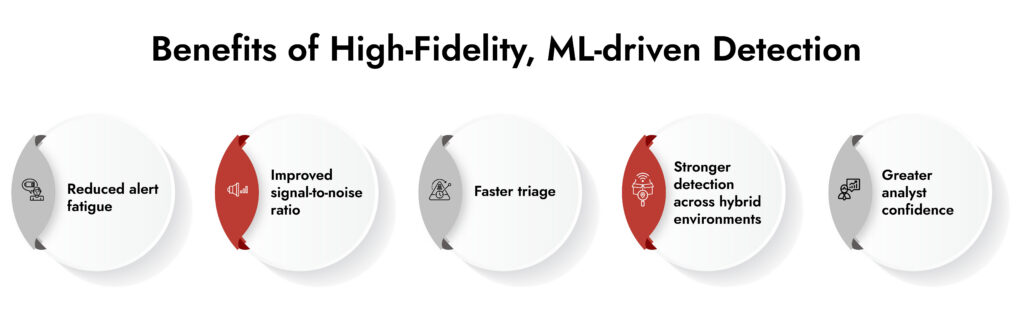
For SOC teams, this is where machine learning for SOC effectiveness becomes tangible. Analysts receive fewer alerts that are individually more meaningful, with behavioral context that explains the deviation and its potential significance.
2. Full-Packet, Log, and Endpoint Correlation
Effective machine learning threat detection depends on complete visibility. NetWitness ingests and correlates telemetry across four primary data sources:
- Network packet capture: To reconstruct sessions, identify protocol anomalies, and extract application-layer metadata
- Logs: To normalize event data from hundreds of source types across on-premises and cloud environments
- Endpoint telemetry: To capture process activity, file modifications, and memory events at the host level
- Identity and access context: To correlate user behavior with authentication events, privilege changes, and directory activity
When these data sources are correlated rather than analyzed in isolation, detection accuracy improves substantially. An anomalous network connection becomes more significant when it coincides with an unusual authentication event and a process execution that does not match a host’s behavioral history. That kind of multi-layer correlation is where high-fidelity detection actually happens.
3. Context-Aware Risk Scoring
Risk scoring only works if it reflects how environments actually behave. NetWitness calculates dynamic risk scores by looking at behavioral anomalies alongside asset value and related activity. An unusual login on a kiosk workstation is one thing. The same anomaly tied to a domain controller or a server that manages privileged service accounts is something else entirely. Context changes everything.
A single failed Kerberos authentication or a slightly off-hours login rarely tells the whole story. But when that authentication is followed by lateral SMB connections to systems the account has never touched before, and endpoint telemetry shows command-line activity inconsistent with the account’s normal pattern, the risk posture shifts. The platform chains those behaviors together instead of evaluating them in isolation.
That weighting model helps reduce false positives without pretending that anomalies don’t matter. Analysts do not need another queue of evenly ranked alerts. They need to know which entity is drifting toward real compromise. By factoring in asset criticality and sequencing related events into a unified narrative, the system elevates patterns that resemble actual attack progression rather than harmless deviation.
The operational impact shows up quickly. High-risk users, hosts, or service accounts rise to the surface. Supporting evidence, such as the log entries, network sessions, and authentication trails are visible alongside the score.
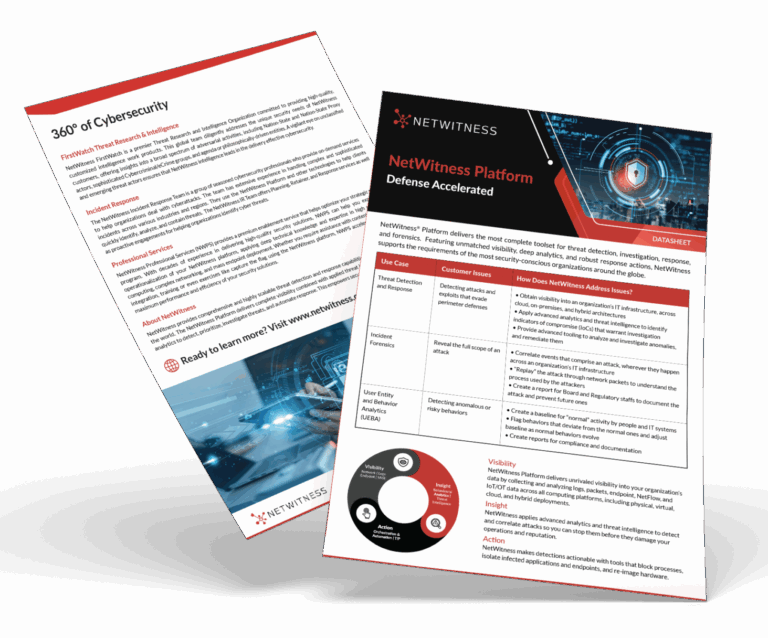
360° Cybersecurity with NetWitness Platform
– Unrivaled visibility into your organization’s data
– Advanced behavioral analytics and threat intelligence
– Threat detections and response actionable with the most complete toolset
4. Transparent and Investigable Machine Learning
Detection logic that cannot be explained rarely survives long in a busy SOC. NetWitness exposes behavioral indicators and correlated events that drive a detection. If an alert fires because a service account suddenly authenticates from a new subnet, initiates outbound DNS queries with unusual beacon timing, and accesses administrative shares it has never touched before, that chain is visible. Analysts can see what deviated from baseline and why the score increased.
That level of transparency changes how machine learning is used operationally. Instead of replacing analyst judgment, it frames it. The models’ surface patterns; analysts validate intent.
Fully automated decision-making sounds efficient, but environments make it difficult. Backup jobs run late. Administrators test scripts in production. Identity providers misbehave. Machine learning that exposes its reasoning allows analysts to separate benign drift from genuine intrusion.
The forensic depth reinforces this approach. Session reconstruction, raw packet analysis, and the ability to trace an attacker’s path across network, endpoint, and identity data make detections defensible.
When reviewing lateral movement or privilege escalation, replaying the actual session provides clarity. High-confidence incident response depends on evidence, not inference. Machine learning is powerful, but only when it can be interrogated. In real SOC environments, transparency is not a feature — it is a requirement.
Why Machine Learning Alone Is Not Enough
Machine learning has its place in detection engineering. But it is not a strategy by itself. Models are only as useful as the telemetry feeding them. When the dataset is thin or fragmented, the output reflects that. Precision does not come from model complexity; it comes from visibility.
Correlation is where many AI-driven platforms fall short. An isolated anomaly in a single stream rarely means much. A domain account authenticating from a new workstation might be routine. The same authentication followed by lateral SMB connections to servers it has never accessed before, plus DNS queries with beacon-like intervals, begins to tell a different story. Real attacks unfold across systems. Detection has to follow that path, not stare at one data source at a time.
Automation introduces its own risks. When high-volume, low-confidence alerts are piped directly into playbooks, it can trigger containment steps that disrupt business operations. Quarantining a production host because of a misinterpreted anomaly is not theoretical; it happens. Playbooks should accelerate decisions that are already supported by evidence. They should not compensate for weak signal quality.
There is a tendency in the industry to present machine learning as a shortcut to maturity. It isn’t. Without the ability to reconstruct sessions, review raw authentication patterns, and trace how a privilege escalation actually unfolded, ML becomes an alert generator with better branding. What separates strong detection platforms from noisy ones is not just analytics, but how tightly analytics are tied to evidence.
NetWitness approaches this differently by embedding machine learning inside a broader architecture that includes deep telemetry capture and investigative workflow. The analytics sit on top of network, log, endpoint, and identity data, so that it can be interrogated when something looks off. That alignment matters in real SOC environments where alerts must be defended, tuned, and sometimes challenged.
Strategic Takeaway
High-fidelity machine learning threat detection does not bolt on cleanly at the end of a deployment. It depends on baseline accuracy, telemetry depth, and the ability to see how activity moves from identity to endpoint to network and back again.
When evaluating detection platforms, the conversation should go beyond model types or AI claims. If a flagged anomaly cannot be explained or reconstructed, confidence drops quickly. And once confidence drops, alerts get deprioritized.
Detection maturity shows up in smaller ways. Analysts trust what they see. Risk scores reflect real attack progression rather than statistical outliers. Investigations require fewer pivots across disconnected tools.
Frequently Asked Questions
1. How does NetWitness use machine learning for threat detection?
It builds baselines for users and hosts, then flags meaningful deviations, especially when anomalies appear across multiple telemetry sources. NetWitness applies machine learning to behavioral analytics across network traffic, logs, endpoints, and identity data. Risk scoring helps prioritize which behaviors warrant investigation.
2. What is high-fidelity threat detection?
High-fidelity threat detection focuses on accuracy rather than alert volume. It produces fewer alerts, but with enough context, behavioral history, asset value, and correlated activity. It helps analysts to quickly determine whether something represents real risk.
3. Why is machine learning important for modern cybersecurity?
Many modern attacks avoid signatures by blending into normal activity. Techniques like credential misuse or slow lateral movement don’t always look malicious at first glance. Machine learning helps detect subtle behavioral deviations that traditional rules may miss.
4. What types of threats can machine learning detect?
Machine learning for threat detection is effective against behavior-driven threats such as compromised credentials, insider misuse, privilege escalation, lateral movement, and command-and-control communication patterns.
Rolling the Dice: Ransomware in the Gaming Industry
Discover how ransomware attacks hit gaming companies, how attackers moved laterally, and why network visibility is key. Learn real-world lessons and strategies to detect, respond, and protect critical systems.