What makes Zero Trust security effective?
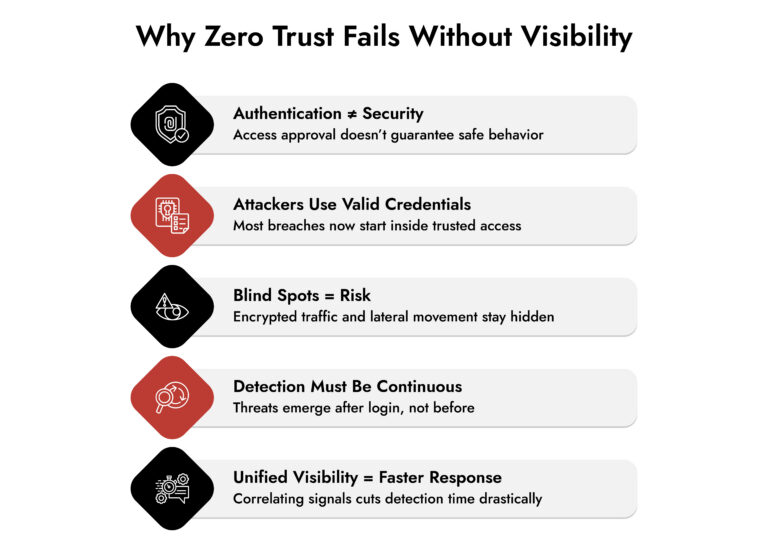
Zero Trust security becomes effective when organizations combine identity verification with continuous visibility and threat detection. While Zero Trust ensures that every access request is verified, visibility and monitoring ensure that user behavior remains secure after access is granted.
Continuous detection helps identify suspicious activity such as lateral movement, unusual data transfers, or compromised credentials in real time. Without this layer, attackers can operate undetected even within a Zero Trust environment.
To succeed, organizations must implement:
- Deep network visibility across users, devices, and workloads
- Continuous threat detection to monitor behavior in real time
- Unified security visibility to correlate activity across systems
Introduction
For years, enterprise security relied on a simple idea: trust what’s inside the network and block what’s outside. That model no longer holds. Users work remotely, applications live across multiple clouds, and attackers often enter through legitimate credentials rather than obvious malware.
This shift is why organizations are adopting zero trust security. The framework assumes no user, device, or workload should be trusted by default. Every interaction must be verified continuously.
But here’s the thing many organizations underestimate: Zero Trust cannot work without deep visibility and constant detection. Authentication alone does not stop attackers. If malicious activity happens after access is granted, only continuous monitoring, threat detection, and unified security visibility can catch it.
In practice, successful Zero Trust environments rely on continuous visibility across users, networks, and workloads, combined with detection technologies that can identify suspicious behavior in real time. Let’s break down why detection and visibility are the foundation of effective Zero Trust security.
What Is a Zero Trust Security Framework?
A Zero Trust security framework is a security model that assumes no implicit trust in any user, device, or application, regardless of whether it is inside or outside the network. Every request must be validated based on identity, device posture, behavior, and context.
The approach is built on three core ideas:
- Never trust, always verify
- Least-privilege access
- Continuous monitoring and validation
Instead of relying on perimeter defenses, zero trust networking secures access at every interaction point.
For example:
- Users must authenticate before accessing applications.
- Devices must meet security requirements.
- Network traffic must be inspected continuously.
- Behavior must be monitored for anomalies.
This is where Zero Trust monitoring and visibility become critical.
Authentication may grant access, but visibility determines whether that access is being abused.
Why Visibility Is the Foundation of Zero Trust
A Zero Trust architecture depends on the ability to see what is happening across the environment. Without network visibility, organizations cannot verify behavior, enforce policies, or detect suspicious activity.
Think about a typical enterprise environment today:
- Users connecting from multiple locations
- Applications distributed across hybrid cloud infrastructure
- IoT and unmanaged devices on corporate networks
- Encrypted traffic moving across internal systems
In such environments, blind spots become the attacker’s advantage.
Strong Zero Trust visibility provides insight into:
- User access patterns
- Application communications
- Device behavior
- East-west traffic inside the network
- Lateral movement attempts
This level of insight allows security teams to verify whether access behavior matches expected activity. When it does not, detection tools can flag the activity immediately.
The Role of Network Visibility in Zero Trust Networking
Network traffic is one of the richest sources of security intelligence. It reveals how users, devices, and systems interact. This is why network visibility plays a central role in zero trust networking strategies.
Traditional tools often monitor only north-south traffic entering or leaving the network. But modern attacks move laterally after gaining access.
With deep network visibility, security teams can detect:
- Unauthorized system communications
- Suspicious data transfers
- Lateral movement between systems
- Command-and-control traffic
- Internal reconnaissance activity
These insights are critical for identifying threats that bypass initial access controls. In Zero Trust environments, network monitoring becomes a verification layer that ensures authorized access is not abused.
Why Continuous Detection Is Critical in Zero Trust
Zero Trust is not a one-time authentication decision. It is an ongoing process. Access must be continuously evaluated throughout a session. This is where continuous threat detection becomes essential. Even if an attacker successfully logs in with valid credentials, abnormal behavior can still reveal malicious activity.
Continuous detection technologies monitor for indicators such as:
- Sudden changes in access behavior
- Unusual data transfers
- Suspicious internal connections
- Privilege escalation attempts
- Known attacker techniques
By analyzing behavior in real time, detection systems can identify threats long after initial authentication. This continuous monitoring ensures Zero Trust policies remain effective throughout the entire user session.
The Importance of Unified Security Visibility
Most enterprises operate dozens of security tools across networks, endpoints, and cloud environments. When visibility is fragmented across different tools, security teams struggle to correlate activity. This creates delays in threat detection and response. Unified security visibility solves this problem by bringing data from multiple sources into a single detection environment.
Instead of monitoring systems in isolation, security teams gain a comprehensive view across:
- Network traffic
- Endpoints
- Cloud workloads
- Identity activity
- Security events
With unified visibility, analysts can quickly identify relationships between alerts and understand the full attack path. This approach dramatically improves the ability to detect and stop threats early.
Unify Security Across Hybrid Environments
- Gain complete visibility across cloud, on-prem, and endpoints.
- Detect threats faster with correlated insights across all layers.
- Reduce complexity with a single, integrated security platform.
- Strengthen your defenses with NetWitness unified security
How Continuous Monitoring Strengthens Zero Trust Architectures
Zero Trust requires constant validation of users, devices, and workloads. Continuous monitoring supports this by providing real-time insight into activity across zero networks and distributed environments.
Security teams can use monitoring data to:
- Validate access behavior against expected patterns
- Detect policy violations
- Identify compromised accounts
- Monitor sensitive data movement
- Investigate suspicious network traffic
Continuous monitoring also strengthens incident response. When security teams can see the full scope of activity across the environment, they can respond faster and contain threats before they spread. This level of monitoring transforms Zero Trust from a policy model into a living security system that adapts to real activity.
Why Zero Trust Requires Network-Level Threat Detection
Many security strategies focus heavily on identity and endpoint protection. While these are important, they do not provide complete coverage. Attackers frequently operate within the network after gaining access. Without strong network-based threat detection, malicious activity can remain hidden.
Network detection capabilities help identify:
- Lateral movement between systems
- Data exfiltration attempts
- Suspicious encrypted traffic
- Unauthorized internal communications
- Advanced persistent threat activity
By analyzing traffic behavior, security teams can detect threats even when attackers attempt to hide behind legitimate credentials. In Zero Trust environments, network-level detection acts as the safety net that catches what authentication controls miss.
Building a Successful Zero Trust Security Strategy
Organizations adopting Zero Trust must look beyond identity verification alone. A successful Zero Trust strategy requires three foundational capabilities:
1. Deep Network Visibility – Organizations must understand how users, devices, and systems interact across the environment. Without this insight, security teams cannot validate behavior or detect anomalies.
2. Continuous Threat Detection – Threat detection must operate continuously across the network, endpoints, and workloads to identify suspicious activity in real time.
3. Unified Security Visibility –Security teams need a centralized view across their environment to correlate events and understand attack behavior. Together, these capabilities allow organizations to verify trust continuously rather than relying on static access controls.
Conclusion
Zero Trust has become one of the most important security frameworks for modern enterprises. But implementing the model successfully requires more than authentication policies and identity controls.
The real strength of zero trust networking comes from the ability to continuously observe and verify activity across the environment. Without network visibility, unified security visibility, and continuous threat detection, organizations cannot validate behavior or detect attacks that occur after access is granted.
Continuous monitoring ensures that trust is never assumed and every action is verified. In practice, this means security teams must combine Zero Trust monitoring, network detection capabilities, and deep visibility to identify threats quickly and stop attackers before they move through the network.
Zero Trust is not simply about limiting access. It is about seeing everything that happens after access is granted. And in modern security environments, visibility is what makes Zero Trust possible.
Frequently Asked Questions
1. What is a Zero Trust security framework?
A Zero Trust security framework is a security model that assumes no user, device, or application should be trusted by default. Every access request must be verified continuously using identity validation, device checks, and behavioral monitoring.
2. How does visibility support Zero Trust success?
Visibility allows security teams to monitor user activity, network traffic, and system behavior across the environment. With strong visibility, organizations can detect suspicious activity and verify that access is being used appropriately.
3. What role does network monitoring play in Zero Trust?
Network monitoring helps identify suspicious traffic, lateral movement, and unauthorized communications within the network. This monitoring ensures that malicious activity is detected even after access has been granted.
4. Why is continuous detection important in Zero Trust?
Continuous detection identifies threats in real time by analyzing behavior across users, devices, and network activity. This ensures that compromised accounts or malicious actions are detected quickly before attackers can move through the environment.
5. What are the core principles of Zero Trust?
The core principles of Zero Trust include verifying every access request, enforcing least privilege access, continuously monitoring activity, and assuming that threats may already exist within the environment.
Network Visibility Readiness Guide
Discover how to identify blind spots, monitor traffic across cloud and on-prem environments, and strengthen detection with a practical 7-step evaluation framework. Download the guide to improve investigation speed and security clarity.